The Federal Reserve left its benchmark interest rate unchanged on October 28, 2026, but the decision was framed by Fed Chair Kevin Warsh as a pause for more information rather than a settled turn toward rate cuts. Behind the headline hold, subtle shifts in the Fed's language, its comments on oil and geopolitics, and diverging signals from credit and inflation-expectations markets give investors several threads worth watching before the next meeting.
The Fed Holds Steady, But With Changed Wording
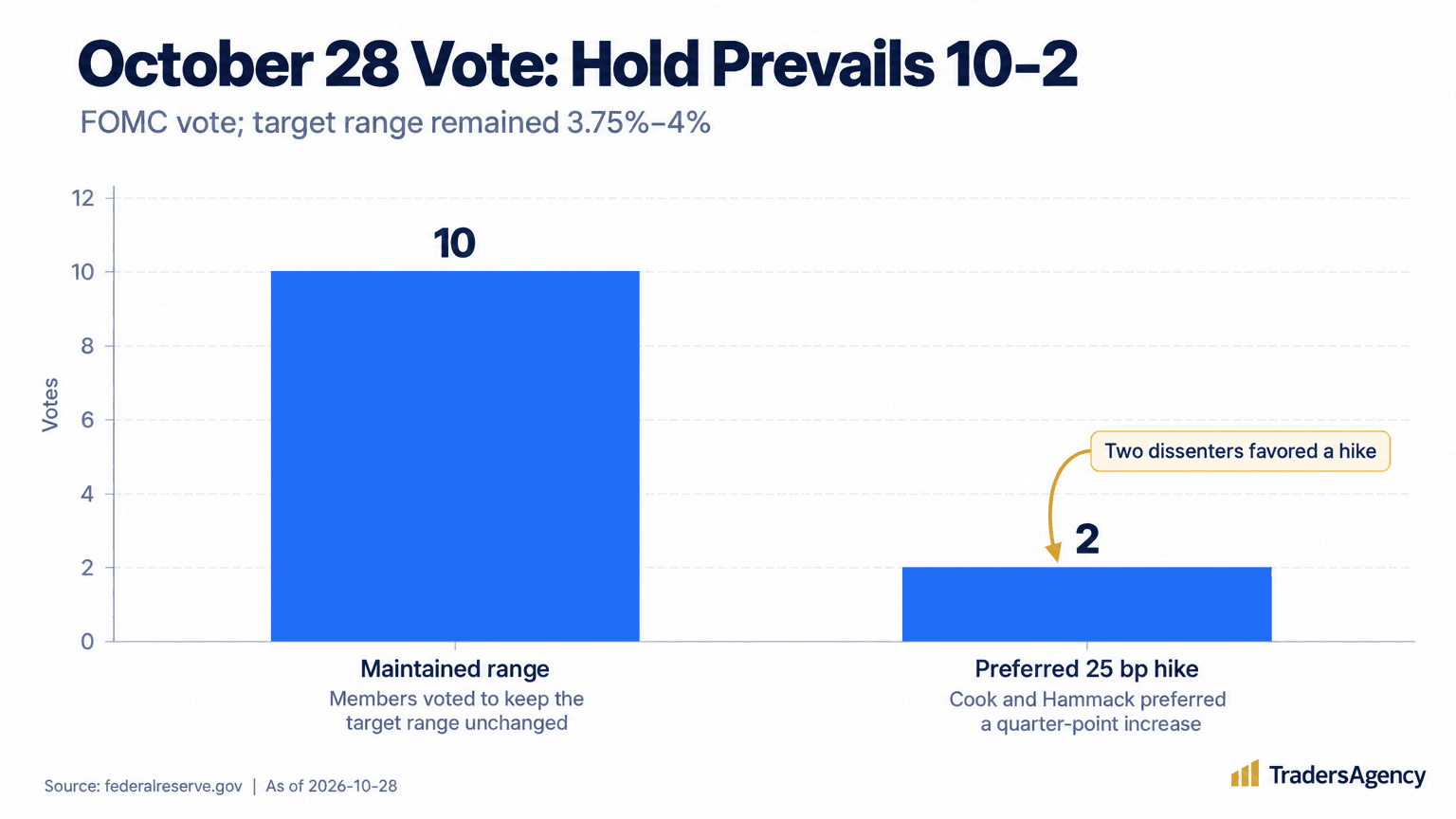
The Federal Open Market Committee maintained its target range at 3.75% to 4%, according to the official statement issued after the meeting. The vote was 10-2, with Governor Lisa D. Cook and Cleveland Fed President Beth M. Hammack preferring a quarter-point increase instead. That split marks a shift from the prior meeting's unanimous decision, reflecting at least some internal disagreement over whether holding rates is the right call.
The statement itself kept language describing inflation as "elevated" and said that accumulating more information would help the committee determine an appropriate and timely policy stance. Notably, the committee's description of economic activity changed from "solid" to "expanding at a strong pace," even as its labor-market language remained essentially unchanged from the prior statement. That combination — elevated-inflation language paired with an emphasis on gathering more data — has been read as the Fed effectively buying itself time rather than committing to any particular path for rates. That reading is an interpretation, not an official position, but it captures the tension in a statement that avoids firm commitments in either direction.
Oil, Geopolitics and the Question Mark Over December
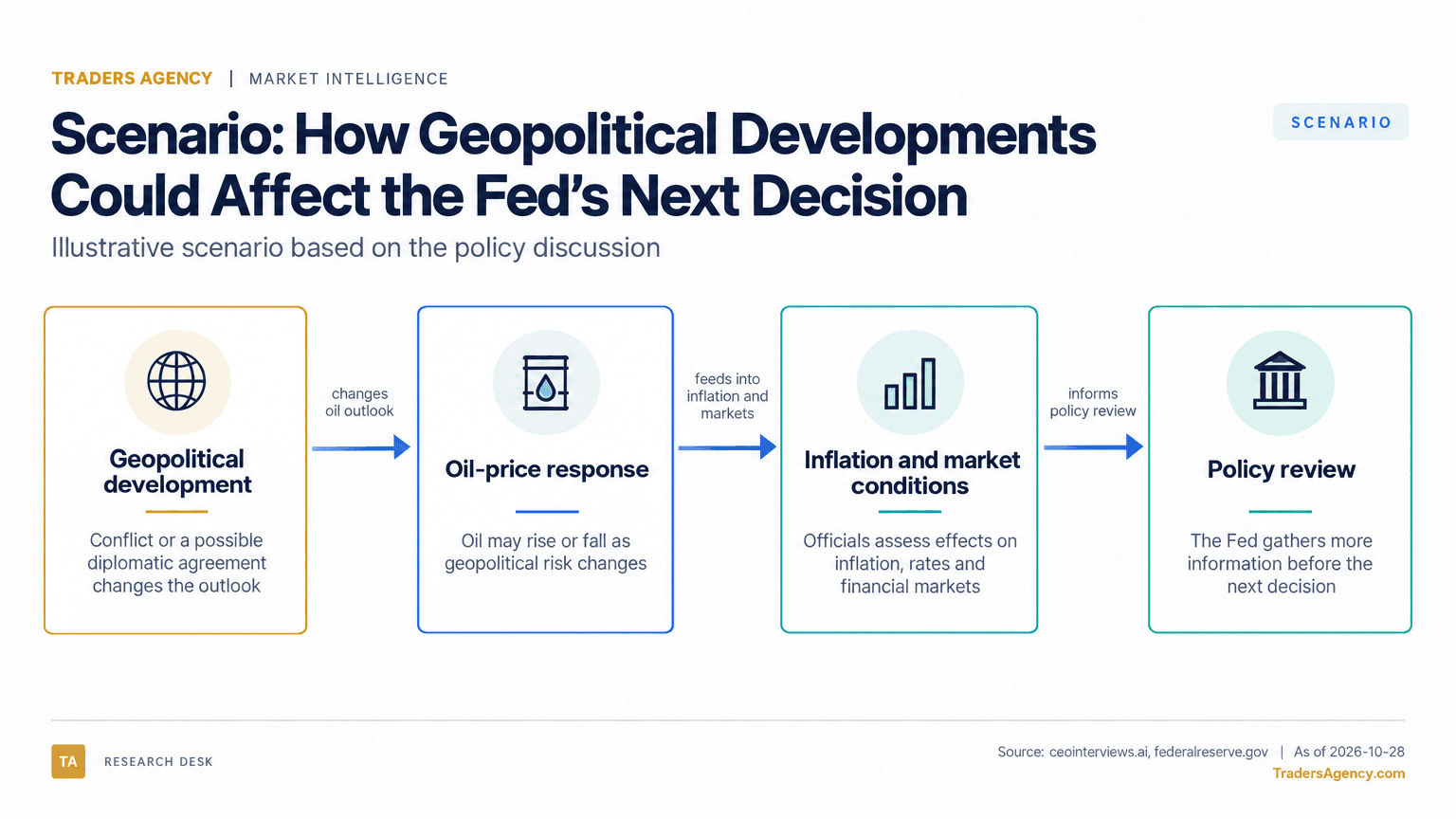
Much of the post-meeting discussion centered on comments linking oil prices, geopolitical events and market-determined interest rates. Fed Chair Warsh noted that oil prices and market-set interest rates have moved together closely for much of the year, largely because of geopolitical developments pushing crude prices higher. He added that if oil prices were to move lower again, also likely due to geopolitical events, the Fed would need to evaluate the effects on both its dual mandate and financial-market prices.
Some commentators interpreted these remarks, along with references to having a clearer picture by December, as hints that a diplomatic resolution involving Iran could be in progress. That reading is speculative. The Fed offered no confirmation of any specific negotiation, and nothing in the statement or press conference established that an agreement is imminent. What the central bank did make explicit is the mechanism itself: geopolitical conditions affect oil prices, oil prices feed into inflation and financial conditions, and those conditions in turn shape the committee's policy review.
As an illustrative scenario rather than a forecast, a resolution that eased geopolitical tension could pull oil prices and market interest rates lower, giving officials more room to hold or even ease policy. A renewed escalation would work in the opposite direction, keeping both oil and inflation expectations elevated and leaving the Fed with less clarity by its December meeting. Traders Agency analysts will be watching oil benchmarks and crack spreads over the coming weeks as a practical proxy for how this geopolitical variable is evolving.
Financial Conditions and Credit Markets Send Mixed Signals
Warsh described himself as unwilling and unable to call financial conditions tight right now, a notable change in tone from prior meetings. He also reiterated that there is no soft inflation target: the Fed's goal remains 2%, not some looser threshold the market might infer from dovish-sounding language.
One channel raised in the post-meeting discussion is that tighter credit conditions for some heavily indebted businesses and households could do some of the Fed's work for it, reducing the need for an additional rate hike if markets keep penalizing overleveraged borrowers on their own. That is a plausible channel through which market discipline substitutes for policy tightening, though it depends on how persistent and broad-based that credit-market pressure turns out to be.
On the inflation-expectations side, the five-year Treasury breakeven rate, a market-based gauge of expected inflation, rose from 2.45% to 2.49% between October 27 and October 28, according to Federal Reserve Bank of St. Louis data. That rise has been read as a negative market reaction to the press conference specifically, but daily data cannot isolate that kind of same-day causation, and Warsh himself distinguished between inflation expectations rising in the near term and confidence holding up over the longer run. The uptick is real; the clean causal story attached to it is less certain.
Want expert trading insights delivered daily?
Join thousands of traders who rely on Traders Agency for market analysis and trade ideas.
Join Traders AgencyLabor Market Risks and the AI Wildcard
Warsh pointed to low unemployment claims as evidence of labor-market strength, though unemployment claims are widely regarded as a lagging indicator that says little about where employment is headed. More forward-looking, Warsh said he plans to attend a November 16 field hearing held by the Fed's Productivity and Jobs task force in the San Francisco Bay Area, examining how quickly AI-driven productivity gains might materialize and what that could mean for both employment and price stability.
That sets up a genuine open question for investors: if artificial intelligence adoption weakens labor demand faster than expected, a central bank still worried about elevated inflation could face a much harder tradeoff. In that scenario, aggressive rate hikes aimed at inflation could do outsized damage to an already softening job market — a risk flagged in the post-meeting discussion as something to watch rather than something confirmed.
Changes to the Fed's Meeting Calendar
Warsh also outlined expected changes to the committee's meeting structure. Starting in 2027, the Fed plans to keep eight meetings a year, but one would be devoted entirely to broad monetary-policy strategy rather than a rate decision and accompanying statement, leaving seven meetings focused on policy action. He said he expects that by 2028, the format would shift to two strategy-focused meetings and six meetings tied to rate decisions. Warsh framed the 2028 arrangement as his expectation rather than a locked-in commitment, and the change does not eliminate the Fed's ability to act outside scheduled meetings if conditions warrant it.
What It Means for Investors
Taken together, the October decision reads less like a pivot and more like a holding pattern while the Fed waits on two fronts it cannot fully control: how geopolitical risk resolves in the oil market, and how quickly AI-driven productivity reshapes the labor market. Inflation expectations ticked up and credit markets showed early signs of self-correcting discipline, counterpoints that complicate any simple dovish narrative. Investors should treat the hold as conditional, watching oil prices, the December meeting, and the Fed's own jobs-and-productivity review for the next real signal on rates.
Want expert trading insights delivered daily?
Join thousands of traders who rely on Traders Agency for market analysis and trade ideas.
Join Traders AgencyDISCLAIMER: Traders Agency does not offer financial advice. The information provided is for educational purposes only and should not be considered financial advice. Traders Agency is not responsible for any financial losses or consequences resulting from the use of the information provided. Trading carries inherent risks and may not be suitable for all individuals. You are advised to conduct your own research and seek personalized advice before making any investment decisions, recognizing the potential risks and rewards involved.
- Federal Reserve issues FOMC statement
- September 16, 2026 FOMC statement
- Watch Live: Fed Chair Kevin Warsh speaks after leaving interest rates unchanged
- October 27–28, 2026 FOMC Meeting
- Analysis: Warsh is learning to wield the Fed's power without showing his hand — CNBC
- Pulse — Tuesday, October 27, 2026
- 5-Year Breakeven Inflation Rate (T5YIE)
- Fed's Warsh: There is no soft inflation target
- Federal Reserve announces the leadership and objectives of its task forces to advance the conduct of monetary policy
- Warsh to attend Fed jobs and productivity task force hearing to refine views
- Fed's Warsh announces changes in how future FOMC meetings will go
See more from Traders Agency on Google
Make us a preferred source and our market analysis will appear more prominently in your Google Search, Top Stories, and AI results.
Add to Preferred Sources