
Credit markets have been flashing warning signs for weeks, with the cost of insuring corporate debt against default climbing alongside wider spreads on riskier bonds. Yet the same data that looks alarming on the surface may already be absorbing much of the risk tied to the AI buildout, raising the question of whether the recent widening marks a peak rather than the start of something worse.
What Credit Spreads and CDS Prices Are Telling Investors
Two distinct but related signals are worth separating. Credit default swaps function like insurance policies: investors pay a premium to protect themselves against the possibility that a company defaults on its debt, and that premium rises when perceived risk increases. Credit spreads measure something slightly different, the extra yield investors demand to hold a riskier bond instead of a comparatively risk-free one. When markets get nervous, that required premium widens.
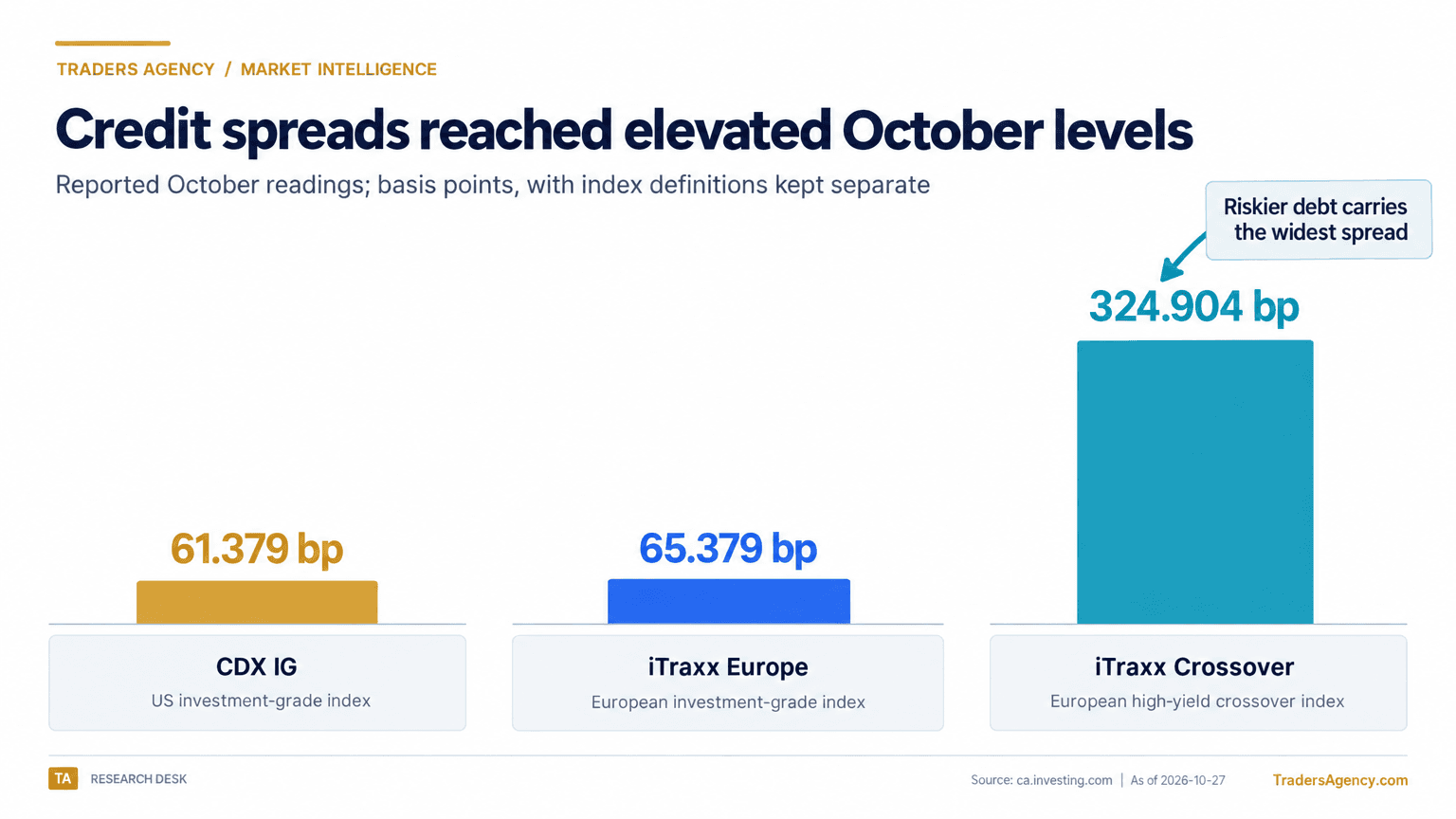
Broad credit-spread indexes climbed into elevated territory in October, with the CDX Investment Grade index reported near 61.4 basis points, the iTraxx Europe index near 65.4 basis points, and the more speculative iTraxx Crossover index near 324.9 basis points. These figures come from a single reported screen rather than a fully verified, dated data series, so they should be read as directional evidence of stress in high-yield credit rather than precise benchmarks. [[VISUAL:v1]]
One comparison points to an earlier episode of geopolitical stress, when credit spreads widened sharply before peaking, and equities did not bottom until roughly two weeks later. A second points to a stretch beginning around September 21 of this year, when spreads widened even as the Nasdaq 100 continued climbing to fresh highs before the index later pulled back. Taken together, these two episodes form the basis of a rough historical pattern in which equity markets react to credit stress with something like a two-week lag. That pattern is a historical observation rather than an established rule, and this interpretation itself acknowledges that the current peak in spreads could simply be a one-off rather than a durable turn.
Nvidia and CoreWeave Show Diverging Credit Risk
Individual company data adds texture to the broader credit picture. Reporting citing S&P Global Market Intelligence indicates Nvidia's five-year credit default swap spread rose from about 87 basis points on October 12 to roughly 130 basis points by October 23, an increase of close to 49%. That is a notable move for a company widely regarded as having one of the strongest balance sheets in the market, and it suggests credit investors are repricing risk even around firms considered relatively safe.
CoreWeave's credit risk, by contrast, is priced far higher. Reported figures place Nvidia's spread near 127 to 130 basis points in late October against CoreWeave's spread near 1,120 to 1,150 basis points over the same window, a gap that underscores how differently the market views an established chipmaker versus a newer, more leveraged AI infrastructure provider. The two companies are not directly comparable in balance-sheet strength or business model, so the contrast illustrates dispersion in credit risk across the AI ecosystem rather than a uniform level of distress.
AI Infrastructure's Multibillion-Dollar Financing Wave
Part of what credit markets appear to be digesting is the sheer scale of financing tied to AI infrastructure buildouts. On October 26, SpaceX disclosed an arrangement in which an Apollo affiliate would purchase AI chips and server hardware and lease the equipment back to SpaceX, with total principal payments of roughly $40 billion. The structure was targeted for finalization by year-end, with leases expected to begin in the first half of 2027 and run slightly more than five years after equipment delivery. Earlier reporting on SpaceX fundraising appears to concern this same initiative rather than a separate, additional $40 billion debt raise.
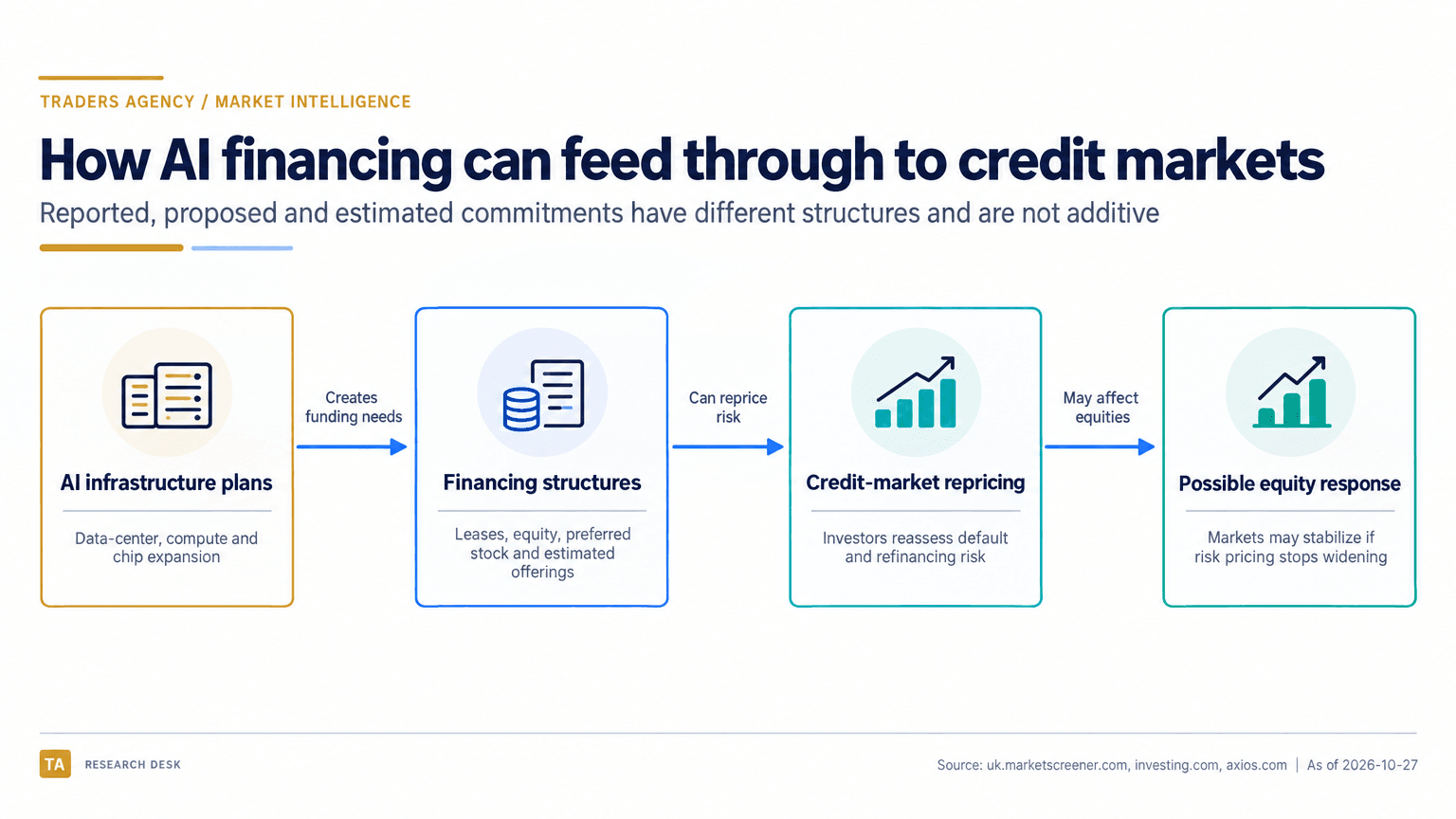
Meta's financing plan has also grown, reaching roughly $97.5 billion as of October 27, a figure that includes a proposed future $60 billion share-sale program. Anthropic's widely discussed possible $100 billion IPO raise remains a reported market estimate rather than a confirmed offering target. Separately, a group of financial partners announced a $63 billion financing structure to purchase Broadcom equipment through a special-purpose vehicle for lease to Anthropic, with deliveries expected to begin in 2027. These commitments involve different structures, issuers and stages of completion, so they should not be added together into a single market-wide total. Much of this financing activity has likely already been priced into credit-default-swap markets, even though more commitments are still to come—a dynamic central to the view that the recent spread widening may be close to a peak.
Want expert trading insights delivered daily?
Join thousands of traders who rely on Traders Agency for market analysis and trade ideas.
Join Traders AgencyMeta's Oversubscribed Offering as a Counter-Signal
If credit markets were truly signaling impending trouble, heavy investor demand for new issuance from AI-heavy borrowers would be harder to explain. Meta's upsized $25 billion share sale reportedly attracted demand at roughly five times the shares available, a result consistent with continued investor willingness to fund large technology issuers despite the credit-market noise.
Meta's October 27 pricing announcement also detailed a $12.5 billion offering of depositary shares representing 6.50% Series A Mandatory Convertible Preferred Stock, with mandatory conversion into common equity scheduled for around August 15, 2029, based on a variable conversion ratio tied to future share-price performance. Instruments like this pay a fixed preferred dividend for a set period before converting to common stock, and that dividend income can receive different tax treatment than ordinary interest, though the specifics vary by investor and jurisdiction. A syndicated Barron's piece speculated that Berkshire Hathaway could be drawn to a Meta equity offering, particularly if attractively priced convertible bonds were involved, given Warren Buffett's long-standing preference for equity exposure paired with steady income. That remains speculation about Berkshire's general appetite rather than a confirmed commitment to this specific preferred offering.
Technical Support and the Catalyst Calendar Ahead
On the technical side, the Nasdaq-100 tracking ETF QQQ was trading near 719.92 as of the video's October 27, 2026 context, with support levels identified around 715.00 and 705.27, well below its 52-week high of 762.86. Index holding that support zone, combined with a pause in credit-spread widening, is read here as a possible sign that peak fear has passed through credit markets—an interpretation, not a confirmed outcome.
A cluster of scheduled events could influence sentiment in the near term, including the Federal Reserve's October 27-28 policy meeting, Microsoft's October 28 earnings report, Amazon's October 29 earnings release, and the U.S. election on November 3. Geopolitical developments, including the situation involving Iran, remain an additional source of uncertainty that could either reinforce or undercut the stabilization thesis depending on how events unfold.
A Cautiously Constructive but Uncertain Setup
The overall picture is one of genuine tension rather than a clean signal in either direction. Credit markets have clearly repriced risk around AI infrastructure financing, and the scale of capital commitments from companies tied to data-center and chip buildouts is substantial by any measure. At the same time, strong demand for new issuance and a stalling pattern in credit-spread widening suggest the market may have already absorbed much of that risk rather than being blindsided by it going forward. Traders Agency analysts will be watching whether credit spreads resume widening or continue to stabilize over the coming weeks, since that distinction, more than any single data point, is likely to determine whether equities follow the loose historical pattern of recovering roughly two weeks after a credit peak, or whether this episode breaks from that pattern entirely.
Want expert trading insights delivered daily?
Join thousands of traders who rely on Traders Agency for market analysis and trade ideas.
Join Traders AgencyDISCLAIMER: Traders Agency does not offer financial advice. The information provided is for educational purposes only and should not be considered financial advice. Traders Agency is not responsible for any financial losses or consequences resulting from the use of the information provided. Trading carries inherent risks and may not be suitable for all individuals. You are advised to conduct your own research and seek personalized advice before making any investment decisions, recognizing the potential risks and rewards involved.
- Invesco QQQ Trust ETF Historical Data
- Nvidia's Credit Risk Has Tripled This Year — and Just Passed Meta's
- SpaceX enters $40 billion deal with Apollo for AI chip financing
- Meta eyes record $97.5 billion equity raise to fund AI expansion
- Axios Pro Rata: Claude cash
- Bank of America, Blackstone, Citi and Morgan Stanley Announce Landmark $63 Billion Financing Structure to Enable AI Compute Capacity in Partnership with Broadcom
- Meta’s $25 Billion Stock Sale Ended Five Times Oversubscribed
- Meta Announces Pricing of Mandatory Convertible Preferred Stock and Class A Common Stock Offerings
- Publication 550 (2025), Investment Income and Expenses
- Meta's Big Equity Offering Might Come Soon; Could Berkshire be a Buyer?
- Federal Reserve Board — Monetary Policy
- Microsoft Investor Relations
- Amazon will share its Q3 2026 earnings on October 29
- General Election — November 3, 2026
See more from Traders Agency on Google
Make us a preferred source and our market analysis will appear more prominently in your Google Search, Top Stories, and AI results.
Add to Preferred Sources