
The next phase of the artificial intelligence boom is turning on a different question than the one investors asked a year ago. It is no longer simply whether companies can beat earnings estimates. Increasingly, markets want to know how those companies plan to pay for the staggering sums committed to compute, power and long-term infrastructure leases, and whether cash is actually flowing in to cover it.
A Financing-Driven Market, Not Just an Earnings Story
Over the past several weeks, a string of enormous capital raises tied to artificial intelligence infrastructure has coincided with choppier trading across AI-linked stocks. The pattern suggests that when large companies pull substantial sums out of capital markets to fund data centers, chips and power equipment, the broader market can feel the pinch, even if the fundraising itself is unrelated to any single stock's earnings. That is one interpretation some market participants have offered for why AI-related shares have struggled even during periods of strong underlying growth.
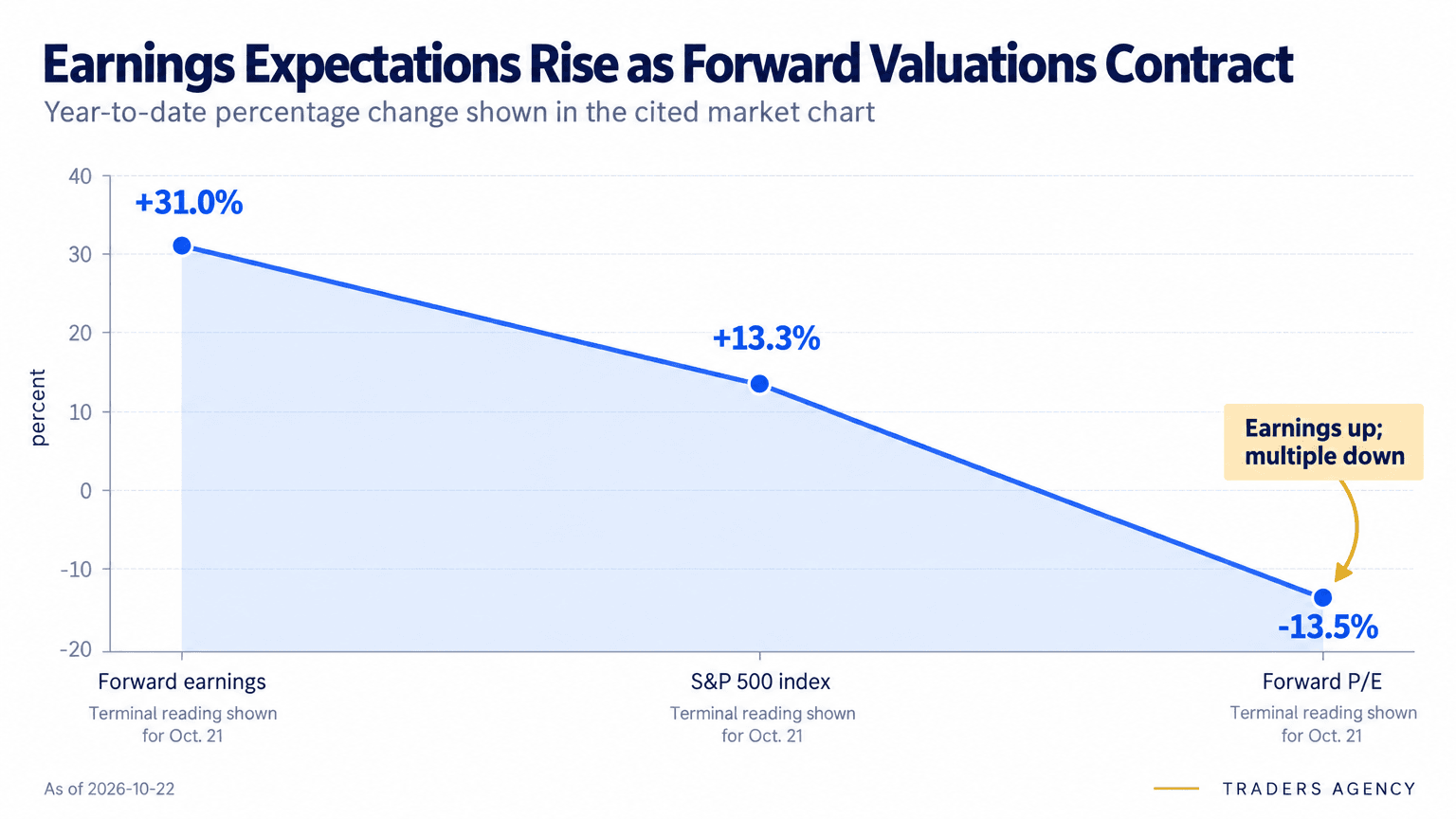
A chart from Yardeni Research, cited in recent market commentary, illustrates the tension plainly. Year to date through October 21, forward earnings estimates for S&P 500 companies had climbed roughly 31%, while the index itself was up about 13.3%. The forward price-to-earnings multiple, meanwhile, had fallen around 13.5% over the same stretch. In plain terms, investors are paying less for every dollar of expected future profit, even as those profit expectations keep rising. That is not a typical bull-market pattern, and it helps explain why some companies can report strong numbers yet still see their shares slide.
Traders Agency analysts note that this divergence does not by itself prove capital raising is the primary driver of the pullback. Liquidity, interest-rate expectations and geopolitical uncertainty are all plausible contributors. But the timing lines up closely enough with major AI financing events that it is worth watching closely heading into year-end.
Why Anthropic and OpenAI Need More Capital
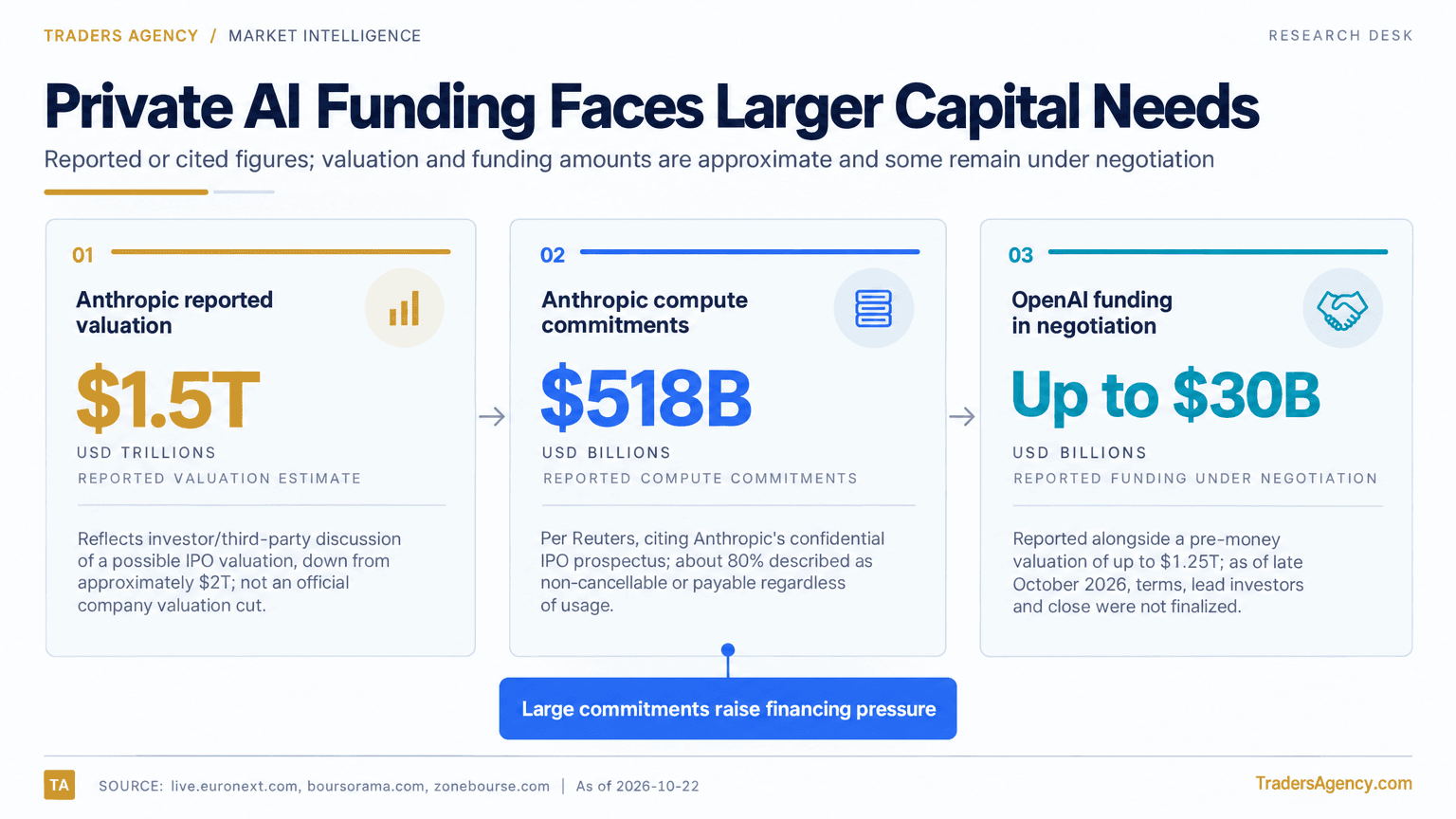
Few examples capture the financing pressure better than Anthropic. Reports have circulated that some current and prospective investors have discussed a possible public listing valuation near $1.5 trillion, down from earlier expectations closer to $2 trillion. It is important to be precise here: this reflects investor conversations and third-party reporting rather than an official valuation cut announced by the company itself.
Separately, Reuters reported in late September, citing Anthropic's confidential IPO prospectus, that the company has committed to at least $518 billion in AI infrastructure spending across six partners over roughly a decade, with about 80% of that amount described as non-cancellable or payable regardless of usage. Commitments of that scale naturally raise the question of how the company intends to fund them, and a public listing is one obvious route to additional capital.
There is also a timing argument worth considering, though it remains speculative. Some observers have suggested Anthropic might look to list between the midterm elections and the end of the year, reasoning that the company would prefer to showcase strong year-over-year growth comparisons before lapping an unusually strong first quarter. Whether that proves accurate depends on market conditions and the company's own decisions, none of which have been confirmed publicly.
OpenAI is facing a similar capital squeeze. Reports from late October describe the company as negotiating approximately $30 billion in new financing at a valuation of up to $1.25 trillion before the investment, with UAE-based investors and the investment firm Coatue reportedly leading the round. As of this reporting, the terms had not been finalized, underscoring that even well-capitalized AI leaders are still working to secure additional funding rather than operating from a position of settled financial strength.
Bloom Energy's Beat That Wasn't Rewarded
Bloom Energy offers a useful case study in how cash flow, not just earnings, is shaping investor sentiment. The fuel-cell and power company reported adjusted earnings per share of roughly $0.94 against expectations near $0.68, alongside adjusted EBITDA of about $299.5 million versus an expected $241.2 million. On paper, that is a substantial beat.
Yet the stock declined anyway. Revenue climbed about 16% sequentially, but total costs rose roughly 27% over the same period, a sign that expenses are growing faster than sales even as the business scales. More notably, operating cash flow turned negative, around negative $27 million for the quarter, while spending on property and equipment ran near $153 million. For investors focused on whether rapid growth is translating into cash in the bank, those numbers mattered more than the headline beat.
This pattern, strong reported earnings paired with deteriorating cash conversion, appears to be resonating across other AI-adjacent names as well, reinforcing the idea that markets are scrutinizing financing quality as closely as top-line results. A single quarter of negative operating cash flow does not necessarily signal a lasting shift in Bloom Energy's business; it could also reflect the timing of receivables and contract assets or a deliberate ramp in growth-related spending that normalizes in later quarters.
Chips, Power and the Multi-Year Spending Buildout
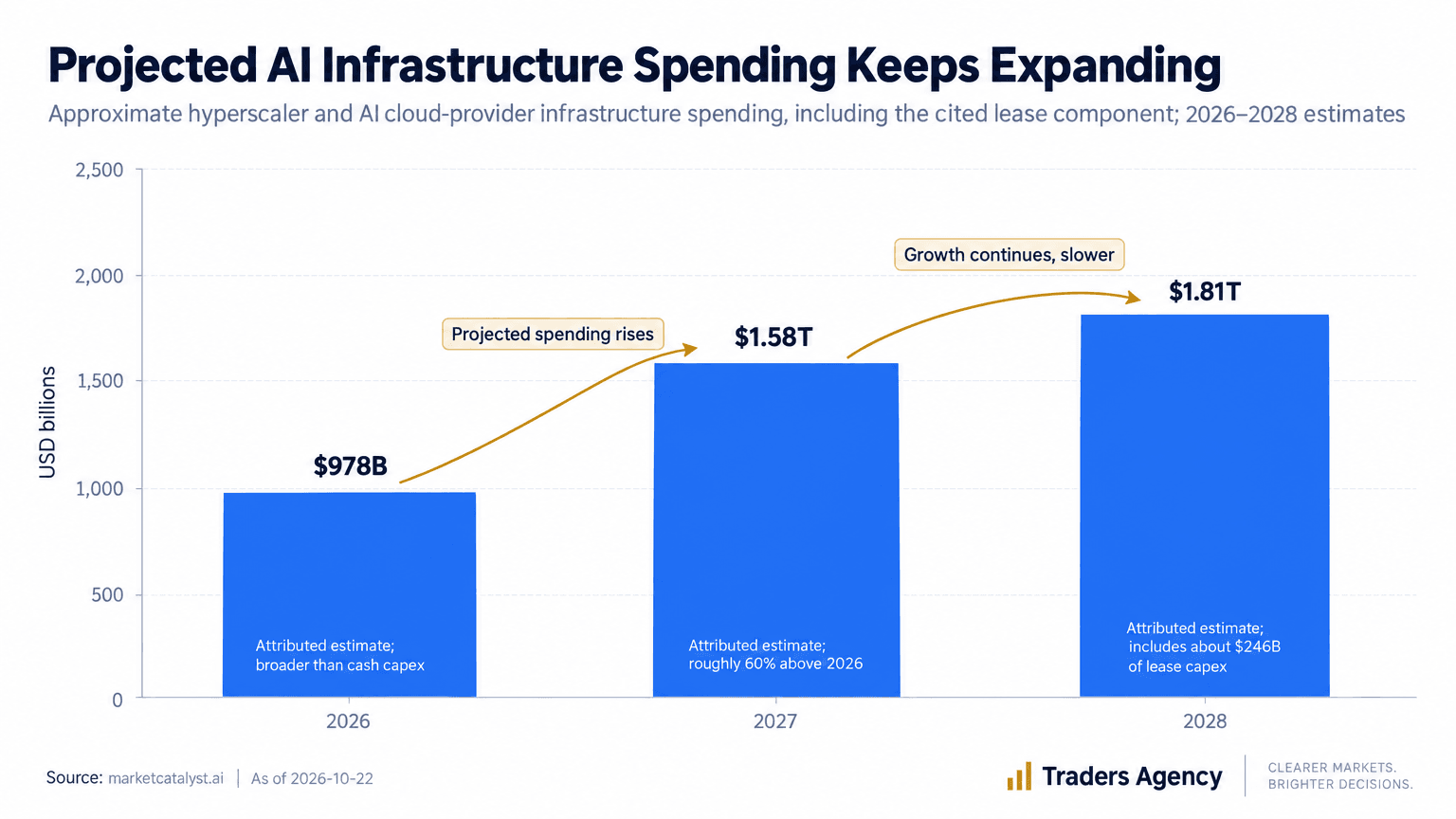
None of this suggests the AI infrastructure cycle is slowing. According to estimates attributed to Morgan Stanley, combined hyperscaler and neocloud capital expenditures, inclusive of lease commitments, are projected to rise from roughly $978 billion in 2026 to about $1.58 trillion in 2027, an increase of roughly 60%, before reaching approximately $1.81 trillion in 2028. That 2028 figure reportedly includes around $246 billion tied to leases, a category investors have come to watch closely because signed leases represent future obligations that do not always show up as near-term cash spending.
Those same estimates suggest AI-related capital spending contributed about 15% of S&P 500 sales growth in 2026, with that share projected to rise to roughly 24% in 2027. A substantial portion of that spending is expected to flow toward Nvidia, with one widely cited estimate putting the company's share of 2027 AI capex absorption at around $690 billion, compared with roughly $340 billion spread across the remaining 499 S&P 500 companies combined. That figure, like the broader capex forecasts, reflects third-party projections rather than confirmed company guidance, but it illustrates how concentrated the AI supply chain's economics have become.
Custom chips are also gaining ground. Application-specific integrated circuits, or ASICs, such as Amazon's Trainium processors and Google's Tensor Processing Units, are estimated to have represented about 34% of incremental AI compute capacity in 2025, with that share projected to climb to roughly 66% by 2028. Power infrastructure has become a parallel bottleneck, with industry reporting pointing to sharply higher turbine pricing and lengthy order backlogs for gas-fired power equipment as hyperscalers race to secure electricity for new data centers. These projections assume AI compute demand keeps expanding roughly as forecast; if that demand growth slows or expected AI revenue fails to materialize, the pace of chip and power investment could slow as well.
Want expert trading insights delivered daily?
Join thousands of traders who rely on Traders Agency for market analysis and trade ideas.
Join Traders AgencyMeta's Lease Burden and the Monetization Lag
Meta illustrates a related tension: heavy upfront commitments paired with uncertain near-term payoff. The company's 2025 annual report disclosed roughly $103.77 billion in leases that had not yet commenced, largely tied to data centers, colocation facilities and network infrastructure. Some market observers have suggested meaningful revenue from Meta's AI models may not materialize until early 2028, though that timeline reflects outside forecasting rather than confirmed company guidance. If accurate, it implies a multi-year gap between when the spending hits the balance sheet and when it begins generating comparable returns, a dynamic that can weigh on sentiment even for a company with Meta's scale.
Lennar and the Rate-Sensitive Trade
Elevated interest rates continue to show up in housing-related results. Lennar's reported quarterly pretax margin fell from roughly 9.0% a year earlier to about 4.8%, while total revenue declined approximately 8.7%. The company has also pulled back from multifamily construction as higher borrowing costs weigh on demand.
At the same time, the 10-year Treasury yield fell to about 4.96% by October 22, down from roughly 5.31% on October 5, a move some have interpreted as a flight to safety amid AI-related market jitters. Falling yields generally support bond prices and can make rate-sensitive assets more attractive, though housing-specific pressures like Lennar's margin compression stem from different, company-level factors and should not be read as directly caused by bond-market moves.
A Longer-Term, More Speculative Scenario
Looking further out, some market commentators have floated a more optimistic long-term scenario: that by around 2032 or 2033, interest rates could fall back toward zero if AI-driven productivity gains generate significant deflation in goods and services, prompting policymakers to keep rates low to offset labor-market disruption. In that scenario, real estate and other rate-sensitive assets could perform strongly during the next decade. This remains a highly speculative outlook that depends on numerous uncertain variables, including labor-market outcomes, fiscal policy, geopolitical conditions and energy prices, and it should be treated as one possible long-term case rather than a forecast.
What It Means for Investors
Taken together, the current moment looks less like a verdict on whether artificial intelligence will deliver long-term value and more like a stress test of how that value gets financed in the near term. Massive capital commitments from Anthropic, OpenAI and major hyperscalers are colliding with a market that has grown more selective about rewarding growth unless it comes with credible cash generation. At the same time, if AI demand, custom-chip development and infrastructure investment continue expanding roughly as projected over the next several years, today's valuation compression could ultimately look like an entry opportunity rather than the start of a broader collapse. Traders Agency analysts are watching how upcoming earnings reports address operating cash flow and lease obligations specifically, since that distinction, rather than headline beats alone, appears to be driving which AI-related stocks hold up and which ones do not.
Want expert trading insights delivered daily?
Join thousands of traders who rely on Traders Agency for market analysis and trade ideas.
Join Traders AgencyDISCLAIMER: Traders Agency does not offer financial advice. The information provided is for educational purposes only and should not be considered financial advice. Traders Agency is not responsible for any financial losses or consequences resulting from the use of the information provided. Trading carries inherent risks and may not be suitable for all individuals. You are advised to conduct your own research and seek personalized advice before making any investment decisions, recognizing the potential risks and rewards involved.
- Daily Treasury Rates — October 2026
- Reuters: Anthropic's soaring sales, steep losses put AI frenzy to IPO test
- Anthropic confidentially submits draft S-1 to the SEC
- Reuters: Anthropic's $518 billion AI infrastructure buildout relies largely on non-cancellable contracts
- Dow Jones: OpenAI funding negotiations at a $1.25 trillion valuation
- OpenAI Fundraising Round Set to Close Soon With UAE Investors, Coatue Leading Investment
- Bloom Energy Reports Record Third Quarter 2026 Financial Results
- ComputeLabs: Bloom Energy third-quarter results
- Morgan Stanley Maps a $1.58 Trillion AI Spending Wave
- Hilo Research: Morgan Stanley on the generative AI inference economy and investment cycle
- GE Vernova — Bank of America Global Industrials Conference, March 18, 2026
- Meta Platforms 2025 Annual Report — Leases
- Lennar Corporation Form 10-Q — Quarter ended August 31, 2026
See more from Traders Agency on Google
Make us a preferred source and our market analysis will appear more prominently in your Google Search, Top Stories, and AI results.
Add to Preferred Sources