Alphabet's stock dropped sharply this week after its latest earnings report reignited a familiar worry: that AI chatbots and AI-powered search tools are starting to eat into Google's core advertising engine. The reaction was dramatic, but the underlying picture is more layered than a single scary headline suggests. Search did decelerate, and free cash flow did weaken, yet Cloud revenue kept accelerating and management pointed to several temporary factors alongside the AI-related one. The real question for investors isn't whether Search slowed last quarter. It's whether this is a brief transition or the start of something more structural.
A Sharp Reaction to a Mixed Earnings Report
Alphabet shares fell about 12% following the report, a roughly $39 decline that pushed the stock below $300 per share. For a company that has delivered strong quarter after strong quarter in recent years, a drop of that size understandably rattled investors. According to figures cited in the earnings commentary, Alphabet shares had still compounded at roughly a 14% annual rate since 2021 even after this pullback, a reminder of how far the stock had run before the reversal. That same commentary pointed to analyst estimates showing Alphabet's trailing revenue growth running above 20% and climbing toward roughly 25% in the near term before gradually easing to about 23% over the following few years. These are forecasts rather than confirmed results, and they should be read with that caveat in mind.
What's Really Behind Alphabet's Search Slowdown
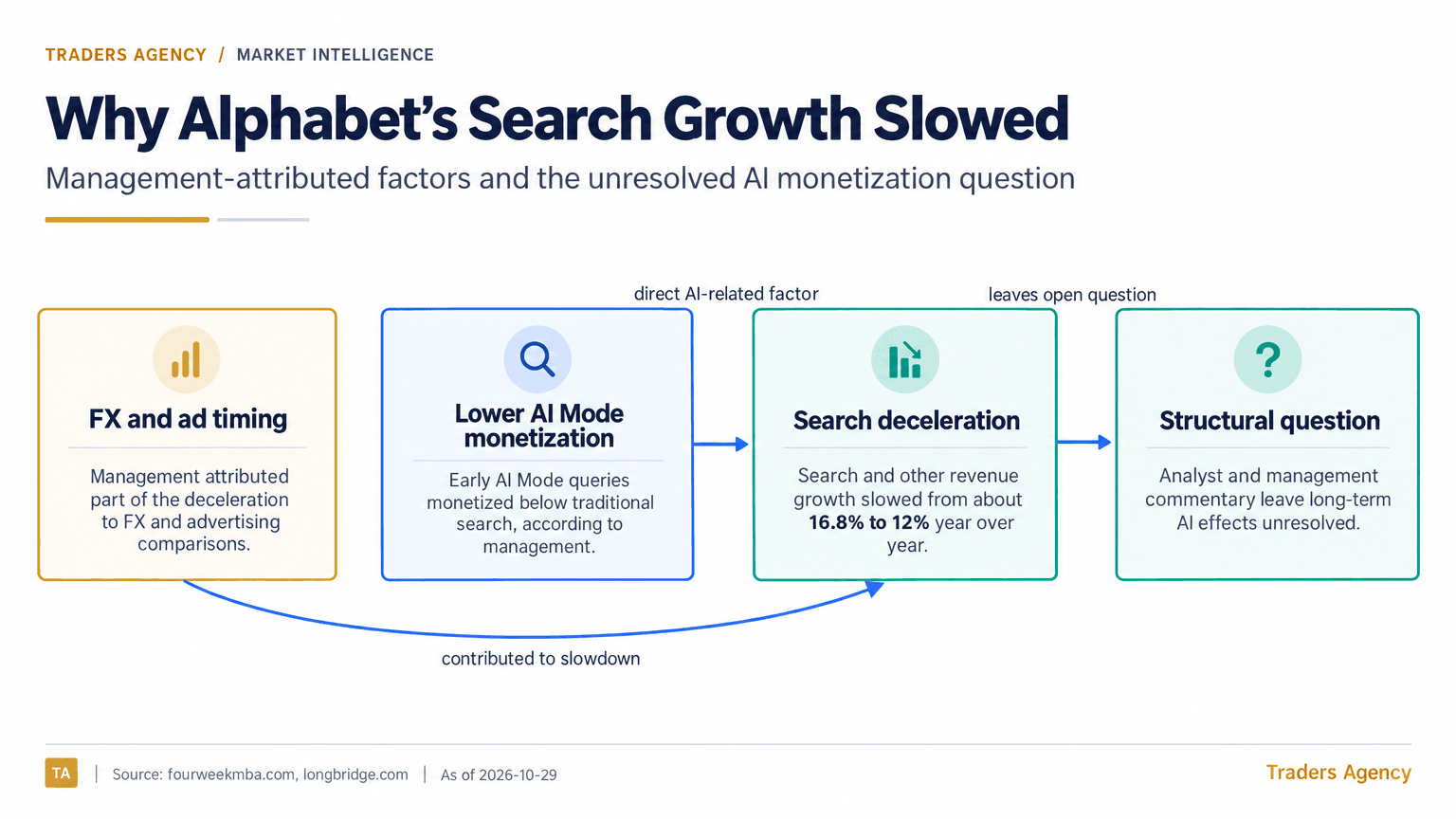
Google Search and other revenue grew 12% year over year in the latest quarter, down from roughly 17% in the prior quarter. That is a meaningful deceleration, and it's the number bears have been waiting for. Independent analyst Gene Munster voiced that concern publicly, arguing that strength in AI Mode queries was weighing on search revenue, a view consistent with commentary he has published elsewhere, even as he has also acknowledged that monetization could improve as the product matures.
According to the source material's account of Alphabet's earnings call, Chief Business Officer Philipp Schindler attributed the slowdown to a mix of factors. Foreign-exchange movements were described as the single largest driver of the deceleration from the prior quarter. Management also pointed to a shift in European Union de minimis import rules that affected some Asia-Pacific retail advertisers, and to a difficult comparison against unusually strong advertising spending tied to the FIFA World Cup the previous quarter. Only one factor in that list speaks directly to the AI debate: lower monetization from early AI Mode queries.
The more nuanced explanation is that Alphabet is deliberately migrating some search traffic toward AI Overviews and AI Mode, interfaces that currently monetize at a lower rate than the decade-optimized traditional results page. Whether that gap narrows over time, the way traditional search monetization improved steadily for years, is the central open question. It's a legitimate bear case, but it isn't yet evidence that Search is structurally declining.
Reading Through the Earnings Noise: Investment Gains and Cash Flow
Alphabet's earnings-per-share trends look erratic largely because of investment accounting, not operating performance. Alphabet's own quarterly filing shows the company recorded roughly $127.3 billion of net equity-security gains over the first nine months of 2026, tied in part to its SpaceX stake and another private holding, which inflated earlier quarters' net income. In the third quarter, that trend reversed: Alphabet booked a net equity-security loss of about $8.7 billion, largely reflecting a markdown tied to the SpaceX position. That swing from large gains to a quarterly loss helps explain why headline EPS figures look so volatile, and why analysts often prefer to strip these investment swings out when judging Alphabet's underlying profitability.
In one illustrative scenario that holds Alphabet's share price steady near $285 and removes those one-time investment effects, the implied forward price-to-earnings ratio runs roughly 26.4x based on 2025 estimates, easing toward about 18.6x by 2027 and 15.5x by 2028, assuming those normalized earnings estimates play out. That is a scenario built on assumptions, not a confirmed valuation outcome, but it suggests Alphabet isn't obviously expensive if its underlying earnings keep growing.
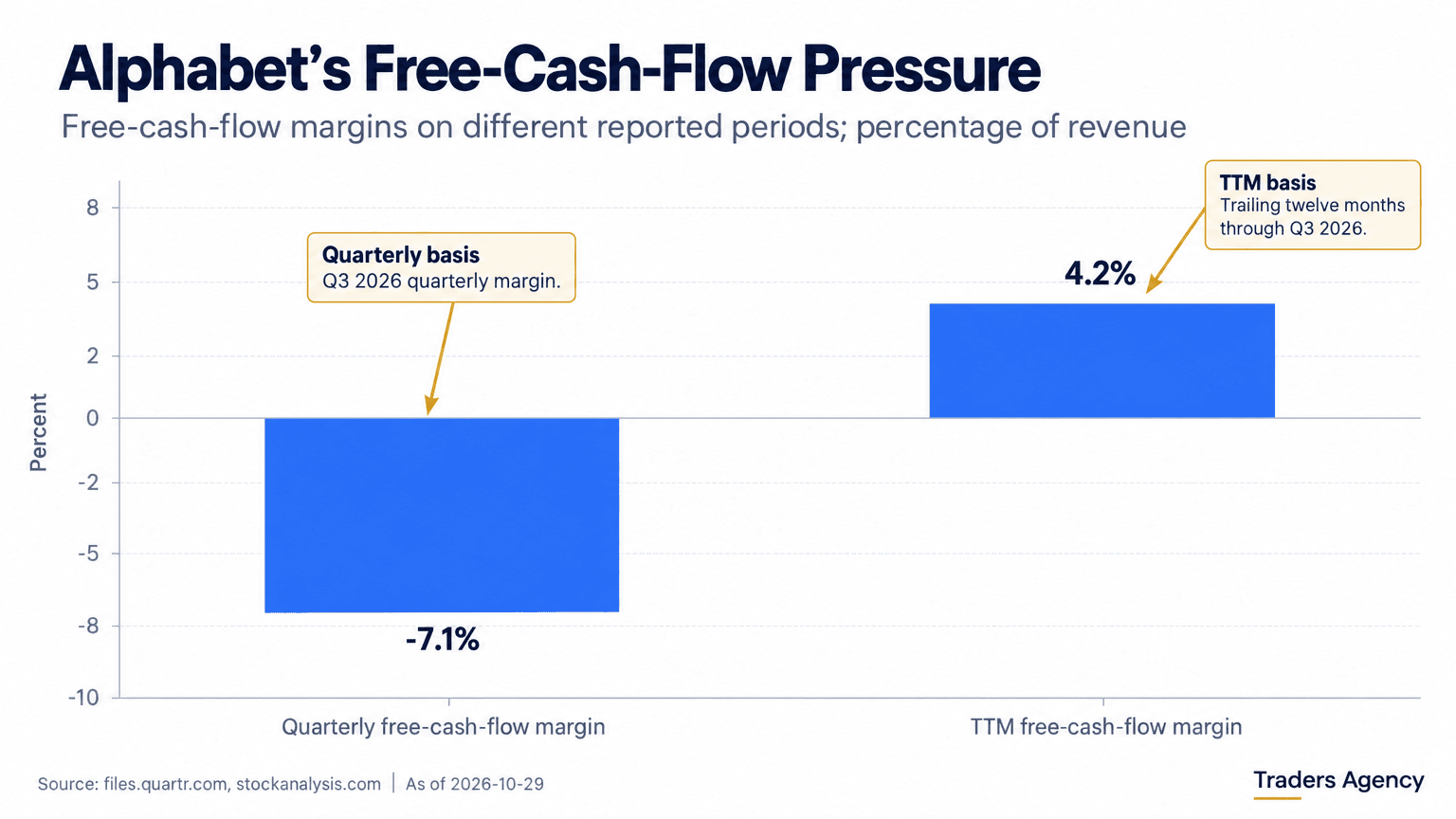
Cash flow is the part of the story that genuinely deteriorated. Quarterly free cash flow fell to roughly negative $9.1 billion, a negative 7.1% margin, as capital spending on infrastructure ramped up. On a trailing-12-month basis, free cash flow came in at about $19.7 billion, or roughly 4.2% of trailing revenue, a steep drop from the 20%-to-25% range the earnings commentary described as typical for Alphabet in recent years. That decline reflects an aggressive investment cycle rather than a weakening core business, but it's a real cost investors are now pricing in.
Want expert trading insights delivered daily?
Join thousands of traders who rely on Traders Agency for market analysis and trade ideas.
Join Traders AgencyCloud, YouTube and the Next Growth Engines
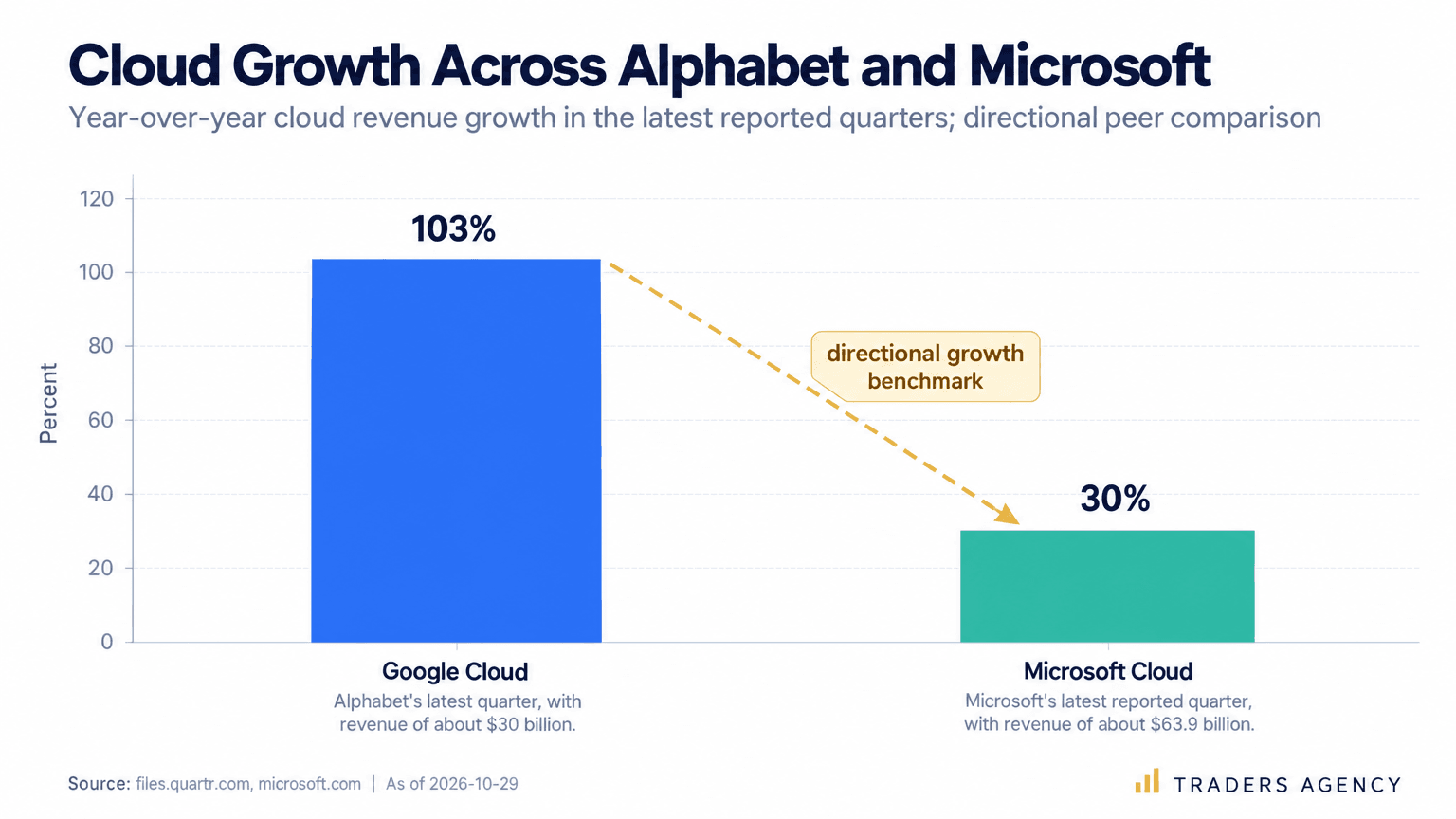
Google Cloud remains the clearest counterweight to Search concerns. Cloud revenue grew 103% year over year to about $30 billion in the latest quarter, with operating margins holding at 36%, a sign the business is scaling profitably rather than buying growth. Cloud backlog, or remaining performance obligations, was cited as rising from roughly $513 billion to about $560 billion. Backlog growth naturally slows as a business converts more of that pipeline into recognized revenue faster, so a smaller increase isn't automatically a red flag, though the two backlog figures should be understood as directional rather than precisely matched to a single reporting period.
YouTube's results were more mixed. Advertising revenue tied to YouTube grew about 9.2% year over year, while the broader subscriptions, platforms and devices category, which includes YouTube Premium and Music alongside other products, grew around 11%. Alphabet also said it has surpassed 150 million YouTube Music and Premium subscribers globally, including trial users, underscoring the scale of its subscription business even as growth there has cooled from earlier peaks.
Microsoft Offers a Cloud-Scale Benchmark
Microsoft's own results, released around the same time, offer useful context. Total revenue grew 19%, operating income grew 21%, and operating margin ticked up to 50%. Microsoft Cloud revenue reached $63.9 billion, up 30% year over year, demonstrating that large-scale cloud demand remains strong across the industry. Microsoft said it expects to remain free-cash-flow positive across fiscal 2027 overall, rather than guaranteeing a positive result in every individual quarter, and management noted that capital spending came in lower than planned in the latest quarter partly due to delayed third-party data-center capacity, with spending expected to pick up later in the fiscal year. Traders Agency analysts are watching whether Alphabet's cash-flow trajectory stabilizes in a similar fashion as its own infrastructure buildout matures.
Mastercard and the Instant-Payments Debate
Mastercard's third-quarter 2026 results showed continued strength, including roughly 14% net-revenue growth. That performance pushes back, at least for now, on the narrative that government-backed instant-payment systems such as Brazil's Pix are displacing card networks. Brazilian central-bank data do show Pix transaction volumes are substantial and still growing, so Mastercard's continued growth doesn't fully settle the long-term competitive question. It simply means the displacement effect hasn't shown up meaningfully in the company's numbers yet.
DoorDash's Proposed Instacart Deal Adds a Retail Push
DoorDash's order volume grew 28% to about 993 million orders in a single quarter, reflecting both organic growth and prior acquisitions. More notably, on October 29, 2026, DoorDash and Instacart announced a definitive agreement under which DoorDash would acquire Instacart in a deal valuing its equity at roughly $17 billion, or about $65 per share, with consideration made up of a mix of cash and stock. This is a signed agreement rather than a mere statement of intent, though it still requires regulatory approval and other closing conditions before it can be completed.
Whether regulators ultimately clear the deal will likely hinge on how the relevant market is defined. Antitrust guidance from the Department of Justice allows for multiple overlapping market definitions based on competitive substitution, so a broader market that includes Amazon or Walmart delivery wouldn't automatically eliminate concerns in a narrower grocery- or restaurant-delivery market. DoorDash's dominant position in restaurant delivery alone also doesn't resolve separate questions regulators could raise about labor practices or platform competition.
The Bottom Line
Alphabet's sell-off reflects a real deceleration in Search growth and a sharp, investment-driven drop in free cash flow, both legitimate reasons for investors to pause. But the same earnings report showed a cloud business growing above 100% with healthy margins, a search business still generating substantial revenue even amid transition, and management attributing most of the quarterly slowdown to currency effects and timing rather than AI alone. The debate over whether AI search ultimately expands or erodes Alphabet's monetization is unresolved, and it will likely take several more quarters of data, not one earnings call, to settle it.
Want expert trading insights delivered daily?
Join thousands of traders who rely on Traders Agency for market analysis and trade ideas.
Join Traders AgencyDISCLAIMER: Traders Agency does not offer financial advice. The information provided is for educational purposes only and should not be considered financial advice. Traders Agency is not responsible for any financial losses or consequences resulting from the use of the information provided. Trading carries inherent risks and may not be suitable for all individuals. You are advised to conduct your own research and seek personalized advice before making any investment decisions, recognizing the potential risks and rewards involved.
- Alphabet — GOOGL Stock Price & News
- Alphabet Revenue 2005–2026
- Alphabet Q3 2026 Form 10-Q
- Alphabet Announces Third Quarter 2026 Results
- Google's $507B Drop, Unpacked: Search, Cash, a SpaceX Mark
- Gene Munster — Investing Ideas, Posts & Market Views
- Microsoft Earnings Release FY27 Q1
- Microsoft Q1 2027 Earnings Call Transcript
- Mastercard Reports Third Quarter 2026 Financial Results
- Banco Central do Brasil — Pix em números
- DoorDash Releases Third Quarter 2026 Financial Results
- DoorDash to Acquire Instacart to Help Local Stores Win
- U.S. Department of Justice — Market Definition
- DoorDash offers $17 billion for Instacart
See more from Traders Agency on Google
Make us a preferred source and our market analysis will appear more prominently in your Google Search, Top Stories, and AI results.
Add to Preferred Sources