Renewed inflation pressure and stubbornly elevated long-term expectations are complicating the setup heading into the Federal Reserve's next policy announcement, even though nearly every major forecaster expects officials to hold interest rates steady. The real debate isn't whether the Fed moves this week. It's what the accompanying language signals about how much more tightening, or patience, lies ahead.
Inflation Signals Flash Renewed Warning
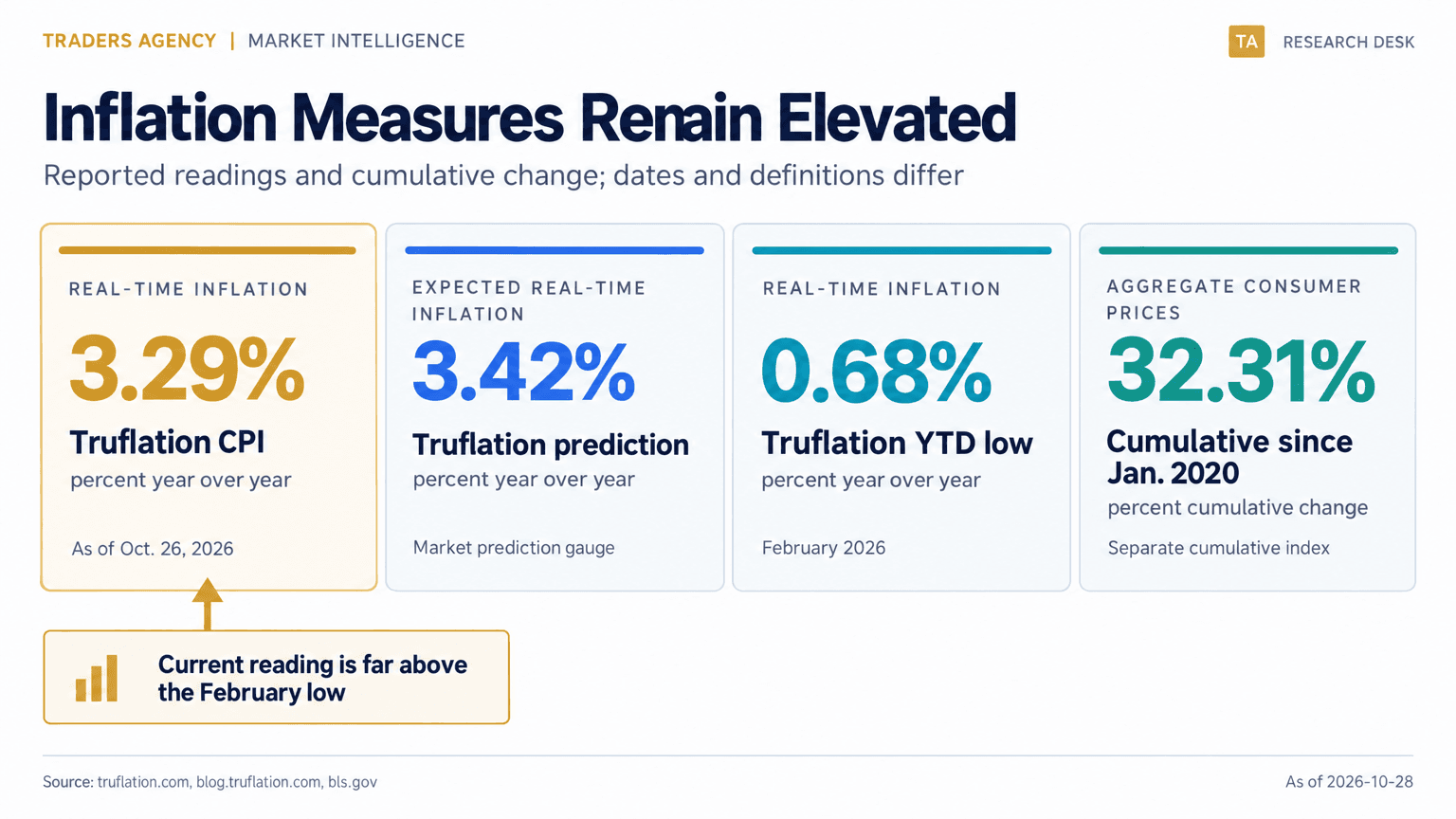
Truflation's real-time measure of U.S. consumer prices climbed to 3.29% year over year as of October 26, 2026, with the service's own forward-looking prediction gauge pointing toward 3.42%. That reading is a sharp reversal from the 0.68% year-to-date low recorded in February, and it still sits below the official Bureau of Labor Statistics figure of 3.70% for the comparable period, underscoring that private, high-frequency gauges and the government's monthly release measure inflation somewhat differently.
The most recent official CPI data showed headline prices rising 0.6% month over month, with core CPI up 0.3%, above the roughly 0.2% consensus many economists had expected. A separate category-by-category tally put close to half of consumer price categories at annual increases above 3%, down modestly from around 54% in the prior reading but still broad enough to worry inflation hawks watching for signs that price pressure is becoming entrenched rather than isolated to a handful of categories.
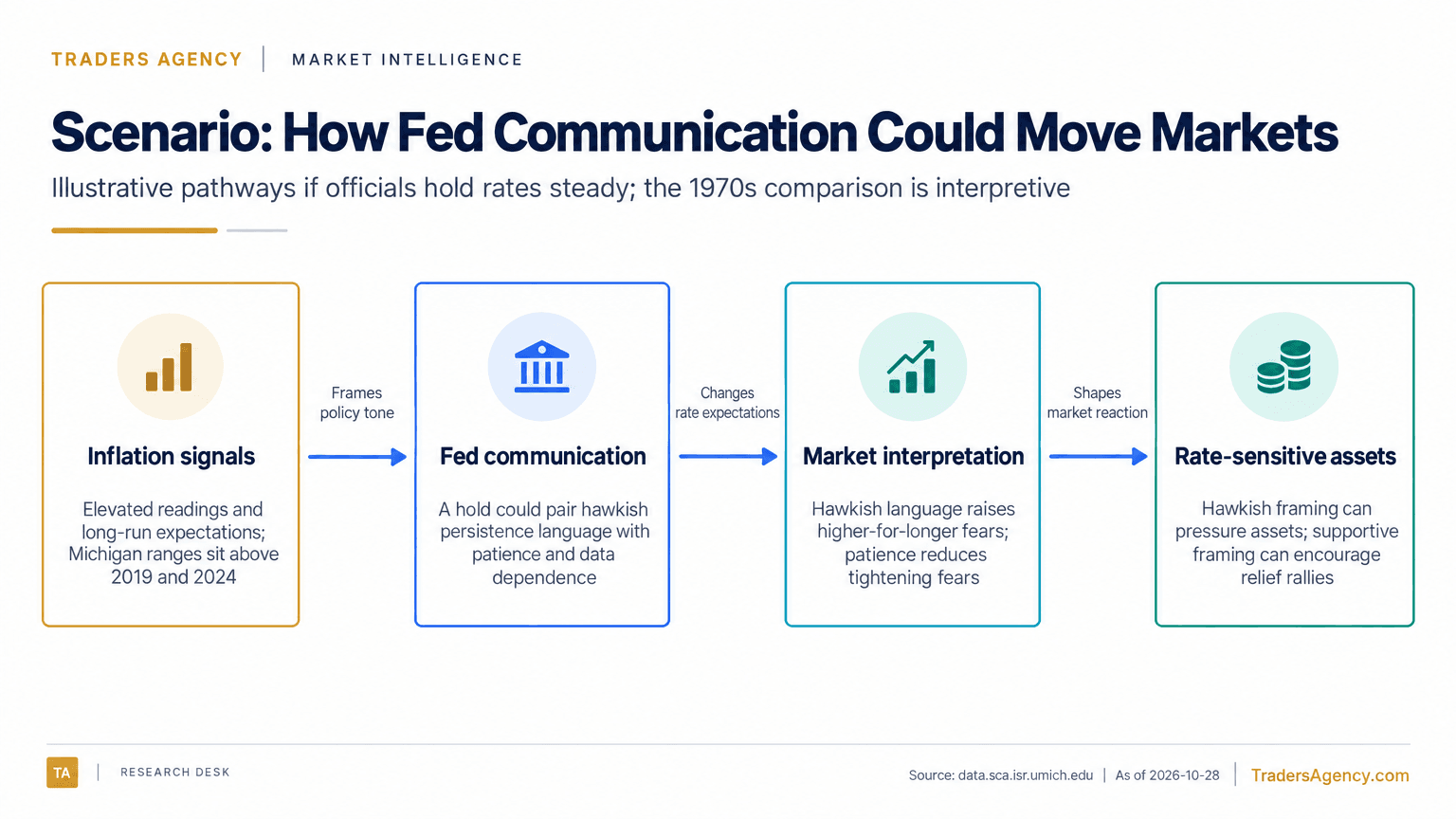
Separately, the five-year inflation breakeven rate, a market-based gauge of expected inflation, has reportedly climbed back toward the level it held before the Fed's September 16 rate hike, suggesting investors haven't fully priced out longer-run inflation risk. University of Michigan survey data add another layer: long-run inflation expectations are sitting above both their 2019 and 2024 ranges, a pattern some analysts have compared to the entrenched inflation psychology of the 1970s. That historical parallel is best treated as an interpretive flag rather than a settled forecast, since survey methods vary across periods and a higher floor in expectations alone doesn't guarantee a repeat of that era's inflation spiral.
Wall Street Converges on a Hold, Diverges on What's Next
Bond-market pricing was cited as showing roughly a 93.4% probability that the Fed holds rates steady this week — a figure that couldn't be independently verified against a specific instrument but that aligns with the broad consensus for a hold. Goldman Sachs economists expect an October hold followed by a December rate increase, and the firm's economist David Mericle has said a March 2027 hike is possible under an alternating-meeting pattern, though that isn't his base-case expectation. Morgan Stanley's economists similarly expect a hold this week, followed by additional hikes in both December and March. MUFG and UBS were also described as broadly aligned with a near-term hold, though views diverge on how many additional increases follow into next year.
Nomura Research reportedly argued that this is an opportune moment for the Fed to begin emphasizing quantitative tightening, the process of shrinking its balance sheet. The Fed does maintain a task force reviewing aspects of its balance-sheet framework, though its public mandate doesn't specifically brand it a quantitative-tightening task force or commit to a firm year-end reporting deadline. Any emphasis on that front this week should be treated as a possibility worth watching rather than a confirmed outcome.
Rate-Sensitive Assets Brace for a Volatile Reaction
The Nasdaq has pulled back roughly 6% from its recent record high — a decline that, in the context of the index's recent trading range, looks more like a routine fluctuation than evidence of a deeper market break. The Invesco QQQ ETF was recently trading near 721.80, close to its 200-period moving average around 721.72 and above its 100-period average near 713.98, a setup suggesting consolidation rather than a decisive trend break in either direction.
History from the Fed's prior meeting offers a useful counterpoint. After the September 16 decision, the Nasdaq initially softened on hawkish-sounding commentary before rallying to fresh records once the policy event had passed. That pattern suggests tomorrow's language, more than the decision itself, is likely to drive the market's near-term direction. Commentary emphasizing persistent inflation or the need for further tightening would likely pressure rate-sensitive assets the most, while language stressing patience could spark a relief rally similar to what followed in September.
Want expert trading insights delivered daily?
Join thousands of traders who rely on Traders Agency for market analysis and trade ideas.
Join Traders AgencySemiconductor Strength Cuts Both Ways
SK Hynix's third-quarter 2026 results came in strong, with the company reporting that long-term agreements now cover more than 50% of its 2027 and 2028 production capacity, a figure that reduces exposure to memory-market cyclicality. The company also pointed to a memory supply shortage that could persist through 2030, citing the difficulty of advancing to newer chip processes and the long lead times required to build new capacity.
That outlook cuts in two directions. It's bullish for chipmakers' earnings visibility and for the broader market's appetite for semiconductor exposure, but a multi-year supply shortage could also feed into the same inflation concerns weighing on the Fed, since persistent memory costs are one channel through which price pressure could linger well into the decade. Strong results at a single chipmaker don't automatically translate into economy-wide inflation, however, and the company's long-term production commitments rest on its own disclosures rather than independent verification.
Housing Slows, But Prices and Labor Tell a Different Story
Housing starts are reportedly down 5.2%, pending home sales down 7.3%, and mortgage applications have fallen for seven consecutive weeks, the longest such streak since November 2022. That slowdown in activity is worth separating from home prices themselves. Limited new construction in desirable, supply-constrained areas can keep prices elevated even as transaction volumes and starts decline, a distinction that matters for anyone assuming falling activity automatically means falling prices.
A stronger-than-expected U.S. economy would be good news for growth, but it could also read as bearish for rate-sensitive assets if it reduces the case for near-term easing. Conversely, signs of labor-market softening, including reported technology-sector departure offers, could support a more patient policy stance if they suggest the labor market is losing momentum faster than headline data currently shows.
Two Paths for Fed Communication
The hawkish path includes language suggesting underlying inflation trends haven't improved, that price increases remain broad-based across categories, or that the neutral policy rate framework implies more hikes are needed until inflation actually falls. Stronger growth data read through a hawkish lens would reinforce that message by removing urgency for near-term easing.
The more supportive path includes references to oil prices expected to ease, AI-driven disinflation in certain sectors, a labor market that remains stable but shows early signs of softening, patience while prior rate hikes work through the economy, a flattening yield curve, and a willingness to wait for additional task-force data before acting further. Which of these themes dominates the communication will likely matter more to markets than the decision to hold itself.
What Investors Are Watching Now
With a hold almost fully priced into markets, the real variable is tone. Traders Agency analysts are watching how the Fed frames underlying inflation trends, how Treasury yields react to that framing, and whether rate-sensitive sectors such as housing, small-cap stocks and growth technology extend their recent gains or give them back in the sessions that follow. The lesson from September is that markets can recover quickly once a hawkish-sounding event has passed, but a communication that leans decisively toward persistent inflation risk could extend near-term pressure on the assets most exposed to higher-for-longer rates.
Want expert trading insights delivered daily?
Join thousands of traders who rely on Traders Agency for market analysis and trade ideas.
Join Traders AgencyDISCLAIMER: Traders Agency does not offer financial advice. The information provided is for educational purposes only and should not be considered financial advice. Traders Agency is not responsible for any financial losses or consequences resulting from the use of the information provided. Trading carries inherent risks and may not be suitable for all individuals. You are advised to conduct your own research and seek personalized advice before making any investment decisions, recognizing the potential risks and rewards involved.
- Truflation Dashboard
- Oil Shock Effects on Consumer Inflation and Truflation Gasoline Index
- Consumer Price Index — September 2026
- Federal Reserve issues FOMC statement — September 16, 2026
- 5-Year Breakeven Inflation Rate
- Why Goldman Sachs expects Fed to skip October rate hike
- Morgan Stanley October FOMC Preview
- FX Weekly — 2 October 2026
- October 2026 FOMC Analyst Views
- Chairman's Task Forces for Advancing Monetary Policy
- New Residential Construction Press Release
- Pending Home Sales
- Purchase slump deepens as mortgage demand loses more steam
- QQQ Historical Prices
- SK hynix Announces 3Q26 Financial Results
- September CPI Report Shows Inflation Remains Red-Hot
- Risks of Entrenchment: Long-Run Inflation Expectations in Recent and Longer Historical Context
See more from Traders Agency on Google
Make us a preferred source and our market analysis will appear more prominently in your Google Search, Top Stories, and AI results.
Add to Preferred Sources