
A sharp decline in long-term bonds is testing investor nerves right now. The relationship between treasury yields and stocks is taking center stage as fixed-income assets absorb a noticeable hit. Our team is watching this dynamic closely because the data suggests equities are holding their ground despite the pressure, and traders need to understand why.
The Key Divergence: TLT (long-term Treasuries) is down -3.57% over the last 60 days, while SPY (S&P 500) is up +3.31% over that same window. Bonds are selling off, but stocks are climbing.
This divergence tells a clear story for traders holding equity positions. The bond selloff is rattling investors, but the numbers suggest a deeper stock downturn may not be imminent.
Why Is the Bond Market Selling Off?
The bond market is selling off because rising yields are pushing down the price of existing long-term debt. When investors demand higher returns for holding government bonds, the value of older bonds drops. This duration risk is putting heavy pressure on fixed-income portfolios across the board.
Many retail traders are asking why the bond market is selling off while equities remain elevated. The answer lies in the specific mechanics of the current market. Rising yields reflect shifting expectations for interest rates and inflation. When rates stay higher for longer, the fixed payments of existing bonds become less attractive.
This creates immediate bond market risk that investors must account for in their portfolios. However, our analysis shows this does not automatically trigger the kind of stock downturn that bond yields sometimes predict. The equity markets are currently brushing off the fixed-income weakness.
What Does the Data Show About Treasury Yields and Stocks Right Now?
The numbers we're tracking show a distinct split between asset classes. TLT is absorbing the brunt of the fixed-income pressure with its -3.57% drop. Meanwhile, the broader equity market continues to show resilience.
Market sentiment currently sits at a Fear & Greed index reading of 68, indicating investors remain largely optimistic. WallStreetBets sentiment registers at 0.03 with 2,748 mentions, showing retail traders are still actively engaging with risk assets. That sentiment score points to a neutral-to-positive baseline among highly active retail participants. This level of retail engagement suggests the appetite for equities remains strong.
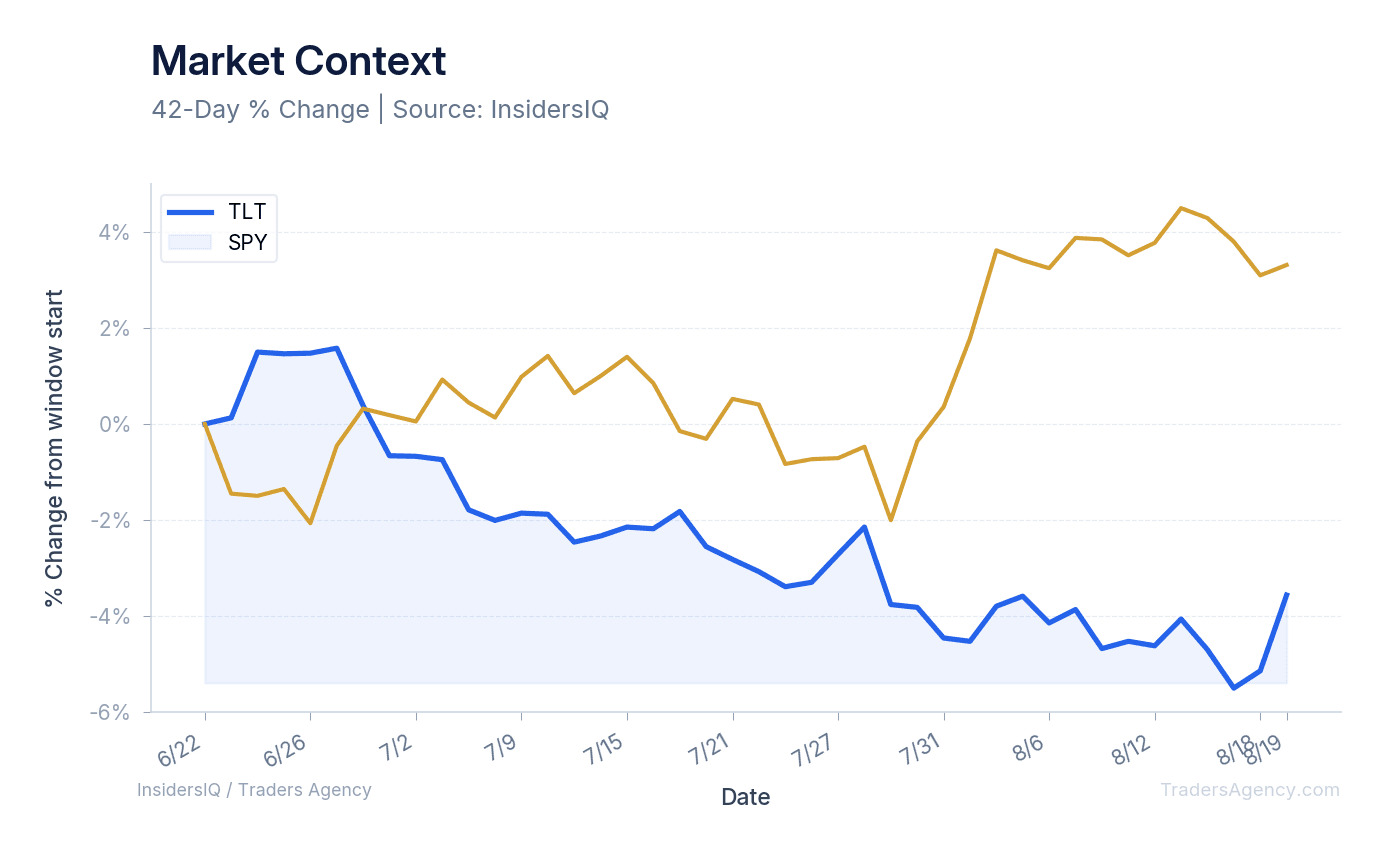
This chart illustrates the exact divergence our team is monitoring. The +3.31% gain in SPY counters the assumption that falling bonds must drag down stocks. The visual data confirms that the two asset classes are currently moving in opposite directions.
What Happens to Bonds If the Stock Market Crashes?
If the stock market crashes, bonds typically experience a surge in demand as investors flee risky equities for safe-haven assets. This sudden influx of capital drives bond prices up and pushes yields down. Historically, government debt acts as a protective buffer during severe equity downturns.
Right now, we're seeing the opposite scenario play out. Bonds are dropping while stocks climb. Traders often wonder what happens to bonds if the stock market crashes, but the current setup requires focusing on the immediate fixed-income weakness. The traditional inverse relationship is functioning exactly as expected, just in the direction of equity strength.
Our research indicates that the current bond selloff should not be viewed as a guaranteed precursor to deeper stock losses. The treasury yields and stocks correlation is not a simple one-to-one mirror. Traders need to evaluate the specific drivers of the current market rather than relying on generalized assumptions.
Want expert trading insights delivered daily?
Join thousands of traders who rely on Traders Agency for market analysis and trade ideas.
Join Traders AgencyIs There a Risk of a Bond Market Crash in 2026?
A bond market crash in 2026 remains a meaningful possibility if inflationary pressures force rates significantly higher for a prolonged period. However, the current data reflects a standard repricing of duration risk rather than a systemic collapse. Traders should monitor yield curves rather than panic selling.
We're tracking the long-term trajectory of these assets closely. While some investors fear a bond market crash 2026 scenario, the immediate reality is a manageable correction in TLT. The -3.57% decline over 60 days is a clear signal, but it does not guarantee an imminent structural failure in the Treasury market.
We often look at historical precedents to understand these moves. The well-known risks of holding fixed-income assets during periods of rising inflation are playing out in real time with the current drop in long-term Treasuries.
How Investors Are Repositioning During the Selloff
With SPY showing a +3.31% gain, traders are actively adjusting their exposure. Our team is watching how capital moves between these two major asset classes. The divergence calls for a tactical approach to portfolio management.
Here are the primary ways we see the market reacting:
- Reducing duration risk: Traders are limiting their exposure to long-term bonds like TLT to avoid further price depreciation as yields rise.
- Maintaining equity allocations: The data shows investors are holding steady in broad market funds like SPY rather than fleeing to cash.
- Monitoring sentiment indicators: With the Fear & Greed index at 68, the market is leaning into greed, largely ignoring the fixed-income warning signs.
- Tracking retail engagement: The 2,748 mentions on WallStreetBets confirm that retail traders are still hunting for opportunities in risk assets.
What Signals Should Traders Watch Before the Next Market Move?
The relationship between treasury yields and stocks may well dictate the next major market trend. We're keeping a close eye on volatility metrics to see if the bond weakness bleeds into equities. A sudden shift in these indicators could signal a change in the broader market direction.
The VIX is a primary indicator for our team. A sudden surge in the VIX would signal that the stock market is finally reacting to the bond selloff. If that happens, it would suggest institutional investors are buying downside protection at aggressive rates. The positive performance of the S&P 500 suggests that level of panic is not present in the current market.
Traders should also watch the Fear & Greed index. A rapid drop from the current 68 level would indicate that the stock downturn bond yields can sometimes trigger may finally be materializing. The sentiment data will likely shift before the price action completely reverses.
The Bottom Line
The bond market is experiencing a clear selloff, highlighted by the -3.57% decline in TLT. However, the +3.31% rise in SPY shows that equities are currently ignoring the fixed-income pressure. Our team is maintaining a close watch on volatility and sentiment metrics to catch any shift in this dynamic.
Our Takeaway: The divergence between bonds and stocks may offer useful context for the coming weeks. We believe the current environment could favor those who respect the price action in equities while managing their fixed-income exposure carefully. Stay focused on the data rather than the fear.
Want expert trading insights delivered daily?
Join thousands of traders who rely on Traders Agency for market analysis and trade ideas.
Join Traders AgencyKey Takeaways
- TLT (long-term Treasuries) is down -3.57% over the last 60 days, while SPY (S&P 500) is up +3.31% over the same period, a clear divergence between bond and equity performance.
- The bond selloff is driven by duration risk: rising yields reduce the attractiveness of existing bonds' fixed payments, pushing their prices lower.
- Despite the fixed-income pressure, equities are currently holding their ground rather than following bonds lower.
- The article flags volatility and sentiment metrics as the key signals to watch for any shift in this bond-equity divergence.
- The article's position is that the current environment favors managing fixed-income exposure carefully while respecting the price action in equities, not abandoning equity positions based on bond market fear.
DISCLAIMER: Traders Agency does not offer financial advice. The information provided is for educational purposes only and should not be considered financial advice. Traders Agency is not responsible for any financial losses or consequences resulting from the use of the information provided. Trading carries inherent risks and may not be suitable for all individuals. You are advised to conduct your own research and seek personalized advice before making any investment decisions, recognizing the potential risks and rewards involved.
See more from Traders Agency on Google
Make us a preferred source and our market analysis will appear more prominently in your Google Search, Top Stories, and AI results.
Add to Preferred Sources