
A massive wave of AI-related corporate bond issuance is contributing to upward pressure on global sovereign bond yields. While many market participants point to inflation fears and energy prices, our analysis identifies the borrowing binge by major technology companies as a significant force driving up borrowing costs across the board. The scale of AI investment corporate bond supply is altering the fixed-income market in real time, and traders need to understand the mechanics behind this yield spike.
How Big Is the AI Corporate Bond Issuance Wave?
Here is what we know about the current wave of corporate borrowing. During the first half of the year, U.S. investment-grade corporate bond issuance jumped 27% year over year. This surge has been led by hyperscalers funding their artificial intelligence ambitions.
The sheer size of this capital raise is staggering. Nvidia Corp. recently announced it is working with Wall Street firms to raise another $500 billion for AI development. Alphabet Inc. recently issued 30-year debt at a yield of nearly 6.4%.
The Key Number: Investment-grade companies have sold nearly $1.5 trillion of bonds this year, a 36% jump from a year earlier. The market is on pace to break the previous issuance record set in 2020. Roughly $200 billion of borrowing by the biggest tech companies alone equals about 25% of the U.S. Treasury's net issuance of notes and bonds to private investors, five times more than it was in 2025.
Why Are Bond Yields Rising?
Bond yields are rising in part because massive AI-related corporate bond supply is forcing issuers to compete for investor capital. When technology giants flood the market with hundreds of billions in new corporate debt, buyers may demand higher returns to absorb the supply, which can pull government bond yields up alongside them.
This dynamic is creating a reverse crowding-out effect. Historically, excessive government borrowing leaves little room for corporate debt. Today, hyperscaler debt issuance is so massive that it is taxing the broader market's ability to absorb the supply.
Investors are actively selling U.S. Treasuries to free up cash. They are rotating that capital into higher-yielding debt from highly profitable tech companies. This selling pressure on Treasuries mechanically drives their yields higher.
What Does It Mean When Bond Yields Are Rising?
When bond yields are rising in this specific context, it means high-quality corporate debt is actively competing with government bonds for the same pool of capital. Relative value investors are buying corporate bonds and hedging them in sovereign bond markets to isolate the specific issuer risk.
This hedging activity requires investors to net out underlying macro and broader market risks. Because this corporate issuance is increasingly global across various currencies, the resulting upward pressure on sovereign yields is also global.
Long-End Pressure: The 30-year bond yield recently touched its highest level since 2007, hitting a high above 5.33%. It pulled back roughly 9 basis points to 5.195% after the Treasury Department announced it would more than double its buybacks of longer-dated debt.
Want expert trading insights delivered daily?
Join thousands of traders who rely on Traders Agency for market analysis and trade ideas.
Join Traders AgencyMarket Implications: Tracking the Sector Divergence
The spillover effects of this borrowing spree are highly visible in recent market performance. Over the last 60 days, we have tracked a clear divergence between broad equities, technology stocks, and long-term Treasuries. The data highlights exactly how this capital rotation is playing out.
The SPDR S&P 500 ETF Trust (SPY) has posted a +3.31% gain over the last 60 days. However, the technology sector is feeling the weight of these massive capital requirements. The Technology Select Sector SPDR Fund (XLK) is down -4.43% over the same period.
The pressure on government bonds is evident in the iShares 20+ Year Treasury Bond ETF (TLT), which has dropped -3.57% in the last 60 days.
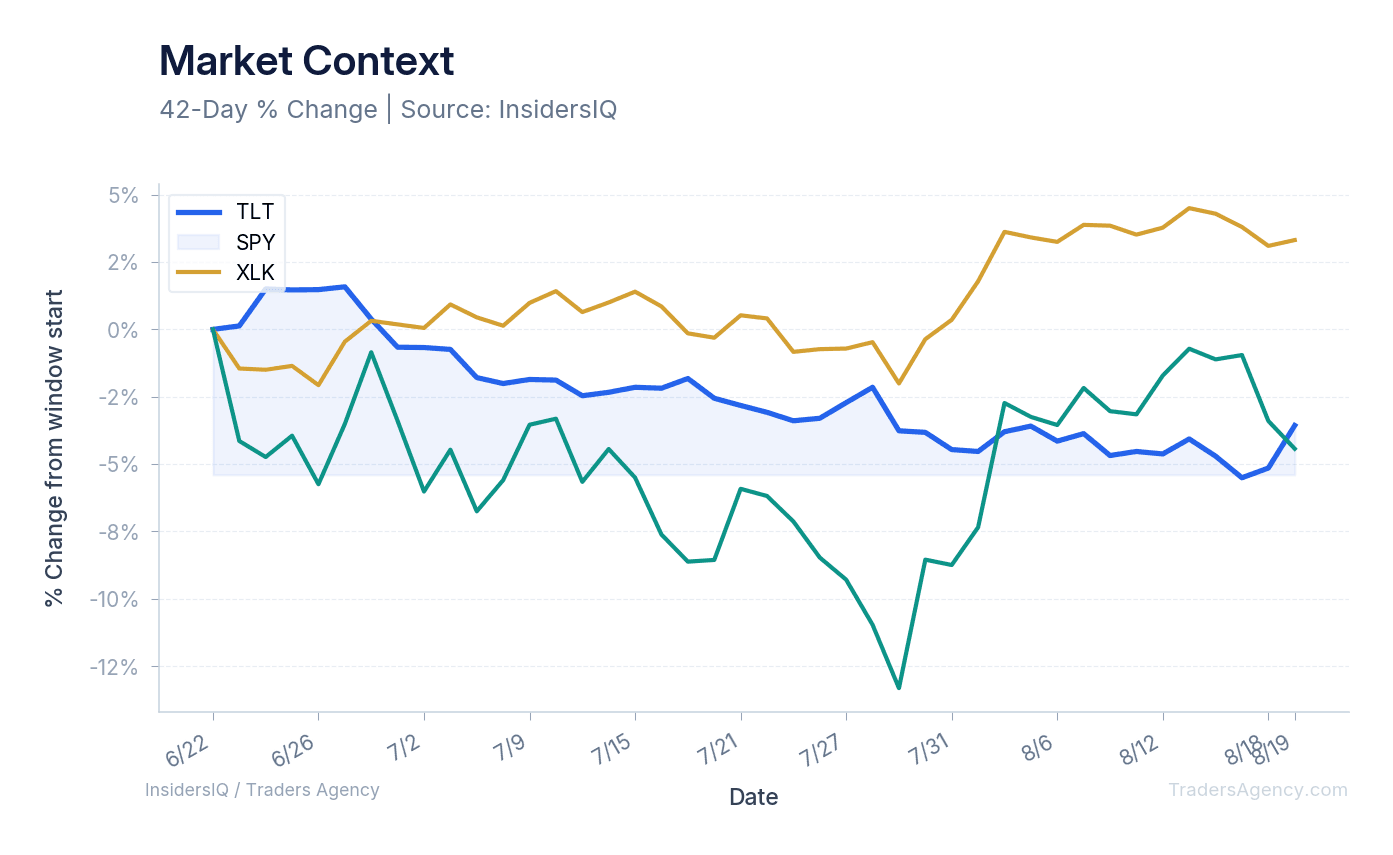
This data confirms that while the broader market remains resilient, the specific sectors tied to AI infrastructure and long-duration government debt are actively repricing. Traders often ask what happens when bond yields rise at this aggressive pace, and the answer is visible in the lagging performance of XLK and TLT.
What Happens When U.S. Bond Yields Rise?
When U.S. bond yields rise due to supply pressures rather than just inflation, borrowing costs elevate across the entire financial system. This forces traders to reassess the valuation of growth stocks and monitor the Federal Reserve for potential interest rate policy shifts.
Many market participants are debating whether inflation or AI-driven supply is the true driver. If inflation were the sole cause of the recent yield spike, breakeven rates would be climbing. The data shows they are not.
However, inflation risks remain a meaningful possibility. The ongoing war in the Middle East continues to put upward pressure on energy prices. This combination of heavy corporate supply and sticky energy inflation could strengthen the case for the Federal Reserve to raise rates later this year.
What Should Traders Watch for in AI Corporate Bond Supply?
The upward pressure on yields reflects past issuance, but it also prices in expectations of substantially higher supply in the future. The combination of rapidly rising investment requirements and falling cash flows suggests that external funding needs could remain substantial.
Our research team is monitoring three specific data points to gauge the future impact of this trend:
- 2026 Capital Expenditures: Projections indicate a potential 94% increase in hyperscaler capex in 2026.
- 2027 Capital Expenditures: Capex is projected to increase another 36% in 2027, reaching approximately $1.3 trillion.
- Treasury Buyback Operations: The Treasury Department's recent move to double buybacks of longer-dated debt provided a brief respite. We are watching whether these interventions can absorb the ongoing corporate supply pressure.
Amazon.com Inc. and Alphabet Inc. have both recently increased their spending forecasts. There are no signs that the AI debt flood is slowing down.
The Bottom Line
The surge in global bond yields appears significantly tied to the massive capital requirements of the artificial intelligence boom. As tech giants issue hundreds of billions in new debt, they are actively competing with government bonds and contributing to higher borrowing costs across the board. Our team is closely watching TLT and XLK for signs of stabilization, but the projected trillion-dollar capex needs suggest this supply pressure is likely to persist.
Want expert trading insights delivered daily?
Join thousands of traders who rely on Traders Agency for market analysis and trade ideas.
Join Traders AgencyKey Takeaways
- U.S. investment-grade corporate bond issuance jumped 27% year over year in the first half of the year, with the market on pace to break the 2020 issuance record after nearly $1.5 trillion in bonds sold, a 36% increase from the prior year.
- Borrowing by the largest tech companies alone equals roughly 25% of the U.S. Treasury's net issuance of notes and bonds to private investors, five times the share it represented in 2025.
- Alphabet recently issued 30-year debt at a yield of nearly 6.4%, illustrating how AI-driven issuance is setting a high-cost benchmark that ripples into broader fixed-income pricing.
- Nvidia is working with Wall Street firms to raise another $500 billion for AI development, signaling that the supply wave is far from over.
- The article identifies TLT and XLK as key instruments to watch for signs of stabilization, given that projected trillion-dollar capex needs suggest supply pressure may persist.
DISCLAIMER: Traders Agency does not offer financial advice. The information provided is for educational purposes only and should not be considered financial advice. Traders Agency is not responsible for any financial losses or consequences resulting from the use of the information provided. Trading carries inherent risks and may not be suitable for all individuals. You are advised to conduct your own research and seek personalized advice before making any investment decisions, recognizing the potential risks and rewards involved.
See more from Traders Agency on Google
Make us a preferred source and our market analysis will appear more prominently in your Google Search, Top Stories, and AI results.
Add to Preferred Sources