
The Treasury Department is expected to reveal the exact size of its expanded 10- to 20-year bond buyback around 11 a.m. Wednesday. Treasury Secretary Scott Bessent has already told FX traders "I am the house now," a line that lands differently depending on which market you're trading. For bond and currency traders alike, this buyback announcement is the event of the day.
We've been tracking this story since the initial disclosure on Aug. 19, when Bessent committed Treasury to buying back at least $4 billion of already-issued long debt, at least double the normal $2 billion operation size. Speculation has been building that $4 billion is a floor rather than a ceiling, and Wednesday's number should go a long way toward settling that question.
What Is the Treasury Buyback Announcement?
The mechanics are straightforward: Treasury repurchases already-issued bonds from the market, in this case focused on 10- and 20-year notes, as part of a strategy aimed at keeping a lid on yields and keeping markets functioning as intended. This is the first official sizing announcement since the department roiled markets last month by declaring it would at least double its standard buyback size.
Bessent has kept the exact figure under wraps ahead of the reveal, but the setup is clear. The market expects the number to land above $4 billion, and how far above it lands is the whole story for Wednesday's session.
How Much Will Treasury Buy Back Today?
Analysts at Wrightson ICAP wrote in a note earlier this week that "the size of the increase in bond-sector repurchases remains highly uncertain, and the odds of a larger increase are rising." Their read: something in the $5 billion to $6 billion range now looks like the likely starting point, and they said they "cannot rule out something larger."
Wrightson also framed the range for traders in plain terms:
- A $6 billion buyback would be "fairly aggressive," in Wrightson's words.
- Tripling or quadrupling the normal buyback level would be an "extreme case."
- That extreme case would produce, per Wrightson, "a much more visible deceleration in the net supply trajectory."
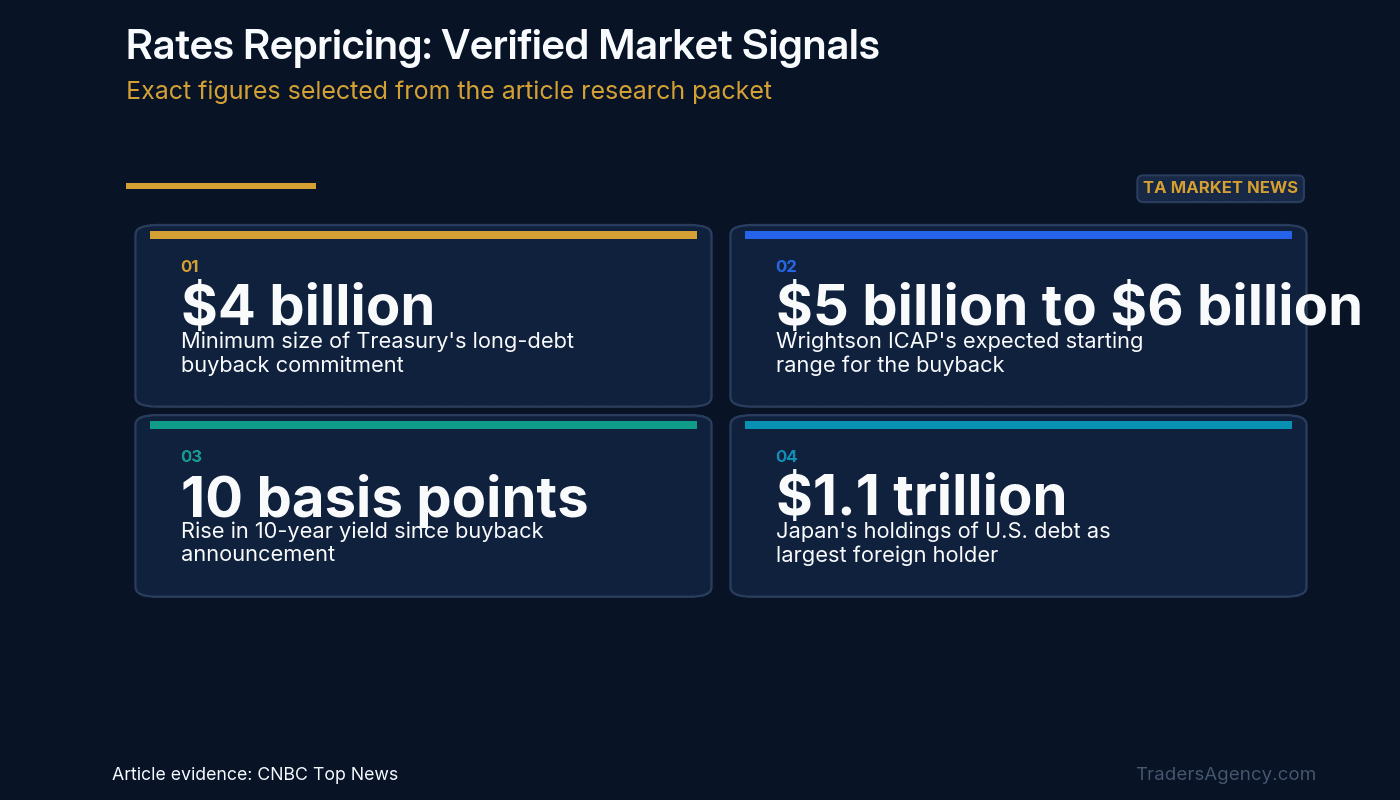
The Scorecard: A print at or near $4 billion reads as cautious. A number in the $5 billion to $6 billion zone matches the range Wrightson flagged as the likely starting point. Anything beyond that would be a genuine surprise and worth repositioning around.
Our read: the range Wrightson has laid out gives traders a practical framework for Wednesday morning. Rather than guessing at a single number, watch which of those three buckets the print falls into and how the long end reacts in the first hour after.
Is the Treasury Buying Back Debt?
Yes. Treasury has committed to buying back already-issued long-term debt, with the first operation under the program set for Thursday, and Bessent has framed the expansion as an effort to cool an overheated bond market rather than a stealth easing program. He was direct about the distinction: "I am not doing quantitative easing," he said, adding that it is "closer to the Treasury's version of Operation Twist," the maneuver historically used by the Fed to sell short-term Treasurys and buy long-term ones.
That framing matters for how traders should read the buyback. Bessent, drawing on his background as a former hedge fund manager, said "heat was building up in the market" and that "when you're speculating in financial markets, you want to accelerate things further." The 30-year Treasury yield had earlier surged to its highest level since 2007, the backdrop he cited in describing the heat building in the market.
Here's the complication traders need to sit with: despite the buyback plan, the benchmark 10-year yield has risen about 10 basis points since the original announcement, and the 30-year yield has edged higher too. The TLT long-duration Treasury ETF has moved only modestly over the past month, up roughly 0.17% over 30 days, so the long end has not rallied on the buyback headlines so far.
BMO Capital Markets analyst Ian Lyngen has flagged a specific level worth watching: 5.3% on the 30-year bond, which he called a "proverbial line in the sand that was effectively established by Bessent." The yield has stayed below that mark so far, and a break above it could signal that the buyback isn't cooling the long end the way Bessent has described.
What Did Bessent Mean by 'I Am the House Now'?
Bessent's line, delivered Tuesday at Southern Methodist University, wasn't about the bond buyback at all. He was referring more specifically to Treasury's parallel operation supporting the Japanese yen, telling the room, "And you can bet against me if you want."
The mechanics behind that remark are worth understanding for anyone trading FX or rates. Treasury stepped in to buy yen so that the Bank of Japan wouldn't sell its Treasury holdings. Japan is the largest foreign holder of U.S. debt at $1.1 trillion, and a move by Japan to sell would likely push yields higher at a moment when domestic debt has soared past $40 trillion and the deficit is headed past $2 trillion.
We read the "house" comment as a signal of intent across two markets at once: Treasury appears willing to intervene in FX to discourage a large foreign holder from selling Treasurys, and it appears willing to intervene directly in the bond market through buybacks. Both moves point at the same problem, upward pressure on long-end yields, from two different directions.
Want expert trading insights delivered daily?
Join thousands of traders who rely on Traders Agency for market analysis and trade ideas.
Join Traders AgencyWhat Is the Treasury Buyback Schedule and What Happens Next?
The schedule this week is tight: the size is expected to be announced Wednesday, with the actual operation slated for Thursday. That gives traders two distinct data points inside 24 hours, and both matter.
Here's what we're watching into Wednesday's reveal and Thursday's follow-through:
- The announced size itself: a print near $4 billion signals caution, $5 billion to $6 billion matches Wrightson's expected starting range, and anything beyond that range would be a genuine surprise.
- Demand from debt holders on Thursday: watch both the offered amount and how much demand actually shows up at the operation.
- The 5.3% level on the 30-year: a break above Lyngen's line in the sand could suggest the buyback isn't containing yields the way Bessent has described.
- 10-year yield direction: it's already up about 10 basis points since the original announcement, so a continued climb even after a large buyback print would be notable.
Longer term, this doesn't happen in a vacuum. Lyngen's broader concern, in his own words, is that the approach "represents a departure from the Treasury's history of being predictable and gradual to change course," and that "our concern is that it will have negative consequences for the credibility of Treasuries as an asset class." That's not a prediction of what happens next. It's a risk flag from a rates strategist worth weighing alongside the near-term price action, and it speaks to why this episode stands apart from prior buyback operations: larger than the normal size, and, in Lyngen's view, a departure from a predictable and gradual approach.
The Bottom Line
The number Treasury reveals around 11 a.m. Wednesday is the near-term event, and Thursday's operation results will tell us whether demand matches the size on offer. We're watching the 5.3% level on the 30-year and the pace of the 10-year yield closely, since both have moved higher even with the buyback in play. We're also treating Bessent's FX comments as a separate but related signal: Treasury appears willing to intervene on two fronts to manage pressure on long-end yields, and traders should track both the bond and currency sides of this story rather than just one.
Want expert trading insights delivered daily?
Join thousands of traders who rely on Traders Agency for market analysis and trade ideas.
Join Traders AgencyDISCLAIMER: Traders Agency does not offer financial advice. The information provided is for educational purposes only and should not be considered financial advice. Traders Agency is not responsible for any financial losses or consequences resulting from the use of the information provided. Trading carries inherent risks and may not be suitable for all individuals. You are advised to conduct your own research and seek personalized advice before making any investment decisions, recognizing the potential risks and rewards involved.
See more from Traders Agency on Google
Make us a preferred source and our market analysis will appear more prominently in your Google Search, Top Stories, and AI results.
Add to Preferred Sources