
A major policy clash at the highest levels of the US government is forcing traders to rethink their bond market strategy right now. Reports diverge on whether Federal Reserve Chair Kevin Warsh and Treasury Secretary Scott Bessent are coordinating or colliding in their approaches to long-term yields. Our team is watching this closely because the outcome could directly impact major financial institutions, with Citrini Research noting that Bank of America and three other lenders could benefit significantly from these bond-market machinations.
The situation escalated last week when Bessent announced a surprise plan to at least double Treasury buybacks. This intervention sent US Treasury rates dropping and introduced a new variable for traders trying to position their portfolios.
Are Warsh and Bessent Working Together or at Odds on Bond Yields?
Here is what we know based on the latest data and reports. Citrini Research suggested that Warsh and Bessent are acting in a coordinated way to reduce long-term bond yields. However, reporting from CNN points to a conflict between the two officials. Warsh has stopped spoon-feeding Wall Street clues on what the US central bank will do next. His hope, according to these reports, is that if the Fed ditches forward guidance, the bond market will stop trying to guess how the Fed is interpreting data and instead simply respond to the economic data itself.
Bessent took the opposite approach last week. The Treasury Secretary intervened directly in the market, a move widely viewed by analysts as an effort to put a lid on surging yields. The Treasury Department presented the move as technical in nature, part of an effort to ensure liquidity in markets. The data shows a muted but positive reaction in long-term Treasuries, with the TLT exchange-traded fund posting a 30-day price change of +0.34%. The financial sector is showing strength as well: the XLF ETF is up +2.12% over the same 30-day period.
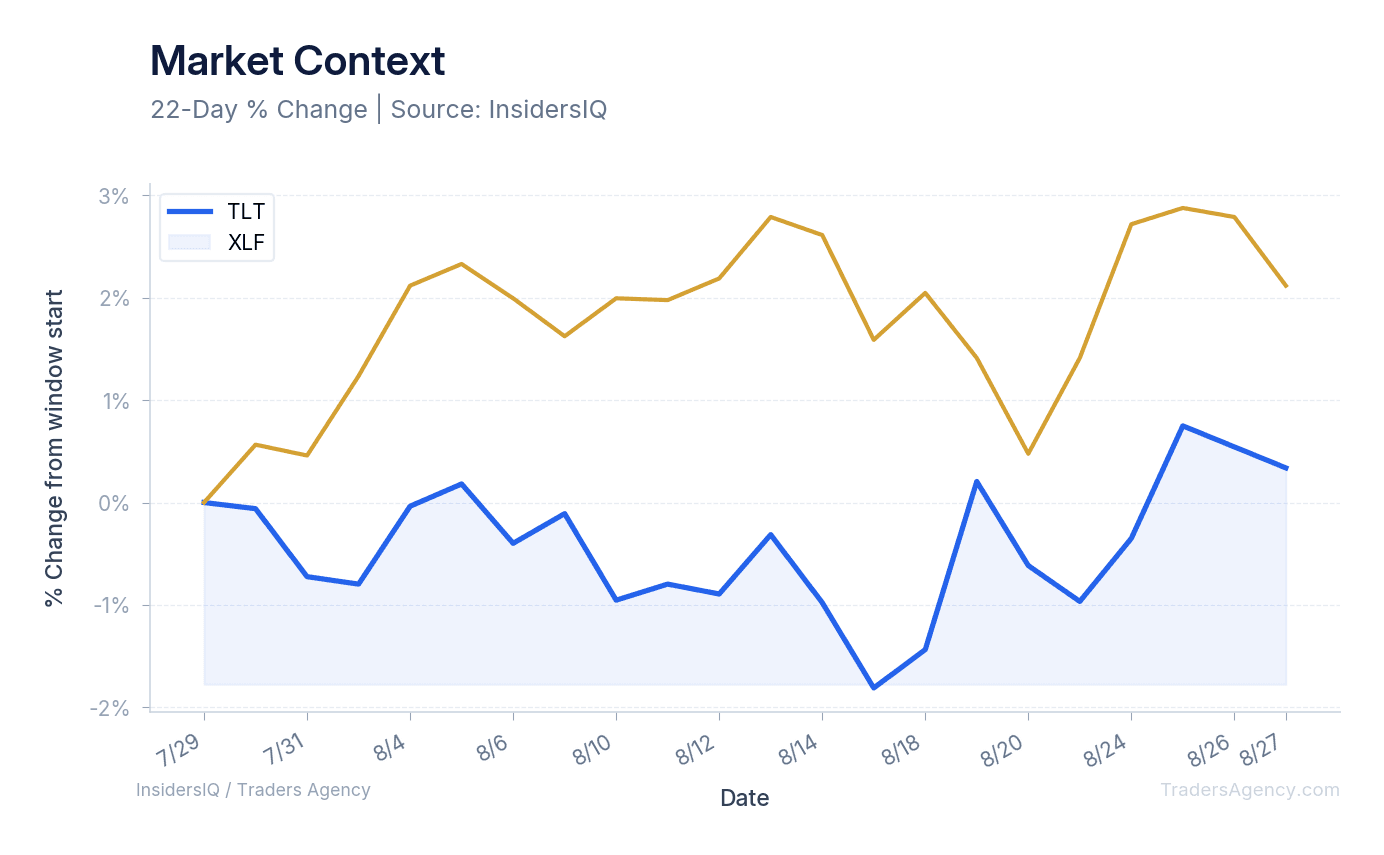
Key Data: The 30-year bond recently climbed to its highest level since 2007, just before the Great Financial Crisis. XLF is up +2.12% over 30 days while TLT has gained just +0.34%, suggesting financial stocks are already pricing in potential benefits from the shifting yield environment.
The Battle Over Long-Term Yields
The stakes for this policy divergence are high. Analysts widely view Bessent's buyback program as an attempt to drive down uncomfortably high bond rates, long a goal of his.
This intervention is drawing heavy criticism from prominent market voices. Legendary investor Stanley Druckenmiller, a mentor to Bessent, slammed the move as "artificial yield suppression" in an op-ed in The Wall Street Journal titled "Let the bond market speak." Druckenmiller was later criticized for using artificial intelligence to write the commentary. Former Boston Fed President Eric Rosengren also dismissed the Treasury's official reasoning, stating that "there is no chaos in the Treasury market" and that "the liquidity argument doesn't hold."
How Should Traders Position Around the Fed-Treasury Conflict?
This policy clash means traders should prepare for potential volatility in both Treasury yields and financial sector stocks. With the Treasury actively working to suppress rates while the Fed attempts a hands-off approach, the traditional signals used to build a reliable bond market strategy are currently clouded by government intervention.
Our analysis shows that this environment could create specific opportunities in the banking sector. Citrini Research specifically highlighted Bank of America as a potential major beneficiary of these market mechanics. The recent +2.12% gain in the XLF ETF suggests that financial institutions may already be reacting positively to the shifting yield environment.
Tim Mahedy, CEO of research firm Access/Macro, noted that the relationship between the Treasury and the Fed might be fracturing. He stated that "if timing is everything in love, the bromance between Bessent and Warsh may be coming to an end." For traders, this means we likely cannot rely on coordinated government action in the coming months.
Want expert trading insights delivered daily?
Join thousands of traders who rely on Traders Agency for market analysis and trade ideas.
Join Traders AgencyCould a Bond Market Correction Hit in 2026?
The risk of a severe market correction depends heavily on whether artificial yield suppression creates a bubble. With the 30-year bond recently hitting highs not seen since 2007, any sudden withdrawal of Treasury buybacks could shock the system and dramatically alter the bond market outlook heading into 2026.
Traders are rightly questioning the stability of current price levels. Rosengren said, "It's not a clean signal of what the market wants if Treasury is intervening." He added that "it looks a lot more like window-dressing before the midterms." If rates are being artificially held down for political reasons, longer-term bond market forecasts become much harder to build using standard economic data.
Many retail investors are asking whether now is a good time to invest in bonds. The answer requires looking past surface-level stability. When the government actively intervenes to cap yields, traditional safe-haven assets carry hidden policy risks that may not be immediately visible in price action.
What We're Watching: Adjusting Your Approach
To trade this complex environment, our team is monitoring several specific metrics. A rigid bond market strategy from previous decades will not work when the Treasury and the Fed are operating with conflicting playbooks.
Here are the exact signals we're tracking:
- Treasury Buyback Execution: We're watching the volume of Bessent's plan to at least double Treasury buybacks. Any reduction in this program could send yields spiking again.
- Financial Sector Outperformance: We're tracking the XLF ETF and specific lenders like Bank of America to see if they continue to capture gains from these yield mechanics.
- The 30-Year Bond Ceiling: With the 30-year bond testing 2007 highs, we're watching to see if Bessent's interventions can establish a firm ceiling on long-term rates.
Trader Alert: If you're using a bond ladder strategy in your portfolio, be aware that Warsh has signalled a preference for the market to dictate terms while the Treasury is actively intervening. These conflicting actions from Warsh and Bessent suggest that underlying structural pressures remain intense.
The Bottom Line
Our research team sees a market caught between the Fed's desire for natural price discovery and the Treasury's aggressive yield suppression. We're actively monitoring Bank of America and the broader XLF for continued strength as this policy battle plays out. Until Warsh and Bessent align their approaches, traders need to remain agile and rely on hard data rather than government forward guidance.
Want expert trading insights delivered daily?
Join thousands of traders who rely on Traders Agency for market analysis and trade ideas.
Join Traders AgencyKey Takeaways
- Treasury Secretary Bessent announced a surprise plan to at least double Treasury buybacks, which sent US Treasury rates lower and introduced a new variable for bond traders.
- Citrini Research identified Bank of America and three other lenders as potential beneficiaries if Bessent's yield-suppression efforts hold, with XLF also flagged for monitoring.
- Fed Chair Warsh has stopped providing forward guidance, hoping the bond market will respond to economic data itself, while Bessent is actively intervening to cap long-term yields.
- CNN reporting points to a conflict between Warsh and Bessent, contradicting earlier analysis that framed their actions as coordinated.
- Traders using bond ladder strategies face a split environment: the Fed is pushing for market-driven price discovery while the Treasury is working against that dynamic in real time.
DISCLAIMER: Traders Agency does not offer financial advice. The information provided is for educational purposes only and should not be considered financial advice. Traders Agency is not responsible for any financial losses or consequences resulting from the use of the information provided. Trading carries inherent risks and may not be suitable for all individuals. You are advised to conduct your own research and seek personalized advice before making any investment decisions, recognizing the potential risks and rewards involved.
See more from Traders Agency on Google
Make us a preferred source and our market analysis will appear more prominently in your Google Search, Top Stories, and AI results.
Add to Preferred Sources