Elon's Next Big Move Could Turn Tesla Into SpaceX
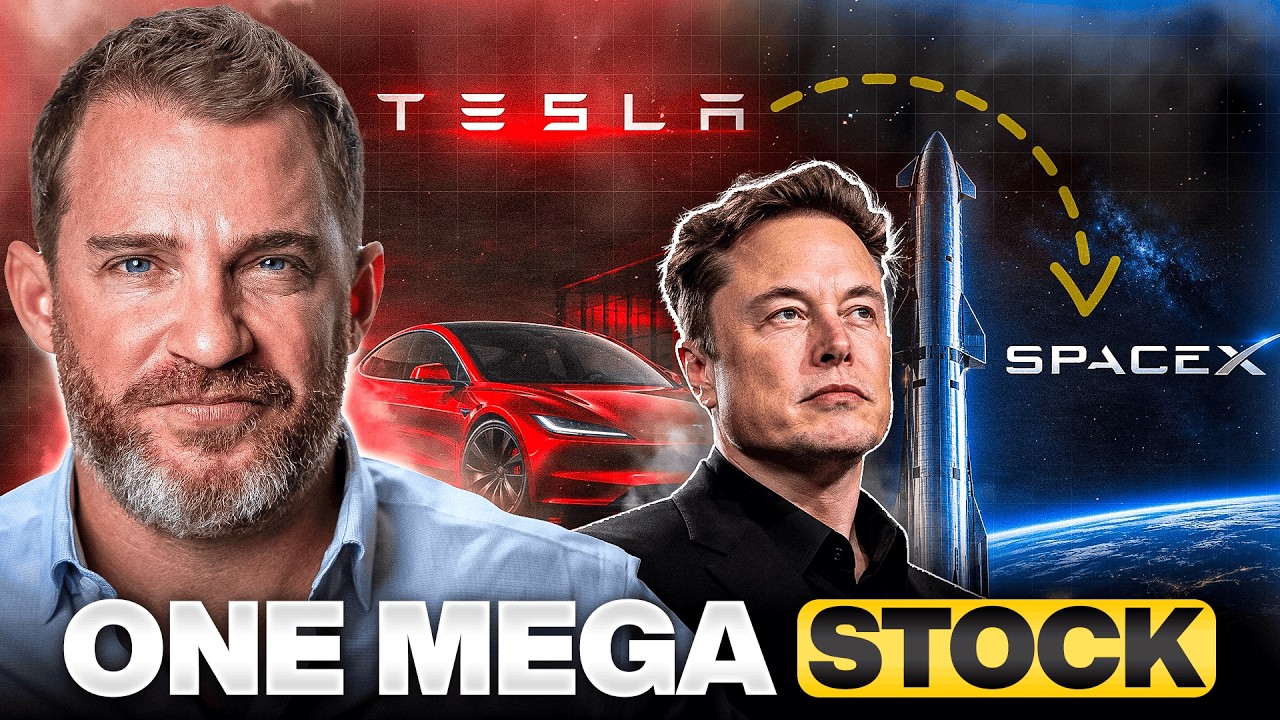
A Tesla-SpaceX merger just stopped being internet speculation.
On SpaceX's October 20th earnings call, someone asked Elon Musk directly if combining the two companies would be a good idea. His answer: "Yes."
Two days later, both companies filed their quarterly reports with the SEC. Both filings said the same thing: their boards have formed special committees of independent directors to look at putting the two companies together.
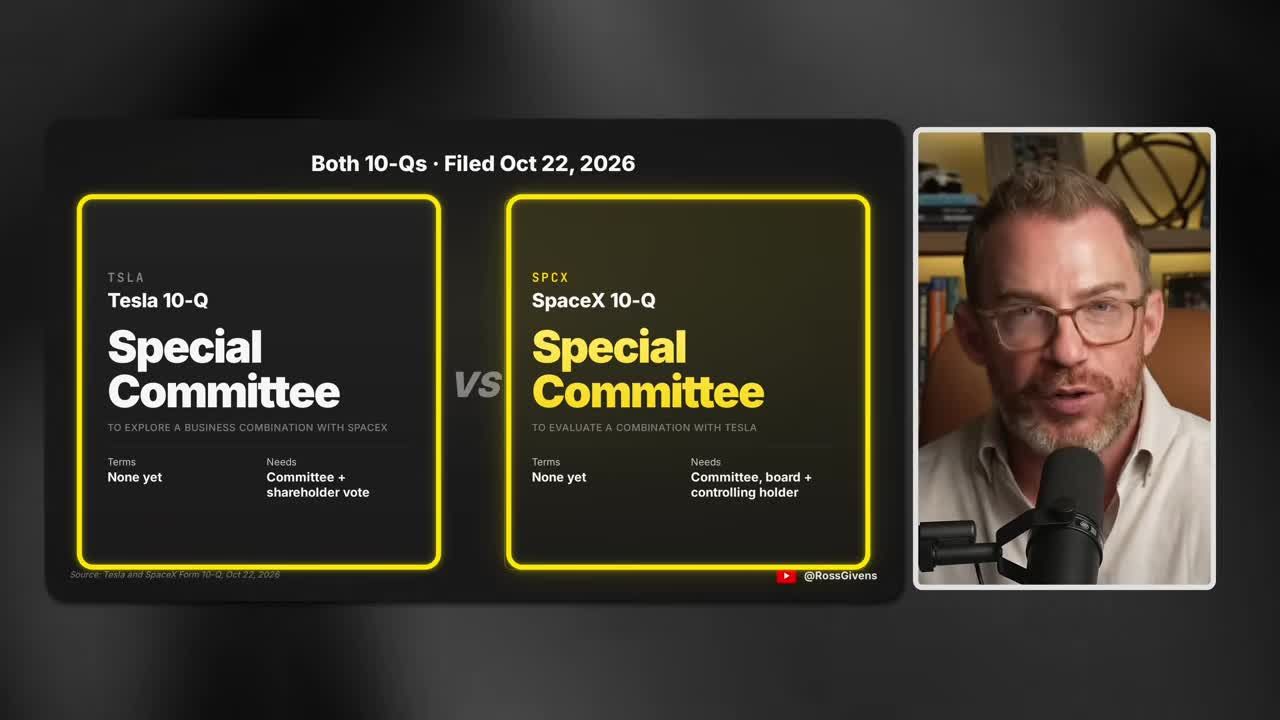
This matters right now because the lawyers are already working on it. Betting markets have odds on when it gets announced. And if you own shares of either company, the mechanics of this deal will decide what lands in your brokerage account.
I told readers this was coming back in May, two weeks before SpaceX ever traded publicly. The thesis was simple: the IPO wouldn't be the end of the story. Elon's real plan has always been to put his companies under one roof. Five months later, that plan has a paper trail.
How Likely Is the Tesla-SpaceX Merger?
Bottom Line: A Tesla-SpaceX merger moved from speculation to formal review once both boards set up special committees to study it, and prediction markets now put the odds near two-in-three by 2027. Nothing is finalized, but a shareholder vote on the Tesla side stands as the key hurdle still to come.
Prediction markets now put real odds on an announcement before the end of 2027.
Prediction markets currently put roughly a two-in-three chance on a formal merger announcement before the end of 2027, based on Polymarket data. That's not a coin flip anymore.
For years, a Tesla-SpaceX merger was something people brought up on podcasts, and Elon would laugh it off with a "maybe someday." That changed the moment both boards formed special committees. These committees follow a formal process: independent directors get selected, each side hires its own bankers and lawyers, and their entire job is negotiating the best possible deal for their respective shareholders.
Elon can't sit in on these negotiations. He said so himself on the call, because he's on both sides of the table as the controlling figure at both companies. That's exactly the kind of structure a board sets up when it wants a deal to survive the lawsuits that typically follow something this large.
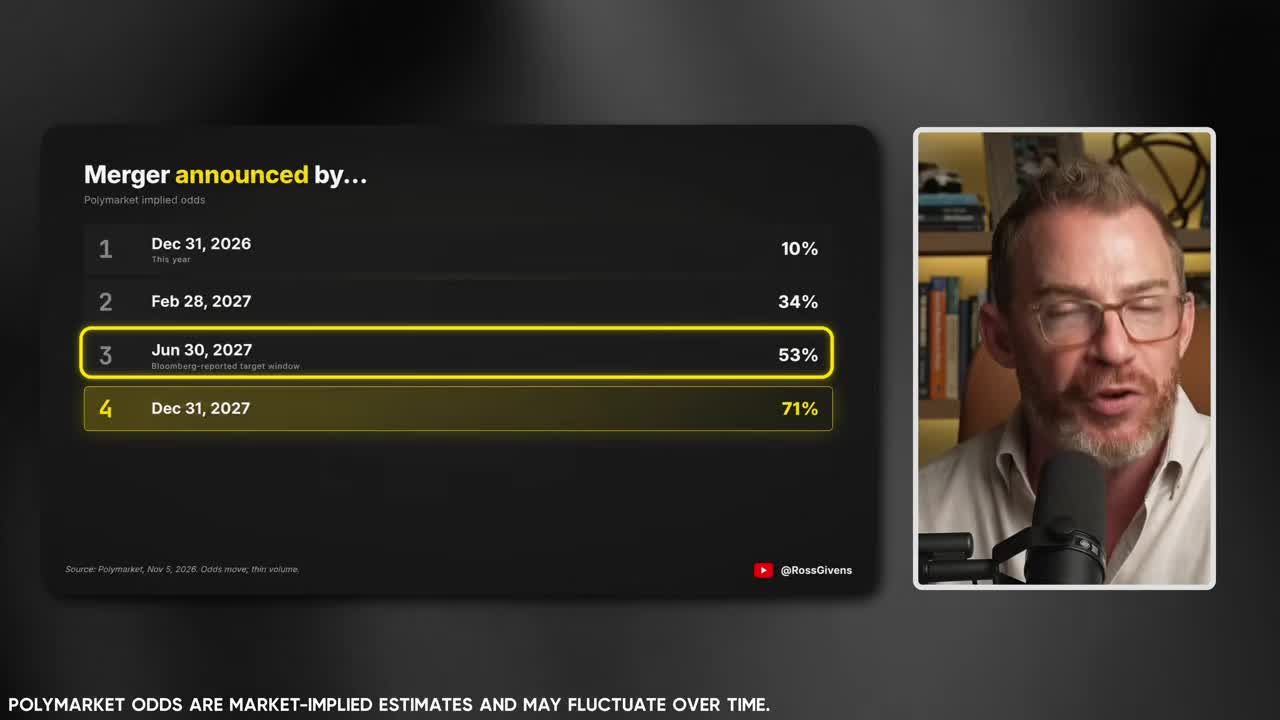
Bloomberg, citing people familiar with the talks, reported the goal is to announce a deal in the first half of 2027. Neither company has confirmed that, which tracks with how Elon's companies tend to operate. But it lines up with what Polymarket is pricing: roughly 55% odds of an announcement by June 30, 2027, and about 66% by the end of that year.
This is going to create a $3.5 to $4 trillion company. It would be the third or fourth largest company on Earth. That kind of scale doesn't get rushed through in a weekend.
What Would a Tesla-SpaceX Merger Mean for Shareholders?
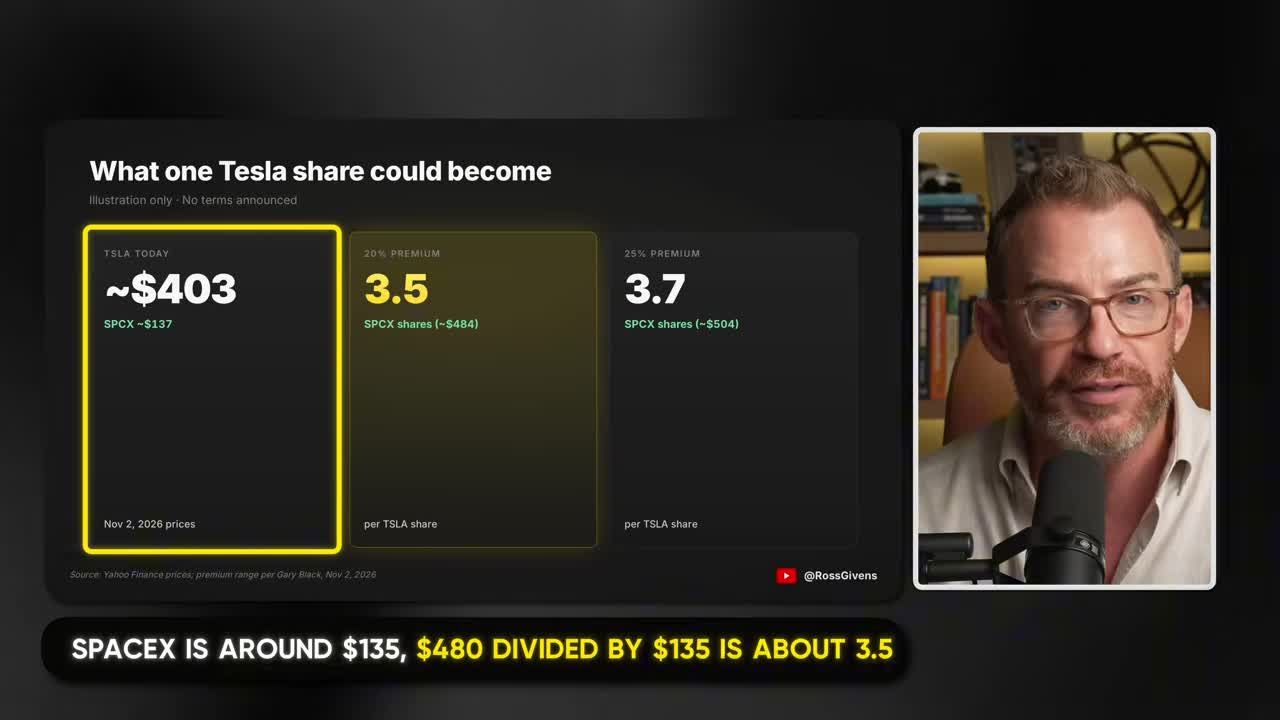
If the deal goes through as an all-stock transaction, Tesla shareholders turn in their shares and receive SpaceX shares in return. No cash changes hands. The exact exchange ratio depends on the premium SpaceX pays, but based on current prices, each Tesla share could convert into roughly 3.5 to 3.7 SpaceX shares.
Here's the math. Tesla trades around $400. Add a 20% premium and you land near $480 a share. SpaceX trades around $135. Divide $480 by $135 and you get about 3.5. That's the conversion multiple. Push the premium to 25% and it climbs to 3.7.
Own 100 shares of Tesla, and a deal closing at a 25% premium would leave your account holding roughly 370 shares of SpaceX. These numbers will shift daily with the stock prices, but that's the shape of the deal.
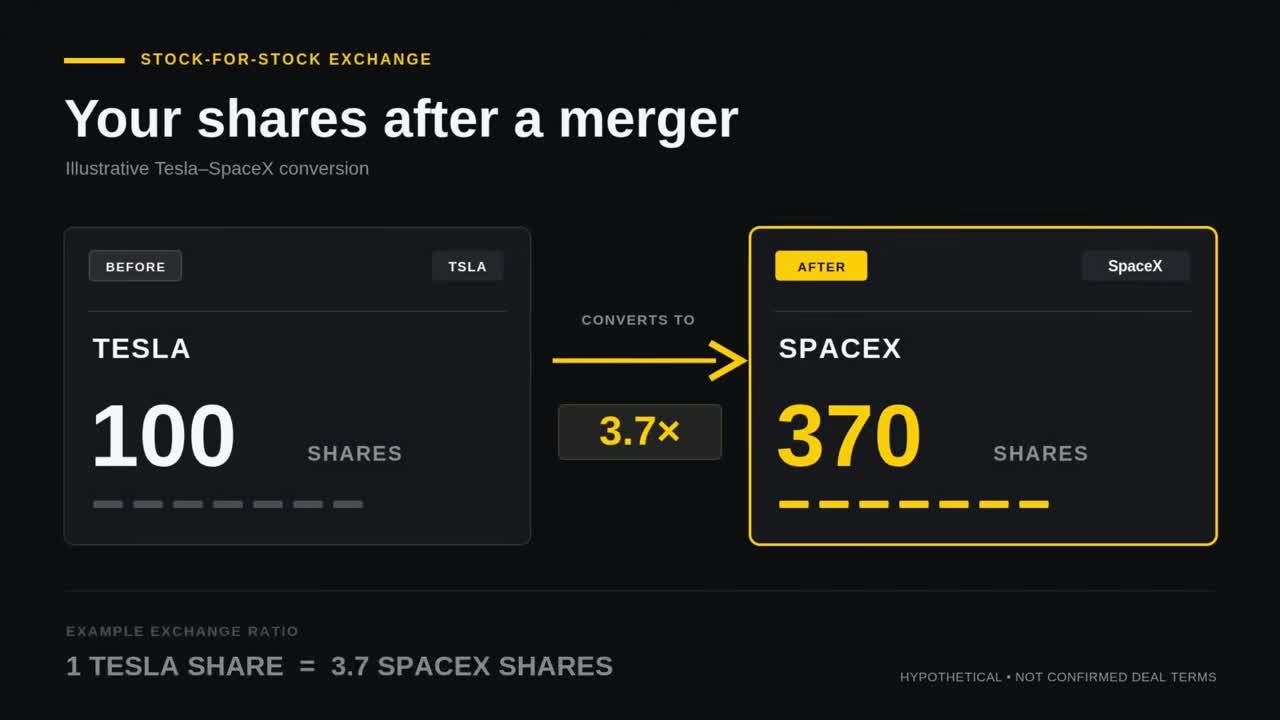
The part that matters most for anyone holding either stock: this conversion happens automatically. There's nothing to buy, nothing to sell. Whether your account sits at a retail brokerage or inside an IRA, the shares convert on their own when the deal closes.
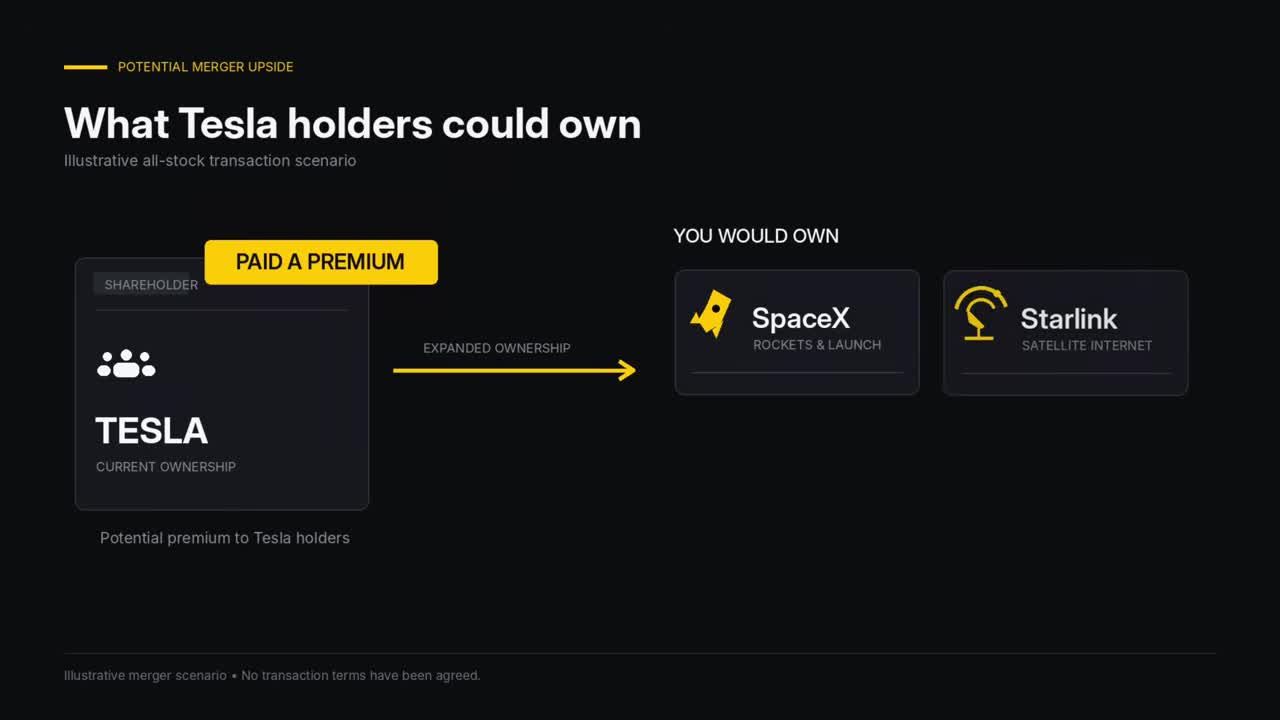
For Tesla holders, the upside is straightforward:
- You get the premium instantly
- You own SpaceX, Starlink, and xAI, on top of Tesla's cars, batteries, and robots
- You get all of it without selling a share or triggering a taxable event
That's a meaningful outcome for long-term Tesla holders sitting on gains in the hundreds, or even thousands, of percent.
Get an entire year of live weekly mentoring sessions, my newsletter, indicators, bonus reports, tons more. Click the link and I'll see you in the next live session.
Join my Black Ops Trading ClubWhat Does Elon Get Out of It?
Elon gets a single company and a single role instead of splitting his time across multiple firms. A combined entity also lets Tesla's cash finance SpaceX's most expensive projects, cutting the need to dilute shareholders or borrow at today's elevated rates.
SpaceX is attempting some of the most expensive undertakings anyone has tried: Starship, an expanding satellite network, and, since February, xAI, which means the company now funds one of the largest AI buildouts on the planet. Chips, data centers, power. All of it burns cash.
This is where Tesla's balance sheet becomes the real prize. At the end of September, Tesla was sitting on about $45 billion in cash and investments. In the third quarter alone, its operations generated $6 billion in cash. Over the trailing four quarters, that number climbs closer to $19 billion.
Why does that matter to a SpaceX shareholder? A company funding a massive project has two choices: borrow money or sell more stock. Selling more stock dilutes existing shareholders, shrinking everyone's slice of the pie. But if SpaceX owns Tesla, it can use Tesla's car profits to fund its other ventures. That's the cheapest money Elon could ever raise, and it's the single biggest reason this deal makes sense from the SpaceX side.
Context matters here. Neoclouds and similar AI infrastructure players were borrowing at 9.75% interest. Those same bonds are now yielding 16%, because investors are growing tired of funding AI buildouts without seeing a return. Fresh capital is getting harder to raise across that sector. A Tesla-SpaceX merger would solve a meaningful chunk of that problem by handing SpaceX an internal cash engine instead of relying on expensive debt markets.
There's also a size argument. SpaceX is currently worth around $1.9 trillion. Tesla is worth about $1.6 trillion. Combined, before any premium, that's roughly $3.5 trillion, putting the merged company on the heels of Microsoft and in the same neighborhood as the largest stocks on Earth.
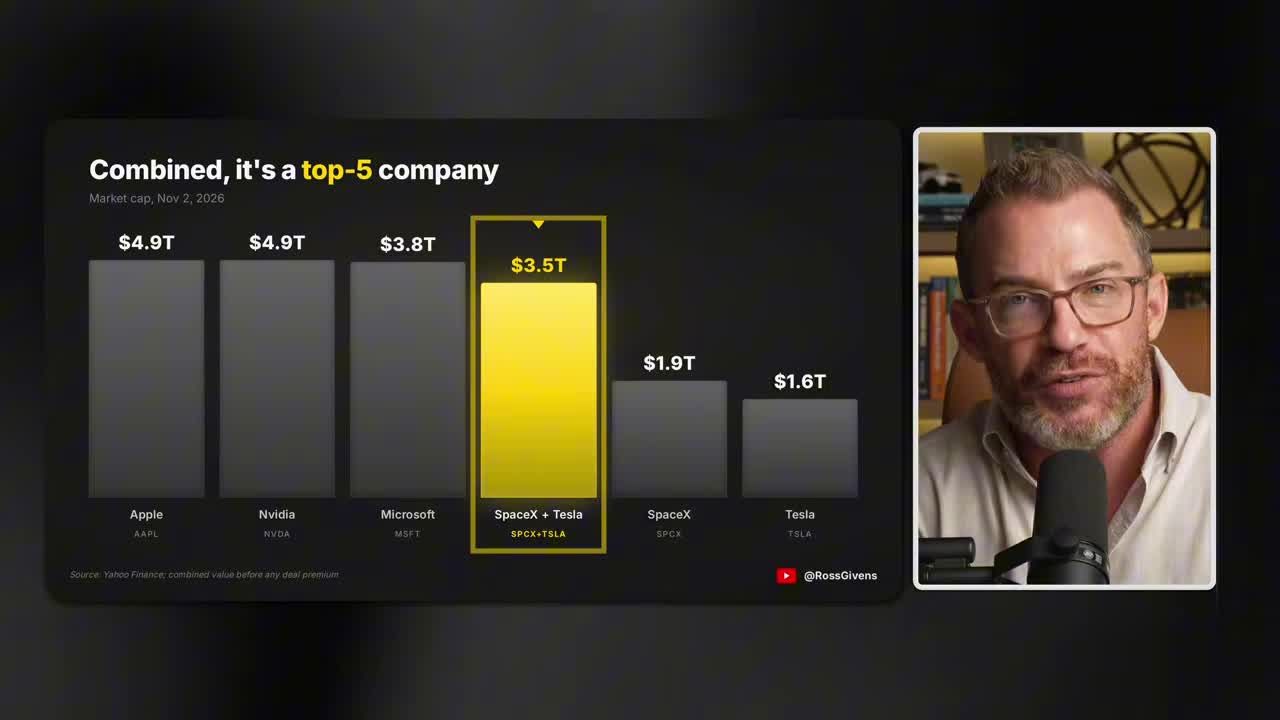
A company that large carries more weight in major indexes. When a stock carries more index weight, every dollar flowing into funds like SPY, the Qs, or a target date fund sends a larger share toward that one ticker. Every 401k contribution and IRA deposit each month adds to that steady buying pressure. The combined stock wouldn't pull in new money that doesn't already exist, but it would concentrate flows into one steadier vehicle instead of two stocks swinging wildly in opposite directions.
And then there's simplicity. Right now, getting exposure to rockets, Starlink, Grok, xAI, electric cars, Megapacks, and Optimus means buying two separate tickers at two separate prices, with a CEO splitting his time across both. A merged company puts every one of Elon's bets under one ticker, with one bill. The two companies are already intertwined: they're building a chip plant together in Texas, and on Tesla's earnings call, Elon noted they still have to work out who pays for what at that plant. One company solves that problem permanently.
When Could the Tesla-SpaceX Merger Happen?
The reported target is the first half of 2027, with Polymarket data showing roughly 55% odds of an announcement by June 30, 2027, and about 66% by year's end. Neither company has confirmed the Bloomberg report, but the betting markets and the reported timeline are telling the same story.
This isn't a deal that gets rushed. A $3.5 to $4 trillion combination that would rank among the three or four largest companies on Earth requires a structured, drawn-out process. The special committees need time to negotiate, the banks need time to model the exchange ratio, and the shareholder vote needs time to play out.
Good or Bad for Investors?
For both sets of shareholders, this merger looks like a net positive, assuming it closes at a fair premium. Tesla holders get instant upside plus exposure to SpaceX, Starlink, and xAI. SpaceX holders get access to Tesla's cash-generating car business to fund expensive future projects.
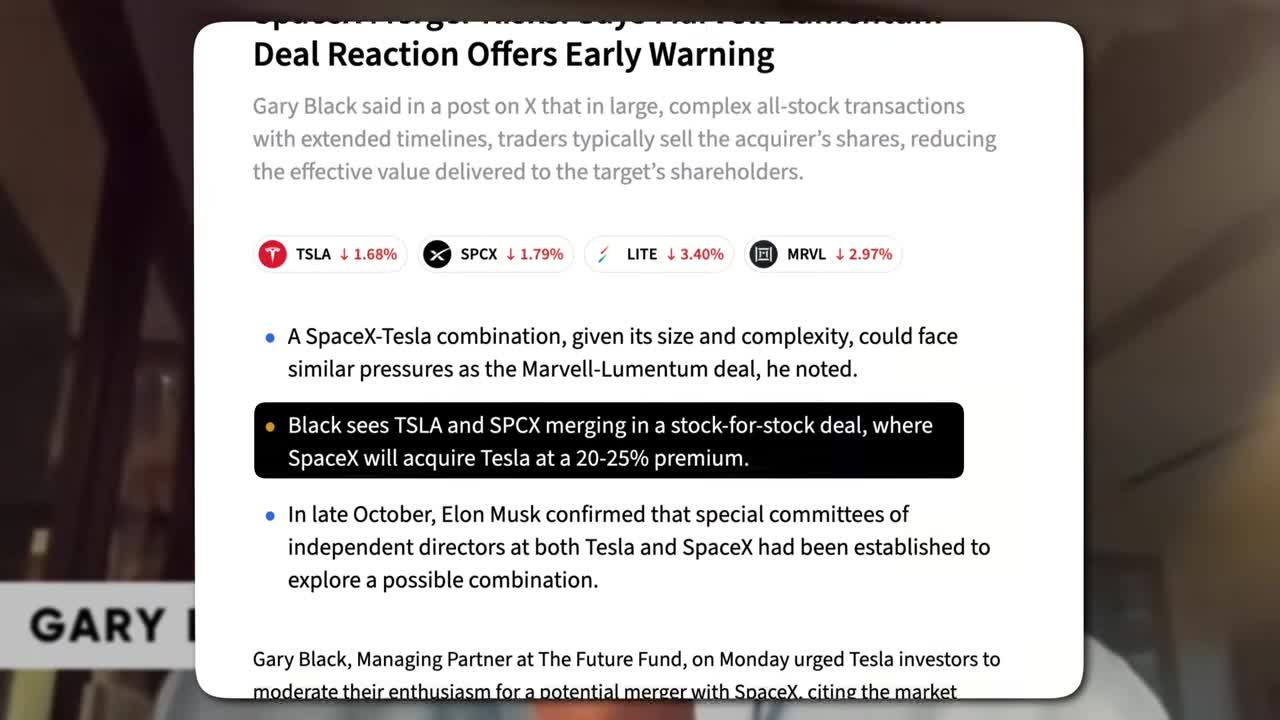
Most of Wall Street now expects SpaceX to be the buyer. Gary Black, a fund manager who has followed Tesla for years, laid out a scenario where SpaceX buys Tesla in an all-stock deal at a 20 to 25% premium.
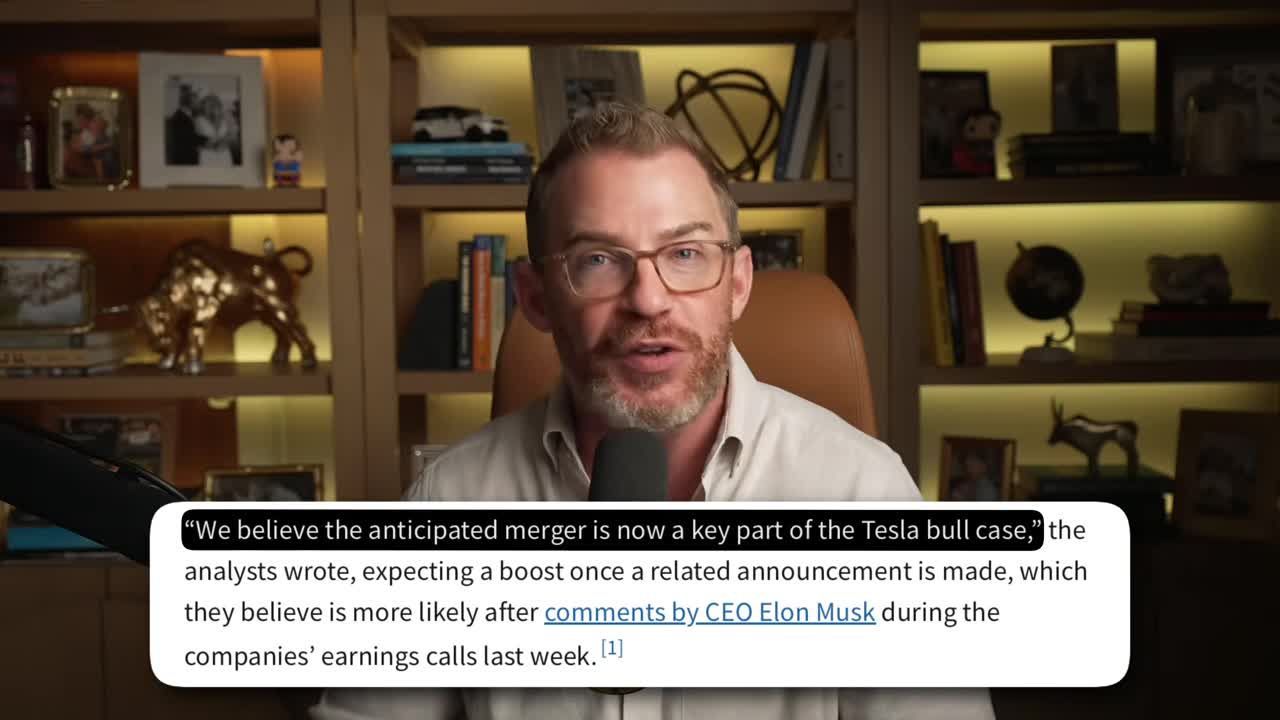
Barclays went further, calling the merger a key part of the bull case for Tesla stock.
Here's who has to approve it. On the SpaceX side, the filing says any deal needs the special committee, the board, and the controlling shareholder, who is Elon. He's already said he supports it, so that vote is effectively locked in.
On the Tesla side, it's harder. A deal needs a majority of all Tesla shares outstanding, not just a majority of those who show up to vote. Own Tesla and skip the vote, and it counts the same as a no.
A large share of Tesla stock sits with index funds and big institutions, and some of those capital allocators will want a bigger premium before signing off. A 20 to 25% premium seems fair for a stock-for-stock transaction, but it does change what you're buying. Someone who wanted pure exposure to electric vehicles or Optimus now gets rockets, satellites, and AI thrown into the mix as well. Any real negotiating over the final terms will come from those fund managers, not retail shareholders.
How Would This Hit the Stock?
If the deal is announced, expect the typical all-stock-deal pattern: the acquiring company's stock tends to dip while the target's stock tends to rise. Traders often short the acquirer and buy the target to capture that spread, though that gap is usually temporary.
SpaceX went public in June at $135, ran as high as $211 within days, then fell to a low of $108 before climbing back into the mid-$130s. The stock has essentially round-tripped back to its IPO price. If SpaceX becomes the acquirer, as most expect, its stock could see short-term pressure around the announcement even as Tesla shares benefit from the premium.
Expect short-term softness in SpaceX shares around any announcement, following that standard acquirer-dips, target-rises pattern. The longer-term case looks stronger: once the deal closes, SpaceX gains Tesla's cash flow, a bigger footprint in major indexes, and every one of Elon's ventures under one roof. That supports upside over time even if the announcement itself creates a temporary dip.
For anyone planning to hold SpaceX for the long haul, a dip around the announcement could be a reasonable place to add to a position. The structural case for the combined company holds regardless of the short-term noise.
Who's Pushing This Deal?
Elon Musk is the controlling shareholder of both Tesla and SpaceX, and the person driving this merger forward. On Halloween, he posted on X that his companies have created meaningful wealth for hundreds of thousands of employees and improved retirement savings for hundreds of millions of people. Given the scale of both businesses, that claim holds up.
What Happens Next in the Tesla-SpaceX Merger Process?
The Tesla-SpaceX merger has moved from rumor to formal process. Special committees are in place, bankers and lawyers are working both sides, and prediction markets are pricing real odds on a 2027 announcement window. None of that guarantees a completed deal, and both companies have said plainly there's no certainty here. But for the first time, both sides are formally at the table.
If it happens, Tesla holders likely walk away with a premium and a stake in SpaceX, Starlink, and xAI. SpaceX holders gain access to Tesla's cash machine, a larger index footprint, and every one of Elon's bets consolidated into a single stock. It's a cleaner structure, a more diversified holding, and it finally lets Elon focus his attention on one company instead of splitting it across several.
None of this happens overnight. Expect this to play out over the next year or more, with the shareholder vote on the Tesla side as the real hurdle to watch. If you hold either stock, the conversion will happen automatically in your account whenever the deal closes. There's nothing you need to do but watch it unfold.
Get an entire year of live weekly mentoring sessions, my newsletter, indicators, bonus reports, tons more. Click the link and I'll see you in the next live session.
DISCLAIMER: Traders Agency does not offer financial advice. The information provided is for educational purposes only and should not be considered financial advice. Traders Agency is not responsible for any financial losses or consequences resulting from the use of the information provided. Trading carries inherent risks and may not be suitable for all individuals. You are advised to conduct your own research and seek personalized advice before making any investment decisions, recognizing the potential risks and rewards involved.
See more from Traders Agency on Google
Make us a preferred source and our market analysis will appear more prominently in your Google Search, Top Stories, and AI results.
Add to Preferred Sources