

Democrats swept the House and Senate last night. The S&P rallied 3% overnight. NASDAQ futures ripped 4.3%. Gold, silver, Bitcoin, and Ethereum all joined the party. If you expected a sell-off on a Democrat sweep, you got the opposite, and there's a reason for that. The post-midterm sector rally is already underway, and it isn't landing where most people expected.
Most people assume Wall Street wants Republicans in full control: lower taxes, pro-business policy, the usual story. That assumption is backwards. What the stock market actually wants is gridlock, and that's exactly what it got with a Republican White House staring down a Democrat-controlled Congress.
Why Is Gridlock Bullish for Stocks?
Bottom Line: Divided government, not one-party control, is the setup behind this rally. Gridlock removes the threat of new taxes or new rules, and that reduced uncertainty is what appears to be lifting stocks and rotating money into specific sectors, not a Democrat win itself.
What Wall Street wants is for Washington to do nothing
Stocks tend to rally after midterms because divided government produces gridlock, and gridlock is exactly what the market loves. When one party controls the House, Senate, and White House, things actually get done. "Things getting done" usually means new taxes, new rules, new uncertainty. Wall Street fears that more than it fears any individual policy.
With Democrats now running both chambers and Trump still in the White House, neither side can pass much of anything without a fight. Trump asks for something. Congress says no. Whatever does make it through gets vetoed. Nothing moves.
That sounds like dysfunction. For a portfolio, it's relief.
The price action told the story in real time. The market sold off in fear Tuesday night as results started pointing toward a Democrat sweep. Then, once the outcome was confirmed, it reversed hard. From 10:30pm to the opening bell, the S&P rallied 3%. NASDAQ futures did even better, tacking on 4.3%.
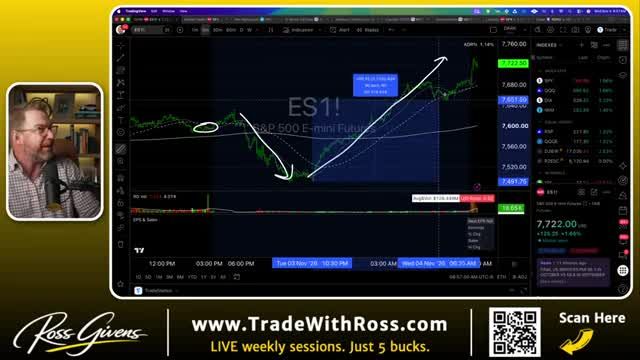
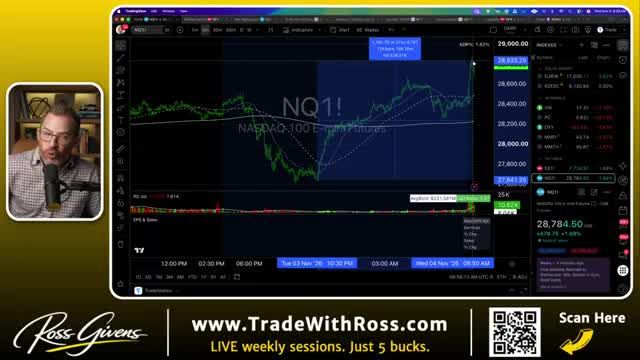
That's not a market afraid of divided government. That's a market relieved by it.
What Two Years of Nothing Means for You
Here's the realistic picture for the next two years: Trump pushes for something, Congress blocks it, whatever does pass gets vetoed, both sides bicker publicly, and substantively nothing changes. For investors, that's about as stable as Washington gets.
Divided government tends to outperform periods of one-party control for a simple reason: no major tax overhauls, no sweeping regulatory shakeups, no surprise legislation forcing entire sectors to reprice overnight. The playing field for the next two years is set. The market already knows what it's dealing with.
The Stealth Bear Market Nobody Saw
Half the market was crashing while the other half rallied
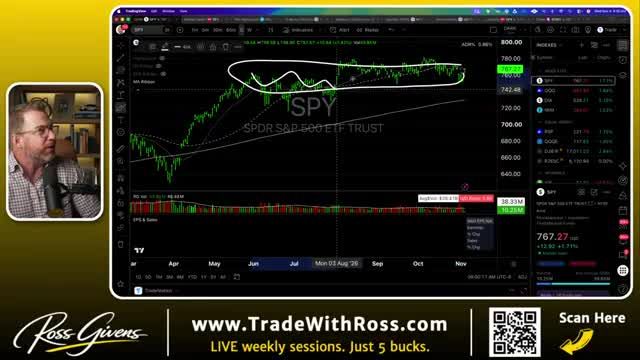
The S&P over the last five or six months looks like a market doing nothing. All summer, it sat in a holding pattern. That sideways chop made it look quiet and boring.
It wasn't. Underneath the surface, two opposite things were happening at once: AI stocks were getting crushed while everything else was surging.
A comparison between the Goldman Sachs AI basket (names like Nvidia and CoreWeave) and the rest of the S&P 500 excluding AI names shows exactly this split. When the broader market started chopping around June, AI stocks got volatile, sold off, and then dumped hard in September. Over that same stretch, the non-AI names: banks, healthcare, consumer staples, surged.
Half the market dropping while the other half rises nets out to a flat index on the surface, even while a real shakeout was happening underneath.
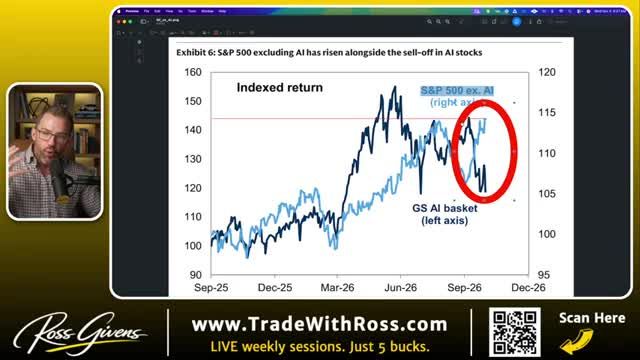
That's the AI bubble bursting in real time, and the market absorbed it without a broader crash. Those names are now trading 30 to 50% below their peaks. The reset already happened. The uncertainty Wall Street hates is now out of the way.
Where Is the Post-Midterm Sector Rally Headed?
Money is flowing hard into healthcare and banks right now, and it isn't a one-day pop. It's a continuation of a pattern that's been building for months. The healthcare ETF IHF is sitting near its highs, and the setups underneath it back that up.
- Stryker (SYK): Bought near the breakout weeks ago with a target of 330 for profit-taking and a raised stop. The stock just hit that level and is stalling right at 330, a textbook breakout pattern.
- Hinge: Entered around 94 to 95 dollars a share on a breakout, with healthcare showing the strength it tends to show in midterm election years. It's up 30% over the last couple of months.
- Rapid7 (RPD): Bought as it broke through 14, it ran to 18 in a couple of days and is now retesting that breakout level and bouncing.
- Check Point: Broke out of a massive base on volume, running from 140 to 160, then retested that zone. It moved from 140 to 148 in the first 45 minutes of trading alone.
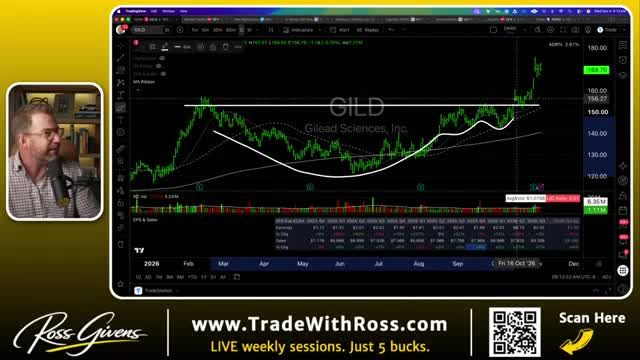
Cybersecurity has stalled slightly over the past month but remains a top performer across multiple timeframes. Pharma and biotech names are waking up too. Gilead just broke out of a tight consolidation. Eli Lilly spent five to six months chopping sideways before finally breaking higher. AbbVie shows the same setup: a run of strength, months of consolidation while institutions quietly accumulate, then a breakout. It's not a stock that jumps 30% in a week. It's a half-trillion-dollar pharmaceutical company in the early stages of a real trend.
Get an entire year of live weekly mentoring sessions, my newsletter, indicators, bonus reports, tons more. Click the link and I'll see you in the next live session.
Join my Black Ops Trading ClubAre Interest Rates Rolling Over Too?
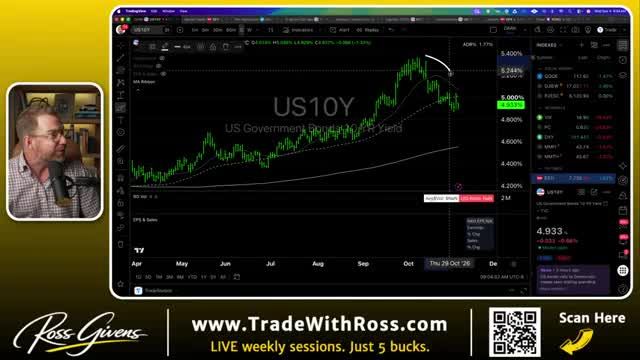
On top of the political setup, the 10-year interest rate is rolling over, down 40 basis points over the last 30 days. That means mortgage rates ease slightly, and as yields shrink, money tends to move out of money markets and into bonds and stocks.
The Historical Pattern After Midterms
Every midterm since 1950 has led to higher stocks a year later
In the 12 months following a midterm election, the stock market has been up 100% of the time since 1950, with an average gain of 12 to 15%. That's not a cherry-picked data point. That's the full sample going back more than seven decades. Every single time, stocks were higher a year later.
That alone should tell you something.
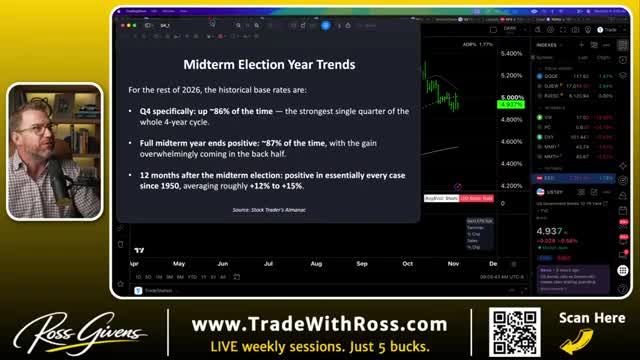
Combine that seasonal tailwind with the current setup, divided government plus a market that's already digested its bad news, and the case for continued strength into next year gets a lot stronger.
Tracking Where the Money Flows
One of the easiest ways to see where the post-midterm sector rally is concentrated is to track which sectors are gaining the most. Right now, healthcare, including medical devices, pharmaceuticals, and biotech, continues to show strength across multiple timeframes.
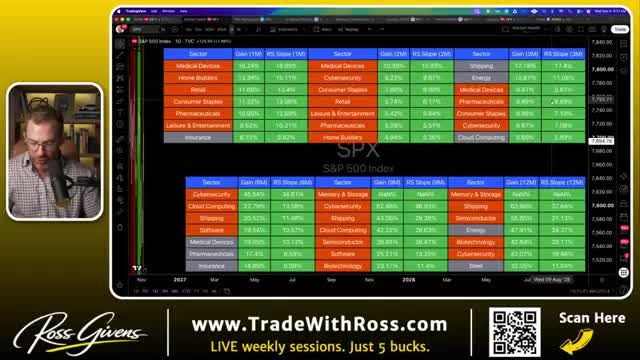
Gilead already broke out of a big consolidation. Eli Lilly spent five to six months chopping before finally finding legs. Merck looks early in the same pattern: a run of strength, now consolidating, worth watching for a tightening move near its highs.
In cybersecurity, Rapid7 and Check Point both broke out and are now retesting those breakout levels, often a good second entry point. Zscaler remains in a clean uptrend, repeatedly testing the 20 to 50 day moving average, historically a strong buying zone.
Gold, Crypto, and Stocks Moving Together
This isn't just a stock story. Gold, silver, Bitcoin, and Ethereum are all rallying alongside equities. Equities, metals, and crypto are all moving in the same direction at the same time, which is simply money flowing into the market broadly.
Positioning for What Comes Next
Whatever you think about the election outcome, it doesn't change what the data is telling you. Divided government has historically been good for stocks. The AI bubble has already deflated without sinking the broader market. Interest rates are easing. Seasonal history says the 12 months after a midterm election have been positive 100% of the time since 1950.
Right now, the post-midterm sector rally favors healthcare, pharmaceuticals, biotech, and cybersecurity, areas where money has been quietly flowing for months while AI names took the hit instead. The seasonal pattern, the technical setups, and the market internals are all pointing the same direction.
This is a case where the uncertainty has cleared, not increased. Washington arguing and getting nothing done isn't a problem for your portfolio. It's the setup behind the post-midterm sector rally the market has been waiting for.
Get an entire year of live weekly mentoring sessions, my newsletter, indicators, bonus reports, tons more. Click the link and I'll see you in the next live session.
DISCLAIMER: Traders Agency does not offer financial advice. The information provided is for educational purposes only and should not be considered financial advice. Traders Agency is not responsible for any financial losses or consequences resulting from the use of the information provided. Trading carries inherent risks and may not be suitable for all individuals. You are advised to conduct your own research and seek personalized advice before making any investment decisions, recognizing the potential risks and rewards involved.
See more from Traders Agency on Google
Make us a preferred source and our market analysis will appear more prominently in your Google Search, Top Stories, and AI results.
Add to Preferred Sources