


A massive liquidity event is about to hit the market, and a severe SpaceX stock price drop is right around the corner.
Tomorrow morning, Tuesday, July 7th, SpaceX officially enters the NASDAQ 100. That triggers billions in blind capital flowing into the stock. Most retail investors think this is a guaranteed ticket to higher prices.
The data tells a completely different story.
The initial retail demand is exhausted. A massive wave of insider selling is about to flood the market with new supply. This is not a time to buy blindly. It is a time to understand the math behind the upcoming selloff.
What Is the Forced Buying Event Happening Before the SpaceX Stock Price Drop?
Bottom Line: SpaceX's NASDAQ 100 inclusion creates a textbook buy-the-rumor, sell-the-news setup: the forced institutional buying is a one-time event already absorbed by the market, while a $400 billion insider unlock represents sustained, months-long selling pressure at a valuation of 80 to 100 times sales. The trade is not to chase the index pop but to wait for the stock to cut in half and buy in the $80 to $100 range once insiders have finished distributing.
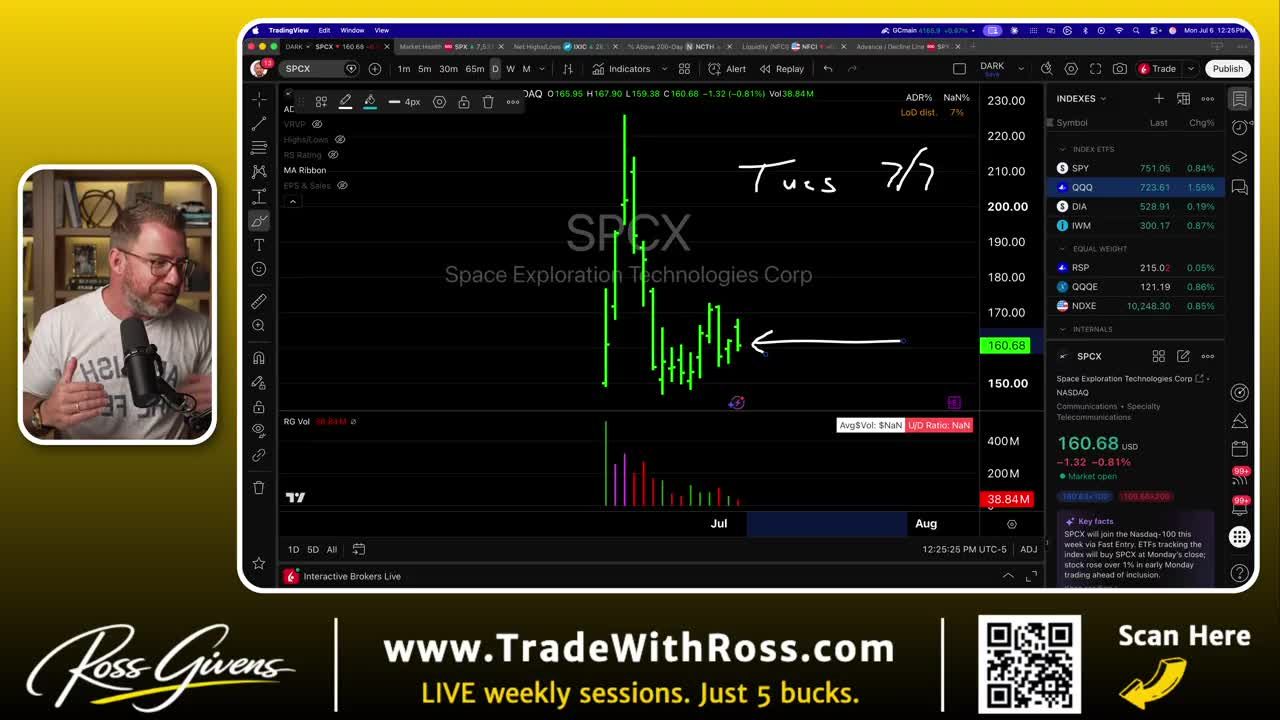
On Tuesday, July 7th, SpaceX officially enters the NASDAQ 100 before the market opens. That triggers billions in forced buying from index funds and retirement accounts. But here's the catch: that capital actually hits the market on Monday between 3:50 p.m. and 4:00 p.m. Eastern time.
Estimates range from $4.3 billion to as much as $7 billion depending on how specific funds allocate. That's a massive chunk of money.
When a company is added to a major index like the NASDAQ 100 or the S&P 500, hundreds of millions of people are forced to own the stock whether they like it or not. It happens automatically through index funds and target date funds sitting inside retirement accounts.
You might think you should buy the stock today to front-run this influx of capital. That already happened. The "buy the rumor, sell the news" phase is over. The stock opened higher today but traded down in the first four hours of the session. That alone should tell you something.
The 15-Day Fast Entry Rule
The NASDAQ index created a new 15-day fast entry rule specifically to attract SpaceX. Typically, a newly public company must trade for six to twelve months before index inclusion. This standard seasoning period allows the free market to discover a fair value.
During a normal seasoning period, global investors get a chance to trade the stock back and forth. Buyers buy, sellers sell, and the free market decides roughly what the company is worth.
We are not getting that chance today.
SpaceX is being added to the NASDAQ 100 after just 15 days. The stock is skipping the necessary price discovery phase and going straight into the index at what many believe is a very high valuation.
Valuation Risk at Entry
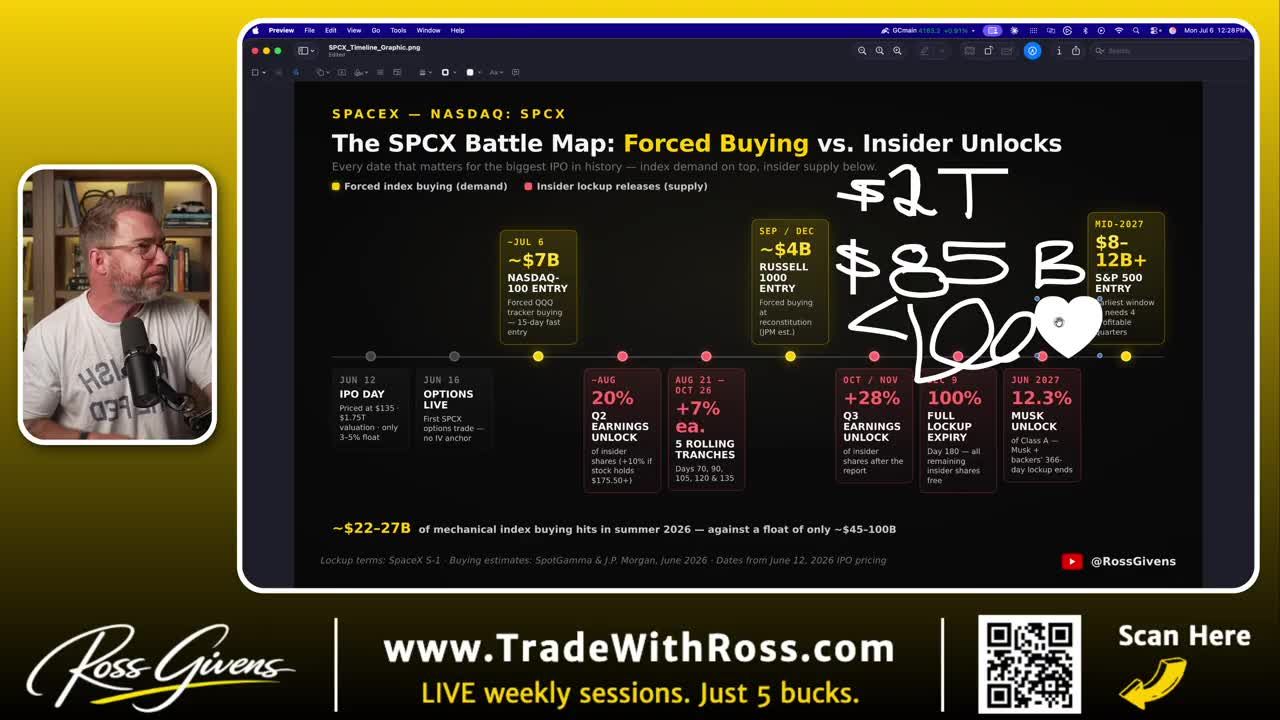
Entering an index after just 15 days at a $2 trillion valuation creates massive risk. SpaceX is currently trading at somewhere around 80 to 100 times sales. Not profits. Sales.
When you force index funds to buy at these levels, you trap passive investors at a price that represents years of success that have not yet happened.
SpaceX looks like a great 10-year investment. But the current valuation needs to be cut roughly in half to make it anywhere close to reasonable. The market is going to price this accordingly, and the stock will come down.
Get an entire year of live weekly mentoring sessions, my newsletter, indicators, bonus reports, tons more. Click the link and I'll see you in the next live session.
Join my Black Ops Trading ClubWhat Happens When $400 Billion in SpaceX Insider Shares Unlock?
The forced buying from index inclusion is just a temporary tailwind. What comes next is far worse.
When a company goes public, insiders and early investors are not allowed to sell on day one. They're usually given a six or twelve-month waiting period to prevent a massive liquidity event from driving the stock lower. SpaceX is doing things differently. They are unlocking insider shares in tranches.
The first big tranche comes following the company's first earnings report, scheduled for the first week of August. Two days following that report, 20% of the shares are unlocked for selling.
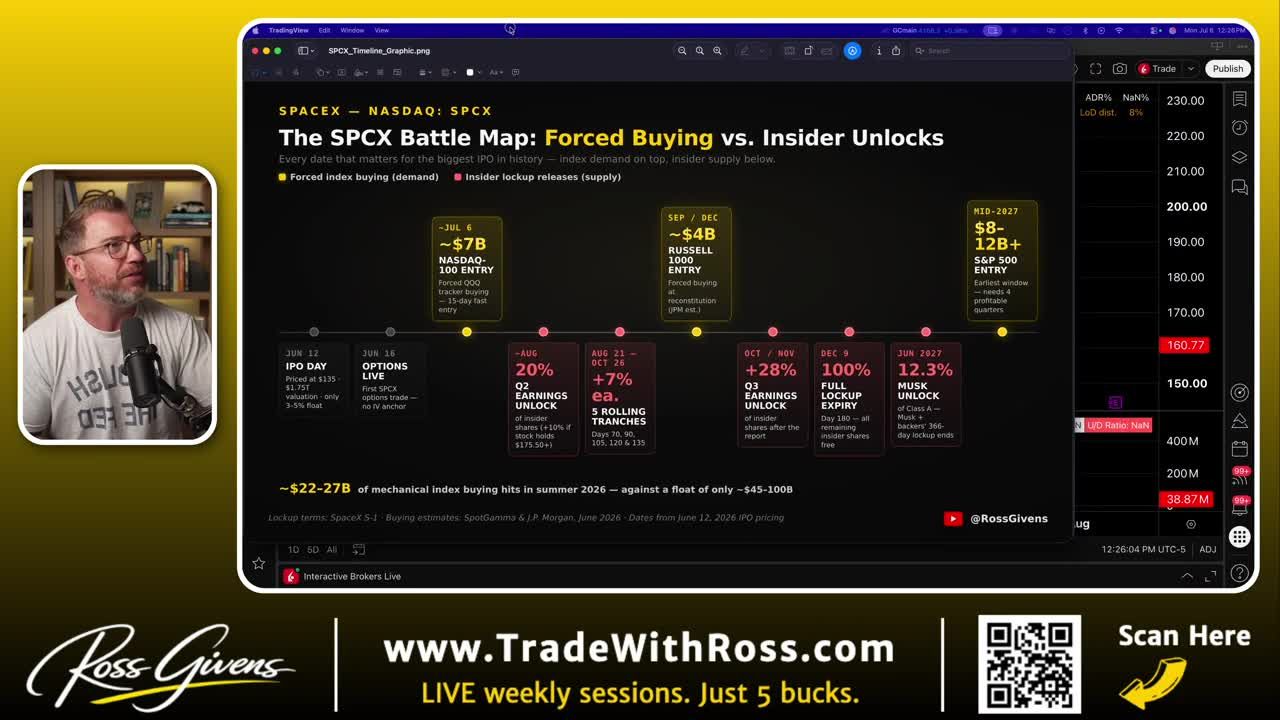
The math here is staggering:
- The company is valued at roughly $2 trillion based on the current share price.
- The total amount of stock offered in the IPO was only about $85 billion.
- A 20% unlock represents roughly $400 billion worth of SpaceX stock.
The "Diamond Hands" Myth
Many people argue that SpaceX employees believe in the company and will hold their shares forever.
Tell that to an employee who makes $87,000 a year and suddenly has $1.2 million in stock. Tell him to believe in the future and forget his dreams of a beach house and a brand new F-150. It will not happen.
Early investors and venture capitalists are up 20, 30, and even 50-fold on their money. These unlock tranches will create a massive new wave of supply. Not all $400 billion will sell on day one. But if just a tenth of it sells, that is $40 billion dumping out of the stock all at once. That wall of supply guarantees downward pressure on the share price.
How to Position for the SpaceX Stock Price Drop
The demand we saw in the first week drove this stock into the stratosphere. The IPO was massively oversubscribed. A $2 trillion company went up 50% in three trading days, mainly from retail investors.
Anybody who wanted to buy 10, 100, or 1,000 shares already has their stock. The buyers are exhausted. Now, the sellers get their turn.
1. Watch the Floor Levels
The stock will likely float around $150 for a few days, as that is the current floor. Once it breaks through $150, it will run down to the $135 IPO price.
2. Expect a Break Below the IPO Price
It will float briefly at $135 before penetrating that level and running lower. SpaceX will likely hit $100, if not lower, at some point in 2026.
3. Study Historical IPO Data
Before you reject this target, look at the IPOs of Google, Apple, Amazon, and Nvidia. Almost all of the big names fall 50% to 60% from their peak. Most fall 50% from their initial IPO price. A 50% drop from the SpaceX IPO price would put the stock down into the mid-60s.
When to Buy SpaceX
The optimal time to buy SpaceX will be later this year during the late third quarter or early fourth quarter. The stock should trade down into the $80 to $100 per share range as insider selling floods the market with new supply. That is when the real SpaceX stock price drop creates a genuine buying opportunity.
Once the stock hits that $100 level or lower, it will likely form a multi-month bottoming pattern. After that base is built, we will likely see the beginning of a multi-year, potentially multi-decade, rally higher.
The NASDAQ 100 inclusion is the last good event in terms of driving this stock higher in the short term. Passive dollars will slowly flow into it over time, just like they do with Apple, Nvidia, Microsoft, and Tesla. But that slow trickle of passive money will not protect the stock from the massive wave of insider selling hitting the market in August.
The Math Is Clear
A $2 trillion company trading at 80 to 100 times sales cannot absorb $400 billion in unlocked shares without experiencing a severe SpaceX stock price drop.
The retail buying frenzy is over. The forced index buying is already priced in. The upcoming insider unlocks are working directly against you as an investor.
Wait for the market to price this stock reasonably. Let the insiders sell their shares. Watch the stock cut in half. And prepare to buy when the dust settles in the $80 to $100 range.
Get an entire year of live weekly mentoring sessions, my newsletter, indicators, bonus reports, tons more. Click the link and I'll see you in the next live session.
Key Takeaways
- Between $4.3 billion and $7 billion in forced index-fund buying hits SpaceX stock in a single 10-minute window on Monday afternoon before the July 7th NASDAQ 100 entry.
- The 15-day fast entry rule means early index buyers are locked out of selling for two weeks, creating a supply vacuum that temporarily inflates price before the real selling begins.
- A $400 billion insider unlock is coming, and a stock trading at 80 to 100 times sales cannot absorb that new supply without a severe price decline.
- The retail buying frenzy and forced index buying are already priced in, meaning both demand catalysts are exhausted before the insider supply wave arrives.
- The target buy range after the anticipated selloff is $80 to $100, roughly half of current levels, once insiders have distributed their shares into the market.
DISCLAIMER: Traders Agency does not offer financial advice. The information provided is for educational purposes only and should not be considered financial advice. Traders Agency is not responsible for any financial losses or consequences resulting from the use of the information provided. Trading carries inherent risks and may not be suitable for all individuals. You are advised to conduct your own research and seek personalized advice before making any investment decisions, recognizing the potential risks and rewards involved.
See more from Traders Agency on Google
Make us a preferred source and our market analysis will appear more prominently in your Google Search, Top Stories, and AI results.
Add to Preferred Sources