
Senate Republicans released an updated version of the Digital Asset Market Clarity Act late Sunday, calling it their final offer to Democrats ahead of a preliminary Senate vote scheduled for Tuesday. The revision folds in new ethics restrictions that President Trump has agreed to support, along with a compromise mechanism aimed at addressing community banks' fears that yield-bearing stablecoins could drain deposits, according to CNBC.
What the new ethics language covers

The updated text incorporates what Republican sponsors describe as large parts of an ethics agreement brokered by Sens. Thom Tillis (R-N.C.) and Ruben Gallego (D-Ariz.), including a Democratic demand to let state attorneys general enforce ethics requirements on federal officials, CNBC reported.
An earlier July draft of the ethics package, detailed by law firm Davis Wright Tremaine, barred covered public officials, employees and their spouses from issuing or sponsoring a digital asset for consideration during a covered period. Officials could avoid violating the rule by placing a prior interest in a qualified blind trust, divesting it, or both. That ban is set to sunset after January 20, 2029.
Watchdog group Transparency International U.S. argued that framework leaves significant gaps: it does not clearly require divestment from business, revenue-sharing or family arrangements tied to the Trump family's crypto ventures, it expressly allows preexisting ventures to keep using Trump's name and likeness to mint and sell additional digital assets once covered interests are divested or blind-trusted, and the 2029 sunset erases liability for earlier violations, the group said. Financial disclosures cited by Coinage Media showed crypto businesses associated with Trump and his family generated roughly $1.4 billion in income in 2025; the White House has denied that the president or his family engaged in conflicts of interest.
The White House press office told CNBC that Congress "must pass the CLARITY Act" and that the administration "has already agreed to the most comprehensive and wide-ranging ethics provision in history," without directly answering CNBC's questions about the specifics of its latest concessions.
The stablecoin-yield circuit breaker and bank pushback

The revised bill adds a compromise on stablecoin yield intended to appease banking interests: it directs the Treasury secretary to restrict rewards on stablecoins if deposit flight from community banks occurs on a substantial scale, CNBC reported. Banks have said they cannot support the bill unless it stops interest-like payments on stablecoins outright, warning that customers would otherwise shift deposits into high-yield crypto accounts.
The Independent Community Bankers of America, joined by seven other banking associations, wrote in a Monday letter that the circuit breaker is insufficient because it only activates after deposit flight has already occurred. "A circuit breaker that activates only after substantial deposit flight has already occurred is not a safeguard at all," the groups wrote, adding that "further technical refinements are needed to ensure that the text clearly and directly prohibits interest-like payments on payment stablecoins." The groups also argued the mechanism's inclusion amounts to an admission of risk, writing that it "is an acknowledgment that shifting deposits from regulated financial institutions into payment stablecoins can threaten credit availability and create broader economic consequences."
American Bankers Association executive Brooke Ybarra said the group's lobbying has centered on deposits that fund local lending, telling CNBC there is a "growing number of lawmakers who share our concerns with the current interest loophole in the bill." Separately, Coinbase struck an agreement last week with financial services provider Moov to give community banks access to stablecoin capabilities, a move CNBC characterized as likely aimed at easing community bank fears about the legislation.
SEC and CFTC jurisdiction, DeFi and market structure
The bill's broader market-structure architecture was largely set in the July merged text, before the latest round of ethics negotiations. A July 22 text spanning 616 pages merged the Senate Banking and Agriculture Committees' bills into a single framework, according to law firm Paul Hastings. That merged text more clearly defines when digital assets are treated as securities versus commodities and divides authority between the SEC and CFTC, Coinage Media reported, and it gives the CFTC exclusive jurisdiction over registered digital commodity intermediaries while preserving state authority to bring enforcement action for fraud, deceit or manipulation, per Davis Wright Tremaine's summary.
The text also preserves the Banking Committee's provisions on stablecoin yield, DeFi risk management, and developer protections, adds protections for decentralized-governance systems by directing the SEC to focus on activities relevant to actual control of a distributed ledger system when determining whether persons are acting in concert, and requires the SEC to adopt insider-trading rules covering control persons and others with material nonpublic information about ancillary assets. It further expands CFTC registration to digital commodity pool operators and trading advisors, replacing a prior provisional-registration approach with a notice-of-intent process, according to Davis Wright Tremaine. Most provisions would take effect 360 days after enactment, and the bill must still be reconciled with the House's version of the CLARITY Act if it passes the Senate, per the same summary.
Not every group that weighed in has stayed opposed. The Fraternal Order of Police reversed an earlier letter opposing the bill on July 24, writing in support after the revision of developer-protection language in the Blockchain Regulatory Certainty Act provisions, according to Paul Hastings.
The vote count
Passage requires 60 votes, meaning at least seven Democrats would need to support the measure with full attendance, CNBC reported. The Senate Banking Committee advanced its version by a bipartisan 15-9 vote in May, but only two Democrats backed it out of committee, and Democrats have said broadly they cannot support the bill without stronger ethics language.
Sen. Chris Van Hollen (D-Md.) came out against the bill in a Sunday video posted to X, calling it "a bill that is masquerading as a way to create good regulation and protection for consumers" with "big problems that have not been fixed," and said "we can't let this pass," per CNBC. Seven Democrats who had been negotiating on the bill issued a joint statement raising concerns with the July text, according to Paul Hastings, and Banking Committee Ranking Member Elizabeth Warren (D-Mass.) separately warned the proposal contained "significant flaws," arguing any final bill must prevent presidents, lawmakers, senior officials and their families from profiting from the industry, according to Coinage Media.
Lead sponsor Sen. Cynthia Lummis (R-Wyo.) said the updated text "includes more than 120 of Democrats' demands" and urged colleagues to "take yes for an answer," CNBC reported. A Democratic aide, speaking to CNBC on condition of anonymity, said Majority Leader John Thune (R-S.D.) has pitched Tuesday's vote as a "free vote" to keep the bill moving toward further amendment, and that the White House has signaled additional ethics concessions only if the preliminary vote succeeds. If the vote fails, CNBC noted it remains unclear whether lawmakers would have time to amend the package and pass it before the end of this Congress.
Industry positioning and odds
Coinbase CEO Brian Armstrong told CNBC the legislation is ready for Senate support, but argued that failure would still be "a good outcome" because the SEC and CFTC have said they are ready to publish rulemaking, giving the industry regulatory clarity "one way or another" within days of the vote.
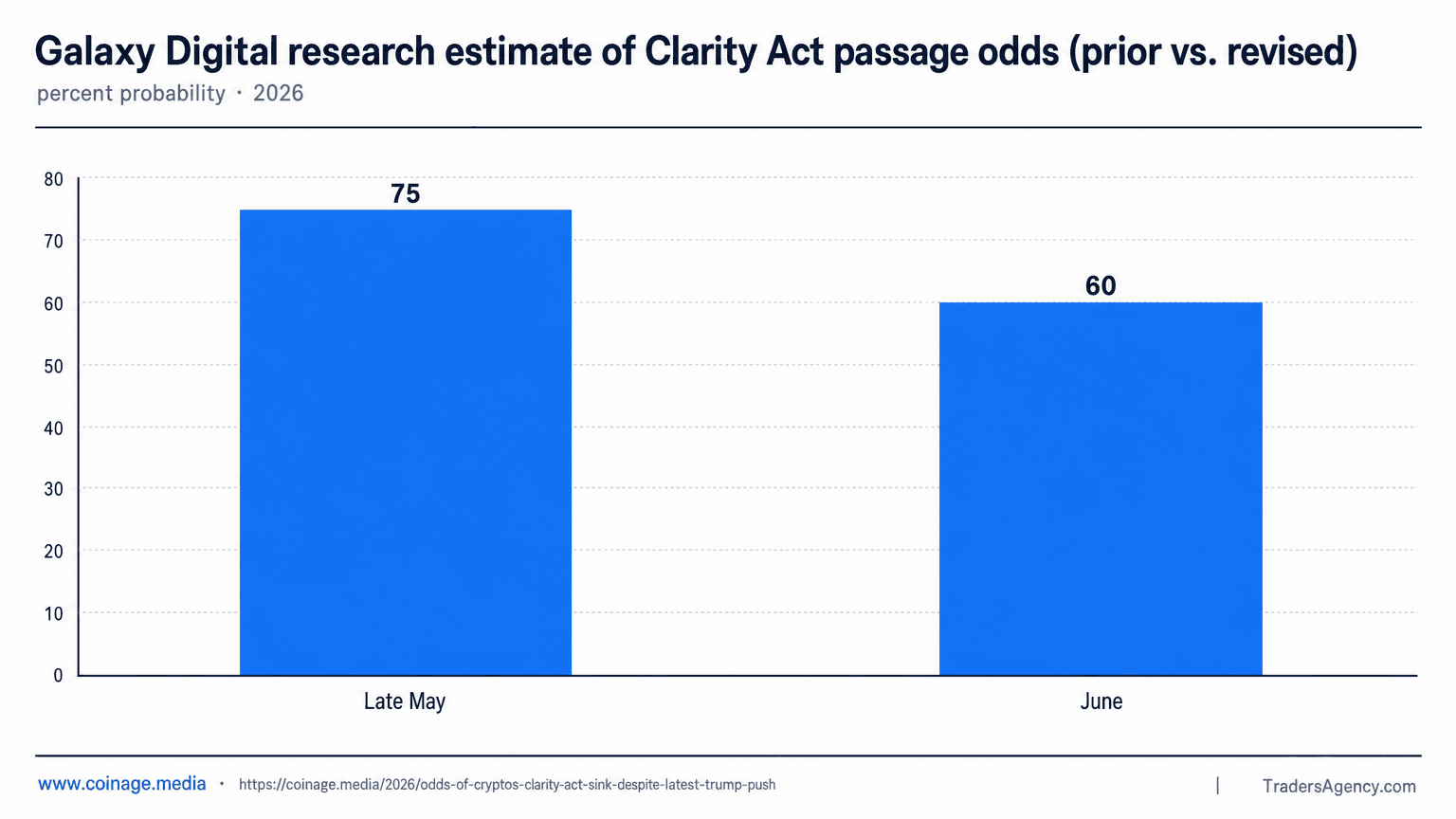
Fundstrat's Sean Farrell told Coinage Media that ethics provisions remain the bill's central obstacle, describing the situation as "kind of a binary situation" and saying that absent the ethics fight he would rate passage odds "north of 80%"; with the fight ongoing, he said the outlook swings between 40% and 60% "on seemingly a daily basis." Coinage also reported that Galaxy Digital's research estimated a 75% chance of passage in late May, cutting that to 60% in June. By our calculation, that is a 15-percentage-point decline (75 minus 60) between the two estimates, a roughly 25% relative decrease (15 divided by 60), based on the figures Galaxy Digital reported to Coinage Media. Those are past estimates tied to specific months, not a live probability of Tuesday's outcome.
Bottom line
The revised Clarity Act narrows some gaps flagged by Democrats and banking groups, adding state attorney general enforcement power over ethics rules and a Treasury-directed deposit-flight backstop for stablecoin yield. But banking associations call the circuit breaker reactive rather than preventive, and watchdog groups say the ethics provisions still leave core Trump family crypto income streams outside clear divestment requirements. With only two Democrats having backed the bill in committee and at least seven needed for Tuesday's procedural threshold, the outcome remains contested, and even bill supporters like Coinbase's Armstrong have framed a stalled vote as tolerable given anticipated SEC and CFTC rulemaking.
DISCLAIMER: Traders Agency does not offer financial advice. The information provided is for educational purposes only and should not be considered financial advice. Traders Agency is not responsible for any financial losses or consequences resulting from the use of the information provided. Trading carries inherent risks and may not be suitable for all individuals. You are advised to conduct your own research and seek personalized advice before making any investment decisions, recognizing the potential risks and rewards involved.
- CNBC Top News: Crypto Clarity Act faces crucial Senate vote as Democrats urge changes · accessed Sep 14, 2026
- www.dwt.com: Senate Republicans Release Updated Crypto Market Structure Text · accessed Sep 14, 2026
- www.banking.senate.gov: NEW: Banking Minority Staff Analysis Confirms Clarity Act Would Do Nothing to Prevent Trump From Making His Next $1.4 Billion in Crypto Profits · accessed Sep 14, 2026
- www.paulhastings.com: Senate Releases Updated Clarity Act Text, SEC Commissioner Addresses Crypto Vaults, and SEC and CFTC Advance 24-Hour Trading · accessed Sep 14, 2026
- www.youtube.com: - YouTube · accessed Sep 14, 2026
- www.facebook.com: 6.5K views · 100 reactions | The Clarity Act, which would create regulation for the cryptocurrency industry, cleared the Senate banking committee. The bill is the top legislative priority of the crypto industry, as it would add predictable oversight and guardrails to the industry. The measure has a long way to go before becoming law, given both powerful opposition and the fact that it would need to clear the full Senate as well as the House before heading to President Donald Trump's desk. Read more: cnb.cx/4tFmKq3 | CNBC · accessed Sep 14, 2026
- us.transparency.org: Senate's New CLARITY Act Leaves Trump’s Core Crypto Conflicts Unchecked · accessed Sep 14, 2026
- www.coinage.media: Odds of Crypto’s CLARITY Act Plummet Despite Latest Trump Push · accessed Sep 14, 2026
- www.banking.senate.gov: Home | United States Committee on Banking, Housing, and Urban Affairs · accessed Sep 14, 2026
- www.banking.senate.gov: Chairman Scott Announces Digital Asset Market Structure Markup · accessed Sep 14, 2026
- www.youtube.com: - YouTube · accessed Sep 14, 2026
See more from Traders Agency on Google
Make us a preferred source and our market analysis will appear more prominently in your Google Search, Top Stories, and AI results.
Add to Preferred Sources