The benchmark 10-year U.S. Treasury yield touched 5% on Monday for the first time since October 2023, according to CNBC and Seeking Alpha, an intraday move that left the bond market's most closely watched rate just short of levels last seen before the 2008 financial crisis, two days ahead of the Federal Reserve's policy decision.
Yield Hits a Threshold Not Seen in Two Years
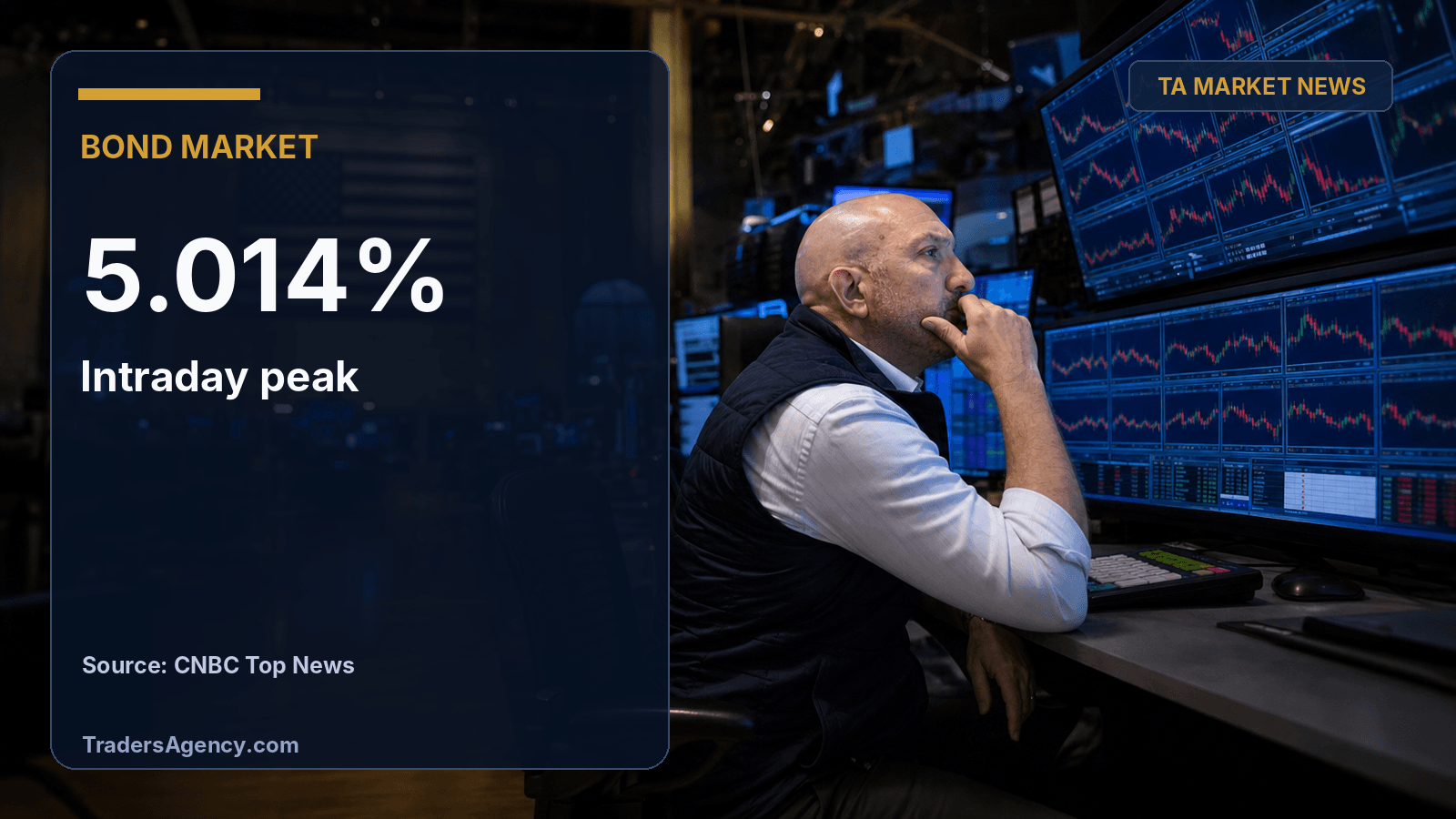
According to CNBC, the 10-year yield reached an intraday high of 5.014% before easing back. Seeking Alpha confirmed the yield crossed 5% for the first time since October 23, 2023, while CNN called the level a "critical threshold," noting the 10-year has otherwise not traded this high since 2007.
CNBC reported that a move beyond 5.02% would take the yield to its highest level since July 2007, before the global financial crisis, underscoring how close Monday's spike came to that marker. Elsewhere on the curve, CNBC said the 2-year yield, which is most sensitive to near-term Fed policy, fell more than 2 basis points to 4.615% after touching its highest level since July 2024 last week, while the 30-year bond yield slipped more than 3 basis points to 5.321%, a bond CNBC described as more sensitive to geopolitical risk than to Fed policy.
A Fed Decision Clouded by Inflation Data
The move comes as the Federal Reserve's policy meeting runs Tuesday and Wednesday this week. CNBC reported that fed funds futures tracked by the CME Group's FedWatch tool put the odds of a quarter-point rate increase at Wednesday's decision at 90%, following Friday's August consumer price index report, which CNBC said matched expectations but remained far above the Fed's 2% inflation goal, a gap that has persisted for five years.
Jay Woods, chief market strategist at Freedom Capital Markets, told CNBC that a hike would be "the cleaner decision based on the data and current market expectations," adding that "the market has priced that in and may rally with a hike," whereas holding rates steady "may cause a negative market reaction as it screams once again the Fed is behind the curve."
Mortgage Rates, Buybacks and a Muted Equity Reaction
The rise in long-term yields has already fed through to household borrowing costs. CNN reported that the average 30-year fixed mortgage rate climbed to 6.76% last week, its highest level in more than a year, up from 6.15% at the start of the year. By our calculation, that is a rise of 0.61 percentage points, or roughly 9.9%, over that period (6.76 minus 6.15, divided by 6.15, multiplied by 100).
Equities have so far taken the move in stride. CNN noted the S&P 500 remains up more than 10% for the year even as yields climbed steadily. CNBC cited BMO Capital Markets strategists observing that when the 10-year previously reached 4.85%, equity weakness stayed modest and the index was still up more than 11% for the year at that point.
Treasury Secretary Scott Bessent has tried to relieve pressure at the long end of the curve through an expanded bond buyback program, according to both CNBC and CNN, but yields have kept climbing regardless. BMO Capital Markets strategists, cited by CNBC, said a more active buyback program "could help limit selling pressure" but "fails to address the prevailing fundamental drivers of the upward pressure on 10- and 30-year yields." CNBC added useful context on scale: roughly $1.2 trillion changes hands in the Treasury market each day, a market CNN describes as nearly $32 trillion and the dominant force in global bonds, meaning buybacks are small relative to the forces they aim to offset.
What's Driving the Selloff
Analysts and strategists cited several overlapping explanations for the move. Jason Ware, chief investment officer at Albion Financial Group, told CNBC the latest rise stems partly from a supply-demand imbalance as heavy Treasury and corporate debt issuance competes for investor capital. CNBC also pointed to large federal deficits, heavy debt issuance and sticky inflation as contributors to a rising term premium, the extra compensation investors demand for holding long-term debt instead of rolling over short-term bills, with surging crude oil prices cited as an additional source of price pressure.
Ware offered a more sanguine read as well, telling CNBC that higher yields are not necessarily bearish if accompanied by healthy growth, and arguing stocks are more vulnerable to a slowdown in consumer spending or artificial-intelligence investment than to the 10-year crossing what he called an "arbitrary threshold."
Not everyone was as relaxed. John Higgins, chief economic adviser for financial markets at Capital Economics, said in a note cited by CNN that 5% "is seen by some as a threshold above which financial markets might go into meltdown," while adding that "we aren't convinced that 5% is that 'magic' number." He cautioned that higher Treasury yields would nonetheless pose a risk to the sustainability of U.S. public finances and threaten equities. CNBC noted that George Awad, principal at Gibraltar Capital, has highlighted the leveraged hedge-fund exposure underpinning the Treasury market, including trades based on spreads between cash bonds and futures, with higher funding costs, margin requirements or increased volatility potentially forcing leveraged investors to unwind positions simultaneously and amplifying any selloff.
The Year's Climb in Context
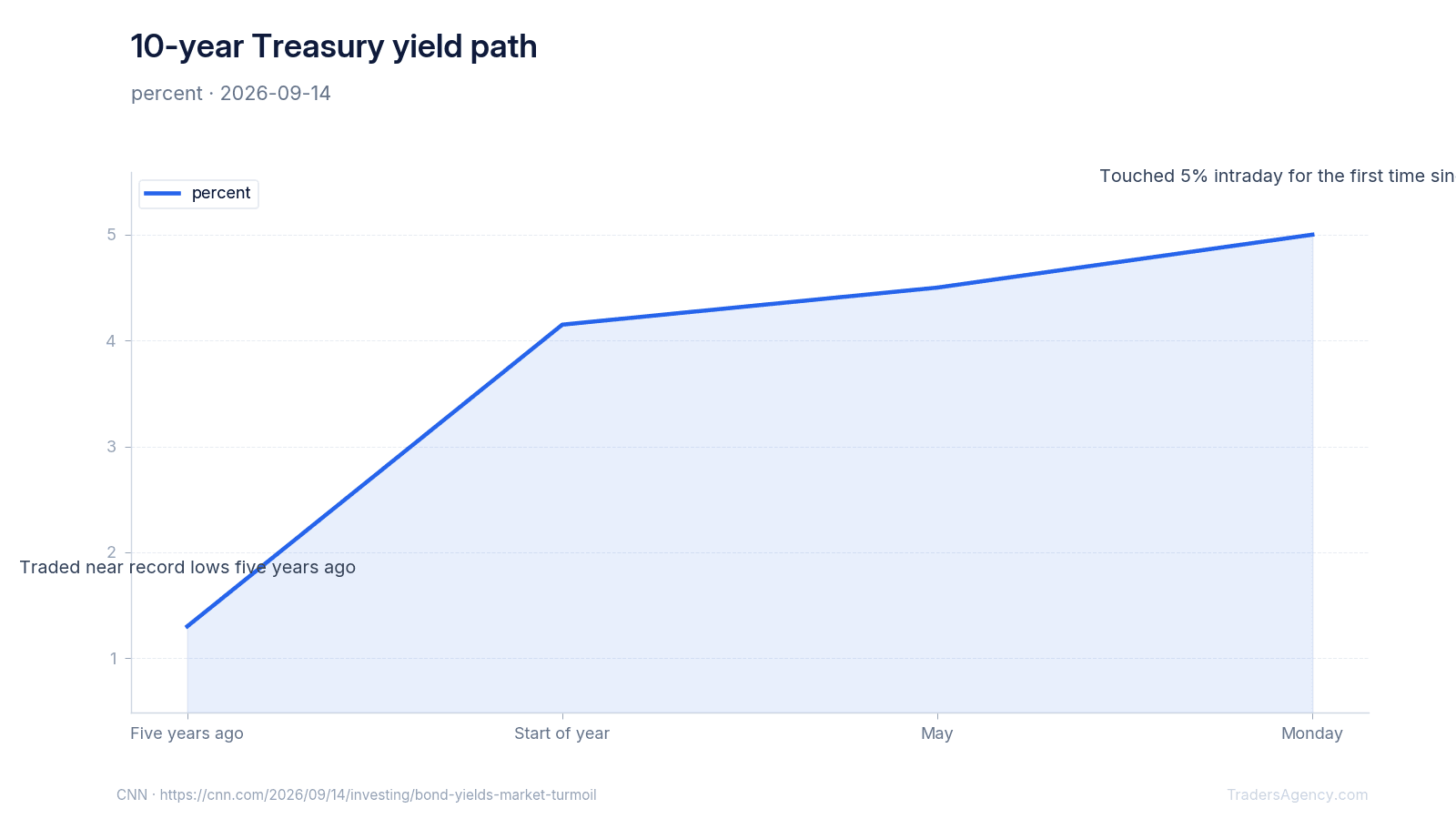
CNN traced the path that brought yields to this point: the 10-year entered the year trading at 4.15% and dipped below 4% in February, before reversing sharply after the start of the war with Iran. It hit 4.5% in May and reached 5% on Monday. Five years ago, CNN noted, the 10-year traded at just 1.3%. Luis Alvarado, co-head of global fixed income strategy at Wells Fargo Investment Institute, told CNN the firm has been telling clients to expect "normal for longer," meaning the forces pushing yields higher are likely to persist rather than fade quickly.
Bottom Line
The 10-year Treasury yield's brief run to 5% takes the benchmark back to a level it has otherwise not held since 2007, apart from a short crossing in October 2023, and it arrives just ahead of a Fed decision where fed funds futures tracked by the CME Group's FedWatch tool imply a 90% chance of a quarter-point rate increase, according to CNBC. Whether the level proves a genuine turning point or merely a psychological marker is contested: Capital Economics' John Higgins said he is not convinced 5% is the "magic" number, even as he flagged risks to U.S. public finances and equities. For now, the practical effects are visible in the average 30-year fixed mortgage rate at 6.76%, its highest in more than a year according to CNN, even as the S&P 500 has held a double-digit gain for the year.
DISCLAIMER: Traders Agency does not offer financial advice. The information provided is for educational purposes only and should not be considered financial advice. Traders Agency is not responsible for any financial losses or consequences resulting from the use of the information provided. Trading carries inherent risks and may not be suitable for all individuals. You are advised to conduct your own research and seek personalized advice before making any investment decisions, recognizing the potential risks and rewards involved.
- CNBC Top News: 10-year Treasury yield hits 5% for the first time since 2023 · accessed Sep 14, 2026
- Seeking Alpha Market News: U.S. 10 Year tops 5% for the first time since October of 2023 · accessed Sep 14, 2026
- CNN: 10-year Treasury yield hits 5%, critical threshold for US economy and markets · accessed Sep 14, 2026
See more from Traders Agency on Google
Make us a preferred source and our market analysis will appear more prominently in your Google Search, Top Stories, and AI results.
Add to Preferred Sources