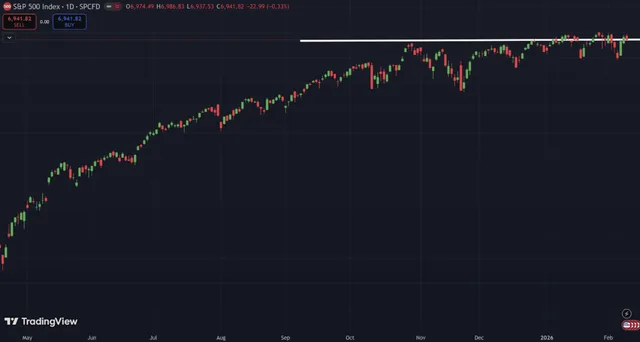
A market rumor connecting two of the most closely watched names in American business has caught investors' attention: could Berkshire Hathaway, sitting on one of the largest cash reserves of any public company, help fund Meta Platforms' next phase of artificial-intelligence spending? The idea remains speculative, but it touches on real questions about financing costs, valuation discipline and how AI infrastructure gets paid for.
Berkshire's Growing Technology Footprint
Berkshire Hathaway's portfolio has long been associated with insurance, railroads and consumer brands rather than technology. That picture has shifted. As of June 30, 2026, Apple represented roughly 22% of Berkshire's U.S.-listed 13F equity portfolio, making it the single largest holding reported in that filing. It is worth noting that the 13F reflects only publicly traded securities and excludes cash, Treasury bills and Berkshire's wholly owned operating businesses, so the 22% figure describes concentration within that slice of assets rather than the company's full balance sheet.
On the balance-sheet side, Berkshire reported roughly $365.5 billion in cash and short-term Treasury investments on a gross basis as of the same date, or about $359.2 billion after excluding railroad-related cash and subtracting Treasury-bill payables. Either way, it is a substantial cash position that gives the company meaningful flexibility.
Berkshire also holds Alphabet shares, a more recent addition that has drawn attention as a signal of changing appetite. Alphabet's Class A shares alone represented about 9.4% of the 13F portfolio, and when combined with the separately reported Class C position, total Alphabet exposure came to roughly 12.6%. Analysts following the company have read this combination, a large legacy bet on Apple paired with a newer stake in Alphabet, as evidence that Berkshire has grown more comfortable paying up for technology businesses when the price and the cash-flow durability look right.
Why Meta Might Need Outside Capital
The speculation linking Berkshire to Meta originates from a Barron's report suggesting Meta could pursue an early equity-linked financing to help fund its AI infrastructure spending, with Berkshire floated as one possible participant. It is important to be clear about what this is: a market rumor built on analyst commentary, not a confirmed transaction from either company.
Evercore analysts cited in that reporting estimated Meta could seek somewhere between $50 billion and $100 billion over the following three to six months through a combination of equity and debt. J.P. Morgan reportedly suggested an equity-linked deal could arrive even sooner, with recent weakness in Meta's share price adding urgency to the timeline. These figures and timelines come from third-party analysts rather than company disclosures, and they should be treated as forecasts rather than settled plans.
The broader backdrop matters here. Credit markets have grown less forgiving. Bloomberg reported that AI-related tech fears helped push global credit spreads to a 17-month high, which the source interprets as a sign that straight debt financing is becoming more expensive for heavy AI spenders broadly. That dynamic helps explain why a company like Meta might prefer an equity-linked structure over simply issuing more bonds.
The Convertible Preferred Playbook
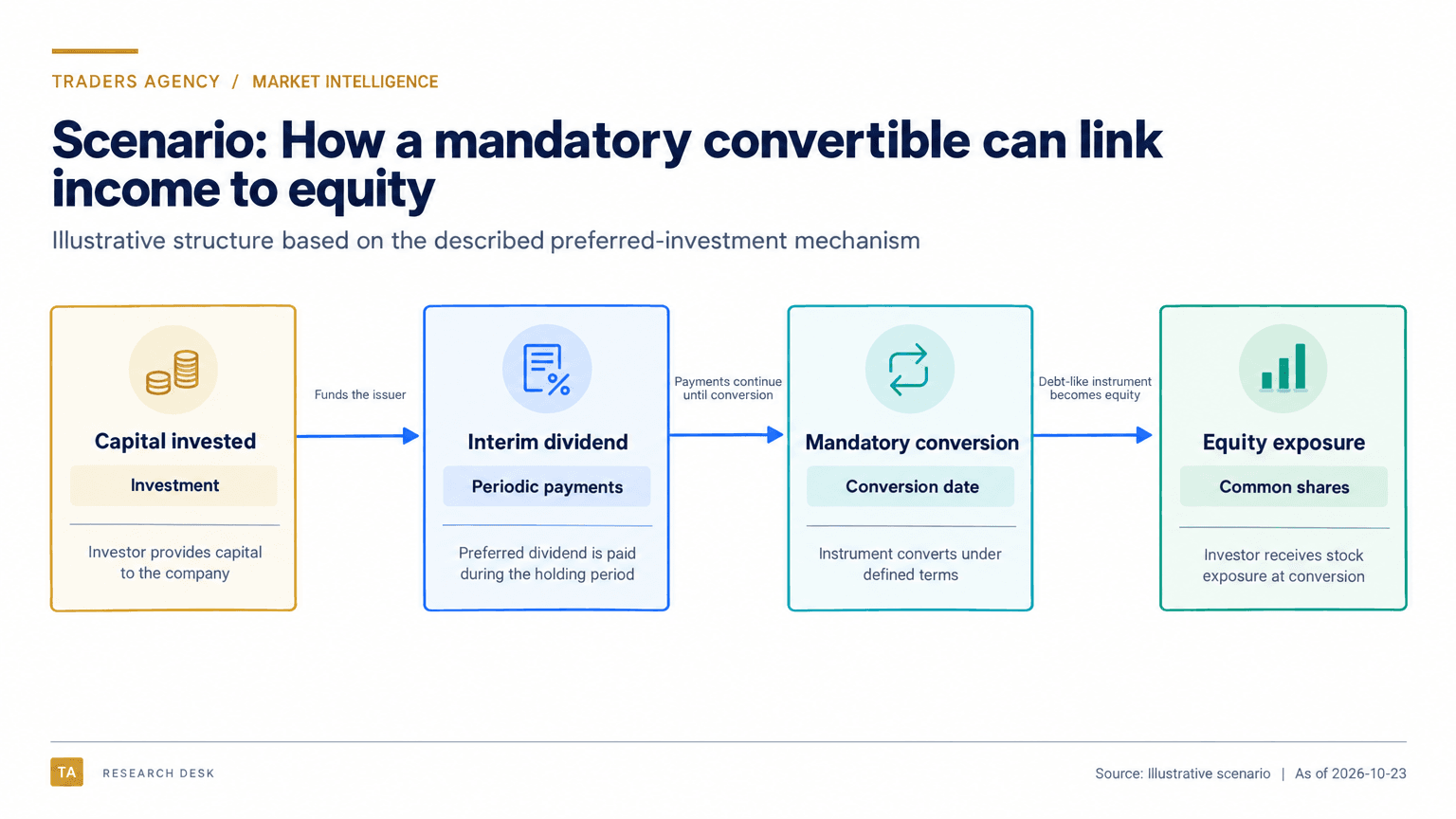
If Meta does pursue this path, the likely template is the kind of mandatory convertible preferred security Alphabet used earlier this year. Under the terms described in connection with that offering, investors receive a fixed annual dividend, reported at 6.25%, for a set period before the security automatically converts into common stock around May 2029. In effect, the instrument behaves like a bond for a while and then becomes equity.
To illustrate the mechanics: imagine investing $100 into such a structure. Instead of simply collecting interest and getting the $100 back at maturity, as with a conventional loan, the investor collects the stated dividend each year and then converts into shares of stock at the end of the term. The final value depends on where the shares trade at conversion, so the investor keeps upside exposure that a straight loan would not provide.
This structure reportedly fits Warren Buffett's long-stated preference for equity exposure over straight lending, and it can carry a tax advantage in certain cases. Using illustrative California tax assumptions, a $6.25 dividend taxed at long-term capital-gains rates could net an investor around 4.19% after tax, compared with roughly 3.125% after tax on the same amount of ordinary interest income. These numbers are a simplified example built on a specific state and bracket, not a universal outcome, since actual after-tax results depend on the investor's jurisdiction, income level and the instrument's legal classification.
Want expert trading insights delivered daily?
Join thousands of traders who rely on Traders Agency for market analysis and trade ideas.
Join Traders AgencyValuations, Leverage and the Cost of Borrowing
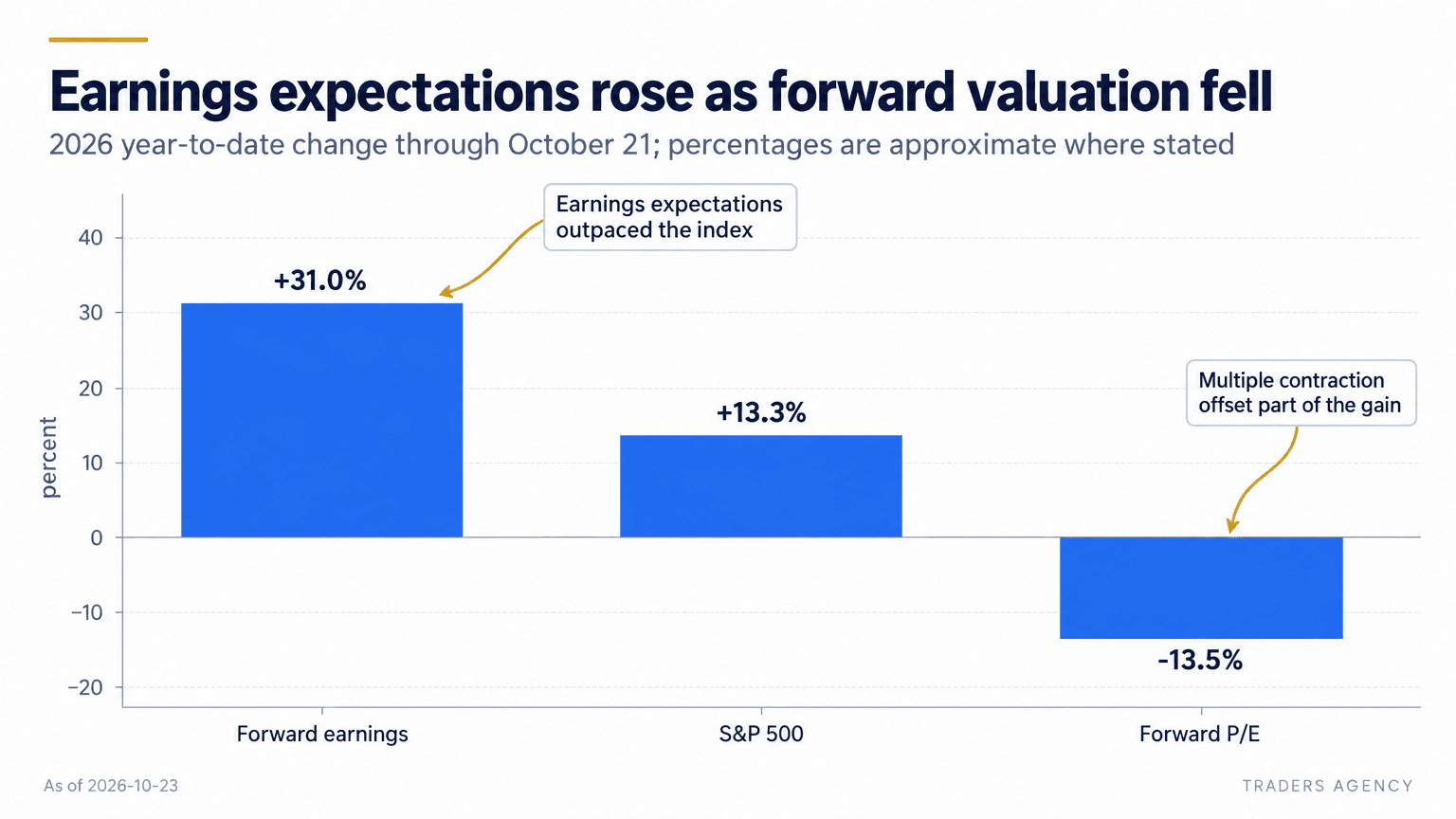
Part of the argument for Berkshire's potential interest rests on valuation. According to a chart attributed to LSEG Datastream and Yardeni Research, forward earnings expectations for the S&P 500 rose about 31% year to date through October 21, while the price index itself gained roughly 13.3% and the forward price-to-earnings multiple fell about 13.5% over the same period. In plain terms, earnings expectations climbed faster than prices, which compressed the valuation multiple even as the market advanced.
Positioning data add another layer. Goldman Sachs and Vanda Research reportedly found hedge funds cutting exposure sharply, with net leverage described as sitting near 43.7% and at the lowest percentile of a five-year range. Lower leverage among institutional traders is sometimes read as a contrarian signal, since it suggests less euphoria baked into prices, though it is an interpretation rather than a guarantee of future returns.
AI's importance to overall market earnings is also considerable. Market commentary puts AI-related companies at roughly 78% of expected S&P 500 earnings growth next year, with the non-AI portion of the index expected to grow only about 4%. That concentration means a slowdown in AI spending could weigh heavily on broader index performance, a risk worth keeping in view regardless of how any single financing deal unfolds.
The Bull and Bear Case for AI Infrastructure
Supporters of continued AI buildout point to data-center economics that, under favorable assumptions, look remarkably fast-payback. Bloom Energy reportedly stated that every quarter of delay in bringing a gigawatt-scale data center online could represent about $10 billion in lost revenue, which annualizes to roughly $40 billion. Elon Musk has been cited suggesting some data centers could see payback periods of close to a year. Using illustrative figures of $40 billion to $50 billion in annual revenue against a $57 billion capital cost, that would imply recovering somewhere between 70% and 87% of the facility's cost in the first year alone, an assumption-driven scenario rather than an established result, since it ignores financing costs, depreciation, taxes and ramp-up time.
The bear case is just as real. Negative free cash flow at some infrastructure companies, accelerating chip depreciation, and the risk of memory-chip oversupply from aggressive capacity additions all represent genuine counterweights to the optimistic payback math. These are the kinds of durability questions that a price-conscious investor would need to weigh before committing capital to any AI-linked security.
Macro Crosscurrents Investors Are Watching
Broader uncertainty frames all of this. Prediction-market pricing on Kalshi recently showed about 69% odds for exactly two Federal Reserve rate hikes this year, with 23% for one hike and 8% for three, figures that reflect a snapshot of market sentiment rather than a forecast guaranteed to play out. Possibilities such as a post-election rally or a resolution to tensions involving Iran are discussed as scenarios that could support markets, not certainties. As one market observer put it, there are no guarantees, only probabilities.
What Comes Next
Whether Berkshire ultimately participates in any Meta financing remains unconfirmed, and the specific size, structure and timing cited by analysts should be treated as estimates rather than settled terms. What the episode does highlight is a broader shift in how AI infrastructure might get funded as debt markets grow pricier: through equity-linked instruments that blend interim income with eventual ownership. Traders Agency analysts will be watching whether Meta formally announces a financing structure, how any deal is priced relative to AI earnings growth, and whether credit spreads continue widening in a way that makes equity-linked capital more attractive across the sector.
Want expert trading insights delivered daily?
Join thousands of traders who rely on Traders Agency for market analysis and trade ideas.
Join Traders AgencyDISCLAIMER: Traders Agency does not offer financial advice. The information provided is for educational purposes only and should not be considered financial advice. Traders Agency is not responsible for any financial losses or consequences resulting from the use of the information provided. Trading carries inherent risks and may not be suitable for all individuals. You are advised to conduct your own research and seek personalized advice before making any investment decisions, recognizing the potential risks and rewards involved.
See more from Traders Agency on Google
Make us a preferred source and our market analysis will appear more prominently in your Google Search, Top Stories, and AI results.
Add to Preferred Sources