Tesla's third-quarter 2026 results showed a familiar pattern: margins improving from a rough start to the year, but profit still shrinking as the company plows cash into artificial intelligence and Optimus development. Revenue came in at $28.05 billion, essentially flat year over year and in line with the roughly $28.06 billion Wall Street expected, while adjusted earnings of $0.48 per share beat consensus estimates but were down 4% from $0.50 a year earlier, according to Electrek and CNBC.
Automotive Revenue Slips, Services Pick Up the Slack
Tesla's core automotive business brought in $20.56 billion, down 3% from a year earlier, while energy generation and storage revenue fell 16% to $2.88 billion. Those declines were partly offset by a 33% jump in services and other revenue, to $4.61 billion, Electrek and CNBC reported.
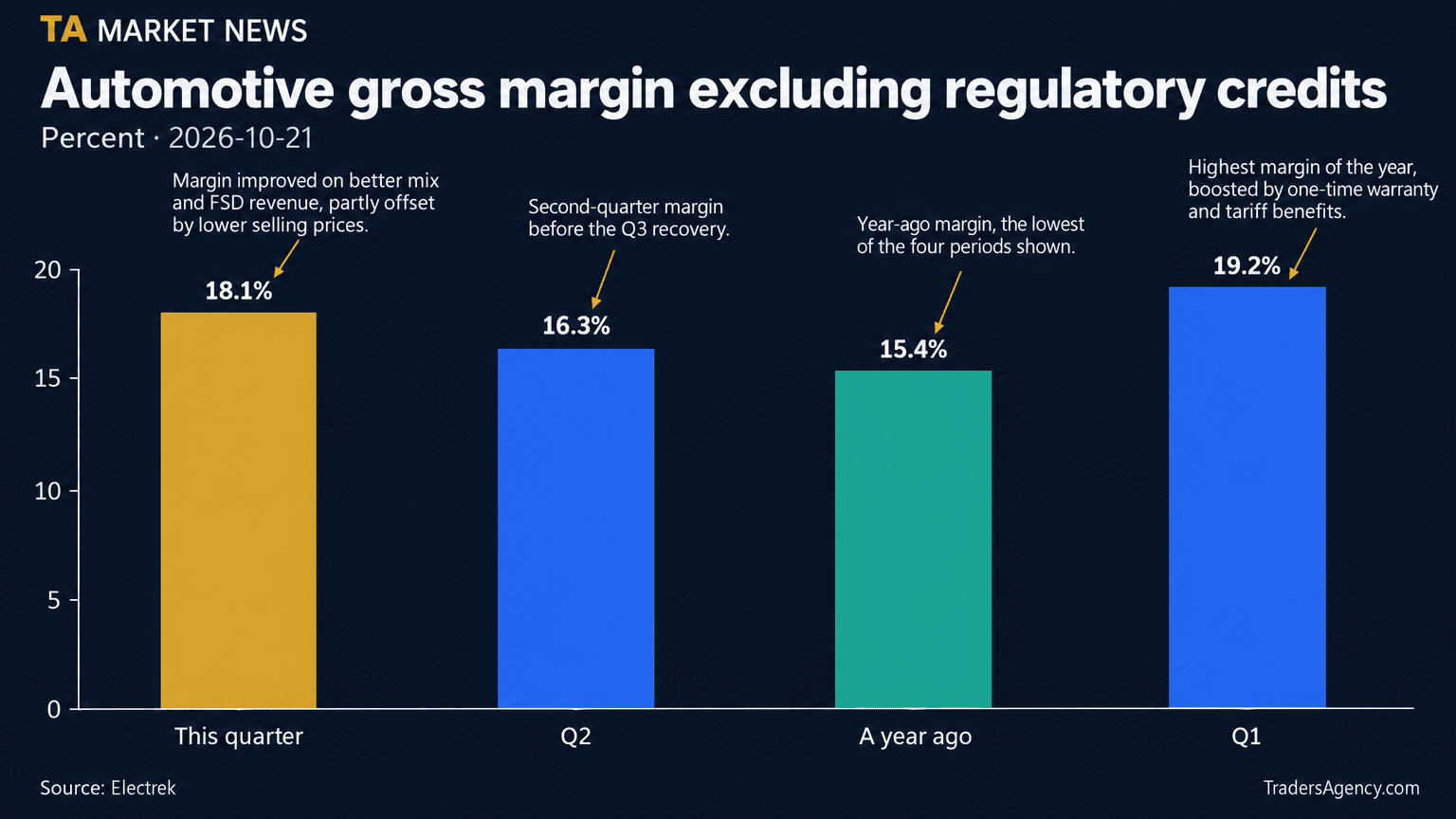
Automotive gross margin excluding regulatory credits came in at 18.1%, an improvement from 16.3% in the second quarter and 15.4% a year ago, though still below the 19.2% posted in the first quarter, when Tesla benefited from one-time warranty and tariff adjustments. Tesla credited a better regional and product mix along with higher FSD subscription revenue, partly offset by lower average selling prices, per Electrek's reporting.
Energy Storage Deployments Miss, Margin Jumps Anyway
Energy storage deployments rose to 13.7 GWh from 12.5 GWh a year earlier but fell short of the roughly 15.9 GWh analysts had expected, according to Electrek. Even so, the segment's gross margin jumped to 33% from 20% in the second quarter, though energy gross profit still slipped to $954 million from $1.07 billion a year ago. Electrek noted Tesla partly blamed the revenue decline on tariff-related customer refunds. Separately, regulatory credit revenue collapsed to $113 million, down 73% from $417 million a year earlier and below the $146 million booked in the second quarter, a line Electrek said isn't coming back now that automakers no longer pay federal fuel-economy penalties.
AI and Optimus Spending Drives Operating Expenses Higher
Operating expenses rose 39% year over year to $4.78 billion. Research and development spending alone jumped 69% to $2.76 billion as Tesla invests in what it now calls "Super Intelligence," Optimus and the Cybercab, Electrek reported. Stock-based compensation, which includes the 2025 CEO pay package, hit $1.17 billion, up from $663 million a year ago.
Electrek's own calculation puts Tesla's capital expenditure at $13.01 billion through the first nine months of 2026, only about half of the "more than $25 billion" management guided for the full year. The outlet noted the Q3 letter did not update that guidance, and capex actually fell sequentially from $5.79 billion in the second quarter. By Electrek's math, Tesla would need to spend roughly $12 billion in the fourth quarter alone to hit the full-year figure, more than double its biggest quarter to date, raising the possibility that the 2026 spending plan is slipping into 2027.
Battery Supply and Demand Questions
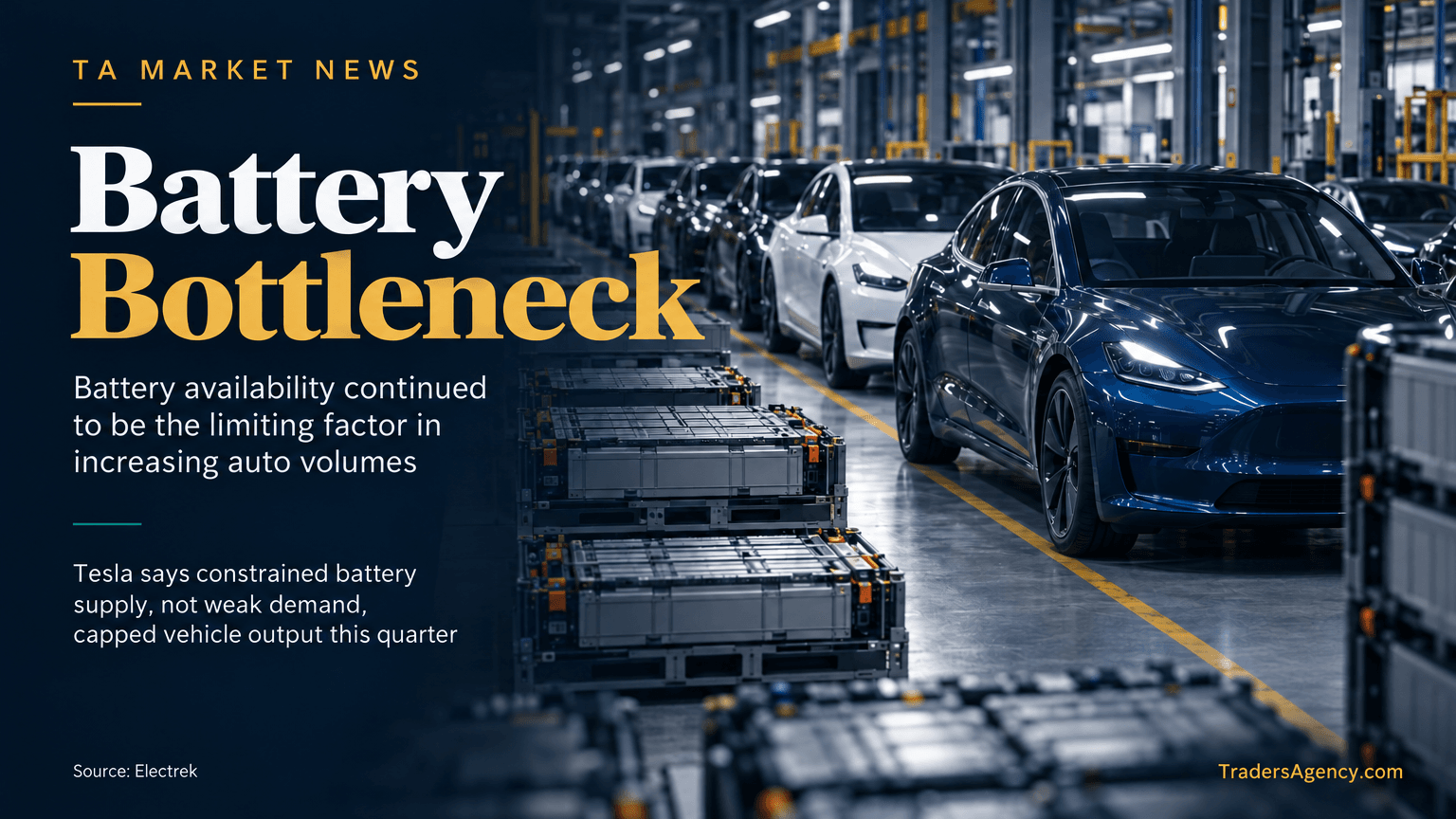
Tesla attributed weak automotive revenue and profit to lower average selling prices and battery supply constraints, saying "battery availability continued to be the limiting factor in increasing auto volumes in the quarter" and that it ended Q3 with "the largest backlog for our passenger vehicles in four years," according to Electrek and CNBC.
Electrek pushed back on that framing, pointing out that deliveries were still down 2% year over year, that "other models" including Cybertruck, Semi, and Model S and X fell 48%, and that Tesla delivered 22,141 more cars than it built, cutting inventory to 11 days of supply from 15 in the second quarter. Average selling prices fell again in the quarter, which Electrek said isn't typical behavior for a supply-constrained automaker. Tesla had previously reported Q3 deliveries of 486,532 vehicles, down about 2% year over year but ahead of the 461,974 consensus, while producing only 464,391, per Electrek. CNBC also noted that Tesla said its auto sales in Canada, Japan, Taiwan and Australia hit new records in the quarter, even as the company has gotten meager growth out of its core market of late while Chinese EV makers such as BYD and Xiaomi gained popularity in Asia and Europe, and after last year's end of the federal EV tax credit.
Autonomy Progress and Optimus Timeline
Active FSD subscriptions rose 67% year over year to 1.74 million, and Tesla said in its investor deck, "We believe that FSD is driving demand in markets where it is available, and we continue to work with regulators to get it approved in other markets," per CNBC. Electrek noted that count includes upfront purchases as defined in Musk's 2025 pay package. Tesla's Robotaxi service reached nearly 2 million cumulative unsupervised miles by the end of the quarter, a month after Cybercab joined the Austin fleet, Electrek reported.
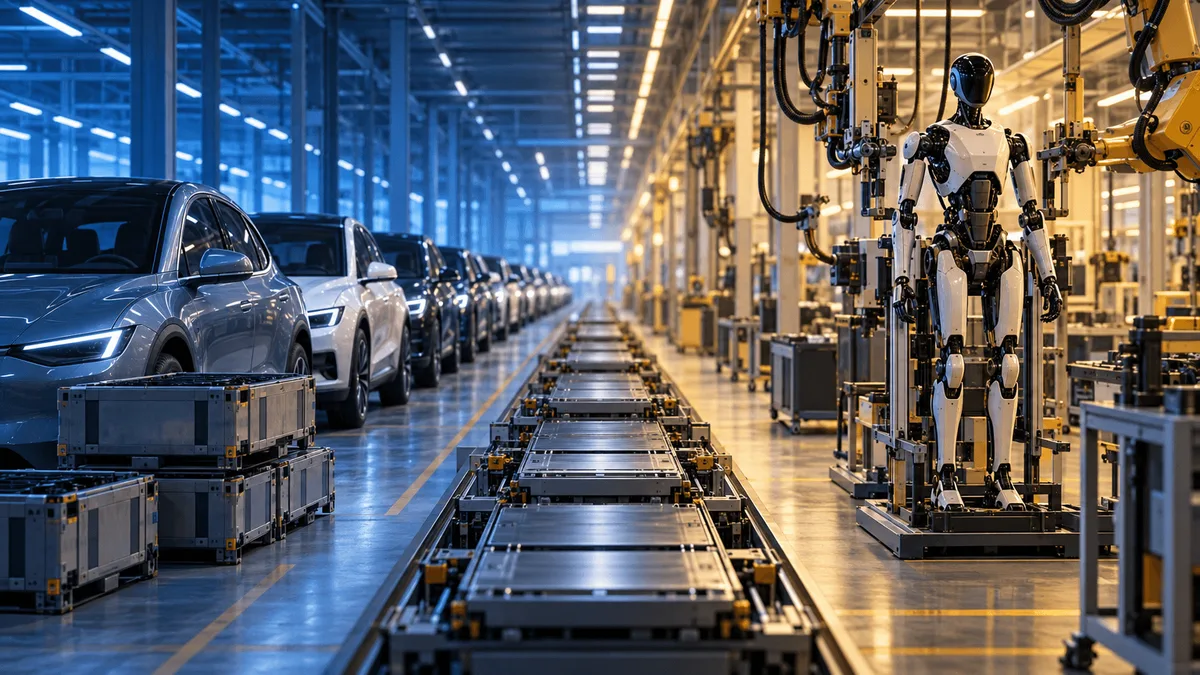
On Optimus, CEO Elon Musk said Tesla is "making good progress" on the AI systems controlling the robots, but acknowledged there's "still quite a lot of work to do with regard to the AI and the robot for it to be truly useful for open-ended tasks." He said he expects current issues around electromechanical design, reliability, usage duration and AI to be "solved around the end of next year," according to CNBC.
SpaceX Merger Talk and Stock Reaction
The earnings landed a day after Musk told SpaceX investors that a merger with Tesla would be a "good idea" and that both boards had formed special committees to discuss a possible tie-up, CNBC reported. On the Tesla call, Musk offered no new details, saying only, "I think I said everything that should be said yesterday." He added that a combination would require a 50% vote of all Tesla shares, calling it "quite a high hurdle," and told SpaceX investors, "I feel like I'm tap dancing through a minefield." CNBC also pointed to Tesla's semiconductor factory being built with SpaceX and Intel in Grimes County, Texas, along with overlap on Tesla's recently announced Roadster refresh, as factors fueling the merger speculation.
Shares were little changed in extended trading immediately after the report but later shed those gains, last trading down 2%, according to CNBC.
Bottom Line
Tesla's third quarter told two stories at once. Automotive margins improved from the prior two quarters as mix and FSD revenue helped offset falling average selling prices, and energy storage profitability jumped even as deployment volumes missed estimates. At the same time, a 39% increase in operating expenses, driven by a 69% jump in R&D tied to AI and Optimus work, weighed on profitability, with free cash flow down about 62% from a year earlier to $1.53 billion, though that marked a recovery from negative $1.09 billion in the second quarter, according to CNBC and Electrek. Tesla ended the quarter with $45.4 billion in cash and investments, Electrek reported. Whether the company can close the gap between its nine-month capex pace and its full-year guidance, and how the SpaceX merger discussion evolves, remain open questions management did not resolve on the call.
DISCLAIMER: Traders Agency does not offer financial advice. The information provided is for educational purposes only and should not be considered financial advice. Traders Agency is not responsible for any financial losses or consequences resulting from the use of the information provided. Trading carries inherent risks and may not be suitable for all individuals. You are advised to conduct your own research and seek personalized advice before making any investment decisions, recognizing the potential risks and rewards involved.
- CNBC Top News: Tesla (TSLA) Q3 2026 earnings report · accessed Oct 21, 2026
- Seeking Alpha Market News: Stocks to watch after hours: IBM, META, and TSLA · accessed Oct 21, 2026
- Electrek: Tesla (TSLA) releases Q3 2026 financial results: margins rebound, profit still falls · accessed Oct 21, 2026
- CNBC: META, TSLA, LRCX, IBM · accessed Oct 21, 2026
See more from Traders Agency on Google
Make us a preferred source and our market analysis will appear more prominently in your Google Search, Top Stories, and AI results.
Add to Preferred Sources