
You've probably seen this setup before: a stock grinding sideways for weeks, implied volatility sitting in the low 20s, and forum threads full of screenshots promising "easy" weekly income. The iron condor strategy is a defined-risk, four-leg options position built by selling an out-of-the-money put and call while buying further out-of-the-money put and call protection, designed to profit when the underlying stays inside a price range through expiration. By the end of this guide, we'll have walked you through how to construct one, manage the Greeks as time decays, size positions the way a professional desk would, and adjust when one side gets tested.
This isn't a beginner primer. We're assuming you already understand calls, puts, spreads, and basic Greek exposure. What we're adding here is the granular mechanics: how delta, theta, and vega interact across the life of the trade, how to roll a tested side without blowing up your risk budget, and how institutional traders think about position sizing before they ever place the order.
How Do You Construct an Iron Condor Strategy?
Bottom Line: An iron condor strategy pays off when a stock stays range-bound through expiration, but managing it well means tracking theta and vega shifts, sizing positions within the same risk budget as any other trade, and rolling a tested side before it threatens the whole position. Defined risk isn't the same as low risk, so skipping trades into earnings or trending stocks matters as much as the setup itself.
An iron condor strategy is built from four separate option legs, all on the same underlying and the same expiration date, combined into one position.
The Four Legs
- Sell an out-of-the-money (OTM) put at a strike closer to the current stock price
- Buy a further OTM put at a lower strike for protection
- Sell an OTM call at a strike closer to the current stock price
- Buy a further OTM call at a higher strike for protection
The two short options generate premium. The two long options cap your risk on both sides. Together, this creates a credit spread on the put side and a credit spread on the call side, combined into a single four-leg structure with a net credit received upfront.
The width between your short and long strikes on each side determines your max loss. A narrower wing reduces risk but also reduces the credit collected. A wider wing increases potential profit but increases max loss proportionally.
Key Concept: An iron condor is two credit spreads sold at the same expiration, one below the stock and one above it. You collect a net credit upfront, and your maximum loss on either side equals the wing width minus that credit.
What Is the Objective of the Iron Condor Strategy?
The objective is to collect premium from time decay and falling or stable implied volatility while the stock stays between your short put and short call strikes until expiration. You're not betting on direction. You're betting on range.
This is fundamentally a short volatility trade. You're selling the expectation of a big move, and you profit as that expectation fails to materialize. The iron condor setups we favor share one trait: the underlying has a history of mean-reverting behavior rather than trending hard in one direction.
Profit/Loss Diagram of an Iron Condor Strategy
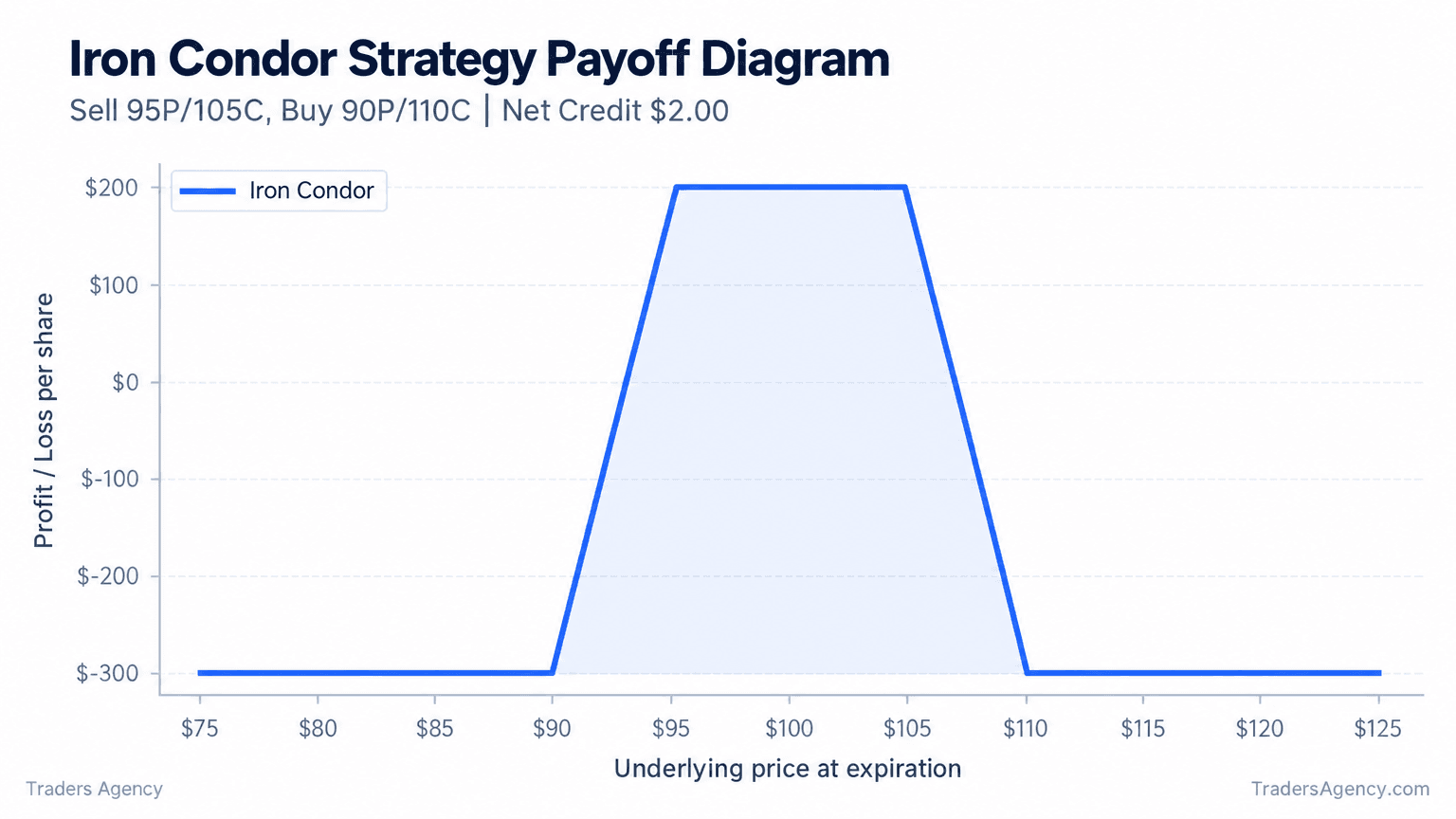
The payoff profile of an iron condor forms a distinctive shape: flat profit in the middle, sloped losses on both wings, and flat max loss beyond the long strikes.
Between your two short strikes, you keep the full credit received. As price moves past either short strike, profit erodes in a straight line until it hits max loss at the long strike. Beyond the long strikes, losses are capped completely, no matter how far the stock runs.
What Does a Hypothetical Iron Condor Trade Look Like?
If you've ever searched for "what is iron condor strategy with an example," here's the full numerical walkthrough rather than a vague summary.
Assume a stock is trading at $100 with 30 days to expiration. Here's how we'd build the position:
| Leg | Action | Premium |
|---|---|---|
| $95 put | Sell | +$1.80 |
| $90 put | Buy | -$0.80 |
| $105 call | Sell | +$1.70 |
| $110 call | Buy | -$0.70 |
| Net credit received | $2.00 per share ($200 per contract) | |
Breakeven, Max Gain, Max Loss
| Parameter | Value |
|---|---|
| Max Gain | $200 (full credit) if the stock closes between $95 and $105 |
| Max Loss | $300 per contract ($5 wing width minus $2 credit) |
| Upper Breakeven | $107.00 ($105 short call + $2.00 credit) |
| Lower Breakeven | $93.00 ($95 short put minus $2.00 credit) |
We always run the exact strikes through an iron condor strategy calculator before execution to confirm probability of profit and expected value given current implied volatility, since small changes in skew can shift the breakeven math meaningfully.
Outcome Scenarios
| Scenario | Stock Price at Expiration | Profit/Loss |
|---|---|---|
| Best Case | $100 | +$200 (full credit kept) |
| Upper Breakeven | $107 | $0 |
| Lower Breakeven | $93 | $0 |
| Worst Case | Below $90 or above $110 | -$300 |
In range-bound, low-volatility conditions, a typical outcome is a drift that finishes somewhere between $93 and $107, which captures a partial to full credit depending on the exact closing price. That is an expectation, not a probability guarantee, and a single breach past $90 or $110 still costs the full $300.
Want expert trading insights delivered daily?
Join thousands of traders who rely on Traders Agency for market analysis and trade ideas.
Join Traders AgencyHow Do You Manage Greeks in an Iron Condor Position?
Greek management is where most traders who only learn the beginner version of this trade get stuck, because the static payoff diagram doesn't show how exposure moves day to day.
At initiation, the position is roughly delta-neutral, meaning it carries little directional bias. As the stock moves toward either short strike, delta shifts meaningfully in that direction, effectively turning the trade into a directional bet against further movement.
Theta (time decay) works in your favor throughout the trade, and decay accelerates as expiration approaches, particularly in the final 7 to 10 days. Vega (volatility exposure) is negative, meaning a volatility spike hurts the position even if the stock hasn't moved. That's why we prefer entering when implied volatility rank is elevated relative to the underlying's own recent history rather than in absolute terms.
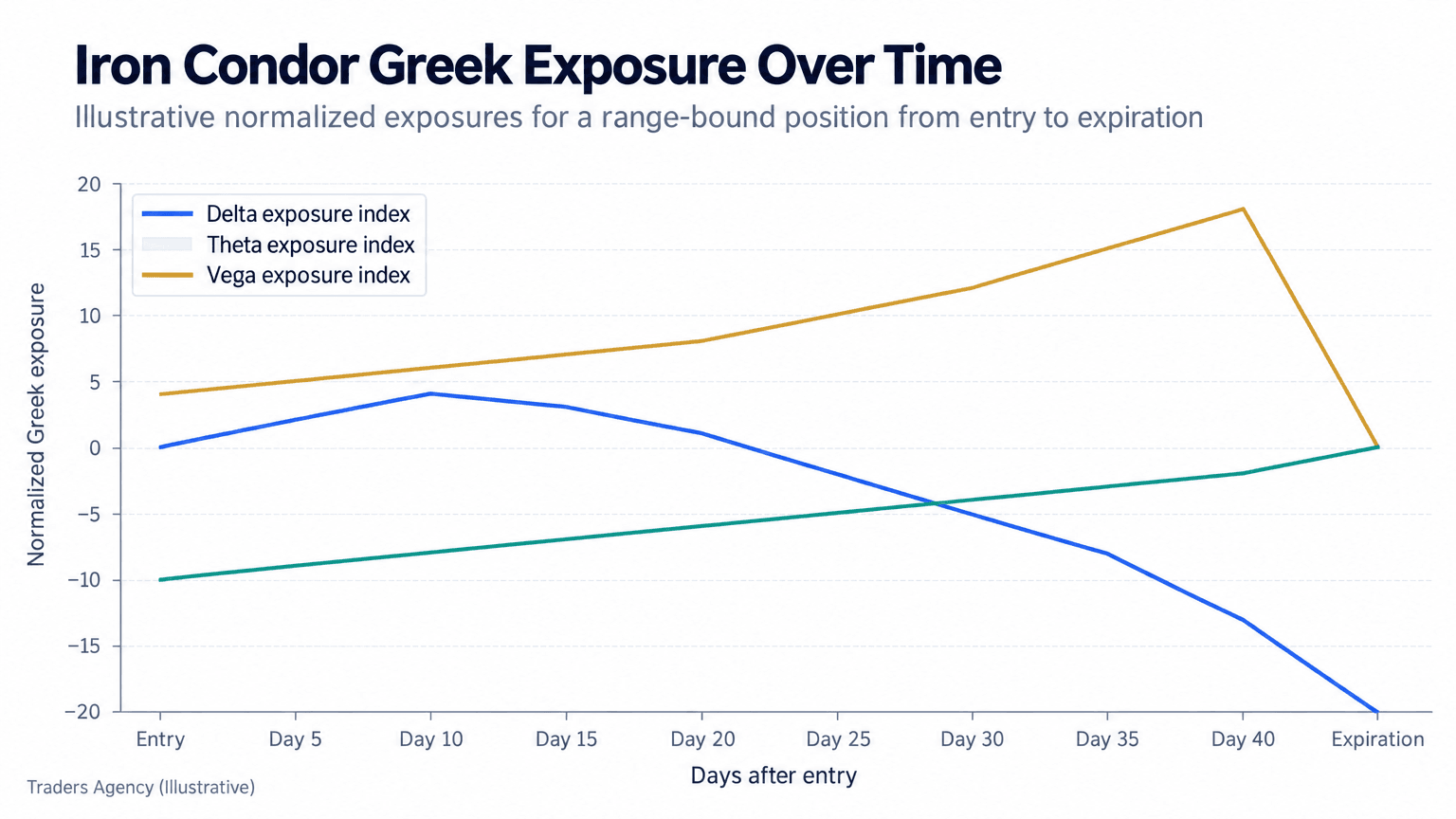
Watch Out: Theta income accumulates fastest near expiration, but that's also when gamma risk peaks. A small stock move in the final week can swing delta rapidly and threaten a short strike that looked perfectly safe just days earlier.
Is the Iron Condor a Good Strategy?
An iron condor can be a strong fit for range-bound, lower-volatility markets, but it isn't universally superior to other options strategies. Its value depends heavily on trade selection, strike width, and discipline around exits, not on the structure alone.
Reported results on iron condor success rates vary widely depending on strike selection and management rules, which is part of why opinions on trading forums differ so much. A condor with short strikes close to the current price collects a larger credit but wins less often, since the profit range is narrow. One with short strikes further out of the money wins more often, but each loss can be several times the smaller credit collected. Neither approach is automatically better; both require consistent risk sizing to be sustainable over many trades.
Related Strategies to the Iron Condor
Several other structures share mechanics or objectives with the iron condor:
- Iron butterfly: Same four-leg structure, but both short strikes sit at the same price, which increases the credit collected and narrows the profit range, so losses occur more often
- Short strangle: Same short strikes as the condor, without the protective long wings, which removes the defined-risk cap
- Credit spread (single side): Just the put or call side of the condor, used when a trader has directional conviction rather than a pure range view
- Calendar spread: Uses different expirations rather than different strikes to express a volatility view
Traders running weekly condors for income often rotate between these related structures depending on whether implied volatility favors a defined-risk, capped-reward approach or a wider strangle with higher theta collection.
How Do You Adjust an Iron Condor When a Side Gets Tested?
Professional-style risk management on an iron condor starts with position sizing, not strike selection.
Position Sizing by Risk Budget
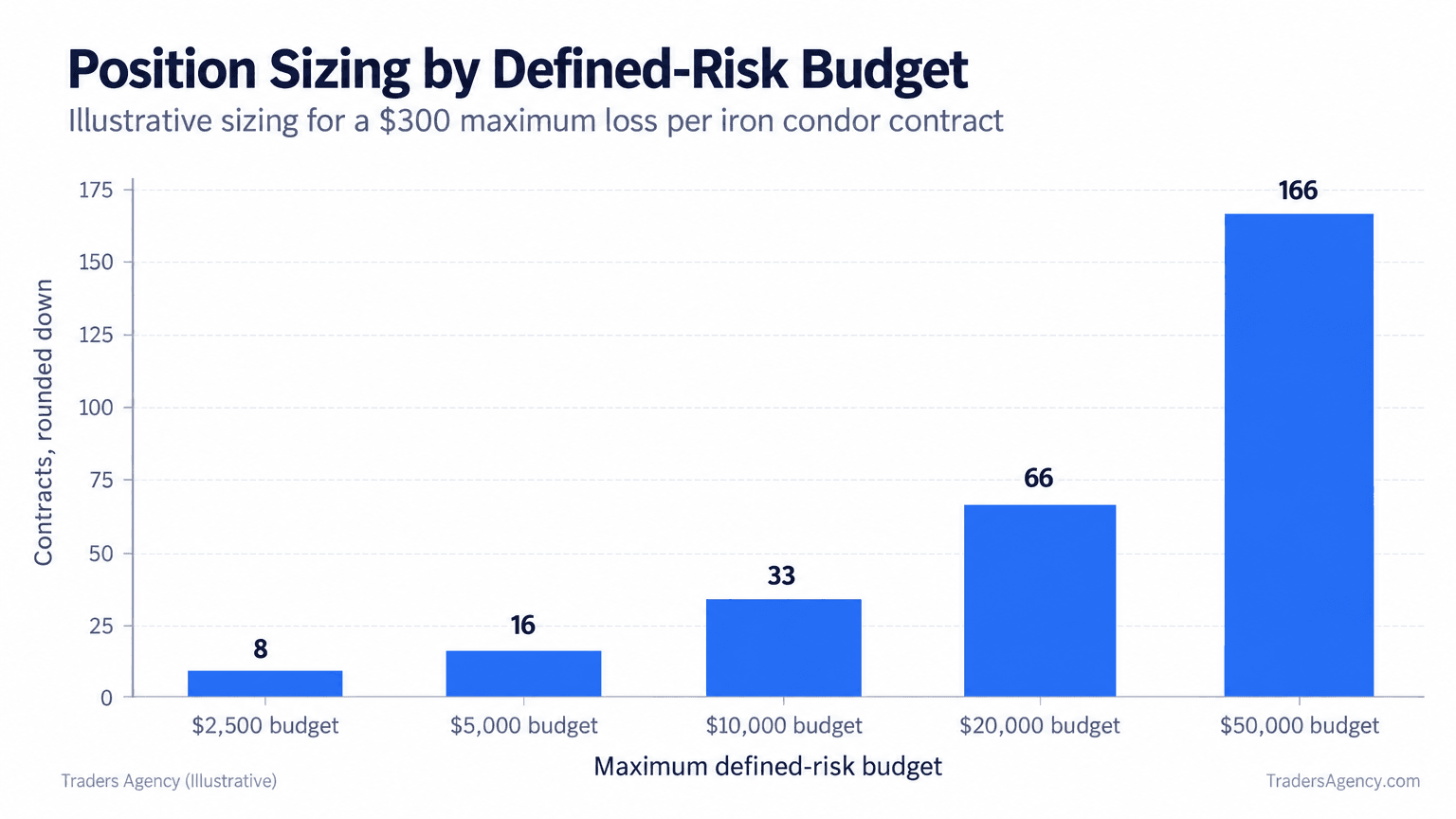
If a desk allocates a fixed dollar risk budget per trade type, say $5,000, and each iron condor contract risks $300 at max loss, that budget supports roughly 16 contracts before hitting the allocation ceiling. We treat this as a cleaner starting point than sizing by account percentage alone, because it keeps correlated condor exposure from stacking up across multiple underlyings.
Rolling a Tested Side
When one short strike gets tested before expiration, we work through these adjustment paths in order:
- Roll the untested side closer to collect additional credit that offsets the loss building on the tested side
- Roll the tested side out in time and away in strike, which reduces immediate risk but extends your exposure to the trade
- Close the tested side at a loss and leave the untested side open, converting the position into a simple one-sided credit spread
- Exit the entire position early once a predefined loss threshold, often 1.5x to 2x the credit received, is hit
Volatility Regime Filtering
Rather than trading every setup that technically fits, we filter candidates by comparing current implied volatility rank or percentile against the stock's own trailing range. The Cboe Volatility Index is a useful broad-market volatility gauge for that context, and the Options Clearing Corporation's standardized educational material on how multi-leg spreads settle at expiration is worth reviewing before you trade real size.
When Should You Use an Iron Condor Strategy?
This strategy fits best when three conditions line up:
- Implied volatility is elevated relative to its own recent history
- The underlying has shown range-bound behavior rather than a strong trend
- No major event (earnings, FDA decisions, macro data) falls inside the expiration window
Skip the trade heading into known binary events, in strongly trending stocks, or when wing widths are so narrow that a single average daily move can breach a short strike.
Watch Out: Max allocation to any single condor should stay inside the same risk-budget framework you use across your entire options book. Defined risk does not mean small risk, so don't treat these as a separate "safe" bucket.
Want expert trading insights delivered daily?
Join thousands of traders who rely on Traders Agency for market analysis and trade ideas.
Join Traders AgencyDISCLAIMER: Traders Agency does not offer financial advice. The information provided is for educational purposes only and should not be considered financial advice. Traders Agency is not responsible for any financial losses or consequences resulting from the use of the information provided. Trading carries inherent risks and may not be suitable for all individuals. You are advised to conduct your own research and seek personalized advice before making any investment decisions, recognizing the potential risks and rewards involved.
See more from Traders Agency on Google
Make us a preferred source and our market analysis will appear more prominently in your Google Search, Top Stories, and AI results.
Add to Preferred Sources