
Cash-secured puts are an options strategy where you sell a put option on a stock while setting aside enough cash to buy 100 shares if the option gets exercised. You collect a premium upfront for taking on that obligation, and you either keep the premium as income or end up owning the stock at a discount. It's one of the most practical ways we know to generate income while getting paid to wait for a better entry price.
We teach this strategy to members who want their cash working for them instead of sitting idle in a brokerage account. By the end of this guide, you'll know exactly how to structure a trade, what the payoff looks like at expiration, and how selling cash-secured puts fits into a broader income approach like the wheel strategy.
You've probably seen this happen: a stock you like pulls back, but you're not quite ready to buy. Cash-secured puts let you get paid while you wait for that dip, and if the stock falls further, you end up owning it at your target price anyway.
What Is a Cash-Secured Put?
Bottom Line: Cash-secured puts pay you a premium for committing cash upfront, but the tradeoff is real risk: if the stock drops sharply, your loss can run into the thousands even though it's capped at the strike price minus premium. Picking strikes with a comfortable buffer, watching delta ranges, and checking earnings dates before entering are what keep this strategy working as steady income rather than a costly surprise.
A cash-secured put is a short put option position backed by enough cash to purchase 100 shares of the underlying stock at the strike price if assigned. You're the seller, not the buyer, which means you collect the premium immediately and hold the obligation until expiration or assignment.
Think of it as an insurance contract. You're the insurer, and the buyer pays you a premium for the right to sell you their shares at a set price. If the stock stays above your strike, the "policy" expires worthless and you keep the premium. If it falls below your strike, you're obligated to buy the shares, just like an insurer pays out on a claim.
Key Concept: Selling a cash-secured put means you get paid today for agreeing to buy a stock at a lower price later. The premium is yours to keep either way.
This differs from buying puts, which is simply purchasing downside protection or speculating on a decline. Selling them flips the risk profile: you want the stock to stay flat or rise, and time decay works in your favor instead of against you.
How Does a Cash-Secured Put Work?
A cash-secured put works by selling a put option on a stock you'd be willing to own, collecting the premium as income, and holding cash equal to 100 shares times the strike price as collateral until the option expires or you're assigned shares.
Here's the sequence we walk members through:
- Step 1: Choose the Stock – Pick a name you actually want to own at a lower price, not just one with a fat premium.
- Step 2: Select the Strike – Set it below the current market price, ideally near a support level you'd be comfortable buying at.
- Step 3: Pick the Expiration – We favor 30 to 45 days out for standard income trades.
- Step 4: Sell the Put – Collect the premium immediately; it hits your account the moment the trade fills.
- Step 5: Hold the Collateral – Keep cash equal to strike price times 100 shares per contract set aside.
- Step 6: Manage to Expiration – Either the option expires worthless and you keep the premium, or you're assigned shares at your strike.
Your broker will lock up the required cash the moment you open the position. That's what separates a true cash-secured put from a naked put, where the short option is backed by margin instead of cash and a sharp decline can trigger a margin call.
What Does a Cash-Secured Put Example Look Like With Real Numbers?
Let's say XYZ stock is trading at $105 per share. You believe it's a solid company, but you'd rather own it closer to $100.
You sell one put contract with a $100 strike price, expiring in 30 days, and collect a premium of $3.00 per share, or $300 total (since one contract covers 100 shares).
| Parameter | Value |
|---|---|
| Stock | XYZ at $105 |
| Put Sold | $100 strike, $3.00 premium, 30 days out |
| Premium Collected | $300 (1 contract × 100 shares) |
| Cash Collateral Required | $10,000 |
| Max Profit | $300 (put expires worthless) |
| Breakeven / Net Cost Basis | $97.00 per share |
| Max Loss | $9,700 (stock goes to $0) |
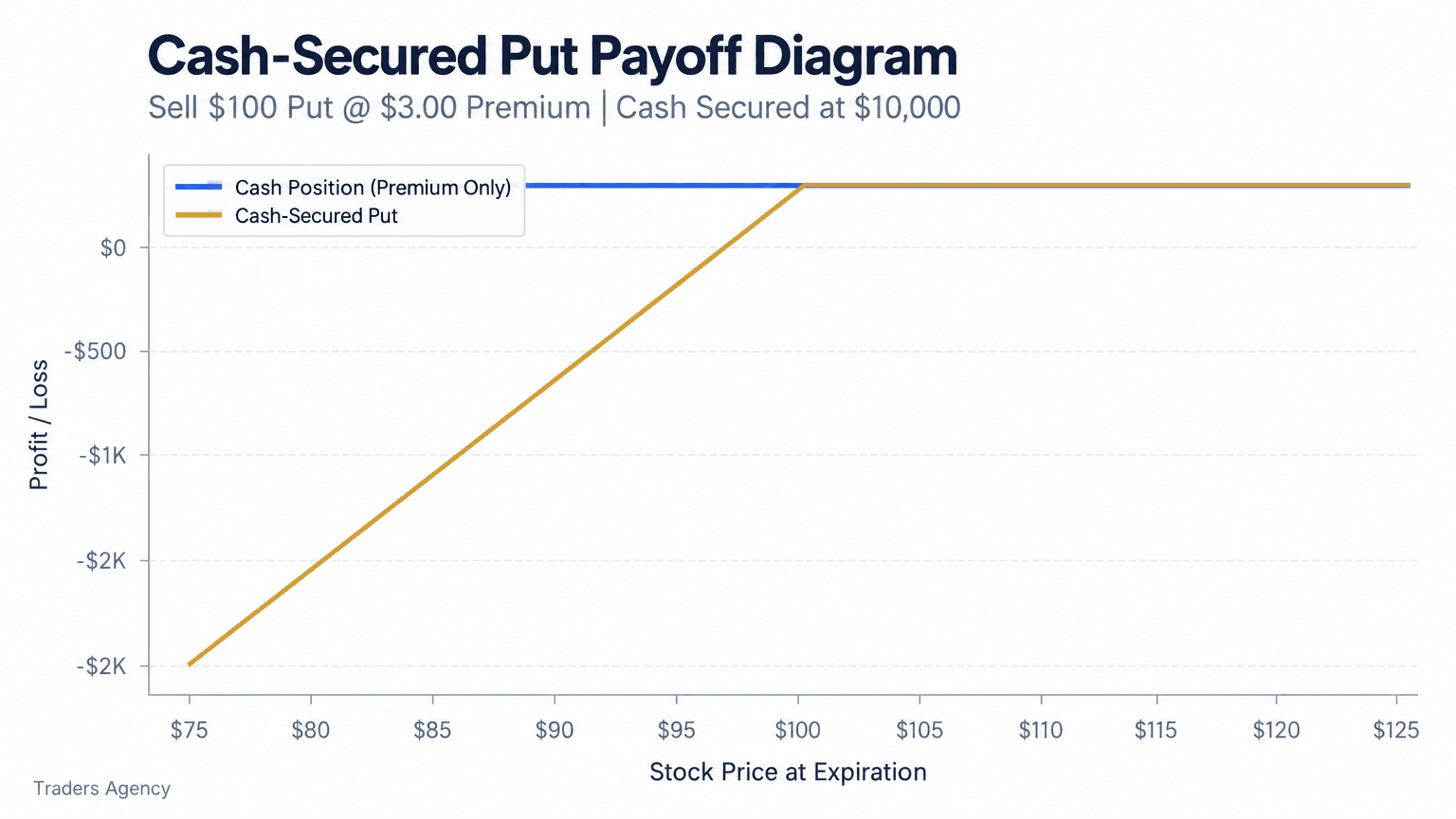
Here's how the trade can play out at expiration:
| Scenario | XYZ at Expiration | Outcome |
|---|---|---|
| Best Case | $100 or higher | Put expires worthless, keep +$300, no shares purchased |
| Breakeven | $97.00 | Assigned at $100, premium offsets the loss: $0 |
| Assignment | $99 | Own 100 shares at a $97 net cost basis |
| Worst Case Shown | $80 | Assigned at $100, underwater $17/share or -$1,700 |
How Much Cash Do You Need for Cash-Secured Puts?
For this trade, your broker requires $10,000 in cash collateral ($100 strike × 100 shares) held aside for the duration of the trade. That requirement is non-negotiable with a true cash-secured put.
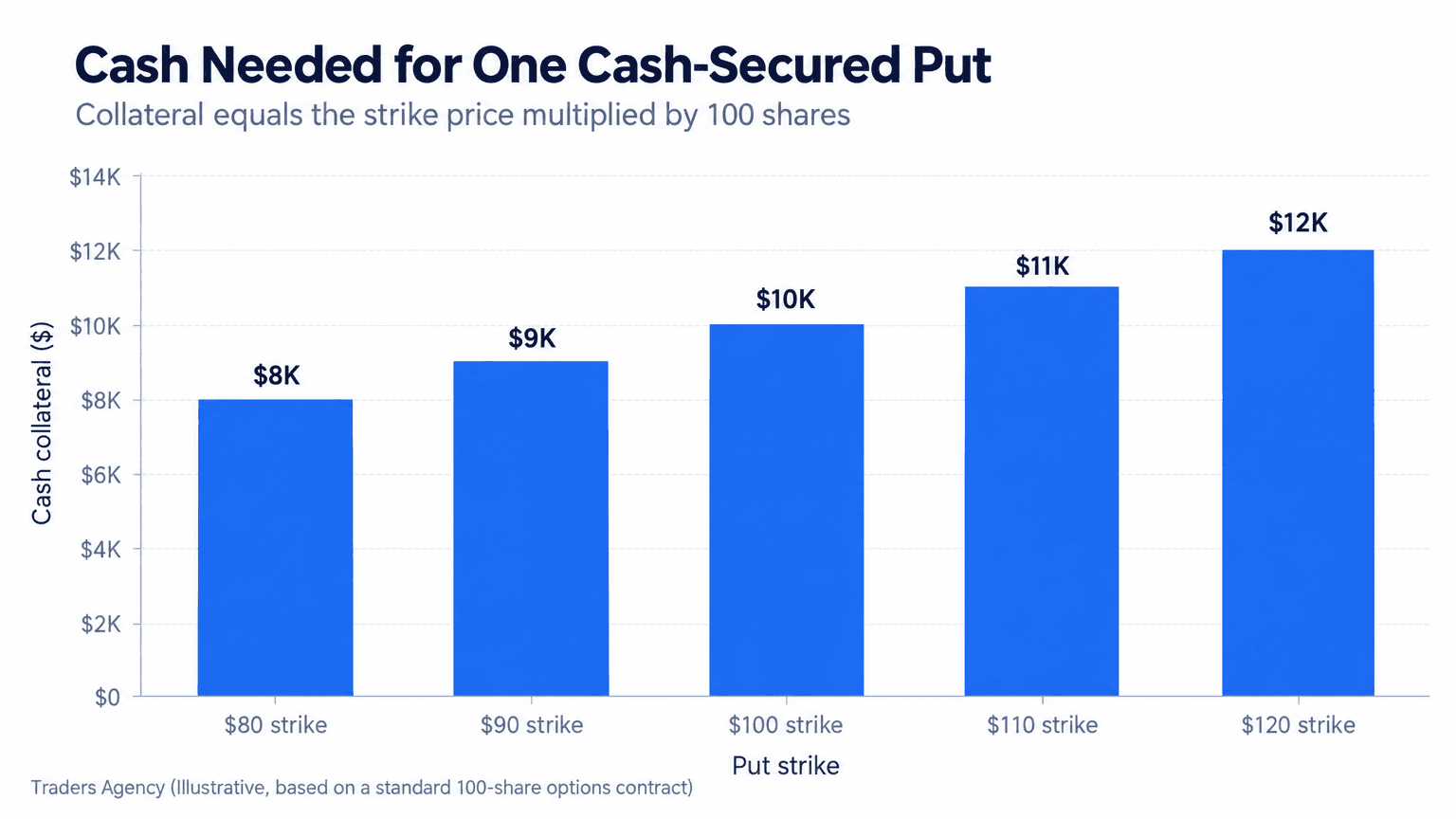
This is also where portfolio-secured puts versus cash-secured puts becomes a relevant distinction. Some brokers allow portfolio margin accounts to secure puts with a fraction of the full cash requirement, using other holdings as collateral instead. That approach increases leverage and risk, and it's generally reserved for larger, more experienced accounts. Most standard brokerage platforms require the full cash amount in a cash account, which is the safer starting point for the majority of traders.
Want expert trading insights delivered daily?
Join thousands of traders who rely on Traders Agency for market analysis and trade ideas.
Join Traders AgencyWhen Should You Sell Cash-Secured Puts?
We like this strategy in range-bound or moderately bullish markets on stocks we'd genuinely want to own. It works best when implied volatility is elevated, since higher volatility means richer premiums, though it also reflects a wider expected trading range in the stock.
Selling weekly cash-secured puts can boost your annualized income because you're collecting premium more frequently, but weekly contracts also carry higher gamma risk, meaning the option's price can swing quickly on small stock moves close to expiration. Our team generally prefers 30 to 45 day expirations for a smoother decay curve and less day-to-day monitoring.
The Greeks That Matter Most
Understanding the Greeks helps you manage risk before it becomes a problem:
- Delta roughly estimates the probability of assignment. A put with a -0.30 delta has roughly a 30% chance of finishing in-the-money.
- Theta represents time decay, and it's your friend as a seller. Every day that passes without a big move in the stock, the option loses value, which benefits you.
- Vega measures sensitivity to implied volatility, and as a put seller you're short vega. Elevated volatility inflates the premium you collect up front, but a further volatility spike raises the option's value and works against an open position. Combined with gap risk, that's why many traders avoid holding short puts through earnings unless they're comfortable with the added uncertainty.
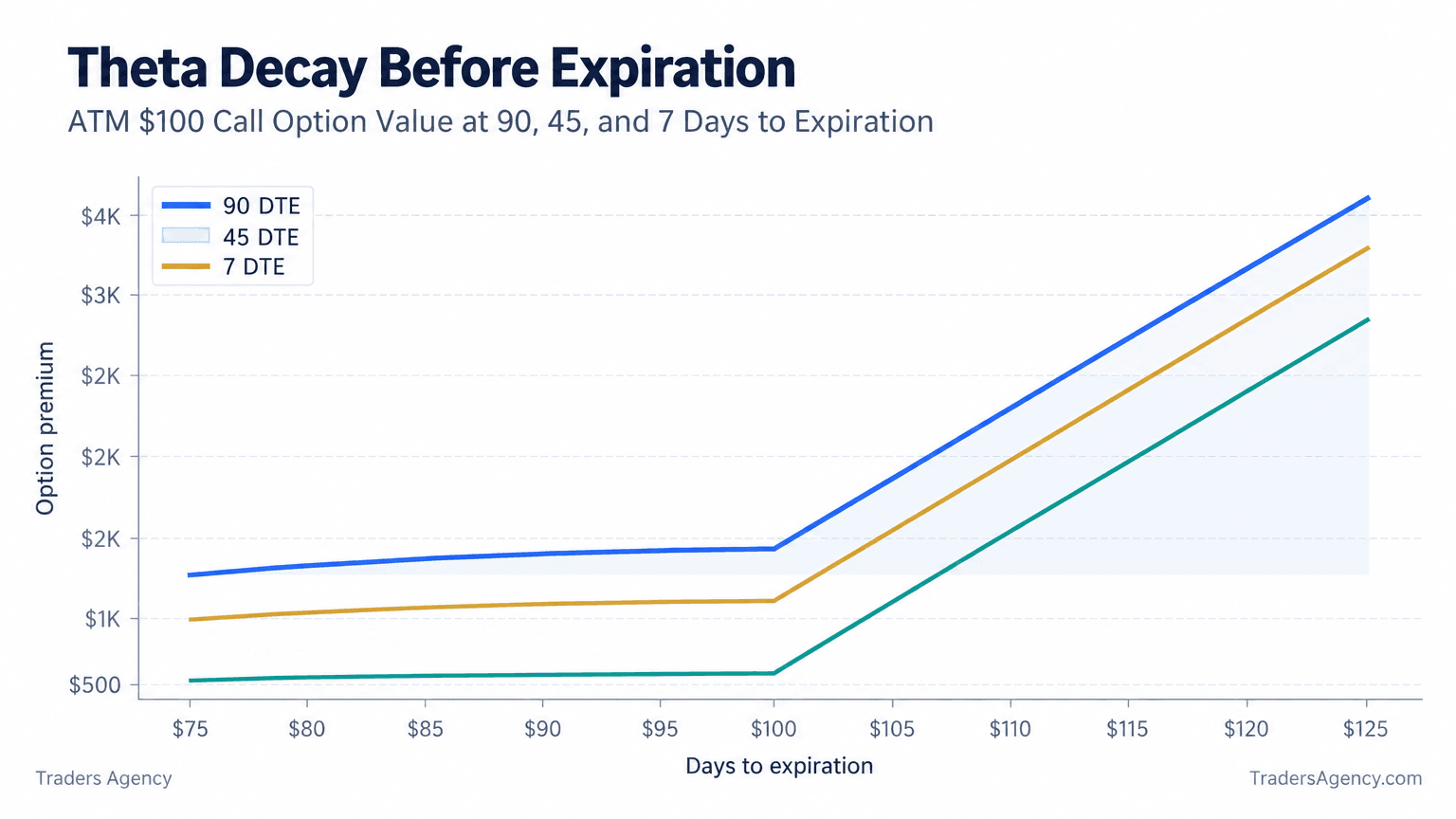
Theta decay accelerates as expiration approaches, which is one reason we favor the 30 to 45 day window. It captures the steepest part of the decay curve while leaving room to manage the position if the trade moves against you.
Cash-Secured Puts vs Covered Calls: Which Is Better?
Neither strategy is objectively "better." Cash-secured puts vs covered calls is really a question of where you are in the ownership cycle. Puts are for entering a position at a discount, while calls are for generating income on shares you already own.
| Feature | Cash-Secured Put | Covered Call |
|---|---|---|
| What You Hold | Cash collateral | 100 shares of stock |
| Goal | Enter at a discount or collect premium | Generate income on existing shares |
| Ideal Outcome | Stock stays above strike | Stock stays below strike |
| Assignment Result | You buy shares | You sell shares |
They actually work together beautifully in what's known as the wheel strategy.
Using Cash-Secured Puts in the Wheel Strategy
The wheel works as a repeating cycle:
- Step 1: Sell a Cash-Secured Put – Choose a stock you want to own and a strike below the current price.
- Step 2: Repeat If It Expires – If the put expires worthless, sell another one and collect more premium.
- Step 3: Take Assignment – If you're assigned, you now own the stock at your discounted cost basis.
- Step 4: Sell a Covered Call – Write a call against those shares at a strike above your cost basis.
- Step 5: Repeat If It Expires – If the call expires worthless, sell another one.
- Step 6: Close the Loop – If the call is assigned, you sell the shares for a gain and return to Step 1.
This cycle is why so many income traders treat cash-secured puts and covered calls as two halves of the same wheel rather than competing strategies.
Is Selling Cash-Secured Puts a Good Idea?
Whether selling cash-secured puts is a good idea depends entirely on one thing: are you truly willing to own the underlying stock at the strike price? If you are, it's a reasonable way to generate income or enter a position at a discount. If you're only doing it for the premium without wanting the shares, you're taking on stock ownership risk without the commitment that makes the strategy work.
What Are the Key Risks of Cash-Secured Puts and How Do You Manage Them?
The biggest mistake we see is selling puts on stocks people don't actually want to own long-term, purely chasing premium income. When the stock drops hard, they're stuck holding a position they regret.
Watch Out: Never sell a cash-secured put on a stock you wouldn't be happy to own at the strike price. The premium is small consolation for holding a company you don't believe in.
Other common mistakes include:
- Picking strikes too close to the current price, which increases assignment risk without enough premium to compensate.
- Ignoring earnings dates, which can cause sudden volatility spikes and sharp price moves through your strike.
- Over-allocating cash to a single name, leaving no flexibility if the trade needs adjusting.
- Forgetting dividend dates, which can affect early assignment risk on some contracts.
Our approach to risk management comes down to three habits: cap any single cash-secured put position at a small percentage of total portfolio value, choose strikes with a meaningful buffer below the current price, commonly in the 0.20 to 0.30 delta range when income is the primary goal, and always check the earnings calendar before opening a new position.
Remember This: The maximum loss on a cash-secured put occurs if the stock falls to zero, and it equals the strike price minus the premium received, times 100 shares. In our example that's $9,700, so the loss is finite but far from small. You can review official contract specifications and options education materials directly at Cboe.
Want expert trading insights delivered daily?
Join thousands of traders who rely on Traders Agency for market analysis and trade ideas.
Join Traders AgencyDISCLAIMER: Traders Agency does not offer financial advice. The information provided is for educational purposes only and should not be considered financial advice. Traders Agency is not responsible for any financial losses or consequences resulting from the use of the information provided. Trading carries inherent risks and may not be suitable for all individuals. You are advised to conduct your own research and seek personalized advice before making any investment decisions, recognizing the potential risks and rewards involved.
See more from Traders Agency on Google
Make us a preferred source and our market analysis will appear more prominently in your Google Search, Top Stories, and AI results.
Add to Preferred Sources