Learning how to trade commodity futures starts with one mechanic that trips up plenty of experienced equity traders: you aren't buying barrels of oil or bars of silver, you're buying a standardized contract that obligates you to a price on a future date. That single distinction changes how you think about margin, expiration, and risk compared to stocks or even options on stocks.
In this guide, we'll walk through the mechanics of contract sizing and leverage across mini and micro commodity contracts, how contango and backwardation affect multi-leg rollover positions, and the account-sizing math that answers questions like whether $1,000 is enough to get started. We'll also break down an institutional-style hedging example so you can see how professional desks use the same instruments retail traders do, just at a different scale.
By the time you finish, you'll be able to calculate margin requirements across contract sizes, read a futures curve for rollover risk, and build a position-sizing framework that doesn't blow up your account on contract number three.
How Do You Trade Commodity Futures?
Bottom Line: Trading commodity futures successfully comes down to respecting leverage and margin math before chasing a position, since contract size and rollover timing can erode an account faster than price direction alone. Traders who build a pre-trade checklist and size positions around worst-case margin calls, rather than best-case profit targets, are the ones who stay in the game long enough to use these instruments the way institutional desks do.
You open a margin-enabled futures account with a registered broker, select a contract (gold, crude oil, or natural gas, for example), post the required margin, and take a long or short position that settles in cash or physical delivery by the expiration date.
The process breaks down into four repeatable steps, and almost everyone today learns to trade commodity futures online through a futures-enabled brokerage platform rather than phoning a floor broker.
- Step 1: Choose Your Contract Size. Many commodities trade in more than one size: standard, mini, and micro, though not every contract offers all three. Gold, for example, trades as a standard GC contract (100 troy ounces) and as an MGC micro contract (10 troy ounces), roughly one-tenth the notional exposure and margin.
- Step 2: Select a Delivery Month and Decide on Rollover. Every futures contract expires. If you hold a position past the exchange's notice date without rolling to the next month, you risk physical delivery obligations on commodities that settle that way, like crude oil.
- Step 3: Calculate Margin and Position Size. Brokers require initial margin (to open) and maintenance margin (to keep the position open). Because futures carry built-in leverage, a relatively small deposit controls a much larger notional value, which is exactly why position sizing deserves more attention than it gets in most beginner guides.
- Step 4: Place the Trade and Manage It Through Expiration. Once the position is live, you manage it with stop orders, calendar rolls, or exit targets, the same as any leveraged position, but with a hard deadline built into the contract itself.
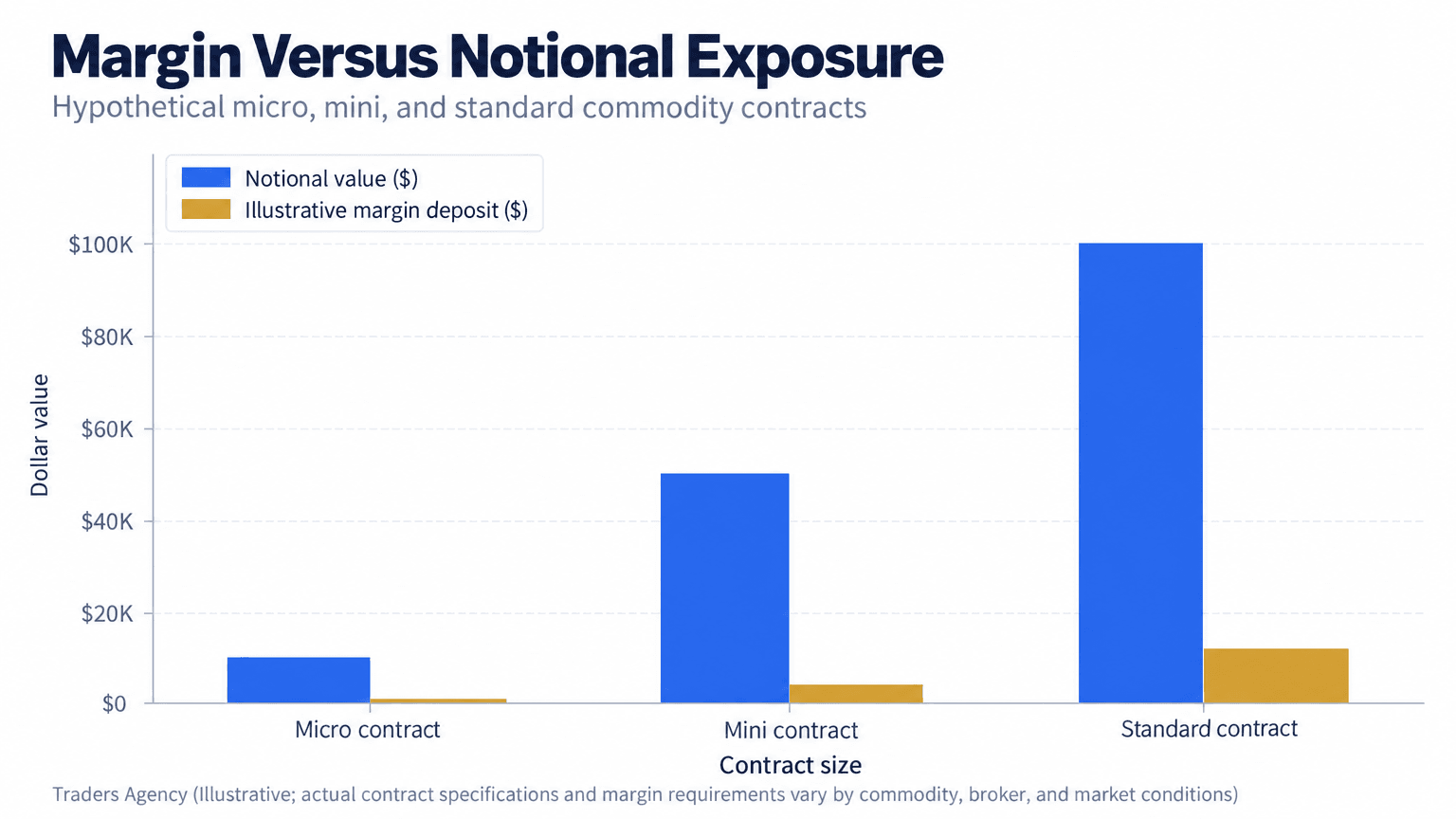
As the illustration above shows, notional exposure and margin requirements scale with contract size, though the leverage ratio itself does not move in lockstep. A micro contract might require roughly $800 in margin against a $10,000 notional position, while a standard contract on the same commodity could require $12,000 against $100,000 in notional exposure.
Key Concept: The ratio of margin to notional value is your real leverage number. We teach traders to check that figure before they check anything else about a contract.
What Are Examples of Futures in Trading?
Here's a commodity futures example using gold micro contracts. Say gold (spot) trades at $2,380 per ounce and the front-month MGC contract trades at $2,384.
You go long 2 MGC contracts at $2,384, with each contract representing 10 ounces (20 ounces total notional, roughly $47,680). Your broker requires $1,000 initial margin per contract, so $2,000 total to open the position.
| Parameter | Value |
|---|---|
| Contract | MGC (10 troy ounces per contract) |
| Position | Long 2 contracts at $2,384 |
| Total Notional | $47,680 (20 ounces) |
| Initial Margin Posted | $2,000 ($1,000 per contract) |
| Scenario | Gold Price | Profit/Loss |
|---|---|---|
| Best Case | $2,420 | +$720 ($36 × 20 oz, before commissions) |
| Most Likely Case | $2,360 to $2,400 | Chop; managed with a stop rather than held blind |
| Worst Case | $2,340 | -$880 ($44 × 20 oz) |
Watch Out: That -$880 loss against $2,000 of posted margin can trigger a margin call if the account is thinly funded. A loss that looks survivable on paper can force you out of the position before your thesis has a chance to play out.
This is also a useful reference point for understanding futures in the stock market: equity index futures (like E-mini S&P 500 contracts) work on identical leverage and margin logic, just applied to an index value instead of an ounce of metal.
How Do Margin, Contango, and Backwardation Work in Practice?
Contango happens when futures prices for later delivery months sit higher than the current spot price. Backwardation is the reverse: later months trade below spot, often because of near-term supply tightness.
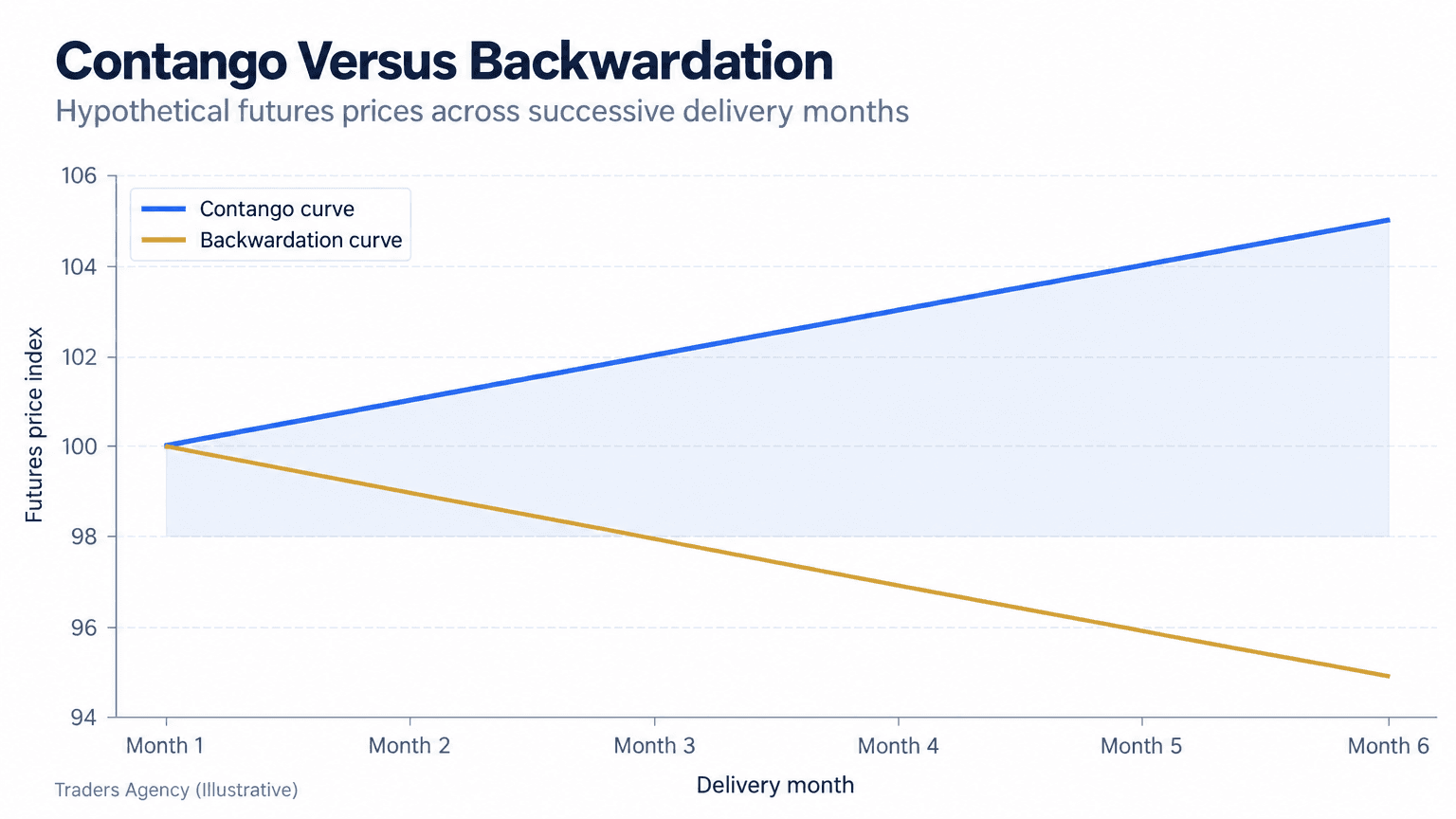
Curve structure matters most when you're running a calendar spread (long one month, short another) or simply rolling a core position forward. In a contango market, rolling a long position typically means selling a cheaper near-month contract and buying a pricier far-month contract, a cost often called negative roll yield.
Consider a crude oil trader holding a long position into the last week before expiration. If the curve is in contango by $0.80 per barrel between the front month and the next, rolling 10 contracts (1,000 barrels each) costs roughly $8,000 in curve structure alone, separate from any directional move in oil itself. Backwardation flips that into a tailwind, where rolling forward can actually add to returns.
Professional desks track roll cost as its own line item, and we'd encourage advanced traders to do the same rather than burying it in "slippage." Contract specifications and curve data for each commodity are published directly by the exchange, and CME Group is the first place we send traders who want the primary source.
Want expert trading insights delivered daily?
Join thousands of traders who rely on Traders Agency for market analysis and trade ideas.
Join Traders AgencyIs $1,000 Enough to Trade Futures?
Yes, for a single micro contract on many commodities, since initial margin on contracts like MGC or Micro WTI Crude can range from a few hundred dollars to roughly $1,200, depending on the commodity and current volatility. What it is not is enough margin cushion to absorb a volatile multi-day move without real risk of a margin call.
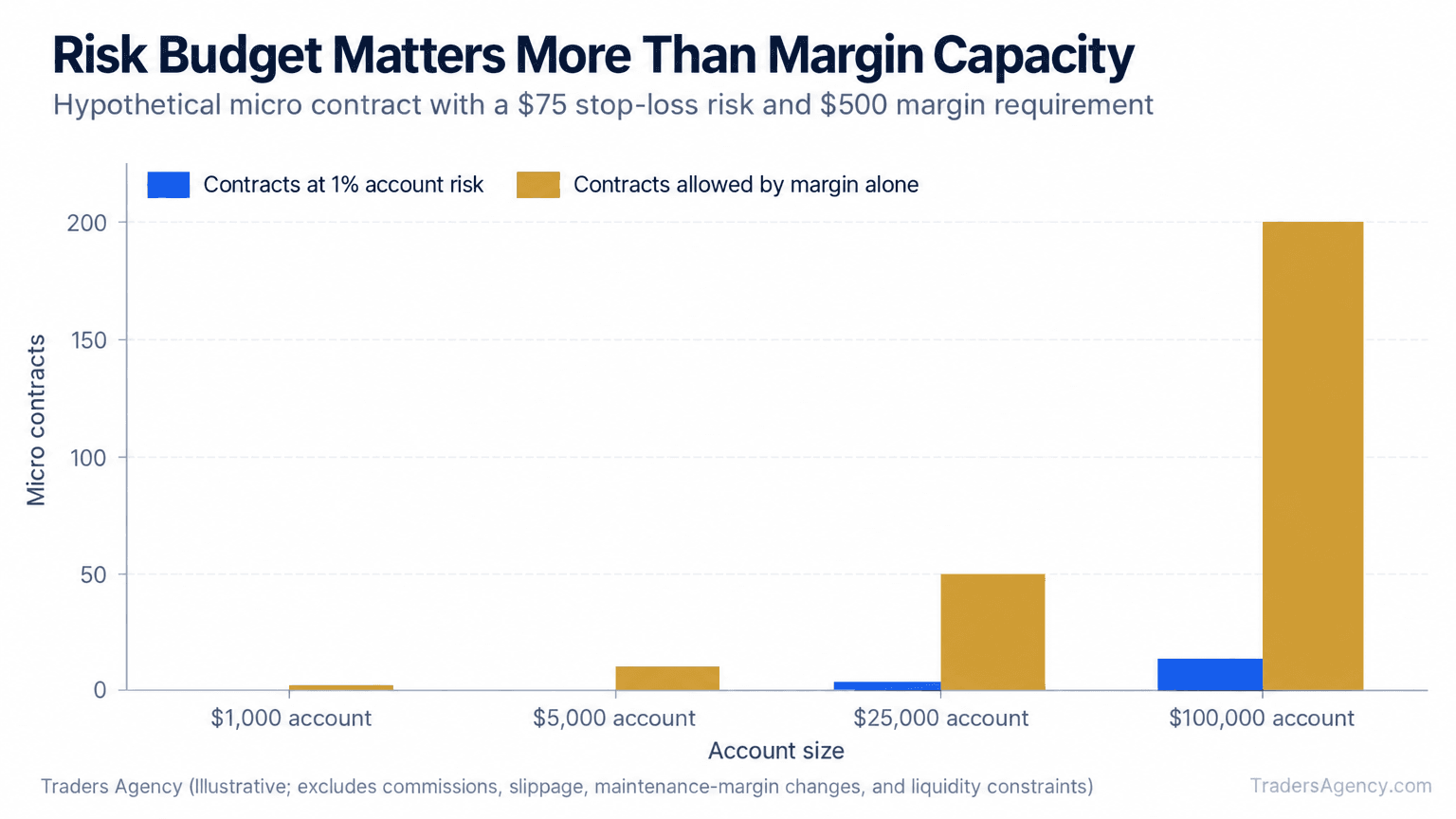
There's an important distinction here between margin capacity and risk-limited capacity. Your broker might let a $1,000 account open one or two micro contracts based on margin alone, but a risk-first approach (capping any single trade's potential loss at 1% to 2% of account equity) often limits that same account to a smaller position, or none at all, depending on the commodity's volatility.
Do You Need $25,000 to Trade Futures?
No. The $25,000 figure comes from the pattern day trader rule, which applies to margin accounts trading equities and equity options on U.S. exchanges. It does not apply to futures accounts, which operate under separate margin rules set by the exchange and your futures commission merchant.
This is where beginner and advanced futures trading start to diverge. New traders often ask whether they can trade futures with a few hundred dollars. The honest answer is that most retail brokers set minimum account funding well above $100, and even where it's technically possible, the risk-adjusted position size at that balance is frequently zero contracts, not one.
Who Actually Uses the Futures Markets?
Futures markets serve three broad groups:
- Hedgers: producers and consumers locking in prices on something they already own or will need.
- Speculators: traders seeking directional profit from price movement.
- Arbitrageurs: participants exploiting pricing gaps between related contracts or markets.
Here's an institutional example worth studying. A jewelry manufacturer holds 500 ounces of physical gold inventory worth $1,190,000 at $2,380/oz. To hedge against a price decline, the company shorts 5 GC contracts (500 ounces total) at $2,384.
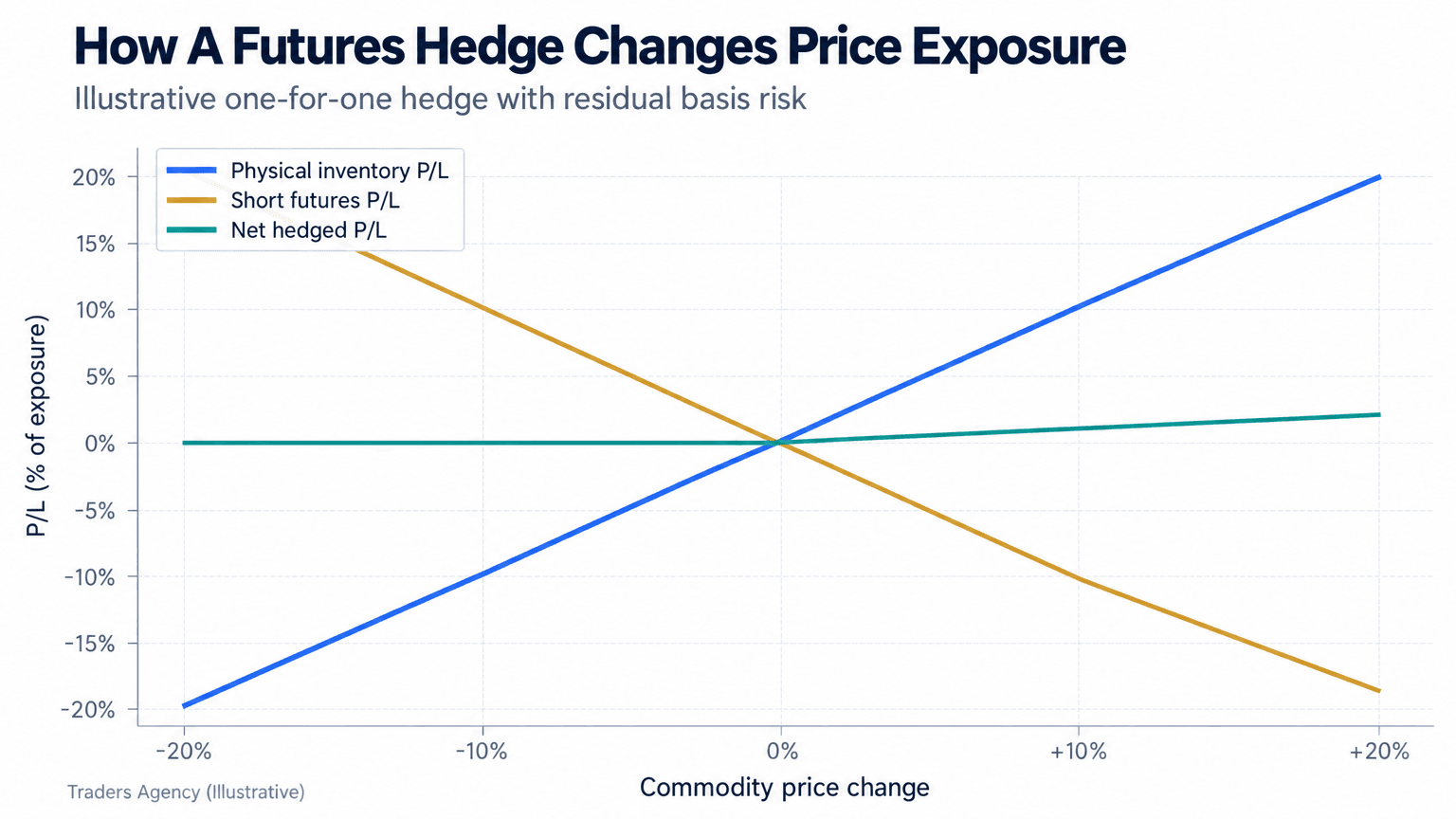
| Outcome at $2,340 Spot | Result |
|---|---|
| Physical Inventory (500 oz) | -$20,000 |
| Short Futures Position (5 GC) | +$22,000 |
| Net Position | Roughly +$2,000 residual from basis |
That small mismatch between the two legs is basis risk, the gap between the futures price and the local spot price. It's the reason even well-hedged institutional books never fully offset to zero, and it's a concept we want every trader to internalize before they assume a hedge is "complete."
How Are Futures Professionals Regulated?
In the United States, futures markets are overseen by the Commodity Futures Trading Commission (CFTC), with day-to-day registration and conduct rules administered through the National Futures Association (NFA). If you're trading commodity futures in U.S. markets specifically, your broker should be registered as a Futures Commission Merchant (FCM) or operate as an introducing broker under one.
Exchanges like CME Group set the actual contract specifications: size, tick value, margin minimums, and delivery terms. Brokers can require more margin than the exchange minimum, but never less, which is worth confirming before you assume your paper margin math matches your live account.
Your Pre-Trade Checklist
Before entering any commodity futures or options position, we run through these five items in order:
- Confirm the contract's notional value, not just the margin requirement, so you know your true exposure.
- Set a hard stop-loss level tied to a dollar amount you can absorb, not just a chart pattern.
- Check the delivery and notice dates and build your rollover plan before you're forced into one.
- Review the current curve structure (contango or backwardation) if you plan to hold through a roll.
- Cap single-position risk at a fixed percentage of account equity, commonly 1% to 2% for advanced traders managing multiple concurrent contracts.
Position sizing in futures is less forgiving than in stocks because leverage is built into the contract rather than being optional. A trader who wouldn't dream of using 10x margin on a stock position can end up with similar effective exposure in a single micro futures contract without realizing it.
Approach the Futures Markets with Caution
Futures work best when you have a defined thesis (directional, hedging, or spread-based) and the margin cushion to survive being early. They work poorly as a substitute for a stock position when a trader simply wants "more exposure" without accounting for the leverage difference.
Common Mistakes We See: Treating micro contracts as risk-free because the dollar margin looks small. Holding a position into the delivery window without a rollover plan. Ignoring roll yield in contango markets and then wondering why a flat market produced a loss. Sizing futures positions the same way you'd size stock positions, without adjusting for built-in leverage.
Commodity futures also fit into a broader portfolio differently than ETFs or direct ownership. Here's how we compare the three:
| Vehicle | Advantage | Trade-Off |
|---|---|---|
| ETFs | Simple exposure, no margin calls | Tracking error and expense ratios |
| Direct Ownership | No counterparty or expiration issues | Ties up capital, storage costs |
| Futures | Highest capital efficiency | Highest risk if mismanaged |
Commodities as a group also tend to show lower, sometimes negative, correlation to equities during inflation-driven market stress, which is part of why traders hold them for diversification rather than as pure directional bets. If you're tracking the macro backdrop that drives those moves, the Federal Reserve publishes the rate and inflation data that shapes most commodity curve behavior.
Want expert trading insights delivered daily?
Join thousands of traders who rely on Traders Agency for market analysis and trade ideas.
Join Traders AgencyDISCLAIMER: Traders Agency does not offer financial advice. The information provided is for educational purposes only and should not be considered financial advice. Traders Agency is not responsible for any financial losses or consequences resulting from the use of the information provided. Trading carries inherent risks and may not be suitable for all individuals. You are advised to conduct your own research and seek personalized advice before making any investment decisions, recognizing the potential risks and rewards involved.
See more from Traders Agency on Google
Make us a preferred source and our market analysis will appear more prominently in your Google Search, Top Stories, and AI results.
Add to Preferred Sources