
Iran-Israel tensions are escalating fast, and the market impact is already showing up across every asset class. Iran fired missiles at Israel for the first time since April, and Israel struck back despite President Trump's calls for both sides to stop fighting. This exchange puts pressure on a fragile ceasefire in the Middle East, and our research team is closely monitoring the fallout across equities and commodities. A major rotation is underway. The data tells a clear story about where capital is flowing, and here is what the numbers mean for your portfolio.
How Are Iran-Israel Tensions Affecting the Stock Market?
The geopolitical shock is creating a mixed trading environment across major US indices this morning. Futures tied to the Dow Jones Industrial Average (YM=F) moved down 0.2%. On the other side, S&P 500 futures (ES=F) rose roughly 0.3%, and contracts on the tech-exposed Nasdaq 100 (NQ=F) jumped 0.6%.
We're seeing markets start the week on unsteady footing. The broader context demands attention: the S&P 500 (^GSPC) just snapped its nine-week winning streak. Over the last month, the SPY exchange-traded fund shows a 30-day price change of -0.24%. Our analysis indicates that traders are actively reevaluating risk exposure as these geopolitical events unfold.
How Are Energy Markets Reacting to the Iran-Israel Strikes?
The most direct impact of the strikes is visible in the energy sector. Oil prices surged immediately after the missile exchange.
Oil Price Spike: Brent futures (BZ=F) climbed over 4% to almost $97 a barrel, while West Texas Intermediate futures (CL=F) neared $95 a barrel. This is a sharp reversal from the prior trend: the USO fund had recorded a 30-day price change of -4.07% heading into this event.
This price action is driven by revived concerns that a US ceasefire with Iran could fall apart, returning open conflict in the Middle East. We believe this sudden reversal in oil prices demands a strategic shift for commodities traders. The baseline trend was negative, but the new geopolitical reality is forcing a rapid repricing of global energy assets.
Is the AI Tech Rout a Buying Opportunity?
The recent tech rout may present a buying opportunity for AI stocks. Following a 4% drop in the Nasdaq Composite (^IXIC) on Friday, chip stocks are gaining in the premarket. Micron (MU) is up 4%, and Nvidia (NVDA) added nearly 2% before the opening bell.
Nvidia (NVDA) CEO Jensen Huang and others suggested the tech rout could be an opportunity to buy into the AI trade. The tech-heavy Nasdaq has been under heavy pressure recently, with QQQ showing a 30-day price change of -1.15%.
Short-Term Damage in Semis: NVDA has a 10-day price change of -2.86%. MU has dropped -11.02% over the same 10-day period. Today's premarket bounce is a critical test for whether these names can find a floor.
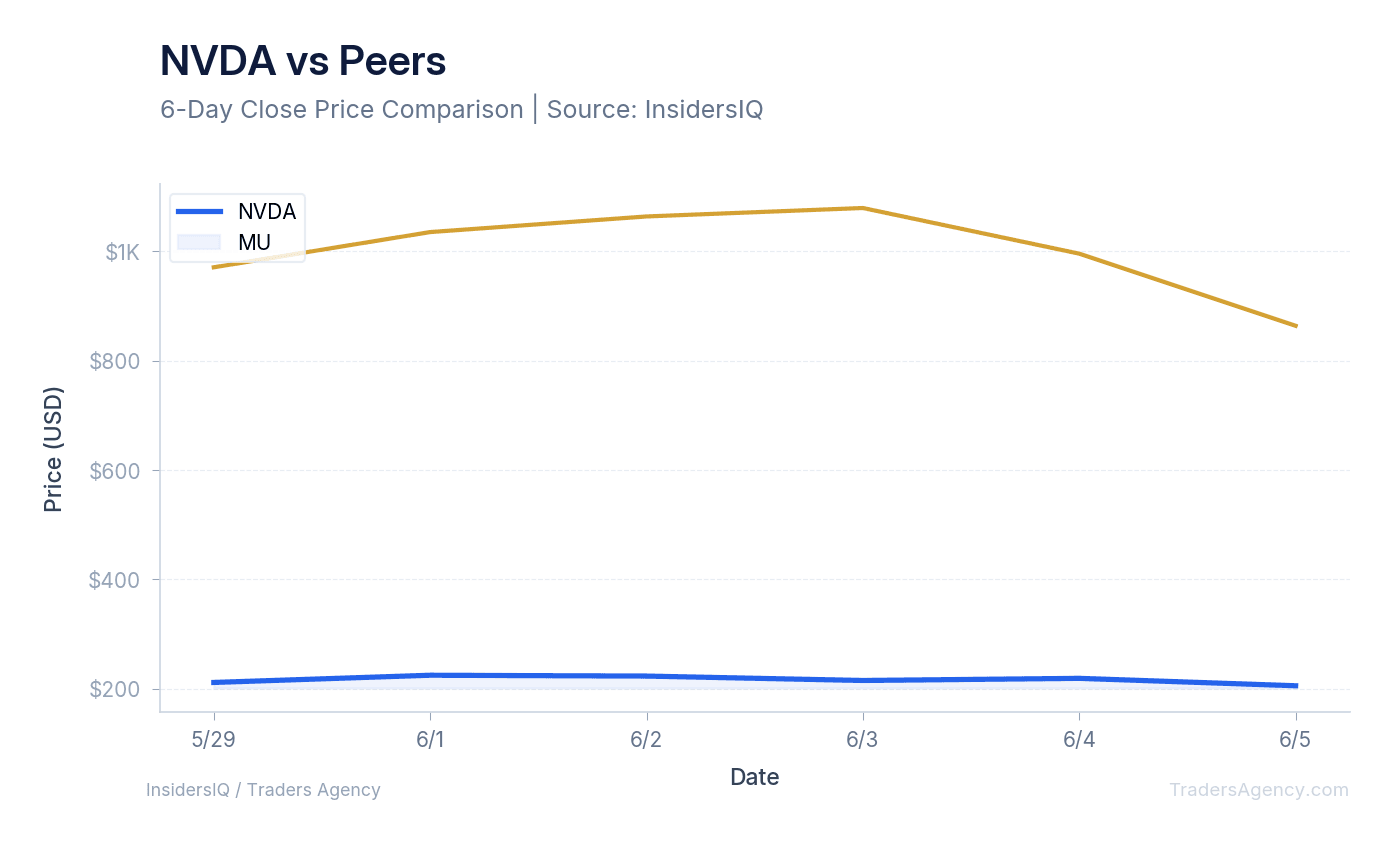
Our team views this premarket bounce as a critical test for semiconductor stocks. The divergence between Friday's selloff and Monday morning futures points to high volatility in the days ahead.
Want expert trading insights delivered daily?
Join thousands of traders who rely on Traders Agency for market analysis and trade ideas.
Join Traders AgencyWhat Does the May Jobs Report Mean for Interest Rates?
The blowout May jobs report strengthened the case for the Federal Reserve to raise interest rates later this year. A strong rotation out of high-flying semiconductor stocks and into more defensive areas of the market came on the heels of this jobs data, forcing investors to reprice rate-hike bets.
Our team is tracking this rotation driven by the macroeconomic data. The Fed's focus will be squarely on inflation after a batch of jobs data last week showed the labor market remains stable. When you combine higher interest rate expectations with rising oil prices, the broader market faces significant headwinds. Traders must account for the possibility of restrictive monetary policy lasting much longer than initially expected.
What Data Should Traders Watch This Week?
Our analysis points to several major events arriving this week. Investors will get a better sense of whether higher oil prices are starting to bleed into core prices very soon.
1. Wednesday: Consumer Price Index
The latest monthly CPI release on Wednesday is the primary economic event of the week. This data will show the direct impact of energy costs on consumer wallets. We expect high volatility across all major indices immediately following this print.
2. Thursday: Producer Price Index
Thursday brings an update on the Producer Price Index, the Fed's preferred gauge of inflation.
3. Oracle Earnings
Oracle (ORCL) reports earnings on Wednesday. This release will provide clarity on the health of the enterprise technology sector and serve as a major test for the ongoing artificial intelligence trade.
4. The SpaceX IPO
Friday features the likely SpaceX (SPCX) IPO, which is expected to be the largest public offering on record. Our team is watching closely to see how the market absorbs this massive liquidity event.
The Bottom Line for Retail Traders
Our research team sees a market caught between geopolitical shocks and shifting monetary policy. The escalation of Iran-Israel tensions is driving energy prices higher, while strong employment data keeps rate hikes firmly on the table.
What We're Watching: The $97 level on Brent crude, premarket strength in semiconductor stocks like NVDA and MU, and Wednesday's CPI print. These are the three signals that will determine the next major directional move.
Traders must stay nimble, manage risk tightly, and monitor the upcoming inflation prints. The data this week will set the tone for the rest of the month.
Want expert trading insights delivered daily?
Join thousands of traders who rely on Traders Agency for market analysis and trade ideas.
Join Traders AgencyKey Takeaways
- Iran fired missiles at Israel for the first time since April, triggering an Israeli counterstrike despite direct calls from President Trump to halt the fighting.
- Oil prices spiked immediately after the exchange, with Brent crude futures (BZ=F) in focus at the key $97 level traders are watching as a directional signal.
- US index futures split sharply on the news: Dow futures fell 0.2%, S&P 500 futures rose 0.3%, and Nasdaq 100 futures jumped 0.6%, reflecting a rotation away from defensives and toward tech.
- The S&P 500 just snapped a nine-week winning streak, and SPY shows a 30-day price change of -0.24%, meaning this geopolitical shock is hitting an already softening tape.
- Wednesday's CPI print is the next major catalyst. Traders are navigating a dual pressure environment where Middle East escalation pushes energy higher while strong jobs data keeps rate hikes on the table.
DISCLAIMER: Traders Agency does not offer financial advice. The information provided is for educational purposes only and should not be considered financial advice. Traders Agency is not responsible for any financial losses or consequences resulting from the use of the information provided. Trading carries inherent risks and may not be suitable for all individuals. You are advised to conduct your own research and seek personalized advice before making any investment decisions, recognizing the potential risks and rewards involved.
See more from Traders Agency on Google
Make us a preferred source and our market analysis will appear more prominently in your Google Search, Top Stories, and AI results.
Add to Preferred Sources