
Gold as an inflation hedge is one of the most repeated claims in investing, but the real track record is mixed. Gold has protected purchasing power during some inflationary periods, like the 1970s and early 2020s, while badly lagging inflation during others, like 2013 to 2018. We'll walk through why that happens and show you what actually drives the metal's price so you can stop guessing and start reading the signals correctly.
We get asked about this constantly by members building out commodity exposure. The honest answer is that gold as an inflation hedge works sometimes, for specific reasons, and fails just as often when those reasons aren't present. This guide covers the historical record, the real mechanics behind gold prices, and how to build a precious metals inflation hedge strategy that doesn't rely on wishful thinking.
By the end, you'll know when gold tends to track inflation, when it doesn't, how real interest rates fit in, and how an asset like TIPS compares as an alternative.
Does Gold Actually Hedge Against Inflation?
Gold hedges against inflation inconsistently. Over very long stretches, like a gold vs inflation 100 years comparison, gold has preserved value, but over shorter and medium windows, correlation with consumer prices breaks down for years at a time.
The confusion comes from mixing timeframes. Zoom out across a century and gold has broadly kept pace with the cost of living, which is why it earns its "store of value" reputation. Zoom into any single decade, though, and the relationship gets choppy. A gold vs inflation chart covering the last 50 years shows multiple multi-year stretches where gold either way outpaced CPI or badly underperformed it.
How Did Gold Perform During the 1970s Inflation Shock?
The 1970s are the textbook example of gold working as advertised. US inflation averaged roughly 7% across the decade and spiked into double digits in 1974 and again in 1979 to 1980, and gold, freshly unlinked from the dollar after the Bretton Woods system ended in 1971, surged from around $35 an ounce to over $800 an ounce by January 1980.
That move wasn't just about rising prices at the grocery store. Real interest rates, meaning interest rates minus inflation, were deeply negative for much of the decade. Investors holding cash or bonds were losing purchasing power every year, so gold became the practical alternative. This combination, high inflation plus negative real rates plus a weakening dollar, is the environment where gold as an inflation hedge performs at its best.
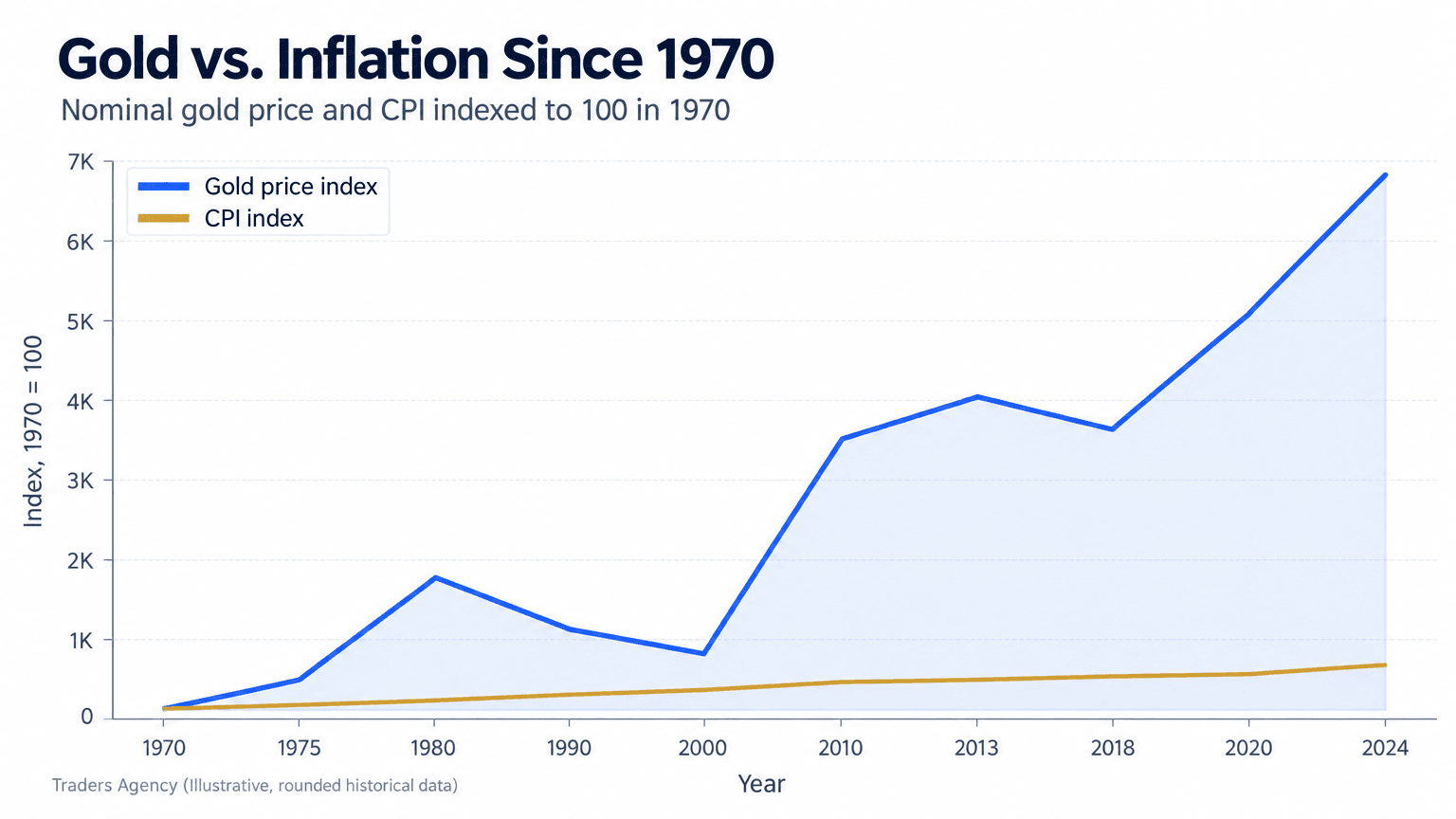
Notice how the lines in that chart drift apart for years at a time. That gap is the whole story. Gold doesn't track inflation month to month, it tracks the conditions that usually come with inflation, and those conditions aren't always present.
Why Did Gold's Hedge Fail Between 2013 and 2018?
Gold's hedge failed between 2013 and 2018 because real interest rates were rising even as headline inflation stayed moderate. Gold fell from roughly $1,700 an ounce in early 2013 to under $1,100 an ounce by late 2015, despite the US economy still experiencing modest, mostly positive inflation over that stretch.
This period is the clearest counter-example to the "gold always beats inflation" myth. The Federal Reserve was signaling tighter policy, the dollar was strengthening, and bond yields were climbing. None of those are unusual conditions, they happen regularly, and gold simply doesn't do well in them regardless of what the CPI report says that month.
This is also roughly the period that comes up in debates over why some well-known voices in personal finance caution against buying gold. The core argument centers on gold producing no cash flow, no dividends, and no earnings growth, meaning its price depends entirely on someone else being willing to pay more for it later. The 2013-2018 stretch is a real example of that argument playing out: a multi-year window where gold went nowhere useful while stocks and bonds in a diversified portfolio kept compounding.
Want expert trading insights delivered daily?
Join thousands of traders who rely on Traders Agency for market analysis and trade ideas.
Join Traders AgencyWhat Really Drives Gold Prices, Inflation or Real Interest Rates?
Real interest rates, not headline inflation, are the single strongest driver of gold prices historically. When real yields fall or turn negative, gold tends to rally, and when real yields rise, gold tends to struggle, even if inflation itself stays elevated.
The logic is straightforward. Gold pays no interest and no dividend, so its opportunity cost is whatever you're giving up by holding it instead of an interest-bearing asset. When TIPS or Treasury yields, adjusted for inflation, turn negative, holding gold costs you nothing relative to those alternatives. When real yields climb to 2% or 3%, gold has to compete against a genuinely attractive, low-risk return, and it usually loses that fight.
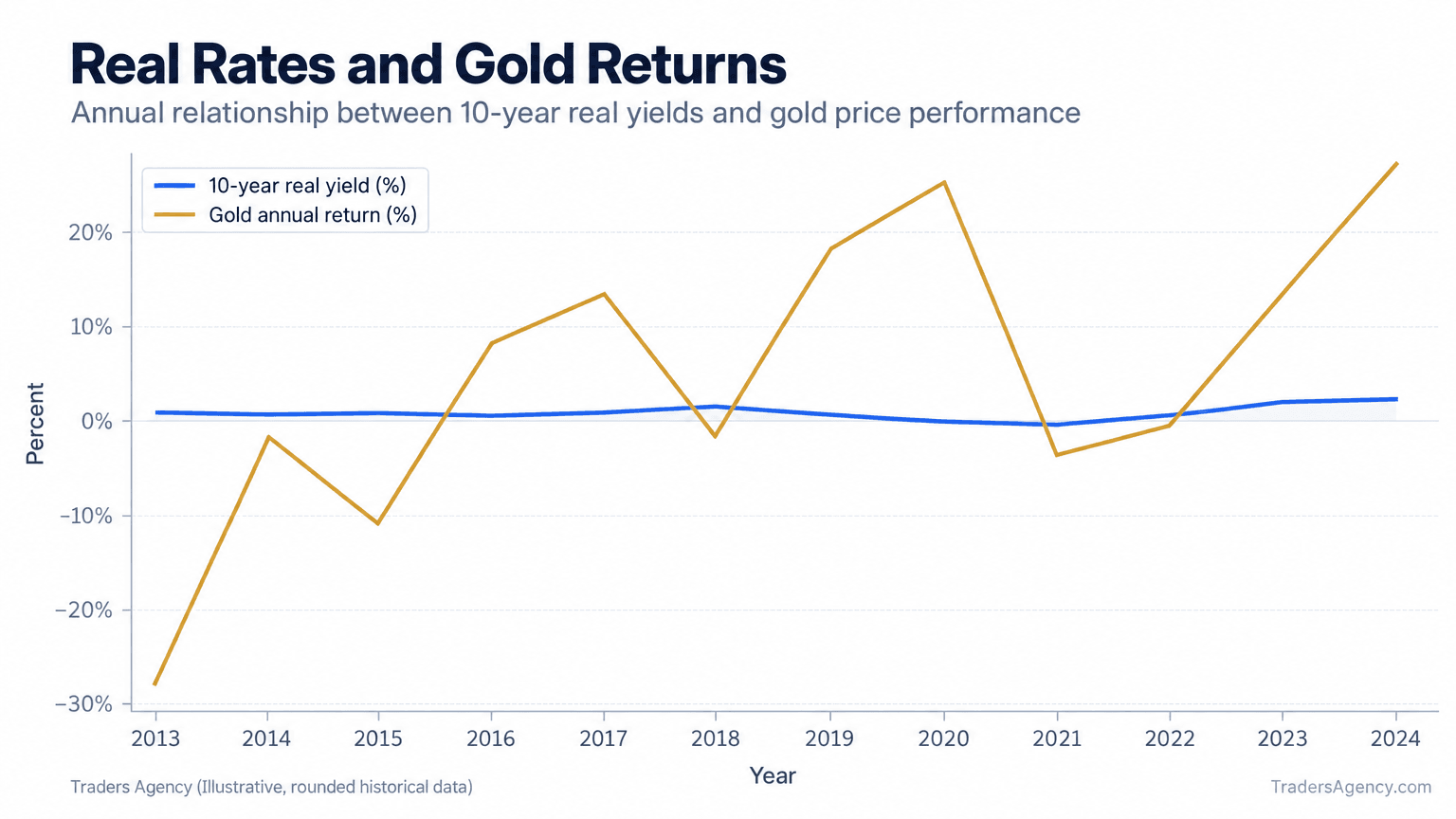
Key Concept: Gold trades on real rates, not headline inflation. That single idea explains most of the "confusing" periods where gold and CPI diverge.
Key Signals We Watch Before Adding Gold Exposure
- 10-year TIPS real yield trend: falling yields favor gold, rising yields work against it
- US dollar index (DXY) direction: a weakening dollar tends to support gold priced in dollars
- Fed policy stance: cutting cycles and dovish signals tend to help gold more than inflation data alone
- Central bank gold buying trends: sustained accumulation can support price even when real rates are mixed
TIPS vs Gold: Which Is the Better Inflation Hedge?
TIPS (Treasury Inflation-Protected Securities) adjust their principal directly with CPI, giving a more precise, lower-volatility inflation hedge than gold, which moves on sentiment, dollar strength, and real rates as much as on inflation itself.
The trade-off is in what each asset protects against. TIPS are built specifically to track inflation, so they do that job reliably but offer limited upside beyond the inflation adjustment plus a modest real yield. Gold has no mechanical link to CPI, so it can hugely outperform inflation in a crisis-driven rally, or underperform it for years, depending on the real rate backdrop we just covered.
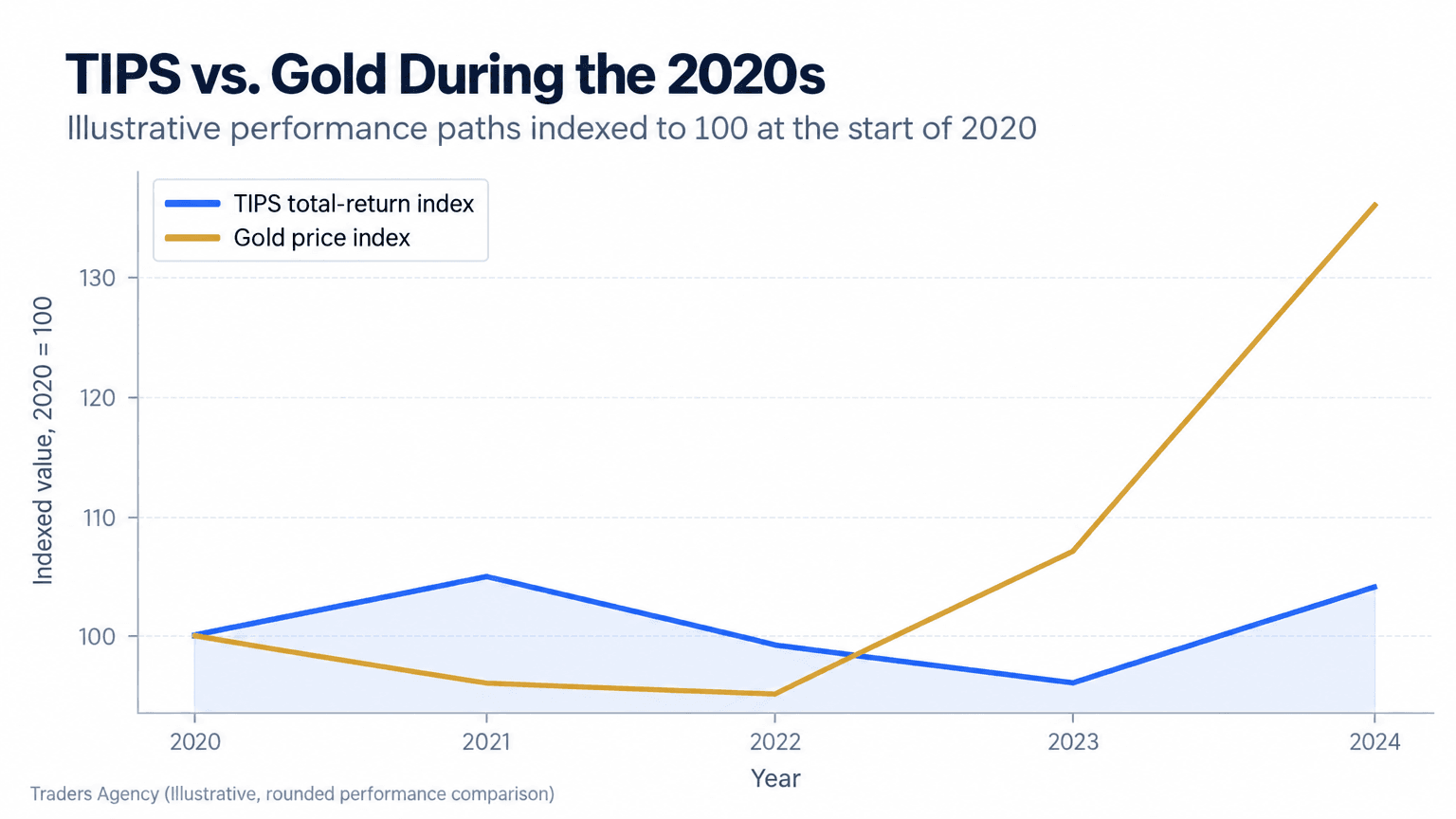
For most members running a precious metals inflation hedge strategy, we suggest viewing TIPS and gold as complementary, not competing. TIPS handle the "known" inflation risk mechanically, while gold adds a tail-risk hedge against currency debasement or a loss of confidence in fiat systems, something TIPS can't fully capture.
Are Precious Metals a Good Hedge Against Inflation?
Precious metals are a situational inflation hedge, not a guaranteed one. They tend to work well when inflation is paired with negative real interest rates and dollar weakness, and they tend to disappoint when inflation is moderate and real yields are rising.
This is the key distinction we try to get members to internalize. The question isn't "does gold hedge inflation," it's "what is the real interest rate environment right now." A trader asking whether precious metals are a good hedge in 2021-2022, with real rates deeply negative, got a very different answer than a trader asking the same question in 2017, with real rates positive and drifting higher.
ETFs, Futures, and Direct Ownership: Choosing Your Exposure
How you get exposure matters almost as much as whether you should have exposure at all. Each vehicle carries a different price structure, liquidity profile, and risk.
- Gold ETFs (like physically-backed funds): easiest for most traders, liquid, low friction, but you don't hold the metal directly
- Futures contracts: efficient for active traders, built-in leverage, but require margin management and rollover awareness
- Direct ownership (coins, bars): no counterparty risk, but storage costs, insurance, and wider bid-ask spreads matter
- Mining stocks: leveraged exposure to gold prices through company earnings, but carry equity-specific risk (operations, debt, management)
We generally steer members who just want inflation-hedge exposure toward ETFs or futures rather than mining equities, since mining stocks correlate more with broader equity markets than with gold itself during risk-off periods.
Bottom Line: When to Use Precious Metals as a Hedge
We'd use gold as part of a hedge when real interest rates are falling or negative, when the dollar is weakening, or when there's clear macro stress (banking instability, geopolitical shocks, aggressive Federal Reserve easing). We'd avoid leaning on it when real yields are climbing and the Fed is in a genuine tightening cycle.
Practical Allocation Guidelines We Teach
- Keep precious metals exposure as a satellite position, commonly in the 5% to 10% range of a diversified portfolio, not a core holding
- Size positions so a 20% to 30% drawdown in gold (which has happened before, including 2013) wouldn't meaningfully damage your overall portfolio
- Pair gold with a TIPS allocation if your primary goal is literal inflation protection rather than crisis hedging
- Reassess the position whenever real yields or Fed policy shifts meaningfully, not just when CPI headlines move
It's also worth putting gold's recent run in context against equities. Looking at gold vs S&P 500 over the last 10 years, gold has had strong individual years but has generally lagged the index's total return over the full decade, reinforcing that gold is a diversifier and hedge, not a primary growth engine.
Watch Out: Common mistakes we see members make include buying gold purely because inflation headlines are rising without checking real rates, overallocating after a big rally, and ignoring the dollar's direction entirely. None of these mistakes are complicated to fix, they just require checking the real rate and dollar backdrop before sizing a position.
Want expert trading insights delivered daily?
Join thousands of traders who rely on Traders Agency for market analysis and trade ideas.
Join Traders AgencyDISCLAIMER: Traders Agency does not offer financial advice. The information provided is for educational purposes only and should not be considered financial advice. Traders Agency is not responsible for any financial losses or consequences resulting from the use of the information provided. Trading carries inherent risks and may not be suitable for all individuals. You are advised to conduct your own research and seek personalized advice before making any investment decisions, recognizing the potential risks and rewards involved.
See more from Traders Agency on Google
Make us a preferred source and our market analysis will appear more prominently in your Google Search, Top Stories, and AI results.
Add to Preferred Sources