
Gold vs Bitcoin is one of the most debated comparisons in modern investing: gold is a physical metal with thousands of years of history as money, while Bitcoin is a digital asset created in 2009 that some investors call "digital gold" because of its capped supply. Both are considered potential stores of value, meaning assets that hold purchasing power over time. By the end of this guide, you'll understand how these two assets compare, where they diverge, and how to think about including them in a portfolio.
You've probably seen this argument play out in a group chat or on social media: someone says gold is the only real store of value, and someone else fires back that Bitcoin is "digital gold" and will replace it entirely. Both sides have a point, and both sides usually oversimplify.
We're going to walk through the actual mechanics behind this debate, not just the headlines. You'll leave this article knowing how scarcity, portability, and correlation actually work for each asset, and how to think about allocation without guessing.
What Does "Digital Gold" Actually Mean?
Bottom Line: Gold and Bitcoin both aim to store value but behave differently in practice: gold offers long-tested stability and low volatility, while Bitcoin offers higher growth potential paired with steep drawdowns. Treating them as a scarcity hedge pairing rather than interchangeable assets, and sizing positions so a 70%+ Bitcoin drop wouldn't force a panic sale, is the practical takeaway for portfolio construction.
The "digital gold" label refers to Bitcoin's fixed supply cap of 21 million coins, which mirrors gold's natural scarcity in the ground. Investors who use this phrase are drawing a comparison between gold's limited physical supply and Bitcoin's limited digital supply, suggesting both can act as a hedge against currency devaluation.
The comparison isn't perfect, though. Gold has roughly 5,000 years of track record as a store of value across civilizations and currencies. Bitcoin has existed since 2009, so it's working with a much shorter history when investors try to judge how it behaves during real financial stress.
Still, the core idea behind the digital gold narrative is simple: both assets exist outside the control of any single government or central bank, and both can't be printed on demand the way paper currency can.
How do gold and Bitcoin compare in scarcity and durability?
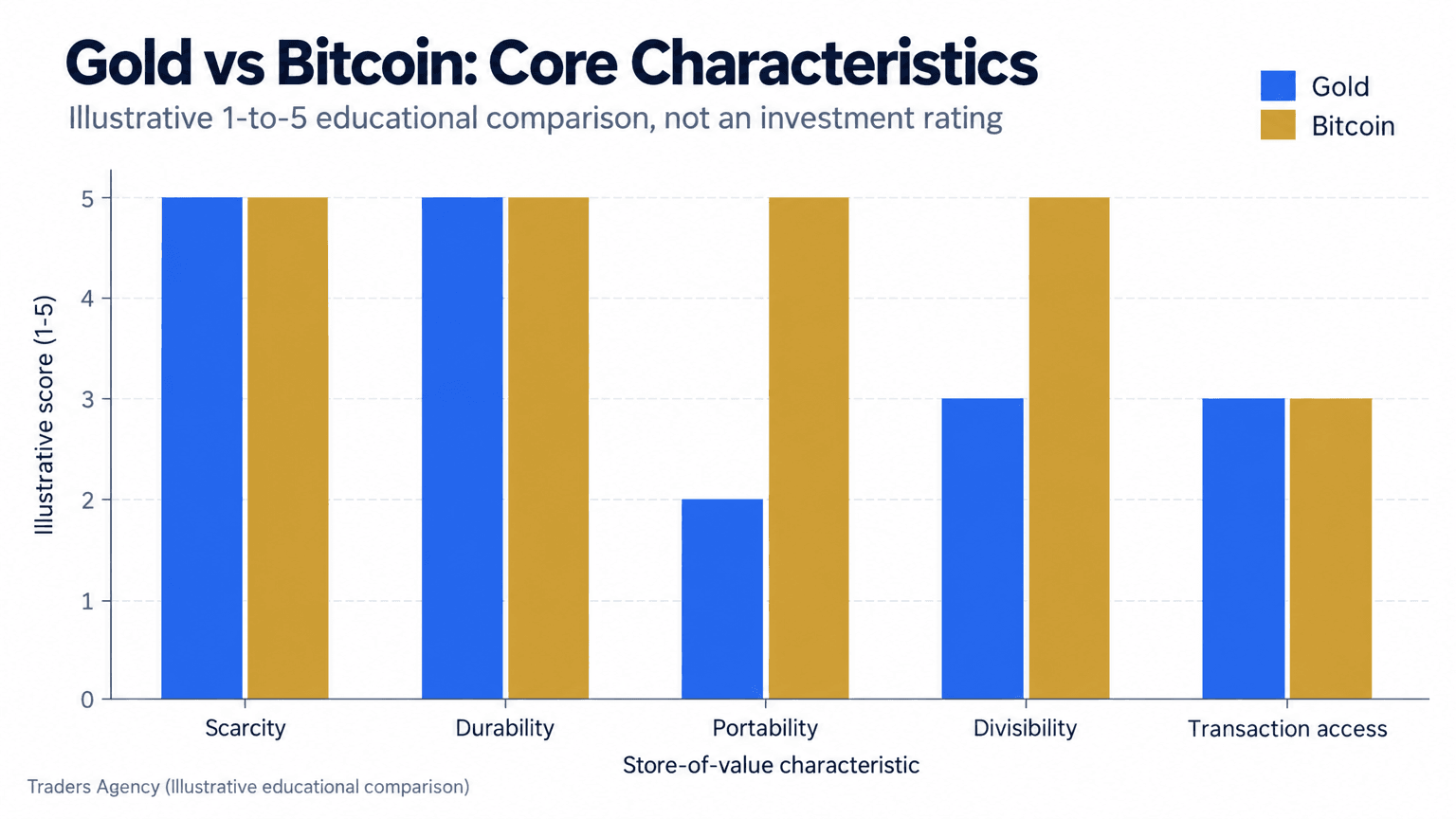
When we compare gold vs Bitcoin, we're usually talking about five core traits: scarcity, durability, portability, divisibility, and ease of transaction. Each asset scores differently across these categories, and understanding the differences helps explain why some investors hold both rather than picking one.
Scarcity: Gold's supply grows slowly, roughly 1-2% per year through mining. Bitcoin's supply growth is coded into its protocol and slows over time through an event called "halving," eventually stopping at 21 million coins.
Durability: Physical gold doesn't corrode and can last indefinitely if stored properly. Bitcoin exists as digital entries on a decentralized ledger called a blockchain, so its "durability" depends on the network staying online and secure, which it has done with only brief early interruptions since 2009.
Portability and divisibility: This is where the two assets look very different. Moving a large amount of gold across borders is slow and often requires physical security. Bitcoin can be sent anywhere in the world in minutes, and it can be divided into tiny fractions called satoshis (one hundred millionth of a Bitcoin).
Why Do Some Investors See Bitcoin as a Hedge Against Inflation?
Some investors treat Bitcoin as an inflation hedge because its fixed supply can't be increased the way central banks increase the money supply. This logic also underpins the Bitcoin digital gold price narrative that circulates during periods of high inflation or currency concern.
The reasoning goes like this: if a government prints more currency, each unit of that currency buys less over time. Assets with a capped or slow-growing supply, in theory, should hold value better because they can't be diluted the same way.
In practice, this relationship hasn't been consistent. Trading communities often point to periods, like parts of 2022, when Bitcoin actually fell alongside rising inflation rather than rising to offset it. Gold has a longer track record of behaving this way, though even gold doesn't move in a predictable straight line with inflation data.
Key Concept: A fixed or slow-growing supply doesn't guarantee an asset will rise during inflation. It only means the asset can't be diluted the way currency can. Those are two different things, and conflating them is one of the most common mistakes we see new investors make.
How Correlated Are Bitcoin and Gold Prices?
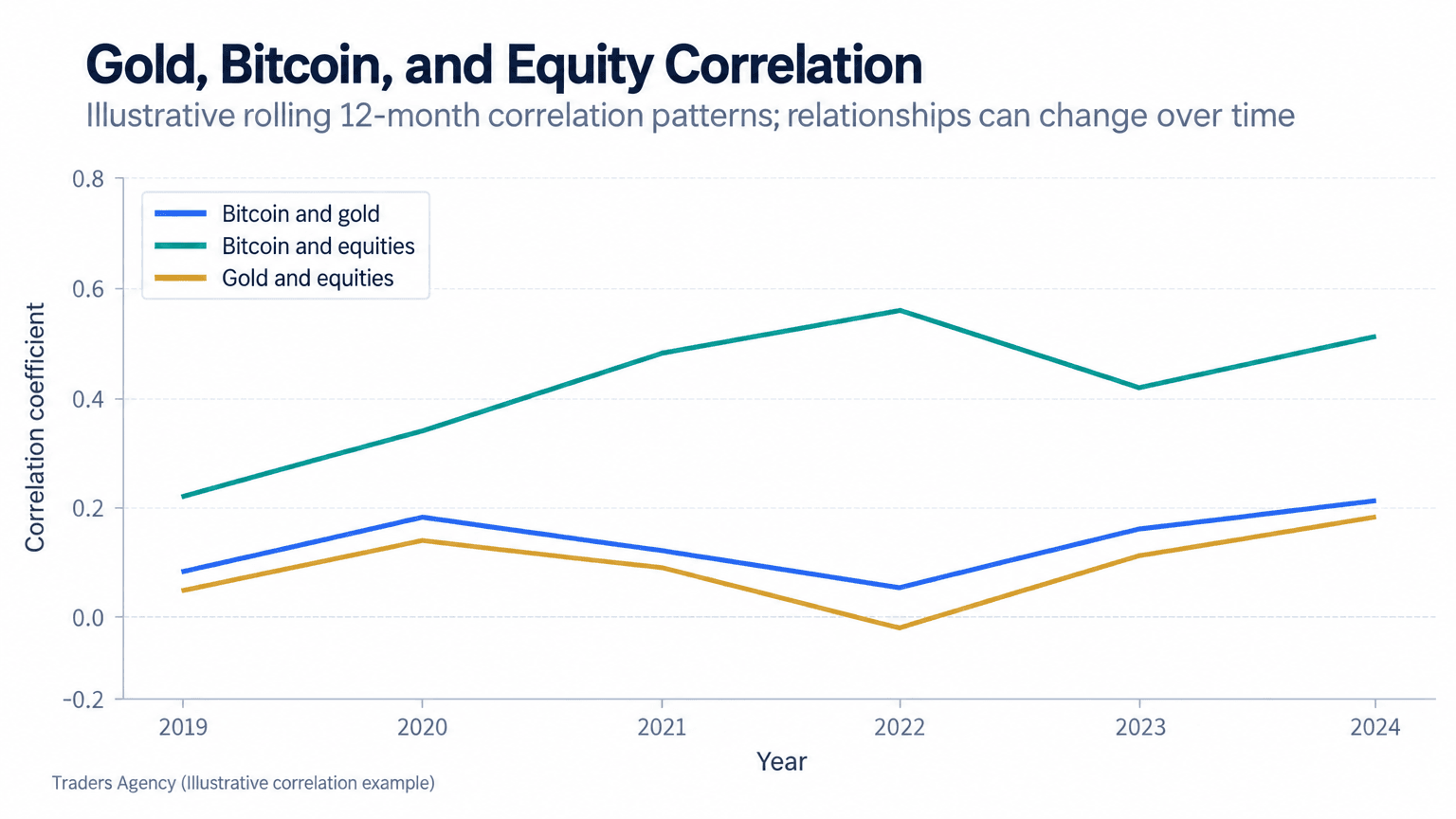
Bitcoin and gold are not consistently correlated, and their relationship shifts depending on market conditions like interest rates, liquidity, and investor risk appetite. A Bitcoin and gold correlation chart typically shows periods of near-zero correlation followed by stretches where both assets move together during broad "risk-off" selling.
Gold tends to behave like a defensive asset: during stock market stress, money often flows into gold as investors seek safety. Bitcoin has historically behaved more like a risk asset, often moving with technology stocks and broader equity markets rather than acting as a safe haven during sharp downturns.
That said, correlation isn't fixed. During periods of extreme liquidity stress, such as March 2020, both gold and Bitcoin sold off alongside stocks as investors rushed to raise cash. Then in later periods, Bitcoin and gold have decoupled again, moving on separate drivers.
Want expert trading insights delivered daily?
Join thousands of traders who rely on Traders Agency for market analysis and trade ideas.
Join Traders AgencyIs It Wise to Invest in Digital Gold?
Whether it's wise to invest in digital gold depends entirely on your time horizon, risk tolerance, and how you define "investing." Bitcoin's price history includes multiple drawdowns of 70% or more, so treating it as a direct substitute for gold's stability would be a mistake for most beginner investors.
A more balanced view: Bitcoin and gold can serve different roles in the same portfolio rather than competing for the exact same job. Gold has historically dampened volatility and held value during equity crashes. Bitcoin has offered higher growth potential but with far larger swings in both directions.
We teach our members to separate the question "should I own this asset" from "how much should I own." Most beginner mistakes come from sizing a position too large relative to its volatility, not from picking the wrong asset entirely.
Portfolio Allocation: How Much Gold or Bitcoin Should You Hold?
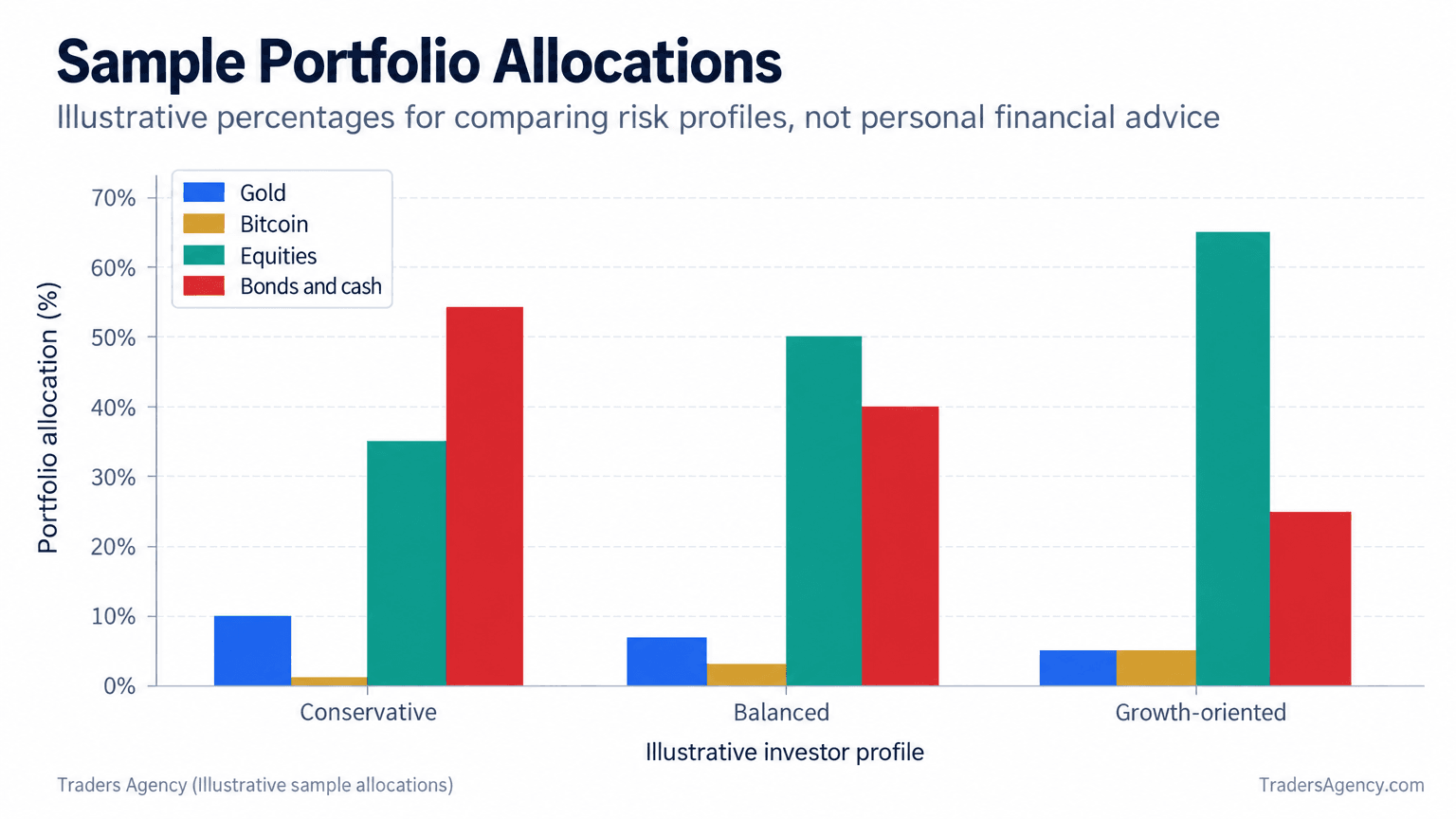
There's no single correct allocation, but risk profile should drive the split between gold and Bitcoin. Conservative investors typically lean toward more gold and little to no Bitcoin, while growth-oriented investors may accept a small Bitcoin allocation alongside a smaller gold position.
Sample Starting Frameworks by Risk Profile
- Conservative: 5-10% gold, 0-1% Bitcoin, remainder in bonds and equities
- Balanced: 5-8% gold, 1-3% Bitcoin, remainder diversified across stocks and bonds
- Growth-oriented: 3-5% gold, 3-5% Bitcoin, remainder weighted toward equities
These are illustrative starting points, not personalized recommendations. Your actual allocation should reflect your own goals, timeline, and how much volatility you can tolerate without panic-selling.
When Does Gold Outperform Bitcoin (and Vice Versa)?
Gold tends to outperform during periods of equity market stress, rising geopolitical tension, and falling real interest rates. Bitcoin has tended to outperform during periods of strong risk appetite, loose monetary policy, and growing adoption by institutions and retail investors.
Neither asset outperforms consistently across all environments, which is exactly why mixing them, rather than choosing one, appeals to many investors. Trying to time which one will "win" in a given year is extremely difficult, even for professional allocators.
What are the ways to gain exposure to gold and Bitcoin?
There are several practical paths to owning either asset, each with different costs and tradeoffs:
- Gold ETFs: Funds that track gold's price without requiring physical storage; convenient but come with a small annual management fee
- Gold futures: Contracts traded on regulated exchanges allowing leveraged exposure; higher risk and typically used by more experienced traders
- Physical gold: Coins or bars held directly; requires secure storage and insurance but carries no counterparty risk
- Bitcoin ETFs: Spot Bitcoin ETFs, approved for trading in the United States, allow exposure through a regular brokerage account
- Direct Bitcoin ownership: Buying and holding Bitcoin in a digital wallet; requires learning proper security practices
- Bitcoin futures: Exchange-traded contracts for more active or hedged trading strategies
For additional background on how regulated products work, the U.S. Securities and Exchange Commission and major futures exchanges like the CME Group offer plain-language explainers on ETFs and futures contracts that are worth a read before using either product.
What Is the Future of Bitcoin in 2030?
No one can predict price with certainty, and any Bitcoin digital gold prediction you see online should be treated as speculation, not fact. What we can say is that the future of crypto over the next five years will likely depend heavily on regulatory clarity, institutional adoption through products like ETFs, and whether Bitcoin's volatility gradually declines as the asset matures.
Gold's future is far less speculative by comparison, since its role as a reserve asset held by central banks has persisted for generations. That history doesn't guarantee future performance, but it does explain why gold remains a baseline holding for many conservative portfolios.
How can investors manage risk when holding gold and Bitcoin?
A few guidelines we share with our members when approaching either asset:
- Never allocate money you'll need within the next 1-2 years into Bitcoin, given its volatility
- Treat gold as a stability anchor, not a growth engine
- Rebalance periodically rather than letting one position grow unchecked after a rally
- Avoid chasing performance after a large price spike in either asset
- Use dollar-cost averaging (buying fixed amounts on a schedule) to reduce timing risk
Watch Out: Bitcoin's history includes multiple 70%+ drawdowns. Position sizing matters more than asset selection. A small, well-sized Bitcoin allocation you can hold through a crash will serve you better than a large one you panic-sell at the bottom.
Want expert trading insights delivered daily?
Join thousands of traders who rely on Traders Agency for market analysis and trade ideas.
Join Traders AgencyDISCLAIMER: Traders Agency does not offer financial advice. The information provided is for educational purposes only and should not be considered financial advice. Traders Agency is not responsible for any financial losses or consequences resulting from the use of the information provided. Trading carries inherent risks and may not be suitable for all individuals. You are advised to conduct your own research and seek personalized advice before making any investment decisions, recognizing the potential risks and rewards involved.
See more from Traders Agency on Google
Make us a preferred source and our market analysis will appear more prominently in your Google Search, Top Stories, and AI results.
Add to Preferred Sources