
If you've ever watched a stock slide while telling yourself "it'll bounce back," you already understand why stop-loss orders exist. A stop-loss order is an instruction you place with your broker to automatically sell a position once it drops to a specific price, limiting how much you can lose on a trade. In this guide, we'll cover how to use stop loss orders effectively: how to set one up, how to choose the right distance, and how to avoid the mistakes that trip up most beginners.
A stop-loss does the selling for you, at the moment you decided in advance, not the moment your emotions finally give in. That's the whole point: you make the hard decision when you're calm, not when you're panicking.
What Is a Stop-Loss Order and How Does It Work?
Bottom Line: A stop-loss works best when the distance is set deliberately, using ATR, percentage, or support levels, rather than guessed at or placed too tight. Knowing the type of stop, its gap risk, and when a stop doesn't fit the trade matters more than just having one in place.
A stop-loss order sits on your account inactive until the market price touches your chosen "stop price." Once that price is hit, the order becomes a market order and sells your shares at the next available price.
Here's a simple example of what a stop-loss does in practice: say you buy 100 shares of a stock at $50. You set a stop-loss at $45. If the price falls to $45, your broker automatically sells your shares, capping your loss at roughly $500 (before fees), instead of letting the position fall further while you're away from your screen.
Key Concept: A stop-loss order is a pre-written exit plan. It converts a decision you made calmly in advance into automatic action, so you're never relying on willpower in the middle of a losing trade.
How Do You Use a Stop-Loss?
To use a stop-loss, you set a trigger price below your entry (for a long position) when you open the trade. Your broker automatically sells if the price falls to that level, turning your plan into action without requiring you to watch the screen all day.
Step-by-Step Setup
- Open your order ticket after buying the stock, or place it at the same time as your buy order if your platform supports an "OCO" (one-cancels-other) bracket.
- Select "Sell" as the action, since you're protecting a long position.
- Choose order type: pick "Stop" or "Stop-Loss" from the dropdown menu.
- Enter your stop price: the level at which you want the sale triggered.
- Set duration: "Day" (expires at close) or "GTC" (Good 'Til Canceled, stays active until filled or removed).
- Review and confirm: your platform should show the order sitting as "pending" in your order book until triggered.
Most beginner mistakes happen at step 4. Picking a stop price that's too tight gets you shaken out by normal price noise. Too loose, and you're risking more than you meant to.
Stop-Loss vs. Stop-Limit Orders: What's the Difference?
A stop-loss order becomes a market order once triggered, guaranteeing execution but not price. A stop-limit order becomes a limit order once triggered, guaranteeing price but not execution. That difference matters most during fast-moving or illiquid markets.
With a stop-limit, you set two prices: the stop (trigger) and the limit (the lowest price you'll accept). If the stock gaps past your limit price, your order may not fill at all, leaving you holding a falling position. We generally recommend new traders start with standard stop-loss orders for liquid stocks, since getting filled, even at a slightly worse price, usually beats not getting filled at all.
What Are the Different Types of Stop Orders?
- Fixed stop-loss: a static price that doesn't move once set, used for simple, set-and-forget protection.
- Trailing stop-loss order: a stop that automatically moves up as the price rises, locking in gains while still protecting against a reversal.
- Stop-limit order: combines a trigger price with a minimum acceptable sale price, trading guaranteed execution for price control.
Understanding how these three interact is central to using stop-losses well across different account types and goals, whether you're holding for weeks or trading intraday.
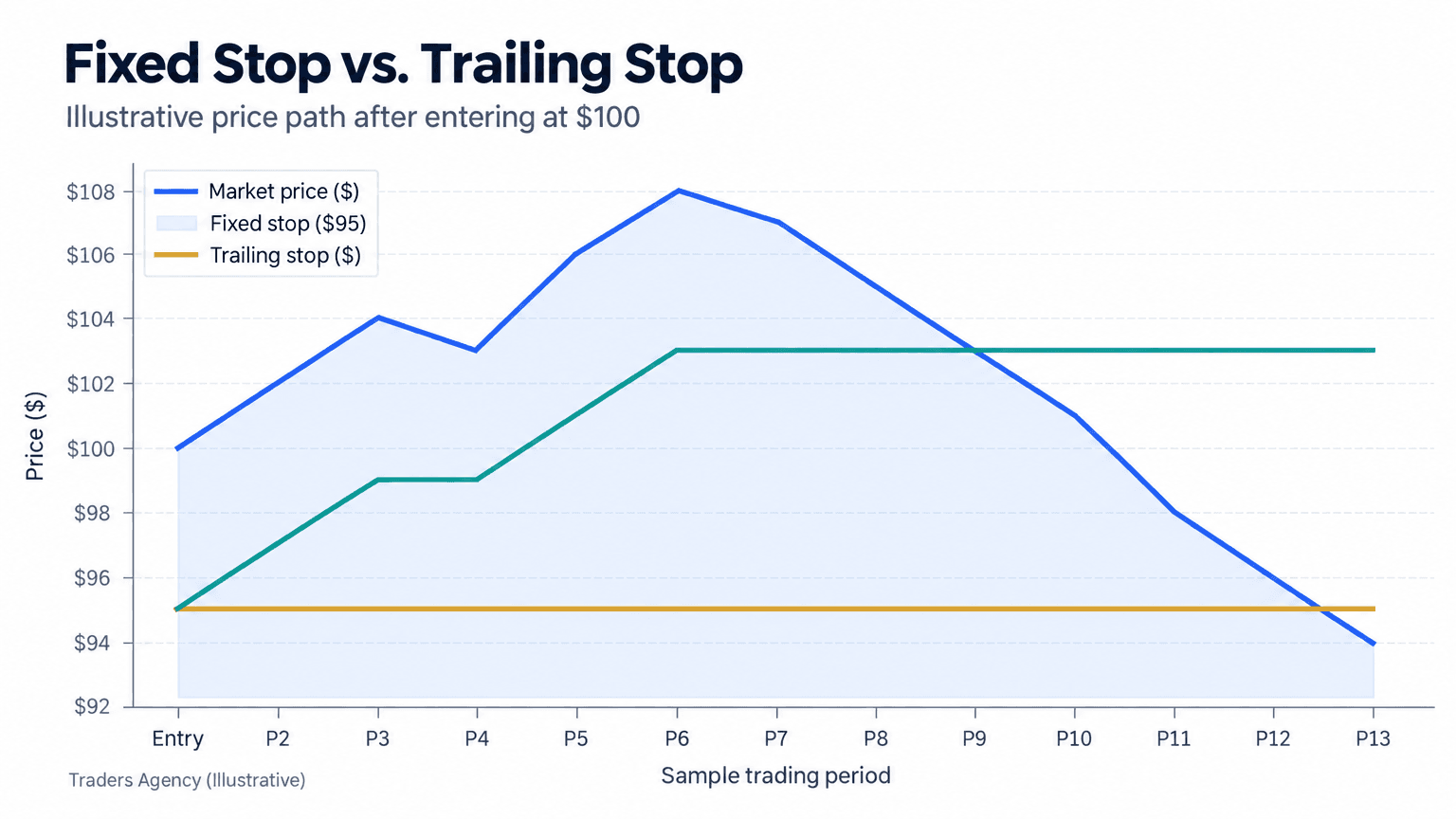
In the chart above, a fixed stop at $95 never moves, even as the price climbs to $108. A trailing stop ratchets up to $103 as the price rises, so if the asset reverses, the trailing stop locks in a much better exit than the fixed version.
Want expert trading insights delivered daily?
Join thousands of traders who rely on Traders Agency for market analysis and trade ideas.
Join Traders AgencyWhat Is the 7% Rule for Stop-Loss?
The 7% rule for stop-loss is a guideline suggesting you sell a stock once it falls 7% below your purchase price, limiting losses before they compound into bigger drawdowns. We treat it as a popular starting point for beginners, not a law of markets.
The logic behind the 7% rule is mathematical: a 7% loss only requires about a 7.5% gain to recover, but a 20% loss requires a 25% gain, and a 50% loss requires a 100% gain just to break even. Cutting losses early protects your capital from needing outsized gains later. That said, a flat 7% doesn't account for how volatile a particular stock is, which is why we teach traders to move toward distance-based methods once they're ready.
How Do You Choose the Right Stop-Loss Distance?
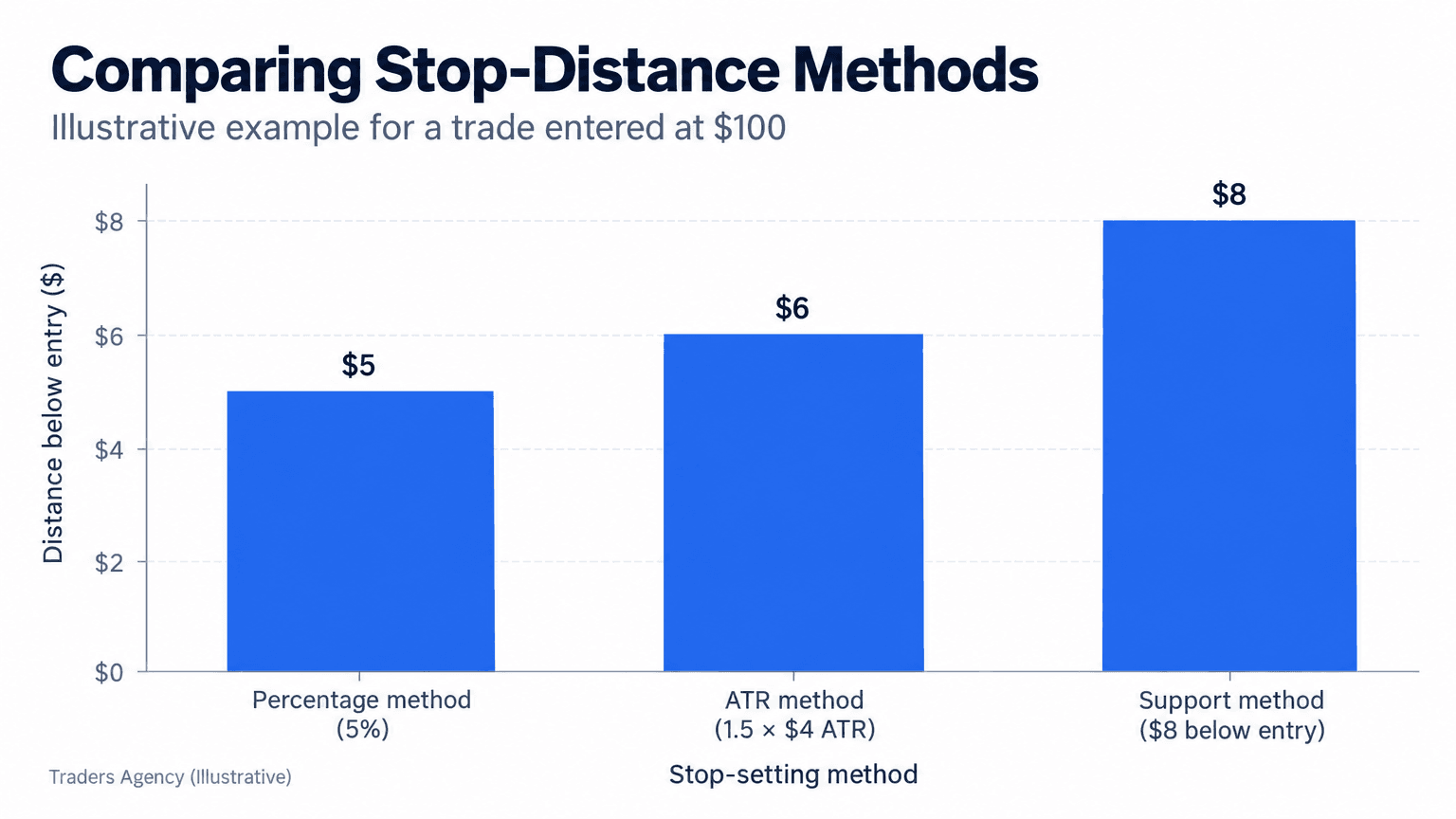
Choosing a stop distance means deciding how far below your entry price to place your stop, using either a fixed percentage, a volatility measure like ATR (Average True Range), or a technical support level, rather than guessing.
Percentage Method
Set your stop a fixed percentage below entry, commonly 5% to 8% for swing trades. Simple, but it ignores how much a specific stock naturally moves.
ATR Method
ATR measures a stock's average daily price range over a set period, typically 14 days. Our approach is to place the stop 1.5 to 2 times the ATR below entry, so volatile stocks get more breathing room and calmer stocks get tighter stops.
Support Level Method
Place your stop just below a recent support level, a price floor where buyers have stepped in before. If that floor breaks, it signals the original trade idea may be wrong, not just normal noise.
For the best stop-loss percentage in day trading, many active traders use tighter ranges, often 1% to 2% of entry price, since intraday moves happen faster and positions are typically held for minutes or hours rather than weeks.
Trailing-Stop Orders Explained
A trailing stop-loss order automatically adjusts upward as a stock's price rises, maintaining a set distance (in dollars or percentage) from the highest price reached, while never moving down.
| Step | Price Action | Stop Level |
|---|---|---|
| Entry | Buy at $50 | $45.00 (10% trailing) |
| Price Rises | Stock climbs to $60 | Stop moves up to $54.00 |
| Reversal | Price falls to $54 | Position sold, locking in a $4 gain per share |
This is a core piece of our recommended approach for trending markets, since it lets winners run while still defining your risk.
Common Pitfalls: Gap Risk and Stop-Loss Failures
Gap risk happens when a stock's price jumps sharply between one trading session's close and the next one's open, skipping over your stop price entirely.
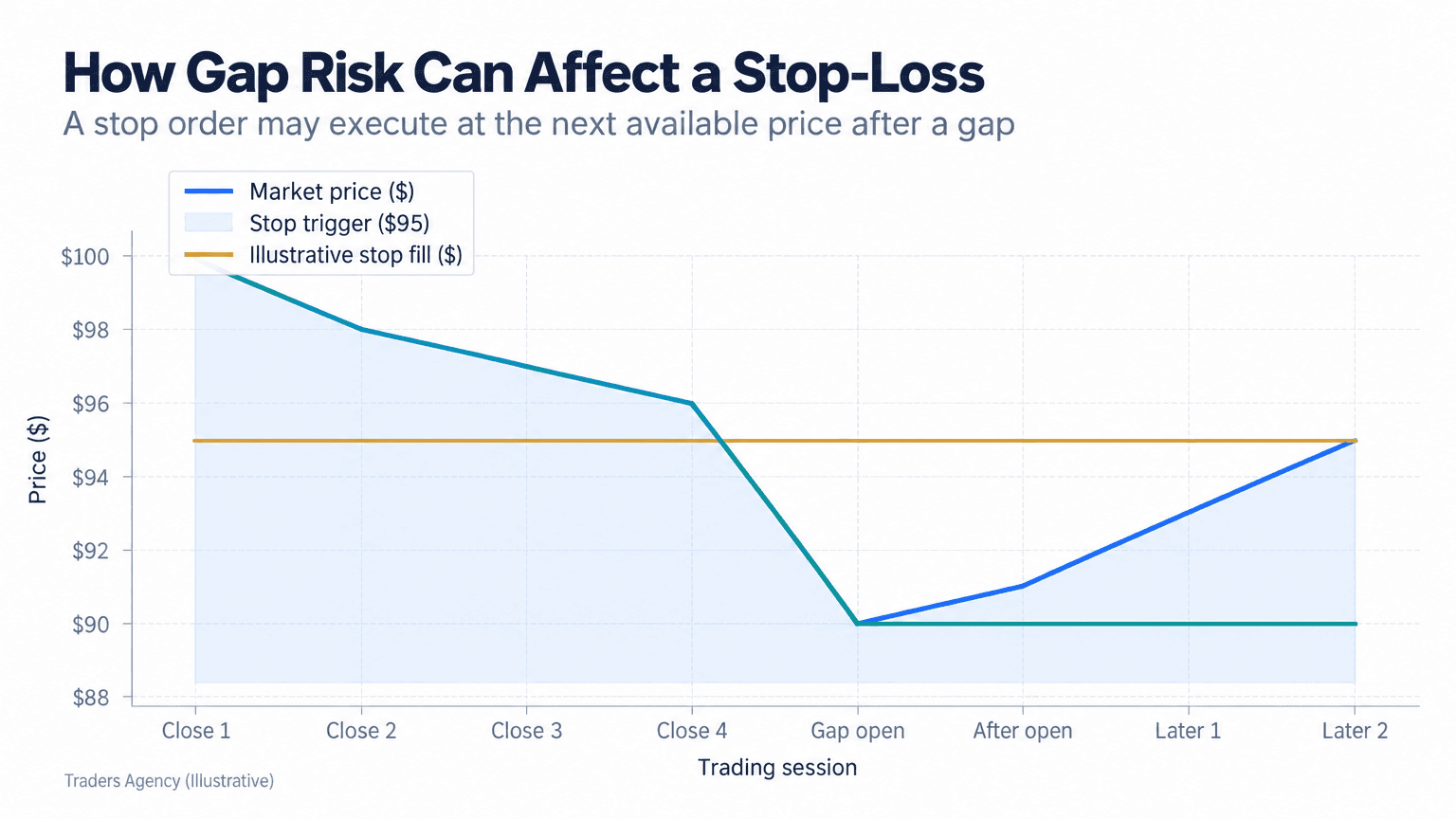
If your stop is set at $95 but the stock opens the next morning at $90 after bad overnight news, your stop-loss order fills near $90, not $95, because a triggered stop becomes a market order that sells at the next available price.
Watch Out: Gap risk is unavoidable with standard stop-loss orders. It's one reason some traders use stop-limit orders on highly volatile or earnings-prone stocks, even though that trades one risk (no fill at all) for another (a worse fill).
Using stop-losses in forex markets carries a similar gap risk, since currency markets can jump sharply over weekends or around major economic news releases, when trading volume is thin and prices can move further than expected between your stop level and the fill.
When Should You Use a Stop-Loss Order?
Stop-losses work best in trending or moderately volatile markets where you have a clear invalidation point, such as a support level or a percentage-based risk limit set before you ever place the trade.
They're less useful in extremely choppy, low-volume conditions where price can whipsaw through a nearby stop and then reverse, triggering an exit right before the move you wanted.
What Is the Golden Rule for Stop-Loss?
The golden rule for stop-loss is simple: decide your exit price before you enter the trade, and never move your stop further away once it's set, only closer to lock in gains.
Key Concept: Widening a stop after a loss starts to grow turns a planned, limited loss into an unplanned, open-ended one. We teach this as the single most important habit in risk management: set it, and only tighten it from there.
Frequently Asked Questions
Do stop-loss orders cost extra fees?
Most brokers don't charge an extra fee to place a stop-loss order itself, though standard commission or spread costs still apply once it triggers and fills.
Can I use a stop-loss on short positions?
Yes, a stop-loss on a short position is placed above your entry price and triggers a buy order if the price rises against you.
What happens if I cancel a stop-loss before it triggers?
You can cancel or modify a pending stop-loss at any time before it triggers, as long as the market hasn't already filled it.
Is a trailing stop better than a fixed stop?
Neither is universally better. Trailing stops suit trending positions where you want to protect growing gains, while fixed stops suit simpler setups with a clear invalidation price.
Does a stop-loss guarantee my exit price?
No. A standard stop-loss becomes a market order once triggered, so in fast-moving or gapping markets, you may be filled at a worse price than your stop level.
Want expert trading insights delivered daily?
Join thousands of traders who rely on Traders Agency for market analysis and trade ideas.
Join Traders AgencyDISCLAIMER: Traders Agency does not offer financial advice. The information provided is for educational purposes only and should not be considered financial advice. Traders Agency is not responsible for any financial losses or consequences resulting from the use of the information provided. Trading carries inherent risks and may not be suitable for all individuals. You are advised to conduct your own research and seek personalized advice before making any investment decisions, recognizing the potential risks and rewards involved.
See more from Traders Agency on Google
Make us a preferred source and our market analysis will appear more prominently in your Google Search, Top Stories, and AI results.
Add to Preferred Sources