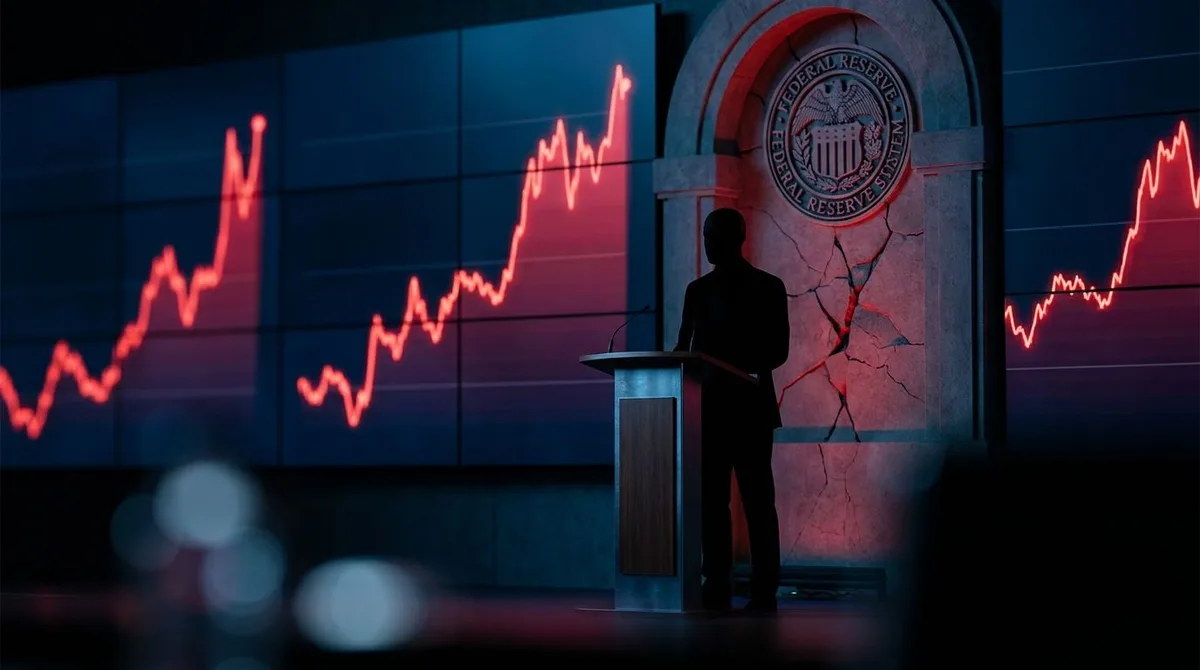
The Federal Reserve just held interest rates steady at 3.5-3.75%, and the bond market immediately pushed back. Long-term Treasury yields jumped in a reaction that puts Fed chairman inflation credibility squarely in the spotlight. Our analysis shows traders now have to reprice risk fast, and the message coming out of the central bank is anything but clear.
We're watching bond markets aggressively question whether the Fed will act forcefully enough to contain rising prices. With inflation running above target for at least 63 months, this policy stall creates a complicated setup for the entire financial sector.
Our research team is tracking a real shift in how the central bank communicates with the market. The uncertainty that follows demands a clear strategy from anyone holding rate-sensitive assets right now.
What Did the Fed Just Decide on Interest Rates?
We've reviewed the latest Federal Open Market Committee decision. The core event is simple: the central bank kept the federal funds rate locked at 3.5-3.75%, a level it has held for months.
The decision was not unanimous. Three FOMC voters dissented from the choice to keep rates unchanged.
The Signal: Three FOMC members dissented against holding rates steady. A sitting Fed chair has never been in the minority on an interest rate vote, and that historical line is now within reach.
This internal division is a major signal. If economic data fails to improve quickly over the next few months, more committee members may join the dissenters. That puts the leadership in a difficult spot within the committee itself, just months into the job.
What Has Kevin Warsh Said About Interest Rates?
Kevin Warsh has shifted central bank policy by ending the practice of forward guidance. He believes rolling forecasts make the Fed inflexible and obscure unfiltered market signals. As a result, he has declined to specify exactly what economic conditions would prompt him to raise interest rates.
Past chairs would strongly signal where they expected rates to go. The new forward guidance blackout means traders no longer have that luxury.
During his opening remarks, the chairman said he wanted to observe direct and unfiltered market reactions to developments. He refused to answer reporters' questions detailing exactly why the current 3.5-3.75% rate is the correct level.
Before taking this job, he sharply criticized his predecessor, Jerome Powell. When long-term rates moved up after Powell cut the federal funds rate, Warsh repeatedly pointed to Powell's lack of credibility as the underlying problem. Now the market is applying that exact same standard to the new leadership after rates were held steady.
Want expert trading insights delivered daily?
Join thousands of traders who rely on Traders Agency for market analysis and trade ideas.
Join Traders AgencyHow Does the Treasury Yields and Fed Policy Relationship Impact Traders?
The immediate market reaction was a sharp jump in long-term Treasury yields. That dynamic tells us bond investors believe the central bank will not act on current inflation readings, forcing them to price in more aggressive tightening later as the economy heats up.
The relationship between Treasury yields and Fed policy is flashing warning signs. The chairman suggested the recent rise in long-term rates might reflect positive economic news, specifically pointing to strong business investment.
Our analysis of the bond market shows investors disagree entirely. The reaction points to a deep lack of confidence in the current strategy. We believe the chairman needed to spell out exactly what would force him to raise interest rates in the face of stubborn inflation. Because that message never came through clearly, the bond market rejected the policy stance outright.
Traders are pricing in the reality that inflation has stayed above the 2% target for over five years. By holding rates steady now, the central bank risks falling behind the curve.
Why Is Fed Chairman Inflation Credibility Under Scrutiny?
Credibility is under scrutiny because the central bank looks internally contradictory on its own data targets. Despite consumer-price-index data showing prices declining by 0.4% in June, the chairman dismissed that positive metric as "not much" of a consideration while maintaining that inflation remains elevated.
The confusion deepens when you look at the official targets. The central bank is committed to 2% annual inflation over the long run, measured by the personal consumption expenditures index.
The Gap: The most recent PCE reading sits at 4.1%, more than double the 2% mandate. The chairman declined to say whether he was satisfied with that number.
We're also tracking five task forces the chairman appointed to review central bank reforms. He noted that one of them might recommend downplaying PCE as the official target when it issues a report at the end of the year.
He said the Fed is sticking with PCE for now, but added that by next January the strategy might change. That unwillingness to commit to a specific target metric directly erodes confidence in the central bank's ability to deliver lower inflation.
What Should Traders Watch After the Fed's Rate Hold?
This rate decision has created a volatile environment. We're monitoring several specific data points that will dictate the next market move.
1. The FOMC Dissenters
We're watching the three committee members who voted against holding rates steady. If inflation stays stubborn, this minority could grow. We believe that would add urgency for the rest of the committee to act on its mandate. A growing rebellion would force the chairman to either raise rates or risk an unprecedented defeat on a policy vote.
2. The Task Force Reports
Mark the end of the year on your calendar. The five task forces will issue reports; one might recommend downplaying PCE as the official inflation target. Any shift in the goalposts will cause massive repricing in the bond market.
3. The 4.1% PCE Level
Until January, the 4.1% PCE reading is the official benchmark. We're watching to see if this number trends down toward the 2% mandate. If it stays elevated while the Fed holds rates steady, inflation fears will only accelerate across the financial sector.
4. Political Pressures
Given the historical tensions and the abrupt policy shifts, questions about whether a president can fire a Federal Reserve chairman tend to surface in market circles during periods of central bank instability. While we focus strictly on the data, the political optics of a divided committee add another layer of volatility for traders to manage.
The Bottom Line
Our read on the press conference is a confusing, internally contradictory message from the central bank. By ending forward guidance and questioning its own inflation targets, the leadership has introduced unnecessary guesswork into the financial system.
We believe the lack of clear communication is a direct threat to market stability. Traders should prepare for sudden swings in long-term Treasury yields as the market tries to price in inflation risks the central bank is currently ignoring. We'll keep monitoring the internal committee votes and the upcoming task force reports to identify the next actionable trade setup.
Want expert trading insights delivered daily?
Join thousands of traders who rely on Traders Agency for market analysis and trade ideas.
Join Traders AgencyKey Takeaways
- The Fed held rates steady at 3.5-3.75% and three FOMC members dissented, a level of internal division that signals growing pressure on the chair's policy position.
- Long-term Treasury yields jumped immediately after the hold decision, meaning the bond market is actively pricing in inflation risk the Fed appears to be sidestepping.
- Inflation has run above the Fed's target for at least 63 months, making the decision to pause rather than act a credibility problem, not just a policy disagreement.
- The Fed abandoned forward guidance at the same time it questioned its own inflation targets, removing two anchors traders typically use to price rate-sensitive assets.
- A sitting Fed chair has never been in the minority on an interest rate vote. With three dissenters already, that historical threshold is now a realistic near-term risk.
DISCLAIMER: Traders Agency does not offer financial advice. The information provided is for educational purposes only and should not be considered financial advice. Traders Agency is not responsible for any financial losses or consequences resulting from the use of the information provided. Trading carries inherent risks and may not be suitable for all individuals. You are advised to conduct your own research and seek personalized advice before making any investment decisions, recognizing the potential risks and rewards involved.
See more from Traders Agency on Google
Make us a preferred source and our market analysis will appear more prominently in your Google Search, Top Stories, and AI results.
Add to Preferred Sources