
A federal judge has decided against breaking up Google's advertising technology business, opting instead for a set of conduct-based restrictions after finding the company liable for illegal monopolization. U.S. District Judge Leonie Brinkema in Alexandria, Virginia, rejected the Justice Department's request that Google divest its AdX ad exchange, according to Yahoo Finance and Mealey's. Instead, on Sept. 2, 2026, she accepted most of the parties' proposed behavioral remedies, as modified by the court.
What the Ruling Covers
The rejected structural package was broader than AdX alone. Per Digiday, the DOJ had also sought divestiture of Google's publisher ad server, DoubleClick for Publishers (DFP), along with a requirement to open-source DFP's final auction logic. Brinkema turned down all of it. Google retains ownership of both AdX and DFP, but Digiday reports the eventual final judgment will restrict how those businesses operate and interact with publishers and rival ad tech firms.
The specifics are not yet locked in. Digiday reports Brinkema gave Google and the government 30 days to submit a proposed final judgment reflecting her decisions, and where the two sides cannot agree on language, each must submit its own preferred version for the court to resolve. That process will determine the practical bite of the remedies.
Why No Divestiture
The case traces back to a 2023 suit brought jointly by the DOJ and a coalition of states, later described by Mealey's as covering the U.S. government and 17 states, alleging Google violated the Sherman Act by monopolizing the publisher ad server and ad exchange markets and through unlawful tying. Brinkema had already found Google liable in April 2025, ruling, per Yahoo Finance, that the company illegally monopolized both the publisher ad server and ad exchange segments and improperly tied use of its ad server to adoption of AdX.
In the remedies phase, the DOJ argued Google's history of misconduct made it unfit to keep operating AdX, while Google countered that unwinding the exchange would be technically intricate and disruptive to customers, according to Yahoo Finance. Google also told the court that its previously reported 2024 offer to divest AdX in a separate European Union antitrust proceeding bore no resemblance to what the DOJ was seeking in this case, the same report says. Available reporting does not spell out Brinkema's reasoning beyond her acceptance of the behavioral framework over the structural one; one reading of the outcome — interpretation, not a stated judicial finding — is that Google's feasibility objections carried more weight than the DOJ's fitness argument.
Ad Manager's Slice of Google's Business
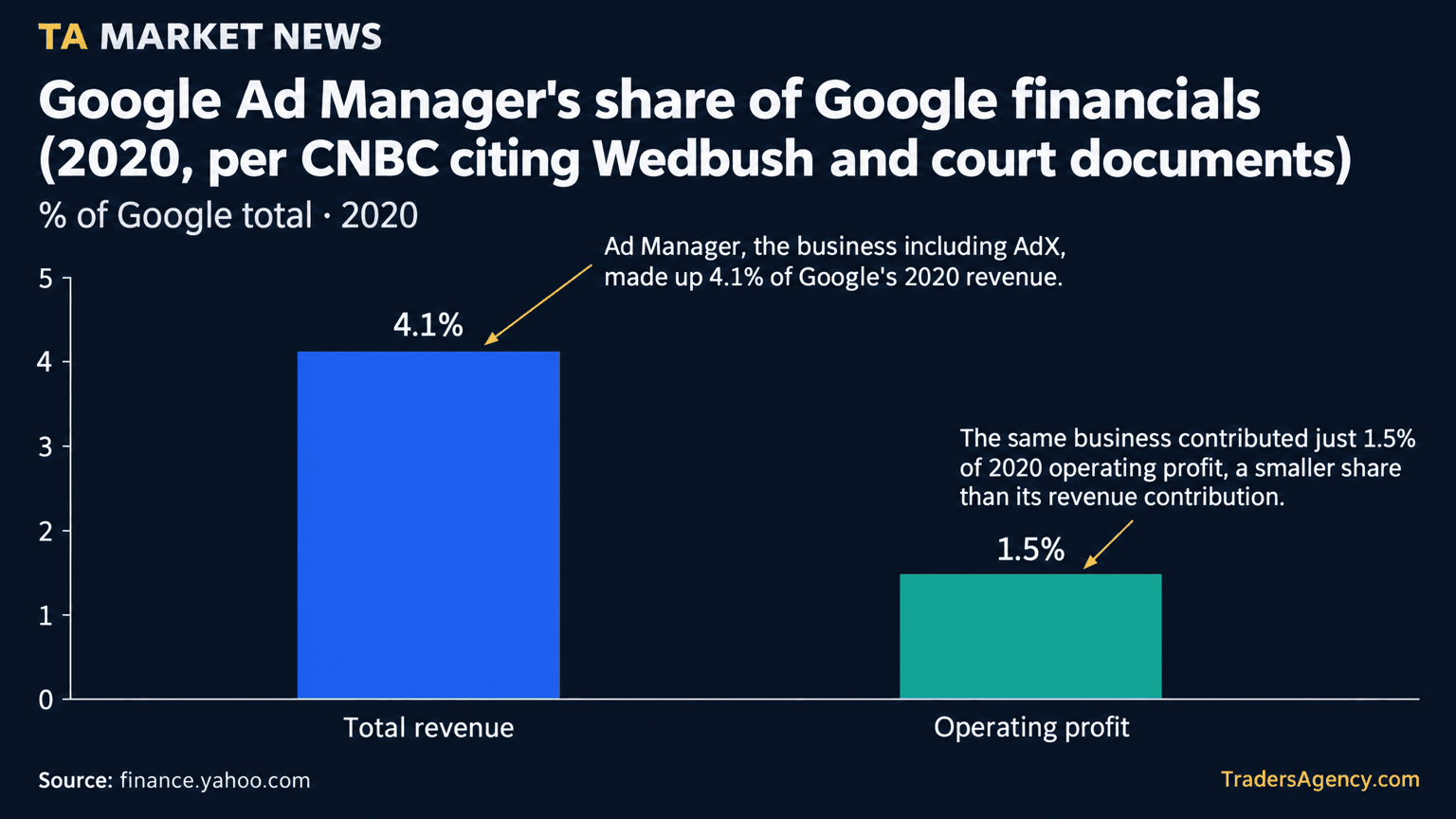
AdX is the exchange through which publishers pay a 20% fee to sell ads in real-time auctions as users load web pages, Yahoo Finance reports. The financial stakes, in relative terms, have historically been modest against Google's overall scale. Ad Manager, the business that includes AdX, accounted for 4.1% of Google's total revenue and 1.5% of operating profit in 2020, according to CNBC's analysis of Wedbush research and court documents, as cited by Yahoo Finance. By our calculation, that is a 2.6 percentage-point gap between the revenue and profit shares (4.1 - 1.5), or a relative difference of roughly 173% ((4.1 - 1.5) / 1.5 x 100). One interpretation of that gap is that Ad Manager contributed proportionally less to Google's operating profit than to its revenue in 2020, implying margins below the company-wide average; it is a single-year snapshot comparison, not a trend or forecast. More recent figures were redacted from court filings, so it is not possible to say how that mix has shifted since 2020.
A Pattern of Rejected Breakups
Yahoo Finance frames this as the second time a judge has refused a DOJ effort to force Google to sell assets, after a Washington judge found an illegal search monopoly but declined to order a Chrome divestiture, citing competition from generative AI firms such as OpenAI's ChatGPT. It was also, per the same report, the third consecutive rejection of a major breakup effort against a big tech company, following dismissal of the FTC's case seeking to strip Meta of Instagram and WhatsApp. Separate government antitrust actions against Amazon and Apple face courtroom dates no sooner than 2027, CNBC reported, as relayed by Yahoo Finance.
Google has said it intends to challenge the underlying liability finding, Digiday reports, an appeal that could extend the legal dispute well beyond implementation of the initial final judgment. No filing date for that appeal is specified in available reporting.
Industry Reaction Shifts to Enforcement
Digiday reports that some publishing executives had already questioned whether transferring AdX to a new owner would materially improve competition, given the disruption of restructuring the ad tech supply chain. With divestiture off the table, that reporting suggests their attention is shifting to whether the behavioral remedies actually improve interoperability and access to auction data. Because those remedies regulate conduct rather than separating Google's businesses, Digiday notes Google could technically comply while still retaining advantages tied to its scale, technology, customer relationships, and presence across the ad supply chain, leaving enforcement as the key variable to watch once the final judgment is entered.
Bottom Line
Brinkema's decision keeps Google's ad tech stack intact but layers on operating restrictions whose precise scope will not be clear until the parties file, and the court resolves, a final judgment within 30 days. Combined with Google's stated intent to appeal the underlying liability finding, the practical impact on publishers and rival ad tech firms is likely to depend less on this ruling's headline outcome and more on how strictly the eventual behavioral terms are drafted and enforced.
DISCLAIMER: Traders Agency does not offer financial advice. The information provided is for educational purposes only and should not be considered financial advice. Traders Agency is not responsible for any financial losses or consequences resulting from the use of the information provided. Trading carries inherent risks and may not be suitable for all individuals. You are advised to conduct your own research and seek personalized advice before making any investment decisions, recognizing the potential risks and rewards involved.
- ScanX: Alphabet Q2FY26 Results: Cloud revenue surges 82%, CapEx guidance raised · accessed Sep 17, 2026
- digiday.com: Google avoided (yet another) breakup... now remedies are tested · accessed Sep 17, 2026
- finance.yahoo.com: Google escapes DOJ bid to break up its ad tech business · accessed Sep 17, 2026
- www.vitallaw.com: Wolters Kluwer · accessed Sep 17, 2026
- www.mealeys.com: Google Divestiture Rejected, Most Behavioral Remedies Accepted In Antitrust Suit · accessed Sep 17, 2026
- abc.xyz: Alphabet Investor Relations - Investors · accessed Sep 17, 2026
- s206.q4cdn.com: Alphabet Announces First Quarter 2026 Results · accessed Sep 17, 2026
See more from Traders Agency on Google
Make us a preferred source and our market analysis will appear more prominently in your Google Search, Top Stories, and AI results.
Add to Preferred Sources