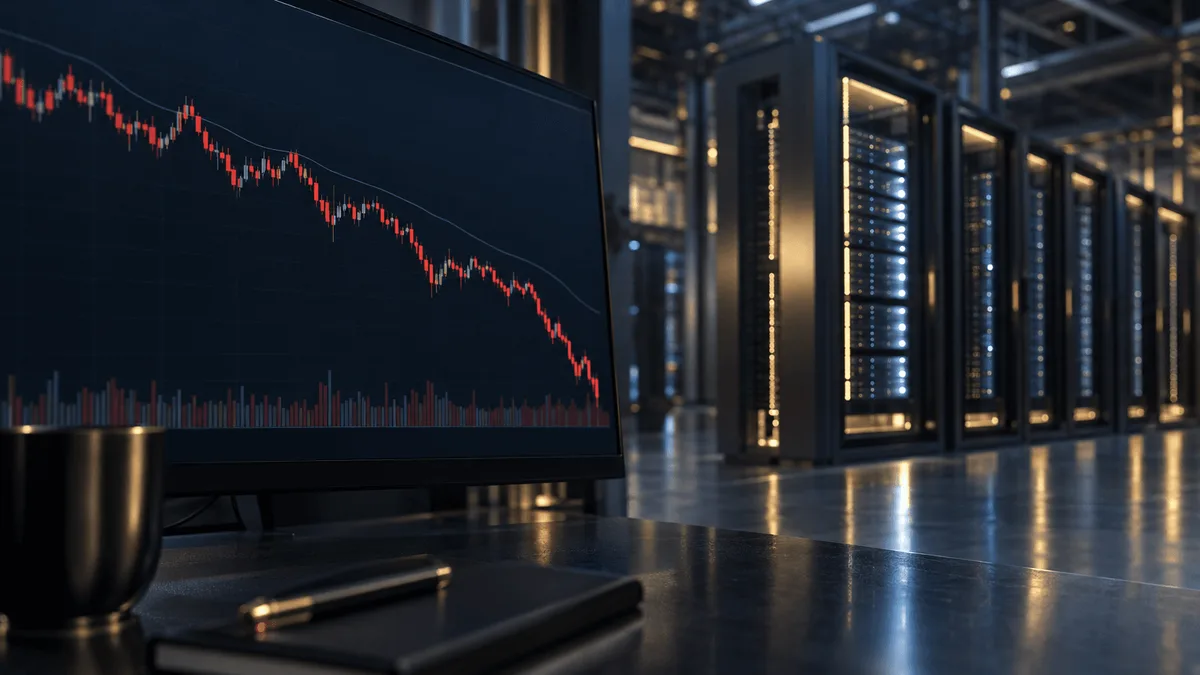
A violent, concentrated sell-off in high-growth technology and semiconductor stocks has reignited an old debate: is this the start of something much worse, or simply an overdue digestion phase after one of the most crowded rallies in years? The case for calm rests on resilient hiring, still-expanding business activity and hyperscalers that keep committing capital to artificial intelligence. The case for caution rests on leverage, financing costs and a political and geopolitical backdrop that has grown noticeably murkier since election day.
A Historic Momentum Collapse in Tech
According to the report under review, the session produced an unusually sharp intraday decline, with the Nasdaq Composite falling roughly 5% and the Nasdaq 100 approaching a 6% drop, a move the source compared to levels not seen since pandemic-era volatility. Several widely held growth and consumer-facing names reportedly suffered double-digit percentage losses on the day.
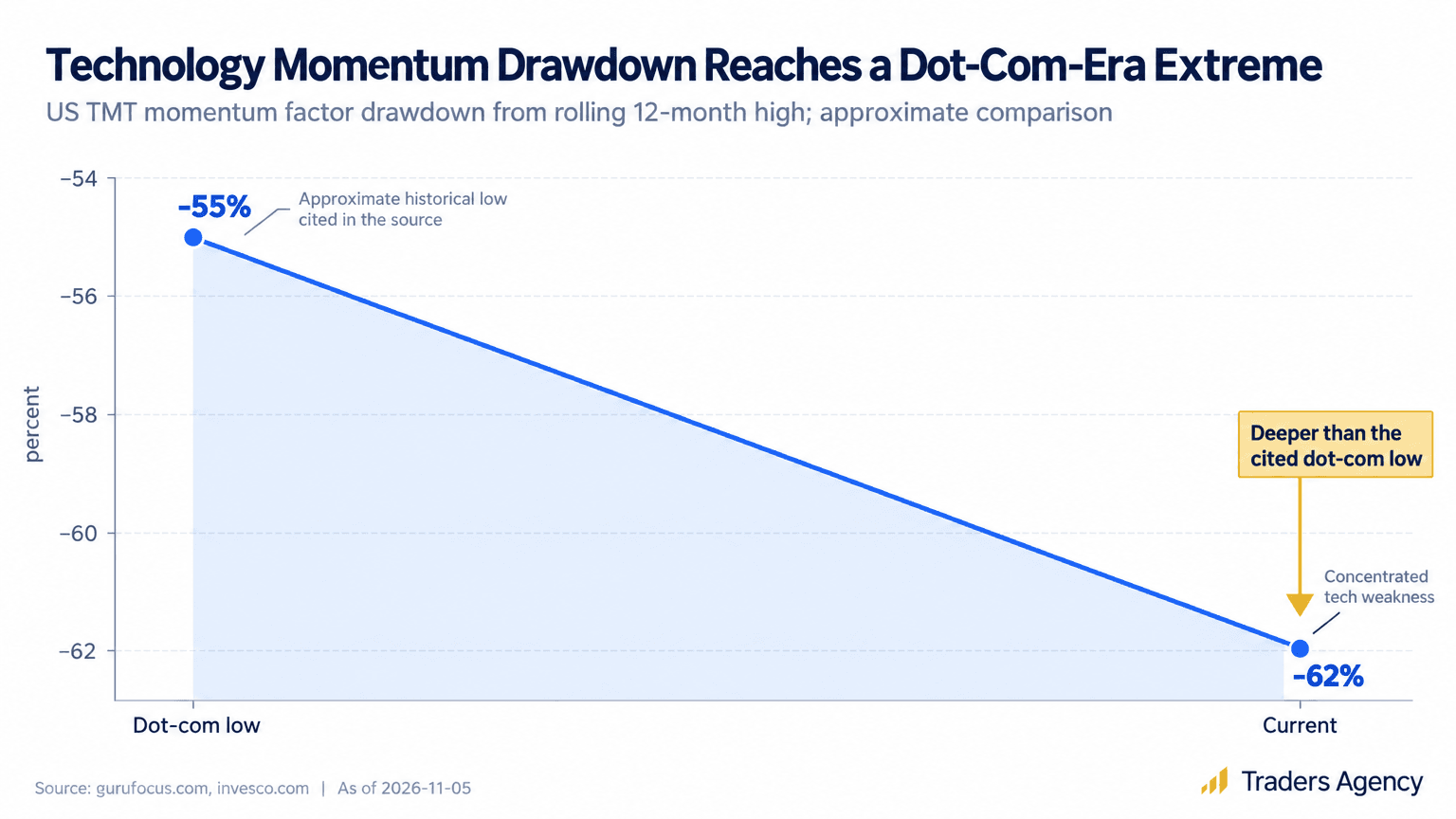
More striking than the single-day move is the broader momentum picture highlighted in the report. Citing Morgan Stanley data, the report said its US technology, media and telecom momentum factor had fallen roughly 62% from its rolling 12-month high, a steeper drawdown than the approximately 55% decline the same factor registered during the dot-com bust. By contrast, the equal-weight S&P 500 was trading near its own highs, suggesting the pain is concentrated in high-momentum growth and semiconductor names rather than spread evenly across the market. That contrast is central to the argument here: this looks more like a liquidation of crowded positioning than a broad repricing of the economy.
Leverage appears to be amplifying the move. The source pointed to forced selling tied to margin calls, algorithmic trend-following strategies and investors using leveraged exchange-traded funds, which can generate outsized losses that don't always show up in standard margin-debt statistics. That dynamic helps explain why the decline has felt so severe even though, as discussed below, the underlying economic data has not deteriorated to the same degree.
Tighter Financial Conditions, Looser Fed Expectations
Financial conditions are not just a function of bond yields; they also incorporate equity-market performance. When stocks fall sharply, financial conditions can tighten even if yields hold steady, and tighter conditions are precisely what the Federal Reserve has said it is watching. The source noted that futures-market pricing had shifted accordingly, with the implied probability of a December rate increase slipping to around 70% and expectations for additional hikes by next September also pulling back, based on pricing cited in the report. In other words, a falling stock market may be doing some of the Fed's tightening work for it, which could reduce pressure for further policy moves even without a change in the inflation outlook.
AI Spending Keeps Rising Even as Stocks Fall
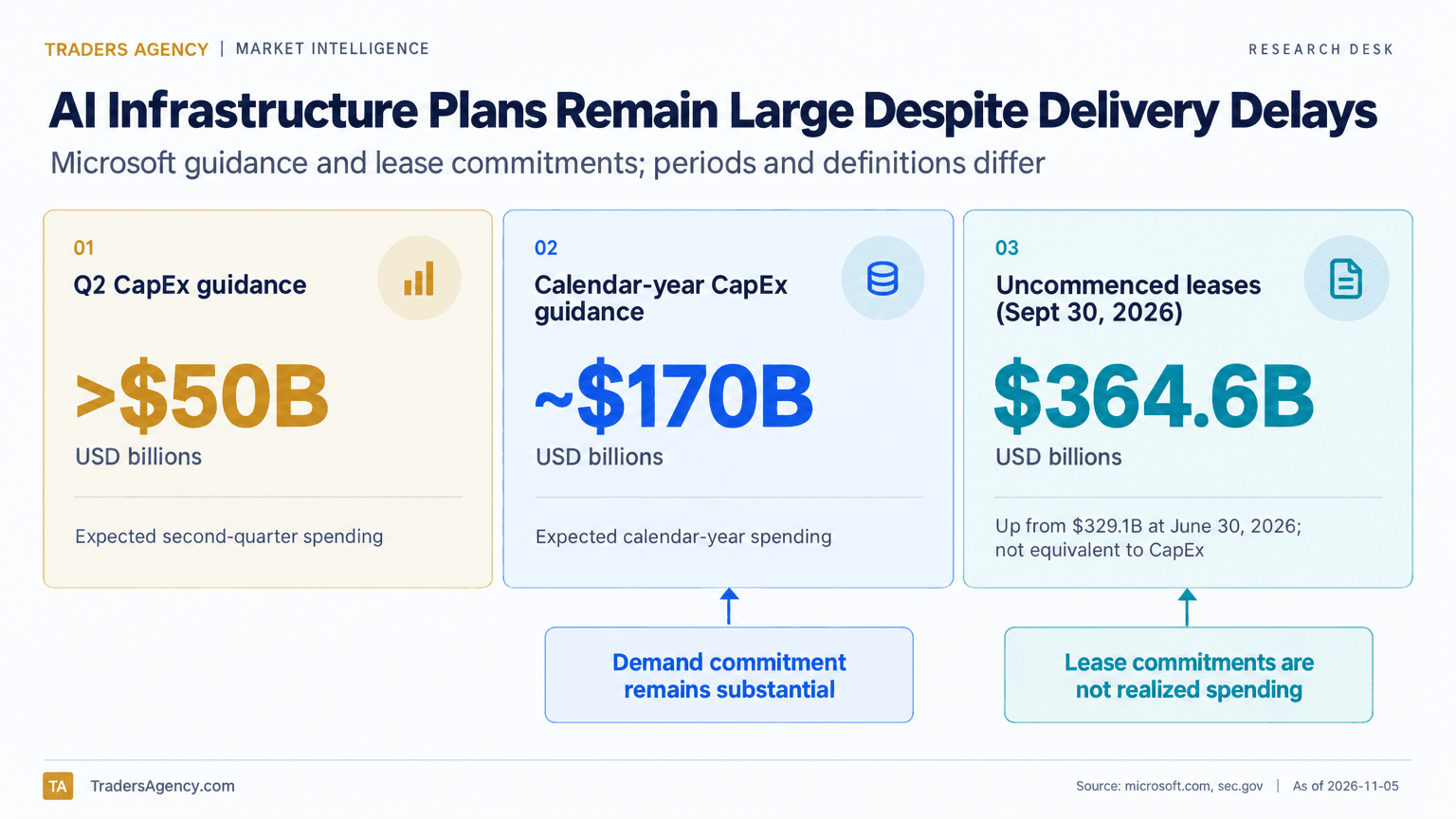
If AI demand were genuinely collapsing, the clearest signal would be hyperscalers quietly pulling back their spending plans. The source argued that is not happening. Microsoft's own earnings-call guidance, cited in the report, calls for second-quarter capital expenditure above $50 billion and roughly $170 billion for the calendar year, even as the company has acknowledged delays in receiving third-party data-center capacity. Separately, Microsoft disclosed $364.6 billion in additional lease commitments, primarily for data centers, that had not yet commenced as of September 30, 2026, up from $329.1 billion three months earlier, with some arrangements still conditional. Uncommenced leases are not the same as realized capital spending, but the scale of the commitment is notable on its own.
The source also pointed to broader off-balance-sheet AI spending estimates that it said had climbed from roughly $1.8 trillion in June to about $3.1 trillion in August and near $4.1 trillion by early November, alongside a reported jump in Amazon's own commitments from about $125 billion to $254 billion. The underlying methodology for those figures was not detailed in the source material, so they are best treated as the presenter's characterization of a fast-moving trend rather than independently confirmed totals. Taken together, though, the pattern the source describes is one of continued, even accelerating, commitment to AI infrastructure, which complicates any narrative that demand has simply evaporated.
Delays, Not Demand Destruction
So why the headlines about Microsoft souring on neocloud partners? The source's answer is that this reflects delivery delays and shifting technical requirements rather than waning appetite. Microsoft has confirmed delays in third-party capacity deliveries; the report's suggestion that changing specifications for persistent AI agents, cabling or network architecture are the specific cause is the presenter's inference rather than a confirmed company explanation, and should be read with that caveat. What is clear is that delays of this kind tend to unsettle a stock market with little patience for timing slippage, even when the underlying spending commitment remains intact.
Want expert trading insights delivered daily?
Join thousands of traders who rely on Traders Agency for market analysis and trade ideas.
Join Traders AgencyThe AI "Doom Loop" and Why It Hasn't Sprung Yet
The source lays out an analytical framework it calls the AI doom loop: infrastructure delays can push up credit-default-swap spreads on companies tied to AI buildouts, which raises borrowing costs, which weakens financing capacity for capital-intensive neocloud providers, which in turn causes further delays. This is a conceptual mechanism rather than an established fact, but it is a useful lens for understanding why financing stress, not just demand, matters to the AI trade.
Crucially, the source argued the loop was not clearly worsening at the time of recording. It described Oracle's credit-default-swap spread as having declined from a recent peak, CoreWeave's as elevated but not deteriorating further, and Meta's as improving modestly. If accurate, that would suggest the market's current stress is more about sentiment and positioning than a genuine credit-driven unraveling, though these are recent, narrow observations that bear continued monitoring rather than a settled conclusion.
Resilient Labor Market, For Now
The source frames the labor market and AI spending as the two indicators most likely to signal a genuine recession, as opposed to a painful but temporary digestion phase. On that score, the data it cited was constructive. ADP reported 86,000 additional private-sector jobs for October 2026, and October ISM manufacturing and services readings came in at 55.5 and 54.5 respectively, both indicating expansion. Third-quarter labor productivity grew 3.6% on an annualized basis, the fastest pace in over a year, while unit labor costs fell 0.7%, a figure the source noted could also reflect softer bargaining power for workers even as it helps corporate margins. Weekly initial unemployment claims came in at 189,000 for the week ending October 31, the fewest since mid-July, according to the Labor Department's November 5 release.
The source's central warning is that this picture could change quickly. If the stock sell-off itself becomes severe enough to force corporate layoffs, that would mark a more serious break from a simple digestion phase into something closer to a genuine downturn. For now, aggregate labor and business-activity data have not shown that kind of stress, but it remains the scenario Traders Agency analysts are watching most closely in the weeks ahead.
Politics and Iran Add to the Uncertainty
Part of the market's anxiety, according to the source, stems from the recent election outcome and concern that incoming officials in some states could move to restrict data-center development. The specific timeline and mechanism for any such restrictions remain uncertain; incoming officials typically do not take office immediately, and any legislative action would need to work through state legislatures, though some restrictions could also be pursued through executive or administrative authority. This should be treated as an unresolved political risk rather than a settled policy outcome.
Separately, the source pointed to stalled nuclear negotiations with Iran as another source of market unease, arguing that a diplomatic breakthrough could ease pressure on equities, bond yields and oil prices simultaneously. Reporting has indicated renewed, if fragile, engagement between the parties, including mediation efforts, though no agreement has been reached and the effect of any eventual deal on markets remains speculative.
A Sharply Divided Market Beneath the Surface
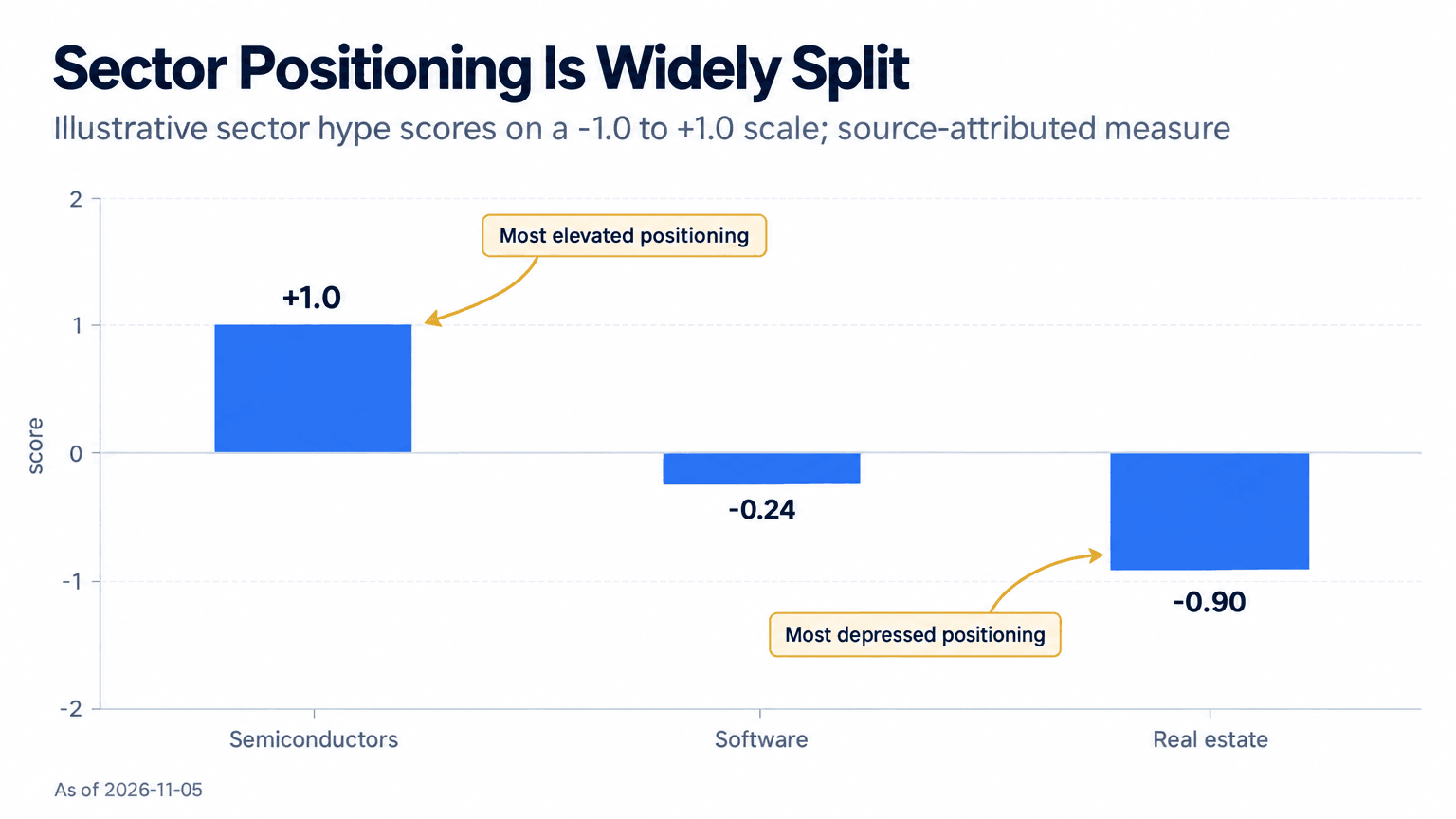
Beneath the headline sell-off lies a market with wildly uneven positioning. Using a self-described sector hype score, the presenter characterized semiconductors as the most crowded and enthusiastically owned sector in the market, while real estate sat near the opposite extreme of investor pessimism. Semiconductors were also described as unusually sensitive to movements in the yield curve, which could help explain why that sector has borne a disproportionate share of the recent damage. This hype-score framework was not independently detailed in the source material and should be understood as the presenter's own measure rather than a standardized industry metric, but the broader point — that sentiment is far from uniform across sectors — is a useful way to read a sell-off that looks far more painful in growth and semiconductor names than in the market as a whole.
The Bottom Line
None of this amounts to proof that the AI buildout is faltering. Spending commitments from major hyperscalers remain large, labor and business-activity data have held up, and credit markets have not shown broad-based deterioration. At the same time, the speed and severity of the technology momentum unwind, combined with leverage, political uncertainty and unresolved geopolitical risk, mean the margin for error has narrowed. The scenario worth watching is not whether AI spending slows at the margin, but whether financial-market stress eventually spills into hiring decisions. That, more than any single data point, is the line between a digestion phase and a genuine downturn.
Want expert trading insights delivered daily?
Join thousands of traders who rely on Traders Agency for market analysis and trade ideas.
Join Traders AgencyDISCLAIMER: Traders Agency does not offer financial advice. The information provided is for educational purposes only and should not be considered financial advice. Traders Agency is not responsible for any financial losses or consequences resulting from the use of the information provided. Trading carries inherent risks and may not be suitable for all individuals. You are advised to conduct your own research and seek personalized advice before making any investment decisions, recognizing the potential risks and rewards involved.
- Hedge Fund Walleye Returns Capital, Fires Head Of Equities After Worst Month Since COVID
- NASDAQ Composite Historical Data
- Nasdaq Enters Correction Territory Amid Data Center Anxiety
- Technology Momentum Slumps Sharply
- Invesco S&P 500 Equal Weight ETF
- Bets on a Fed hold in December jump, but a quarter-point hike is still favored
- Over $4.1 Trillion: Beware AI’s Off-Balance-Sheet Bill
- Microsoft Fiscal Year 2027 First Quarter Earnings Conference Call
- Microsoft Form 10-Q for September 30, 2026
- Microsoft 2026 Annual Report
- LPL Research: Has AI Become a Rates Story?
- ADP National Employment Report: October 2026
- October 2026 ISM Manufacturing PMI Report
- October 2026 ISM Services PMI Report
- Productivity and Costs: Third Quarter 2026, Preliminary
- Unemployment Insurance Weekly Claims, November 5, 2026
- Unemployment claims drop to 189,000, the fewest since mid-July
- Permitting's election twist
- Midterm Preview: November 3, 2026
- Reuters: Iran says contacts over ending war continue after talks finish with no breakthrough
- US and Iran review draft proposal to end war, Qatar says
See more from Traders Agency on Google
Make us a preferred source and our market analysis will appear more prominently in your Google Search, Top Stories, and AI results.
Add to Preferred Sources