
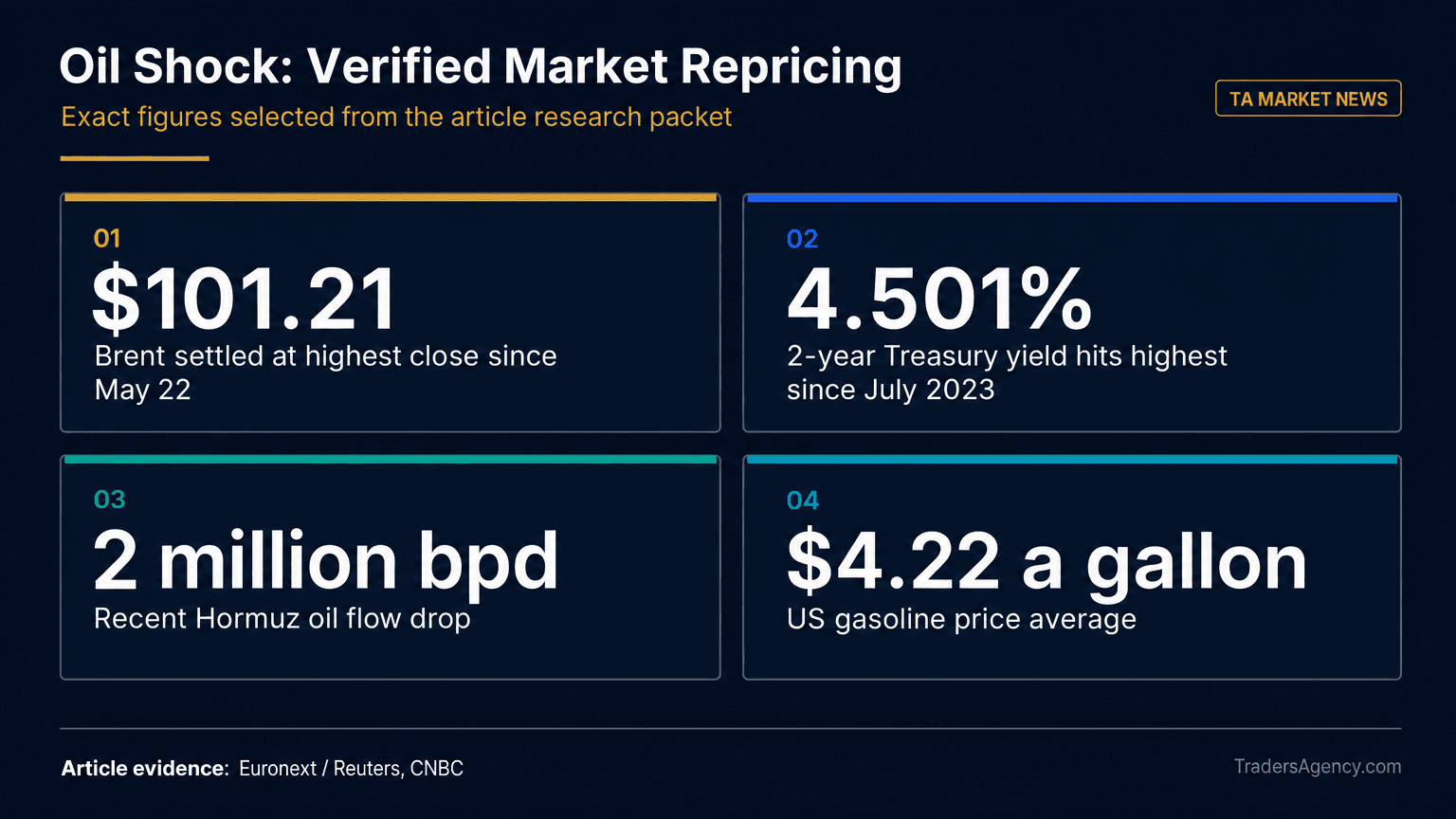
Brent settled at $101.21 a barrel today, up $3.29, or 3.4%, after touching an intraday high of $101.58. WTI crude closed up $3.02, or 3.25%, at $96.05. Both benchmarks marked their highest closes since May 22, following reports of Iran attacking vessels near the Strait of Hormuz, and the move coincided with the release of US wholesale inflation data.
This is the kind of session that forces traders to rethink positioning fast. Oil, bonds, and inflation expectations are moving together right now, and the Strait of Hormuz sits at the center of it.
What caused Brent crude to cross $100 again?
Iran said it attacked 10 ships near the Strait of Hormuz, and the US sank five Iranian oil tankers, in what Reuters described as a sharp escalation of the six-month war. That headline hit directly on top of a US wholesale inflation report, and Brent pushed through the psychological $100 level for the first time since a brief touch in late July.
The wholesale inflation reading itself was unremarkable. CNBC reported prices rose 0.4% in August, in line with Dow Jones consensus estimates, and core prices excluding food and energy rose 0.2%, slightly below the forecasted 0.3% increase. The oil surge, and the impact it may have on inflation and interest rates, overshadowed that data.
Why Did Brent Settle Above $100 a Barrel?
Brent settled above $100 as the Middle East conflict intensified, with shipping through the Strait of Hormuz thinning sharply while fighting between the US and Iran escalates. Preliminary Kpler shipping data showed just six commodity vessels transited the strait on Tuesday, down from nine a day earlier and below the 10-day average of about 12.
The Number: Rystad Energy chief economist Claudio Galimberti said roughly 8 million to 9 million barrels per day flowed through the strait in the week before fighting resumed on August 30, double the previous week's volume. More recently, those flows have fallen below 2 million bpd. The strait has been responsible for transiting about one-fifth of the world's oil and gas supply.
Saxo Bank's head of commodity strategy Ole Hansen said the move back above $100 Brent "is reflecting a market that increasingly has to change its view on how long the Middle East crisis will continue to curb supply from the region." That is a fair summary of what we are seeing in price action across the complex.
How are the Hormuz shipping attacks affecting oil prices?
Our read on this: the physical market moved before the futures market did. Dated Brent, against which roughly two-thirds of supply is priced, has been above $100 per barrel since September 3, according to LSEG data. Today's settlement looks like confirmation of a repricing that was already underway on the ground, not the start of one.
What We're Watching in the Physical Chain
- Vessel counts through Hormuz: a further drop below the six-vessel Tuesday reading could point to deeper disruption.
- The dated Brent price: its persistence above $100 since September 3, based on LSEG data, suggests physical buyers are already paying up.
- Consumer fuel costs: US gasoline is averaging about $4.22 a gallon, while diesel is at a record and closing in on $6 a gallon.
For traders using USO as a crude proxy, the tape backs up the headline move: the ETF is up 12.17% over the last 10 days, moving in line with the crude rally. Energy-sector exposure through XLE has moved more modestly, up 2.11% over the same stretch, which suggests the equity side has not fully caught up to the commodity spike yet.
Want expert trading insights delivered daily?
Join thousands of traders who rely on Traders Agency for market analysis and trade ideas.
Join Traders AgencyHow did US wholesale inflation data factor into the oil price reaction?
The bond market gave the clearest signal of how traders are pricing this. CNBC reported the 10-year Treasury yield topped 4.9%, its highest level since 2023, as the oil surge raised inflation fears. The 2-year yield hit a high of 4.501%, its highest trading level since July 2023, while the 30-year bond yield was up more than 5 basis points at 5.337%.
That is a market worried about inflation feeding through from energy costs into everything else. TLT, our proxy for long-duration Treasury exposure, is down 0.96% over the past 10 days, consistent with yields grinding higher as oil-driven inflation concerns build.
With wholesale price data out of the way, CNBC reported investors are now looking ahead to consumer price data due Friday and next week's Federal Reserve interest rate decision. Neither of those events has happened yet, and we would treat any read on the Fed's next move as conditional until that data lands. A softer consumer print could strengthen the case for the Fed to continue holding rates steady, while an energy-driven upside surprise would keep another hike a meaningful possibility.
How Could the Fed Decision Factor Into Oil Markets?
The data we have in front of us centers on the US side of the reaction, particularly Treasury yields and the Federal Reserve's decision next week. What is clear is that policymakers are now contending with an oil move landing right as they assess the inflation trajectory.
We would flag this as a reason to watch cross-asset moves closely into next week rather than trade oil in isolation. A hawkish surprise from the Fed on top of a Hormuz-driven supply disruption could compound volatility across rates, currencies, and commodities at once.
Brent vs WTI: Latest Price Comparison
Brent's $101.21 settlement against WTI's $96.05 keeps the spread in a familiar range, with Brent holding its usual premium as the international benchmark most exposed to Middle East supply risk. WTI still closed at its own highest level since May 22, so this is not a Brent-only story.
Both benchmarks are trading well below the war-era peak. Since the Iran war began on February 28, Brent has surged as high as $126.41 a barrel, a peak reached on April 30, before retreating below $100 in late May and only briefly touching that level again in late July.
What Is Today's Brent Crude Price?
The Brent oil price today closed at $101.21 a barrel after a session high of $101.58, a 3.4% gain and the highest settlement since May 22. That puts crude back above the psychological triple-digit mark for the first time in weeks.
What Traders Should Note: The physical market, via dated Brent, has been above $100 since September 3, according to LSEG data. The futures settlement is catching up to where roughly two-thirds of supply has already been pricing for about a week.
Oil Price Forecast After the $100 Settlement
Any forecast from here has to start with the Strait of Hormuz. Vessel traffic has fallen from a 10-day average of about 12 to just six on Tuesday, and flows that ran roughly 8 million to 9 million bpd in the week before August 30 have since dropped below 2 million bpd. If that trend continues, further upside in crude remains a meaningful possibility, though nothing here guarantees a straight line higher.
The counterweight is demand destruction. Gasoline near $4.22 a gallon and diesel closing in on $6 could eventually curb consumption, and a hawkish Fed decision next week could tighten financial conditions in ways that weigh on crude demand expectations. We are not calling a direction here. We are flagging the two forces pulling against each other.
The Bottom Line
Brent's move back above $100 reads as a response to a real supply disruption at the Strait of Hormuz rather than a speculative overshoot, based on the vessel-count and flow data now available. Our team is watching Treasury yields, USO, and XLE for confirmation that this move has legs, alongside Friday's consumer price data and next week's Fed decision. Until vessel traffic through Hormuz stabilizes or the conflict shows signs of easing, we are treating elevated volatility across oil, bonds, and energy equities as the base case rather than the exception.
Want expert trading insights delivered daily?
Join thousands of traders who rely on Traders Agency for market analysis and trade ideas.
Join Traders AgencyDISCLAIMER: Traders Agency does not offer financial advice. The information provided is for educational purposes only and should not be considered financial advice. Traders Agency is not responsible for any financial losses or consequences resulting from the use of the information provided. Trading carries inherent risks and may not be suitable for all individuals. You are advised to conduct your own research and seek personalized advice before making any investment decisions, recognizing the potential risks and rewards involved.
- CNBC: 10-year Treasury yield tops 4.9%, highest since 2023, as oil surge raises inflation fears · accessed Sep 10, 2026
- Euronext / Reuters: Brent settles at over $100 a barrel as Middle East conflict intensifies · accessed Sep 10, 2026
See more from Traders Agency on Google
Make us a preferred source and our market analysis will appear more prominently in your Google Search, Top Stories, and AI results.
Add to Preferred Sources