Federal Reserve Chairman Kevin Warsh just used the 2026 Jackson Hole Economic Policy Symposium to deliver a hawkish warning on inflation. After a confusing July press conference, Warsh clarified his stance, signaling that a rate hike remains a meaningful possibility. Our research team is watching a major shift in monetary policy expectations, and traders need to pay attention right now.
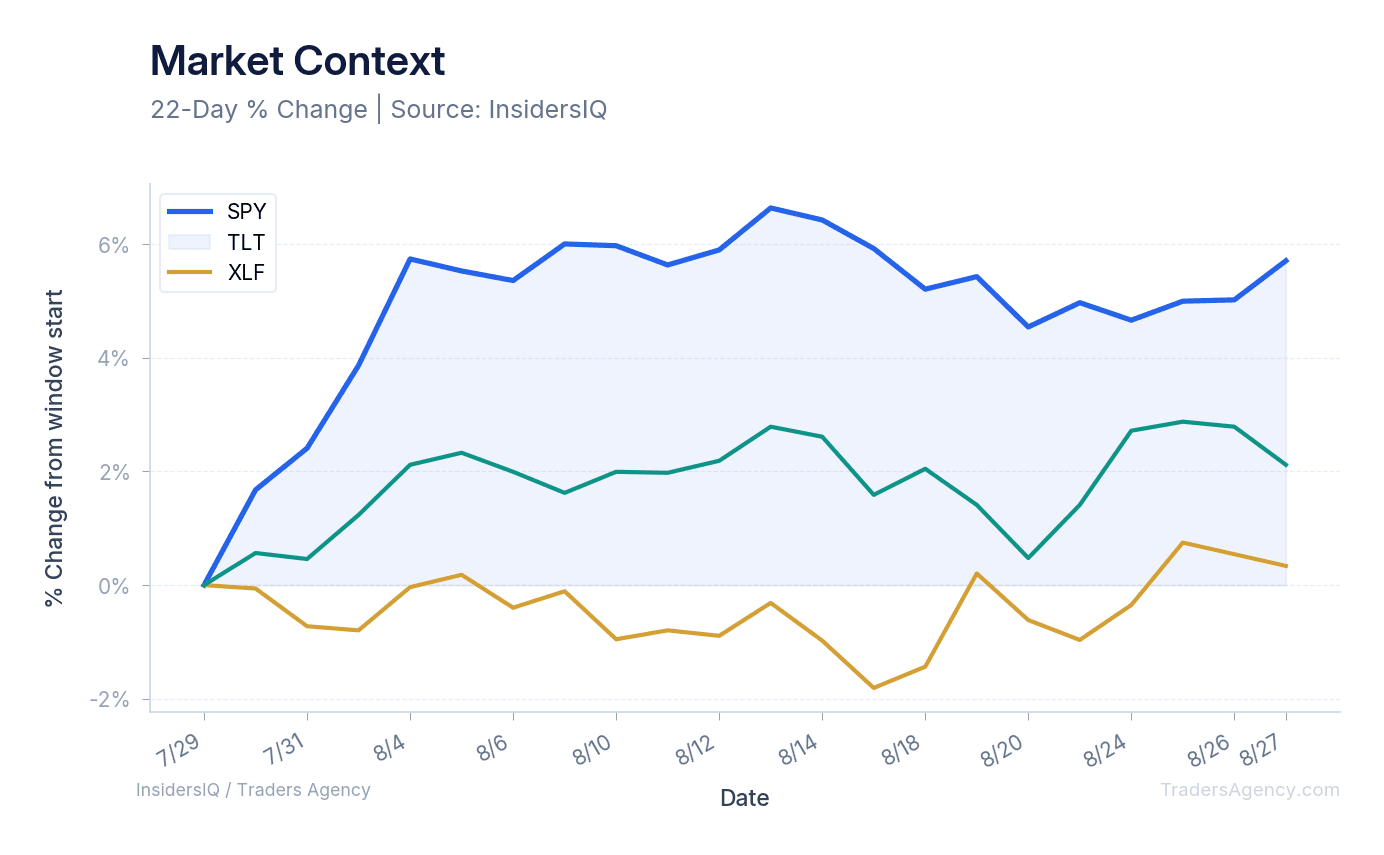
With the SPY posting a 30-day price change of +5.71%, equity markets may be underestimating the central bank's willingness to tighten financial conditions. Traders are actively asking what does Kevin Warsh mean for interest rates as the September meeting approaches. The numbers tell a clear story.
What Did Kevin Warsh Say About Inflation at Jackson Hole?
Bottom Line: Warsh's Jackson Hole remarks represent a measurable shift in tone toward tighter policy, backed by a 3.7% PCE print and broad-based inflation across more than half of PCE components. Traders watching the September meeting should note that rate-sensitive sectors may not be fully pricing in the possibility of a hike.
The data we're tracking shows a clear change in tone from the Fed Chairman. During his keynote remarks at the 2026 Jackson Hole Economic Policy Symposium, Warsh stated that elevated prices must be the primary focus for policymakers. He described current financial conditions as not being broadly restrictive. This marks a sharp departure from his July press conference, where he called conditions "uneven."
Warsh pointed directly to the numbers. Government data released this week shows July PCE inflation at 3.7%. Warsh recommitted to maintaining the 2% PCE goal, calling it a "firm, fixed target." He also noted that 54% of PCE components have seen annualized inflation above 3% over the past 12 months. Over the past six months, 49% of components exceeded that 3% mark.
Key Inflation Data: July PCE inflation stands at 3.7%, with 54% of PCE components running above 3% annualized over the past 12 months. The consumer price index is currently at 3.4%.
The consumer price index is currently running at 3.4%. Warsh indicated that while no single metric is perfect, they collectively show inflation running above target.
Could the Fed Raise Interest Rates at the September Meeting?
The Federal Reserve could raise interest rates at the September 15-16 meeting. Chairman Warsh stated that short-term interest rates are the predominant tool for achieving price stability. With PCE inflation at 3.7%, multiple Fed officials have raised doubts about whether current policy is restrictive enough.
Broader reporting from the symposium shows that multiple Fed officials have raised similar concerns. Kansas City Fed President Jeffrey Schmid expressed doubts about whether holding the policy rate at 3.5% to 3.75% is exerting any meaningful brake on economic activity. Schmid noted that he is still working to understand demand-side forces before taking a stand on a September hike.
Cleveland Fed President Beth Hammack took a stronger position. She repeated her call for higher rates, pointing out that inflation has run above the 2% target for more than five years. Hammack was one of three dissenters when the FOMC voted 9-3 to hold rates steady at the July 28-29 meeting.
What Does Warsh's Stance Mean for Interest Rates?
For traders wondering what does Kevin Warsh mean for interest rates, his latest remarks indicate a shift toward tighter monetary policy. He indicated that artificial intelligence considerations have no bearing on current policy decisions and gave no signal that balance sheet cuts were coming. Instead, he recommitted to a firm, fixed inflation target, which could increase the probability of a near-term hike.
Warsh noted that a Fed task force examining AI use is encouraging. However, he clarified that AI has no bearing on decisions made in the current policy conjuncture. In the past, he had said advances in AI might be a reason to cut interest rates, a position he is now moving away from.
This hawkish stance puts Warsh at odds with President Donald Trump, who continues to demand lower rates. Trump has also reinstated an effort to fire Governor Lisa Cook. Warsh did not address Trump at Jackson Hole, and there was no signal that balance sheet cuts or rate decreases are coming.
Want expert trading insights delivered daily?
Join thousands of traders who rely on Traders Agency for market analysis and trade ideas.
Join Traders AgencyHow This Could Affect the Market
The setup we see involves significant risks for rate-sensitive sectors. Traders evaluating the Fed's next move must account for the possibility of higher borrowing costs through the end of the year.
We are closely monitoring the SPY, which posted a 30-day price change of +5.71%. This suggests equity markets have largely priced in a soft landing, potentially ignoring the hawkish signals from Jackson Hole. If the Fed moves forward with a rate hike, we could see a sharp repricing in broad market indices.
Market Snapshot (30-Day Changes): SPY +5.71% | XLF +2.12% | TLT +0.34%. Equities appear to be pricing in a soft landing while bond traders remain cautious.
The XLF financial sector ETF shows a 30-day price change of +2.12%. Banks and financial institutions are highly sensitive to the spread between short-term and long-term rates. A hike in the 3.5% to 3.75% policy rate could impact loan demand. Long-term Treasury bonds are also reacting: the TLT ETF posted a modest 30-day price change of +0.34%, showing that bond traders appear cautious as they wait for concrete action against inflation.
Chicago Fed President Austan Goolsbee warned that inflation returning is a pressing worry. He cited elevated energy prices stemming from the Iran war and tariff impacts as heavy burdens on consumers. The core PCE reading, which strips out food and energy, climbed 3.3% over the past year.
The Persistence of Inflation and What It Means for Policy
The current market environment requires close attention to incoming data. When comparing the current situation to the 2023 rate hike cycle, the persistence of price increases remains a primary concern for the central bank.
Hammack warned that a prolonged stretch of above-target inflation could cause households and businesses to accept higher prices as the new normal. She cited conversations with workers in Erie, Pennsylvania, who struggle to make ends meet despite holding steady jobs.
Goolsbee mentioned that the recent three-month inflation trend does not look terrible, suggesting rate cuts could eventually happen if inflation moves back toward 2%. However, Warsh's heavy focus on the 3.7% headline PCE figure suggests tightening may be the more immediate priority.
What Should Traders Watch Ahead of the September Fed Meeting?
Our team is tracking several specific factors ahead of the next FOMC gathering:
1. The September 15-16 FOMC Meeting
The committee will decide whether to maintain the current 3.5% to 3.75% policy rate or implement a hike. The July meeting resulted in a 9-3 vote to hold, but Warsh's new tone could shift the internal debate.
2. Core Inflation Metrics
Warsh explicitly highlighted that 54% of PCE components are above 3% annualized inflation over the past 12 months. Any acceleration in these underlying components could strengthen the case for a hike.
3. Dissenting Voices
Pay attention to officials like Beth Hammack and Jeffrey Schmid. Their public statements indicate that the consensus for holding rates steady is fracturing. Hammack has publicly stated she believes now is the time to act.
Our Assessment
The Traders Agency research team sees a Federal Reserve that appears to be laying the groundwork for tighter monetary policy. Chairman Warsh used Jackson Hole to establish a firm commitment to the 2% inflation target, dismissing political pressure for rate cuts. We are adjusting our expectations for the September meeting and closely watching rate-sensitive sectors for potential volatility. The risk of a rate hike is real, and the market may not be fully prepared for it.
Want expert trading insights delivered daily?
Join thousands of traders who rely on Traders Agency for market analysis and trade ideas.
Join Traders AgencyKey Takeaways
- Fed Chairman Kevin Warsh used the 2026 Jackson Hole symposium to signal that a rate hike remains a meaningful possibility, walking back the ambiguity from his July press conference.
- July PCE inflation came in at 3.7%, well above the Fed's 2% target, with 54% of PCE components showing annualized inflation above 3% over the past 12 months.
- Warsh described current financial conditions as 'not broadly restrictive,' a harder line than his July characterization of conditions as 'uneven,' suggesting his tolerance for elevated inflation may be narrowing.
- Equity markets may be underpricing tightening risk: SPY posted a 30-day gain of +5.71% heading into this shift in Fed tone.
- Dissenting FOMC voices, including Beth Hammack and Jeffrey Schmid, are publicly signaling support for action, indicating the consensus for holding rates steady could be fracturing ahead of the September meeting.
DISCLAIMER: Traders Agency does not offer financial advice. The information provided is for educational purposes only and should not be considered financial advice. Traders Agency is not responsible for any financial losses or consequences resulting from the use of the information provided. Trading carries inherent risks and may not be suitable for all individuals. You are advised to conduct your own research and seek personalized advice before making any investment decisions, recognizing the potential risks and rewards involved.
See more from Traders Agency on Google
Make us a preferred source and our market analysis will appear more prominently in your Google Search, Top Stories, and AI results.
Add to Preferred Sources