The stock market today is staging an aggressive rebound, and our team is tracking every move. A massive rotation back into semiconductor stocks is driving equities higher following Friday's brutal sell-off, while escalating military strikes between Iran and Israel are sending oil prices surging. The data we're watching suggests traders are repricing both Federal Reserve rate expectations and artificial intelligence valuations in real time. Here's what the numbers mean for your portfolio right now.
What Is the U.S. Stock Market Doing Today?
The U.S. stock market is showing strong recovery momentum, led by the technology sector. The S&P 500 rose roughly 0.9%, while the Nasdaq Composite jumped 1.2% after an initial 1.6% surge. The Dow Jones Industrial Average gained 0.7%, reversing early premarket losses.
This bounce follows a punishing Friday session where the Nasdaq dropped 4% and the S&P 500 snapped its nine-week winning streak. Over a 10-day window, the QQQ still shows a -4.50% price change, highlighting the severity of last week's tech rout.
Key Context: The SPY sits at a -2.50% 10-day price change, while the DIA is down -0.21% over the same period. An unexpectedly strong May jobs report showed a stable labor market, strengthening the case for the Federal Reserve to raise interest rates later this year.
Why Are Semiconductor Stocks Rallying?
Semiconductor stocks are rallying because Nvidia CEO Jensen Huang and others have suggested the recent tech sell-off is an opportunity to buy into the AI trade. Nvidia and Micron are leading the charge at the opening bell.
Micron (MU) shares surged 9% at the open. Despite this jump, the stock still carries a -11.02% 10-day price change.
Nvidia (NVDA) added 2% in early trading. The global chip leader currently shows a -2.86% 10-day price change, reflecting the volatility in the AI trade.
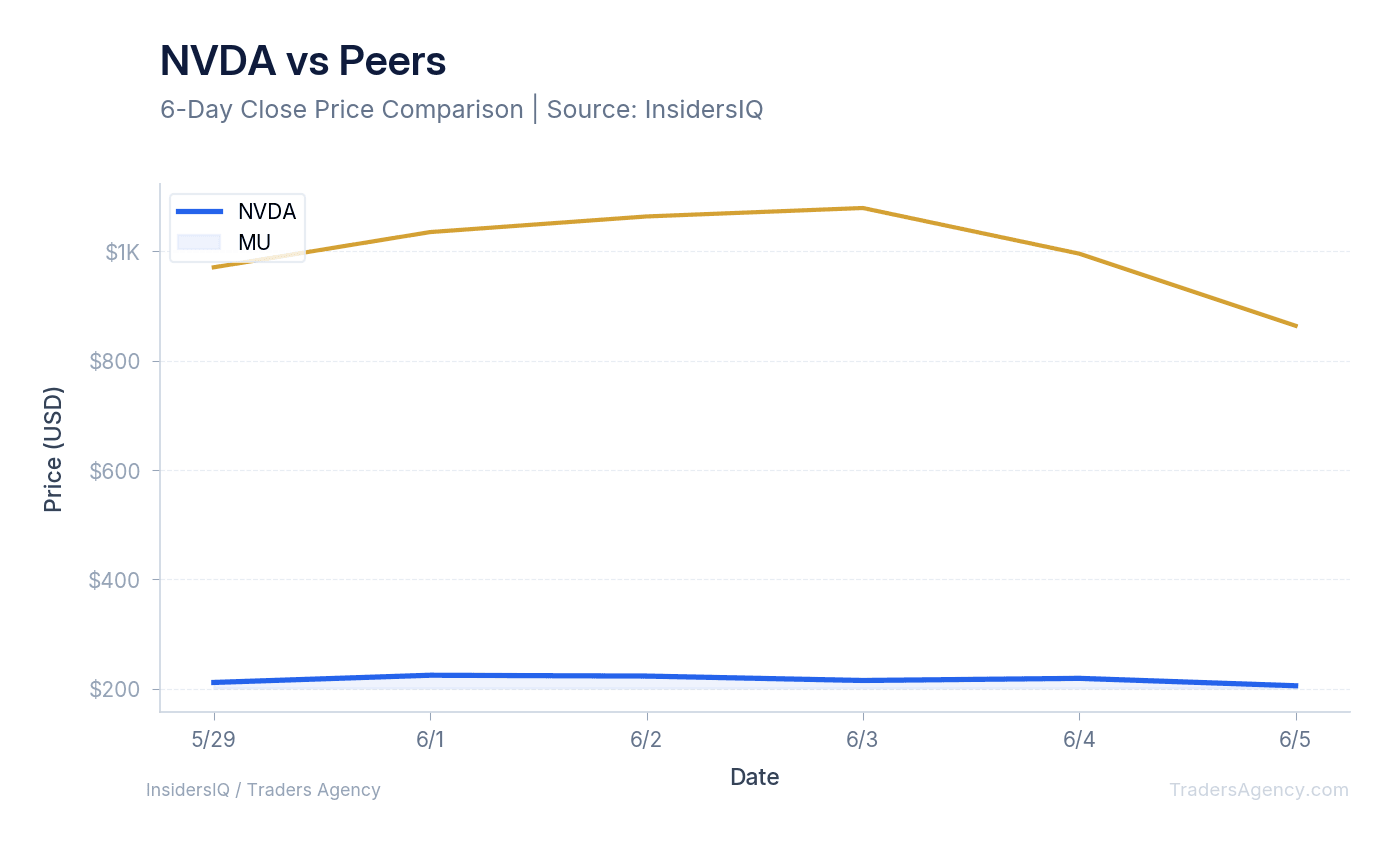
We're also tracking massive moves in the broader chip manufacturing space. Intel (INTC) rallied more than 11% after Google (GOOG) asked Intel to manufacture 3 million of its in-house Tensor Processing Unit (TPU) chips. Google is expected to produce more than 6 million TPUs through 2027 and 2028.
This order comes as Taiwan Semiconductor Manufacturing Company (TSM) struggles to keep up with demand. Nvidia, which is TSM's largest customer, is currently testing whether Intel's foundry technology could manufacture its next series of GPUs. That's a potentially enormous shift in the semiconductor supply chain.
How Will the Iran-Israel Conflict Affect Oil Markets?
The renewed strikes between Iran and Israel are directly inflating global oil prices. Brent crude futures climbed as much as 4% to almost $98 a barrel before pulling back, while West Texas Intermediate neared $95 a barrel. Brent later traded around $94 a barrel and WTI around $91 a barrel, creating significant volatility for energy traders.
Energy Watch: The USO tracker shows a +3.04% 10-day price change, confirming upward pressure on energy assets. The conflict marks the first direct exchange of blows since early April, threatening delicate ceasefire negotiations as the war hits its 100th day.
Iran launched a new wave of strikes against Israel in retaliation for Israeli strikes on Lebanon. Israel then struck back at Iran. Oil prices pared some gains after President Trump urged both sides to stop shooting, stating that peace talks should move quickly.
Our analysis indicates that these energy spikes could complicate the inflation narrative. Higher oil prices risk bleeding into core consumer prices, which directly impacts central bank policy and the trajectory of interest rates for the rest of the year.
Want expert trading insights delivered daily?
Join thousands of traders who rely on Traders Agency for market analysis and trade ideas.
Join Traders AgencyIs the Artificial Intelligence Rally a Bubble?
The AI rally is showing signs of extreme strength, but the data suggests it has not yet reached bubble territory. Prior to Friday's steep pullback, the S&P 500 had surged by 15% during the prior two months. That represents a 99th percentile return relative to history dating back to 1980.
The strength of this rally has generated concerns that stocks have moved too far and are reflecting an unsustainable degree of investor euphoria. However, one key metric tells a different story: the number of initial public offerings remains below average and well below prior cycle peaks. This lack of IPO mania indicates that while trading activity is feverish, the market hasn't hit the speculative extremes that typically precede a crash.
S&P 500 Index Rebalancing Is Driving Big Moves
Index inclusion is driving massive volume into specific tickers today. Marvell (MRVL) jumped nearly 9% and Flex (FLEX) gained 4% after securing spots in the S&P 500.
They will replace The Campbell's Company (CPB) and Pool Corp (POOL) in the index. This shift forces passive funds to accumulate shares of the new entrants, creating a short-term bump in share prices.
Marvell has been on a historic run, climbing 210% since the start of 2026. The custom chip provider now commands a $230 billion market cap, even after a sharp 16% pullback last Friday.
Global Markets and Economic Resilience
The international picture is feeling the pressure from the U.S. tech sector. The South Korean Kospi Composite Index dropped more than 8% overnight, heavily impacted by its exposure to the semiconductor industry.
The global economy is facing rolling shocks. The International Monetary Fund, which maintains a funding line of roughly $1 trillion, downgraded its global growth projections in April on the back of the Iran war. The fund will update its global growth guidance in July.
Despite the international tech sell-off, industry executives remain optimistic. Nvidia and SK Hynix just struck a multi-year agreement to design future generations of memory chips for AI applications. This is a major win for SK Hynix as it competes with Samsung Electronics Co. in the memory chip arena.
South Korean President Lee Jae Myung stated on Monday that he believed the domestic market remained undervalued. This commentary helped stocks like SK Hynix pare their early losses. Nvidia CEO Jensen Huang, speaking to reporters in Seoul, echoed this sentiment, stating that the industry is still in the early stages of constructing AI infrastructure.
What Should Traders Watch This Week?
The market is digesting multiple crosscurrents, from geopolitical shocks to shifting interest rate expectations. An unexpectedly strong May jobs report saw markets move to fully price in a rate hike by the end of the year. Our team is monitoring several specific events that will dictate price action in the coming days.
1. Consumer Price Index Release
We're watching Wednesday's monthly Consumer Price Index report closely. Traders need to see if higher oil prices are starting to bleed into core prices, which would force the Fed to maintain a hawkish stance.
2. Major Corporate Events
Oracle (ORCL) earnings hit the tape on Wednesday. On Monday, Apple (AAPL) hosts its Worldwide Developers Conference in Cupertino, running through June 12. The market expects a major artificial intelligence strategy update and the debut of an AI-infused version of Siri, which landed on iPhones in 2011.
3. The SpaceX Public Offering
Traders are preparing for the likely SpaceX (SPCX) IPO on Friday. This event is expected to be the largest public offering on record.
The Crypto Market Reaction
The digital asset space is mirroring the broader tech recovery. Bitcoin (BTC-USD) rebounded nearly 3% to hover above $63,000.
This bounce follows a steep sell-off where the token fell below $60,000, more than 50% below its October all-time high. The asset is down roughly 20% over the past month.
Year-to-date bitcoin inflows from treasury companies and ETFs stand at around $12 billion, compared to $60 billion last year. Despite the lower inflows, the long-term thesis for the token as a store of value remains intact for many institutional holders.
Our Bottom Line
The stock market today is defined by aggressive dip-buying in the semiconductor sector and rising risk premiums in energy markets. Our team is positioning for continued volatility as traders balance artificial intelligence growth against the reality of higher interest rates.
We're keeping a close eye on Wednesday's inflation data to confirm the next directional move for the major indices.
Key Signals We're Tracking:
- Energy sector reactions to the Middle East conflict and oil price fluctuations
- Volume flows into newly added S&P 500 components like Marvell and Flex
- The upcoming SpaceX IPO and its impact on broader market liquidity
Want expert trading insights delivered daily?
Join thousands of traders who rely on Traders Agency for market analysis and trade ideas.
Join Traders AgencyKey Takeaways
- The Nasdaq jumped 1.2% Monday after Friday's 4% drop, but the QQQ still shows a -4.50% price change over 10 days, meaning the rebound has not erased last week's damage.
- Semiconductor stocks are leading the recovery after Nvidia CEO Jensen Huang signaled the recent sell-off was overdone, making chip names the key sector to watch for confirming trend direction.
- Iran-Israel military strikes are pushing oil prices sharply higher, creating a split market where energy gains and tech rebounds are running simultaneously.
- A stronger-than-expected May jobs report is reinforcing Federal Reserve rate hike expectations, which adds pressure to AI-driven valuations even as those stocks bounce.
- Wednesday's inflation data is the next major catalyst. The outcome will likely confirm or reverse the current rebound across the major indices.
DISCLAIMER: Traders Agency does not offer financial advice. The information provided is for educational purposes only and should not be considered financial advice. Traders Agency is not responsible for any financial losses or consequences resulting from the use of the information provided. Trading carries inherent risks and may not be suitable for all individuals. You are advised to conduct your own research and seek personalized advice before making any investment decisions, recognizing the potential risks and rewards involved.
See more from Traders Agency on Google
Make us a preferred source and our market analysis will appear more prominently in your Google Search, Top Stories, and AI results.
Add to Preferred Sources