
Our research team has been tracking one of the most aggressive speculative surges in recent memory. Total net assets in leveraged U.S. equity ETFs have doubled from $39 billion in April to $84 billion by the end of May. This massive influx signals extreme market appetite for tech exposure, and the structural risks building beneath the surface raise a red flag for every active trader.
The Number: Leveraged U.S. equity ETF assets surged from $39 billion to $84 billion in just two months, a dramatic acceleration in speculative positioning. The Fear & Greed index currently reads 68, reflecting strong bullish conviction.
The data we're watching suggests retail and institutional participants are aggressively chasing momentum across the technology sector. This matters right now because parabolic inflows into derivative-based funds create severe structural vulnerabilities. When capital concentrates this heavily in leveraged products, the eventual unwinding process can trigger aggressive market corrections.
What Is Driving the $84 Billion Surge in Leveraged ETFs?
The numbers tell a clear story of escalating risk appetite. Data tracking 573 leveraged U.S. equity ETFs confirms the massive jump to $84 billion in total net assets. This doubling of capital in just two months represents a dramatic accumulation period.
The enthusiasm extends far beyond domestic markets. We're seeing identical patterns in international funds. Leveraged ETFs focused on South Korea and Taiwan surged from $17 billion to $43.1 billion during the same two-month window.
Global Surge: Across 52 ETFs in South Korea and 11 in Taiwan, leveraged fund assets jumped from $17 billion to $43.1 billion, highlighting a global rush into some of the most important companies in the entire AI ecosystem.
Our analysis shows that traders are no longer satisfied with standard index returns. They're actively seeking maximum exposure to the artificial intelligence trend, accepting significantly higher risk profiles to capture outsized daily moves.
Why Are Investors Using Leveraged ETFs to Bet on AI?
Investors are using these funds to maximize returns during a historic bull run in the technology sector. Major infrastructure providers like Alphabet, Microsoft, Meta, and Amazon are expected to pour over $700 billion into capex this year. Traders want magnified daily returns that traditional index funds simply cannot provide.
The underlying performance of the technology sector explains this aggressive positioning. Over the last 60 days, QQQ posted a +26.79% gain. The more concentrated XLK technology sector fund delivered an explosive +44.91% return over the same period.
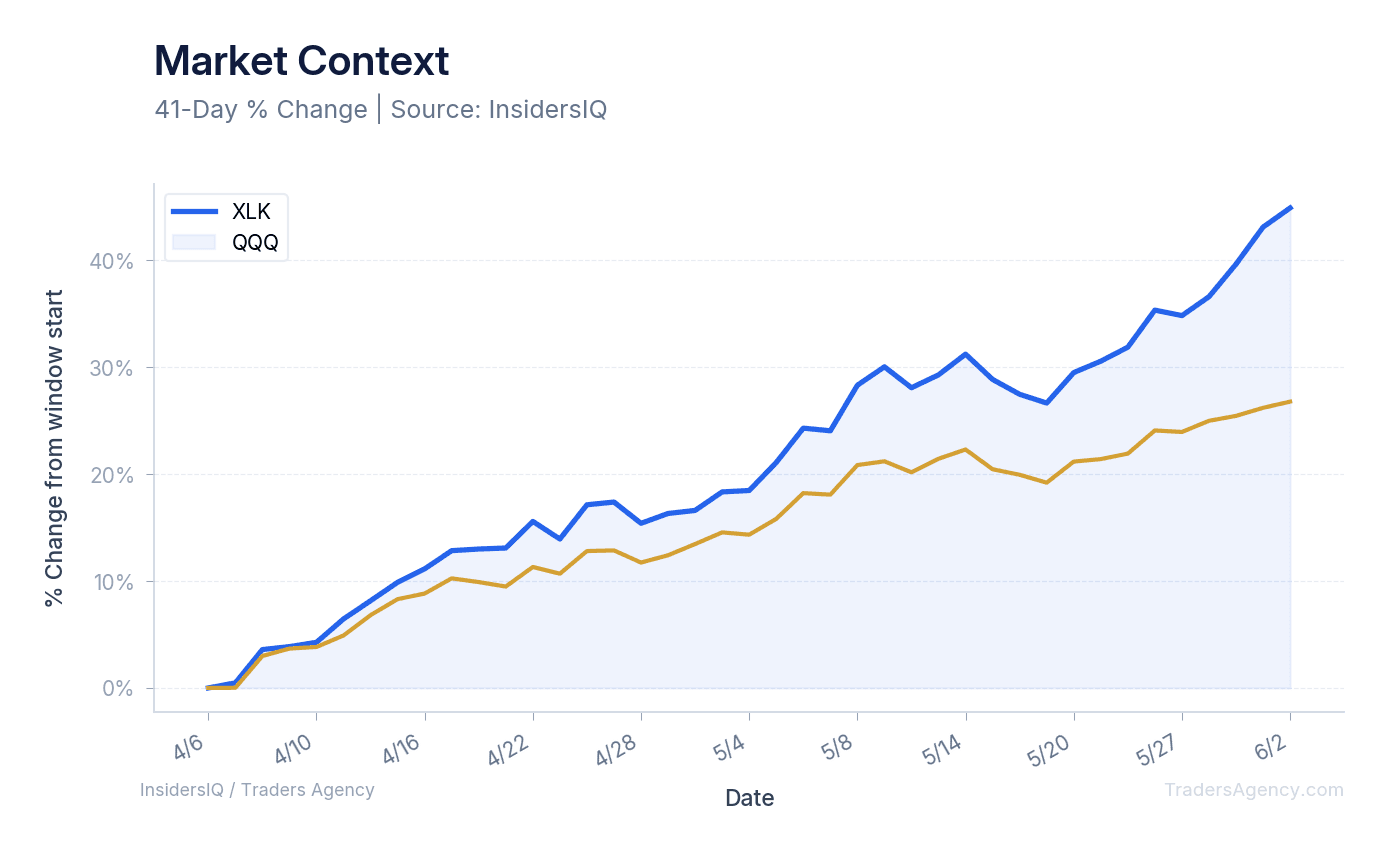
When base indices are generating these types of returns, the temptation to apply multipliers becomes overwhelming for many market participants. Wall Street analysts estimate total AI spending will climb above $1 trillion by 2027. Traders are using leveraged products to front-run this massive capital deployment.
How Leveraged ETFs Double Exposure Through Derivatives
These specialized funds use financial derivatives to deliver daily returns that double or even triple the performance of specific underlying indexes and stocks. Instead of holding shares directly, the funds enter into derivative contracts that magnify price movements, creating significant potential for outsized gains and equally severe losses.
The mechanics require daily rebalancing to maintain stated leverage targets. This daily reset means the funds perform as advertised over a single trading session. Over longer periods, however, the compounding mathematics can cause the fund's performance to deviate wildly from the underlying asset.
We're watching this dynamic closely because the leveraged ETF AI trade relies heavily on continuous upward momentum. When a stock doubles in a handful of days, the derivative contracts inside these funds generate massive paper profits. The parabolic price action attracts even more capital, pushing the funds higher in a self-reinforcing cycle.
Want expert trading insights delivered daily?
Join thousands of traders who rely on Traders Agency for market analysis and trade ideas.
Join Traders AgencyWhat Happens During a Market Pullback?
During a market pullback, the same derivatives that magnify gains will aggressively compound losses. If the current momentum reverses, the massive concentration of capital in these funds could force rapid liquidations. This dynamic creates a dangerous feedback loop where forced selling accelerates downward price action across the broader market.
The primary danger lies in the speed of the reversal. Because these funds promise double or triple daily returns, losses are magnified just as aggressively as gains, and investors face big losses in the funds during any significant pullback.
Our team views the current environment as sharing some similarities with the late 1990s tech boom. The key difference today: some of the biggest artificial intelligence companies, including OpenAI, Anthropic, and xAI, remain private, making market evaluations difficult to access.
The Global Dimension of the Leveraged ETF AI Trade
The international component of this story requires special attention. While U.S. markets dominate the headlines, supply chain realities are driving massive capital flows into Asian markets. South Korea and Taiwan house some of the most important companies in the entire AI ecosystem.
The concentration risk in these international benchmarks is staggering. SK Hynix, a key supplier to AI chip giant Nvidia, and Samsung Electronics together account for over 40% of South Korea's benchmark Kospi index.
The situation in Taiwan is nearly identical. Taiwan Semiconductor Manufacturing Company (TSMC) accounts for over 40% of Taiwan's Taiex benchmark. When traders buy leveraged ETFs tracking these countries, they're effectively placing highly concentrated, magnified bets on just a few companies. These markets have recently surged past several long-established Western countries, driven by this specific hardware demand.
The data shows that while artificial intelligence is driving enormous revenue growth for a wide swath of firms, it is only generating actual earnings and cash for a handful of companies, especially these memory and chip manufacturers.
What Should Traders Watch Next in the Leveraged ETF AI Trade?
The markets are going to have to absorb a lot of supply in the coming months. We're monitoring several specific data points to gauge the health of this trend.
1. Daily Inflow Velocity
We're tracking the daily net asset flows into the 573 U.S. equity funds. If the pace of new money slows while prices continue to rise, it signals exhaustion in the buyer pool.
2. Retail Sentiment Metrics
Current WallStreetBets sentiment sits at 0.03 with 2,748 mentions. A sudden spike in retail euphoria often precedes short-term market tops. We use these sentiment trackers as contrarian indicators when they reach extreme levels.
3. Hardware Supplier Price Action
Because the actual cash flow is concentrated in the memory and chip sectors, hardware is the true bellwether. We're watching the daily price action of TSMC, SK Hynix, and Samsung Electronics for any signs of institutional distribution.
The Bottom Line
The doubling of leveraged ETF assets to $84 billion in two months represents a historic concentration of speculative capital. Our analysis indicates that while the fundamental spending on tech infrastructure is real, the parabolic price action appears to be in unsustainable territory. We're maintaining strict risk management protocols on all technology positions and watching closely for the inevitable volatility that follows parabolic derivative inflows.
Want expert trading insights delivered daily?
Join thousands of traders who rely on Traders Agency for market analysis and trade ideas.
Join Traders AgencyKey Takeaways
- Leveraged U.S. equity ETF assets doubled from $39 billion to $84 billion in just two months (April to end of May), across 573 tracked funds.
- The surge is not limited to domestic markets: leveraged ETFs focused on South Korea and Taiwan jumped from $17 billion to $43.1 billion in the same period.
- The Fear and Greed Index sits at 68, confirming broad bullish conviction is fueling the inflows rather than isolated positioning.
- Parabolic inflows into derivative-based funds create structural vulnerabilities because the unwinding process, when it comes, can trigger aggressive market corrections.
- Traders should monitor TSMC, SK Hynix, and Samsung Electronics for signs of institutional distribution as early warning signals of a reversal.
DISCLAIMER: Traders Agency does not offer financial advice. The information provided is for educational purposes only and should not be considered financial advice. Traders Agency is not responsible for any financial losses or consequences resulting from the use of the information provided. Trading carries inherent risks and may not be suitable for all individuals. You are advised to conduct your own research and seek personalized advice before making any investment decisions, recognizing the potential risks and rewards involved.
See more from Traders Agency on Google
Make us a preferred source and our market analysis will appear more prominently in your Google Search, Top Stories, and AI results.
Add to Preferred Sources