General Mills reported fiscal 2027 first-quarter results that beat Wall Street's lowered expectations, even as both sales and profit fell from a year earlier. Non-GAAP earnings per share of $0.75 topped consensus by $0.03, and revenue of $4.4 billion beat estimates by $50 million, according to Seeking Alpha Market News. Sales fell 2.8% to $4.39 billion for the quarter ended Aug. 30, but still came in ahead of the $4.35 billion Wall Street had modeled, per FactSet data cited by Yahoo Finance. Yahoo Finance also reported that shares were little changed in premarket trading, noting the declines in profit and sales were smaller than the company and Wall Street had expected.
Segment Performance: Retail Pressure, Pet Nearly Flat
The North America Retail segment, General Mills' largest, saw net sales fall 7% to $2.4 billion, according to the company's Business Wire release. That figure included a 4-point headwind from the U.S. yogurt divestiture completed in the prior fiscal year. Stripping that out, organic net sales in the segment were down 3%, which the company said lagged Nielsen-measured retail sales by roughly 1 point due to changes in retailer inventory.
North America Pet net sales of $613 million essentially matched year-ago levels, per the company's release. Cat food sales rose double digits and treats grew low single digits, while dog food fell high single digits. Segment operating profit of $100 million dropped 12% as reported and in constant currency, which the company attributed to higher input costs, lower volume and higher SG&A expenses, partially offset by favorable pricing and mix.
Margins Under Pressure From Input Costs
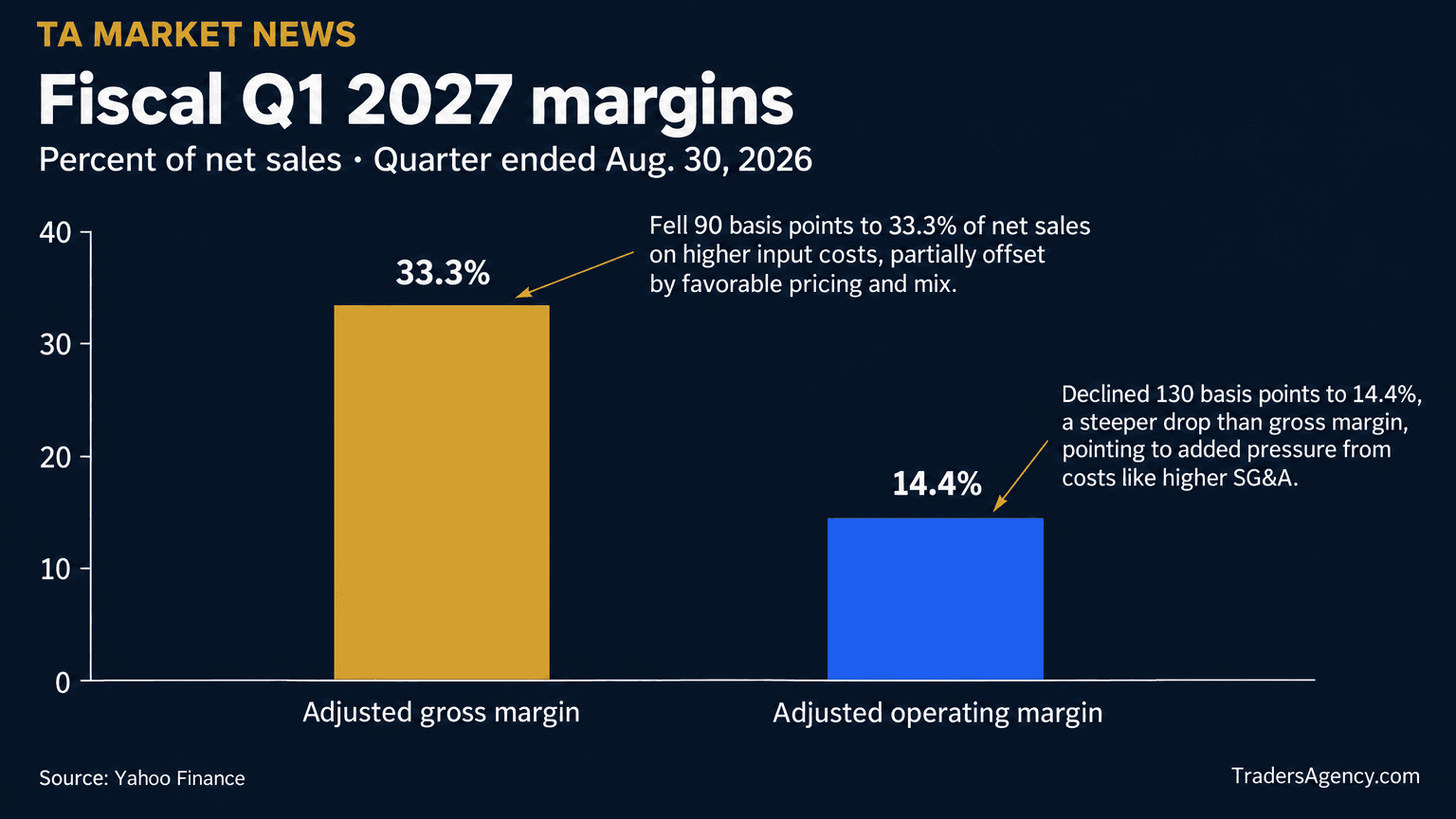
Adjusted gross margin fell 90 basis points to 33.3% of net sales, and adjusted operating margin declined 130 basis points to 14.4%, according to Yahoo Finance's summary of the earnings call. Reported gross margin, by contrast, was unchanged at 33.9%, with higher input costs offset by favorable mark-to-market effects and pricing, per the company's release.
Adjusted operating margin fell further than adjusted gross margin — 130 basis points versus 90 — leaving a spread of 18.9 percentage points between the two (33.3% minus 14.4%), based on the reported figures. That spread is arithmetic, not a company-disclosed metric, but the steeper erosion below the gross-profit line suggests that costs beyond raw materials, including the higher SG&A expenses the company flagged in its Pet segment, added to the margin squeeze.
CFO Kofi Bruce told analysts the company now expects annual input-cost inflation at the high end of its previously projected 4% to 5% range, citing higher spot prices for freight, grains and packaging during the quarter as well as new Canadian tariffs, according to Yahoo Finance's account of the call.
Fiscal 2027 Outlook Reaffirmed
General Mills reaffirmed its full-year targets: organic net sales of down 1.5% to up 0.5%, adjusted operating profit down 13% to down 8% in constant currency, adjusted diluted EPS of $3.00 to $3.20, and free cash flow conversion of approximately 95% of adjusted after-tax earnings, per the company's release.
The guidance embeds roughly 9 points of headwind on operating profit and 11 points on EPS from lapping the 53rd week in fiscal 2026, normalizing corporate incentive expense, and the impact of fiscal 2026 divestitures, the company said. Divestitures, currency and the 53rd week comparison are expected to cut reported net sales growth by about 4% for the full year, driven primarily by the 53rd week and the Brazil divestiture.
Part of the year-over-year profit comparison reflects a one-time boost in the prior period: fiscal 2026's first quarter included a $1,046 million pre-tax gain from the completed sale of the U.S. yogurt business to Groupe Lactalis, per the company's release.
Innovation and Marketing Push
CEO Jeff Harmening said in the earnings release that the company is "off to an encouraging start in fiscal 2027, driving improved topline performance with stronger product innovation and renovation." Chief Operating Officer Dana McNabb said in prepared remarks reported by Yahoo Finance that last year's affordability investments are complete and the company's full focus this year is on accelerating innovation and renovation.
Yahoo Finance reported that General Mills has brought in new agency partners, built a next-generation content studio, and doubled its use of influencers. In cereal, the company said its protein-cereal portfolio, including Honey Nut Cheerios Protein, generates roughly $200 million in retail sales and is growing at a strong double-digit rate. Retail sales of Cinnamon Toast Crunch, Lucky Charms and Reese's Puffs rose at a low-single-digit rate, compared with a mid-single-digit decline in fiscal 2026, per Yahoo Finance.
The company renovated 70% of its canned dough line during the quarter and said Pillsbury retail sales stabilized after eight consecutive quarters of declines. In pet food, Tiki Cat posted double-digit retail-sales growth and gained share, while Wilderness remained the most challenged dry dog feeding business, according to Yahoo Finance's account of the call.
General Mills remains on track to deliver at least $750 million in cost savings this fiscal year and $3 billion cumulatively by fiscal 2030, split between roughly $2 billion from its Holistic Margin Management program and about $1 billion primarily from a global transformation initiative involving supply-chain changes, the company said.
Cash Flow, Capital Allocation and Portfolio Moves
First-quarter operating cash flow fell to $298 million from $397 million a year earlier, which the company attributed mainly to lower accrued federal income taxes payable tied to the yogurt sale. Capital investments totaled $90 million versus $110 million a year ago, and dividends paid were $330 million. The company did not repurchase any shares in the quarter, compared with $500 million in buybacks a year earlier, per its release.
Bruce told analysts, according to Yahoo Finance, that near-term capital allocation will prioritize reducing leverage toward a long-term target of three times net debt to adjusted EBITDA, with the dividend maintained, excess cash directed toward debt reduction, acquisitions deprioritized and no share repurchases expected in the near term.
On portfolio changes, the company said it completed the sale of its Brazil business to 3corações on Sept. 2, 2026, after recording an additional $24 million non-cash pre-tax valuation loss on the deal during the quarter. The planned sale of mainland China Häagen-Dazs shops remains on track to close later in the calendar year, the company said.
Bottom Line
General Mills cleared a bar that had already been lowered, with sales and adjusted EPS both beating consensus even as they fell year over year. The North America Retail segment's 7% sales drop included a 4-point headwind from the lapped U.S. yogurt divestiture, but organic net sales in the unit were still down 3%, indicating the underlying business remains soft once that portfolio change is stripped out. Management is leaning on new product innovation, expanded marketing and continued cost savings to support its reaffirmed fiscal 2027 targets, but rising input-cost inflation and a near-term halt to share buybacks signal the company is prioritizing balance-sheet repair over aggressive capital returns for now.
DISCLAIMER: Traders Agency does not offer financial advice. The information provided is for educational purposes only and should not be considered financial advice. Traders Agency is not responsible for any financial losses or consequences resulting from the use of the information provided. Trading carries inherent risks and may not be suitable for all individuals. You are advised to conduct your own research and seek personalized advice before making any investment decisions, recognizing the potential risks and rewards involved.
- Seeking Alpha Market News: General Mills in charts: North America retail sales fall 7% in Q1; pet segment is flat y/y · accessed Sep 23, 2026
- Seeking Alpha Market News: Earnings Snapshot: General Mills tops Q1 expectations despite yogurt divestiture · accessed Sep 23, 2026
- Seeking Alpha Market News: General Mills Non-GAAP EPS of $0.75 beats by $0.03, revenue of $4.4B beats by $50M · accessed Sep 23, 2026
- General Mills via StockTitan: General Mills Q1 earnings: diluted EPS falls 67% · accessed Sep 23, 2026
- Yahoo Finance: General Mills Bets on New Products, Marketing to Drive Turnaround · accessed Sep 23, 2026
- Seeking Alpha Market News: General Mills beats conservative FQ1 estimates, but higher costs weigh on profits · accessed Sep 23, 2026
- Yahoo Finance: General Mills Q1 Earnings Call Highlights · accessed Sep 23, 2026
- General Mills via Business Wire: General Mills Reports Fiscal 2027 First-quarter Results and Reaffirms Full-year Outlook · accessed Sep 23, 2026
See more from Traders Agency on Google
Make us a preferred source and our market analysis will appear more prominently in your Google Search, Top Stories, and AI results.
Add to Preferred Sources