
U.S. retail sales rose 1.2% in August 2026 from July, comfortably outpacing the 0.8% gain economists polled by Reuters had expected, according to the Commerce Department's Census Bureau. The advance was the largest monthly increase in five months and followed a revised 0.5% decline in July, itself the first monthly drop in nine months, Reuters reported via Yahoo Finance.
The report's core measure was even stronger. Retail sales excluding automobiles, gasoline, building materials and food services, the so-called control group that Reuters said corresponds most closely with the consumer spending component of GDP, surged 1.4% after an unrevised 0.4% July decline. Economists had forecast a 0.4% rise in that measure, meaning the control group beat expectations by a full percentage point (1.4% actual minus 0.4% forecast, our calculation).
The Headline Numbers
Reuters said the consensus for headline retail sales was 0.8%, with individual forecasts ranging from 0.2% to 1.1%, making August's 1.2% print above even the top of that range. That represents a 0.4 percentage point beat versus the median forecast (1.2% actual minus 0.8% consensus, our calculation). Separately, tradingeconomics.com listed a comparable consensus of 0.8% against its own forecast model estimate of 0.7%, both of which the actual print exceeded.
July's decline was revised to a smaller drop than first reported. The Census Bureau's initial July estimate of a 0.6% decline was revised up to a 0.5% decline, according to both Reuters and tradingeconomics.com. That upward revision means the economy entered August slightly stronger than earlier data had suggested, though the direction of the month, a decline, was unchanged.
What Drove the Gain
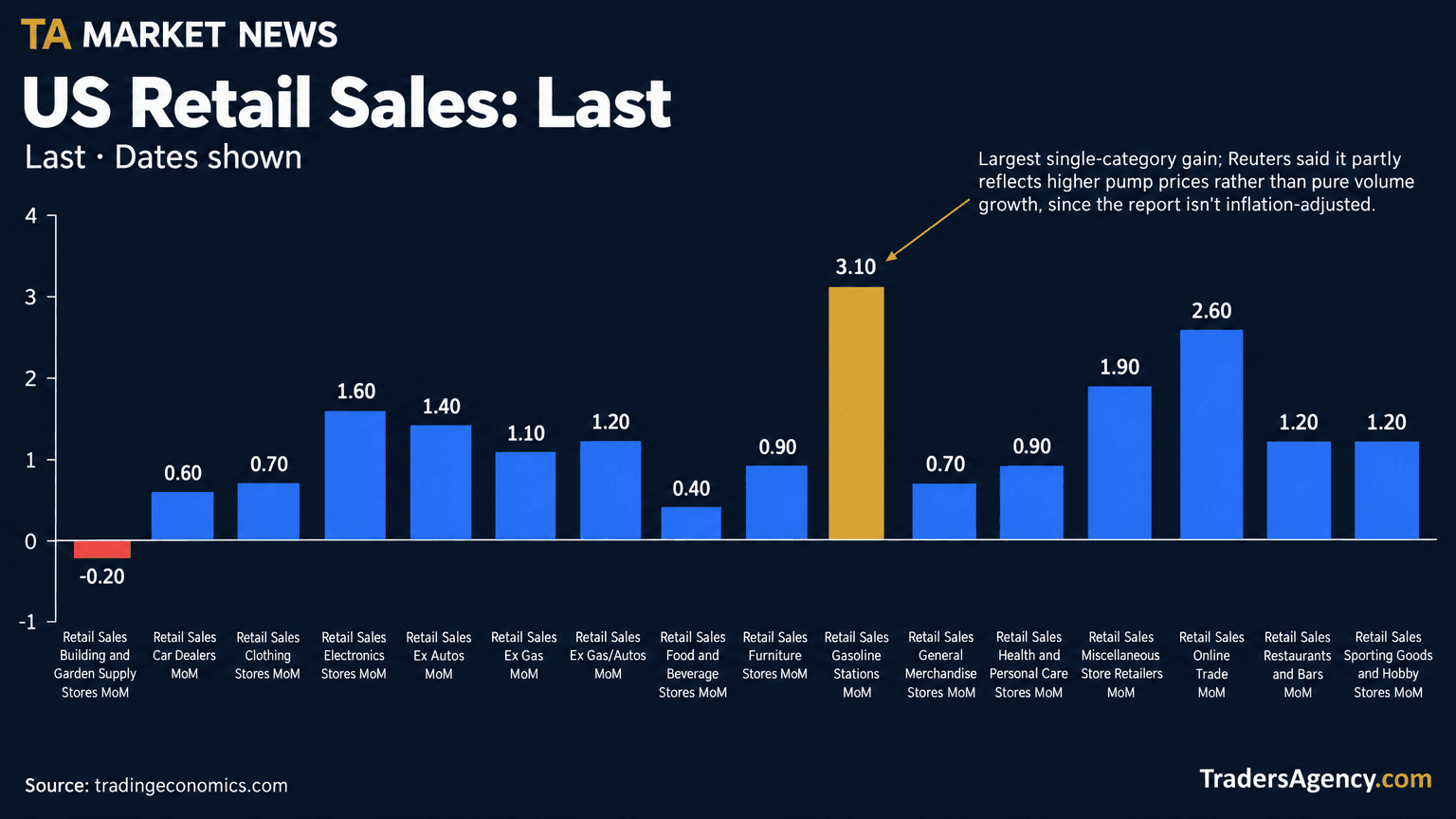
The increase was broad across categories, tradingeconomics.com data show. Gasoline stations posted the largest single-category increase at 3.1%, followed by nonstore retailers (2.6%), miscellaneous store retailers (1.9%), electronics and appliance stores (1.6%), and food services and drinking places (1.2%). Motor vehicle and parts dealers rose a more modest 0.6%. Building material and garden equipment stores were the only category to decline, slipping 0.2%.
Reuters noted that the gasoline station gain partially reflected higher prices at the pump rather than pure volume growth, since the retail sales report is not adjusted for inflation. Reuters also attributed the broader rebound to households stepping up vehicle purchases and back-to-school shopping, calling the report a sign of the economy's resilience even as consumers grow more anxious about high inflation.
Consumer Behavior Beneath the Headline
Reuters reported that spending is being supported by steady wage growth and recent stock market gains, and that households are saving less and tapping into their nest eggs to fund purchases. At the same time, Reuters said consumers have become more selective and are seeking lower-priced goods, and that consumer sentiment deteriorated this month even as the hard spending data came in strong. Reuters further reported that households have kept spending despite stubbornly high inflation, which it linked to an oil price shock and supply-chain strains tied to the U.S.-led war with Iran.
What It Means for Growth and the Fed
Reuters said the retail strength, combined with elevated price pressures and a labor market it described as regaining its footing after a wobbly summer, reinforced market expectations that the Federal Reserve would raise interest rates later the same day the data were released. Reuters also reported that third-quarter growth estimates currently exceed a 2.0% annualized rate, up from 1.5% growth in the prior quarter.
Those are reported expectations and growth tracking figures attributed to Reuters, not independently confirmed projections, and they describe conditions as of the data's release rather than a forecast of where rates or growth will ultimately land. For scale, tradingeconomics.com data show that U.S. retail sales have averaged 0.39% monthly growth since 1992, with an all-time high of 19.3% in May 2020 and a record low of negative 14.4% in April 2020, underscoring that August's 1.2% gain, while a clear beat versus consensus, sits well within the normal range of a resilient consumer economy rather than at a historical extreme.
Bottom Line
August's retail sales report beat expectations on both the headline and control-group measures tracked by Reuters and tradingeconomics.com, with the control group's 1.4% jump the more consequential number for GDP accounting. Part of the headline strength reflects higher gasoline prices rather than pure volume, and Reuters said consumer sentiment weakened even as spending held up, a combination that suggests underlying resilience is not free of strain. Reuters said the report further strengthened market expectations for a Federal Reserve rate increase later the same day, and reported third-quarter growth estimates above a 2.0% annualized rate, though how durable that pace proves will depend on incoming data beyond this single month.
DISCLAIMER: Traders Agency does not offer financial advice. The information provided is for educational purposes only and should not be considered financial advice. Traders Agency is not responsible for any financial losses or consequences resulting from the use of the information provided. Trading carries inherent risks and may not be suitable for all individuals. You are advised to conduct your own research and seek personalized advice before making any investment decisions, recognizing the potential risks and rewards involved.
- Yahoo Finance: US retail sales rebound sharply in August · accessed Sep 16, 2026
- tradingeconomics.com: US Retail Sales · accessed Sep 16, 2026
- www.census.gov: Monthly Retail Trade - Sales Report · accessed Sep 16, 2026
- www.haver.com: U.S. Retail Sales Show Resilience in August · accessed Sep 16, 2026
- coresight.com: US Retail Sales Projections and Retail Context-July 2026 · accessed Sep 16, 2026
- lao.ca.gov: U.S. Retail Sales Update: August 2023 · accessed Sep 16, 2026
- datatrack.trendforce.com: US August Retail Sales Show Strong Growth, Consumer Momentum Remains Robust · accessed Sep 16, 2026
- economics.td.com: U.S. Retail Sales (August 2026) · accessed Sep 16, 2026
- www.census.gov: Monthly Retail Trade · accessed Sep 16, 2026
- www.census.gov: Monthly Retail Trade - Release Schedule · accessed Sep 16, 2026
See more from Traders Agency on Google
Make us a preferred source and our market analysis will appear more prominently in your Google Search, Top Stories, and AI results.
Add to Preferred Sources