
Few events in modern market history captured public attention like the GameStop short squeeze of January 2021. But short squeezes didn't start there, and they haven't stopped happening since. In this guide, we'll teach you exactly how a short squeeze works, how to read the warning signs before one happens, and why most predicted squeezes never actually materialize.
What Is a Short Squeeze?
Bottom Line: A short squeeze happens when forced buying from short sellers, not genuine demand, drives a feedback loop of rising prices. Real squeezes show up first in data like short interest and days to cover, so chasing a stock just because it's trending in headlines is a sign you're reacting too late, not spotting a setup early.
A short squeeze is a rapid price spike that happens when traders who bet against a stock (called short sellers) are forced to buy shares to close out their losing positions, which pushes the price even higher. This buying pressure creates a feedback loop: rising prices force more short sellers to cover, which drives prices up further. If you've ever looked for the GameStop short squeeze explained in a single sentence, this feedback loop is the whole story.
Short selling itself is a normal trading strategy. A trader borrows shares, sells them at today's price, and hopes to buy them back later at a lower price to return to the lender and pocket the difference. The risk is that losses are theoretically unlimited, since a stock can keep rising with no ceiling.
When a stock has a large number of shares sold short and the price starts climbing unexpectedly, short sellers face mounting losses and margin calls. Many are forced to buy shares immediately to limit the damage, regardless of price. That forced buying is what separates an ordinary rally from a genuine squeeze, and it's the mechanic we always teach first when explaining this setup.
Key Concept: A short squeeze isn't caused by optimism alone. It's caused by forced buying, short sellers scrambling to close positions before losses spiral further, which pushes price higher in a self-reinforcing loop.
How Did the GameStop Short Squeeze Happen?
The GameStop (GME) squeeze in January 2021 happened because an unusually large portion of the stock's available shares were sold short, retail buying on platforms like Reddit pushed the price up sharply, and short sellers were forced to buy back shares at escalating prices to cover their positions.
Heading into January 2021, GME had short interest estimated above 100% of its public float, an extreme reading that meant more shares had been sold short than were actually available to trade. That alone created fragility. When retail buying volume surged, driven largely by coordinated attention on r/WallStreetBets, the stock moved from around $20 per share to an intraday high near $483 within weeks.
As the price climbed, short sellers who had bet the stock would keep falling were sitting on mounting paper losses. Brokers and lenders issued margin calls, and many funds had no choice but to buy shares to close their short positions, adding fuel to the exact rally they were trying to escape. This is the organic feedback loop that retail trading communities helped trigger in the first place.
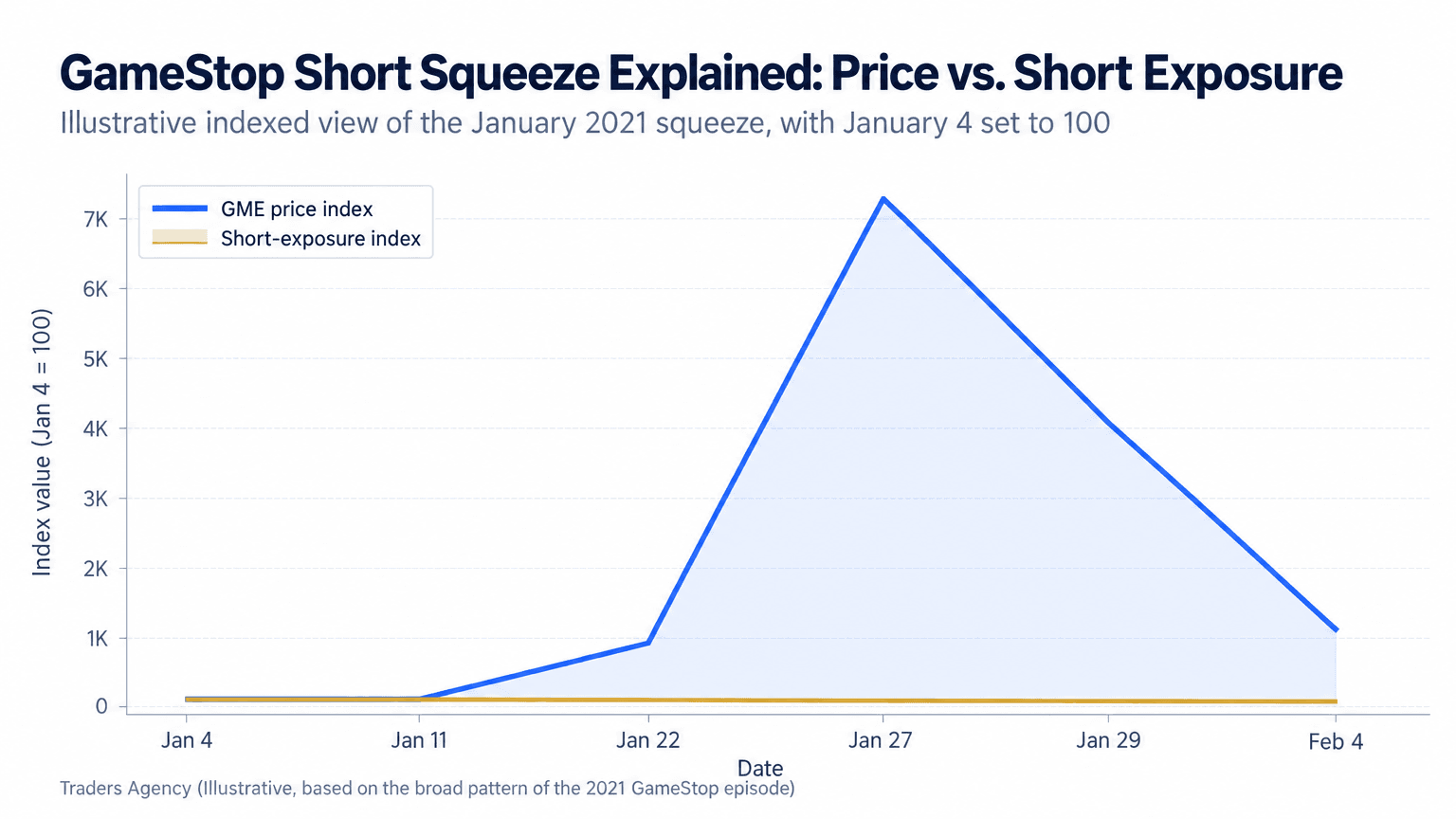
GameStop's 2021 run is frequently cited as one of the biggest short squeezes in history for a single, widely held stock, largely because of how fast the price moved and how many market participants were affected at once.
What Are Short Interest, Days to Cover, and Cost to Borrow?
Three numbers tell you whether a stock has the raw ingredients for a squeeze: short interest, days to cover, and cost to borrow. None of them predicts a squeeze on their own, but together they show how exposed short sellers actually are.
Short interest is the percentage of a company's available shares that are currently sold short. This data is published twice a month through FINRA's short interest reporting, and most brokerage platforms display it for individual stocks. A reading above 20% of float is generally considered elevated, while GameStop's reading above 100% in January 2021 was historically rare.
Days to cover measures how many trading days it would take short sellers to buy back all their borrowed shares, based on average daily volume. A high days-to-cover number (often above 5 to 10 days) means that even modest buying pressure could take a long time to absorb, which raises the odds that a price spike gets prolonged rather than quickly resolved.
Cost to borrow is the fee a short seller pays to borrow shares, expressed as an annualized percentage. When demand to short a stock is high and shares are scarce, this fee can spike into double digits or higher, which pressures short sellers financially even before the price moves against them.
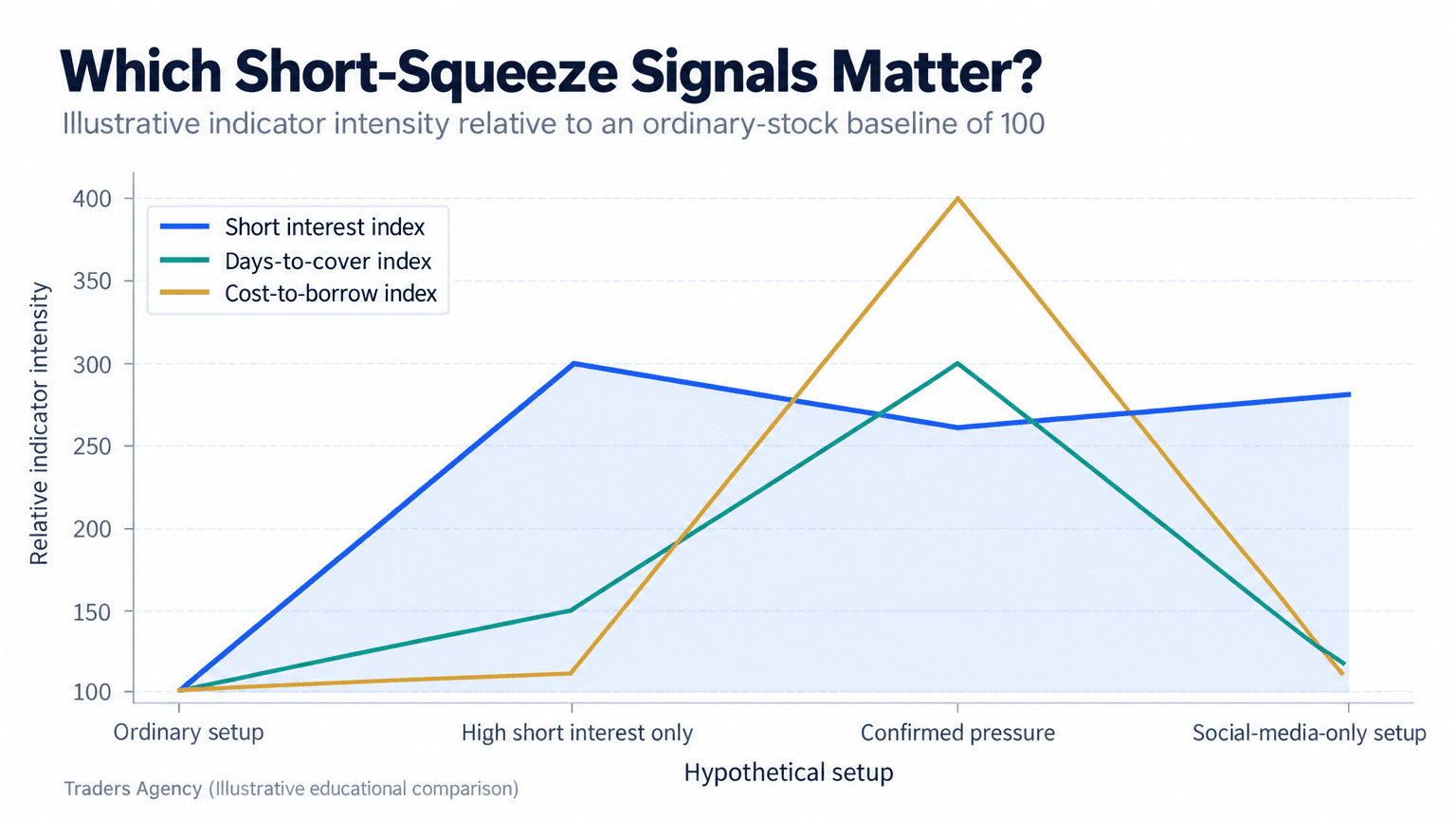
We teach our traders to treat these three figures as a checklist, not a single signal. A stock with high short interest but low days-to-cover and cheap borrow costs is far less likely to squeeze than one where all three are stretched at once.
Why Do Most Predicted Squeezes Fail?
Most stocks that social media labels as "the next squeeze" never actually squeeze, because high short interest alone does not force anyone to buy. A squeeze requires a genuine price trigger, forced covering, and enough volume to sustain the move, not just a crowded short position sitting quietly.
A common mistake is assuming that a high short interest percentage guarantees upward pressure. In reality, short sellers can hold losing positions for a long time if they have enough capital and the price isn't moving fast enough to trigger margin calls. Without a trigger event, a crowded short can simply sit there for months.
Here's what typically causes a predicted squeeze to fizzle:
- No real trigger. Short interest is high, but there's no news, earnings surprise, or volume spike to force anyone's hand.
- Thin retail participation. Social media chatter doesn't always translate into enough actual buying volume to move the price meaningfully.
- Well-capitalized shorts. Institutional short sellers with deep pockets can absorb losses that would wipe out smaller traders.
- Low days-to-cover. If short sellers can unwind their positions in a single trading session, there's little time for a sustained feedback loop to build.
- Borrow costs that stay manageable. If it remains cheap to stay short, there's less financial pressure forcing anyone to cover.
This is also where the opposite scenario matters: a "long squeeze," where overly optimistic buyers get flushed out during a sharp drop, can happen just as easily when a crowded trade reverses without warning.
Want expert trading insights delivered daily?
Join thousands of traders who rely on Traders Agency for market analysis and trade ideas.
Join Traders AgencyHow Do You Identify a Genuine Squeeze Setup?
A genuine squeeze setup combines extreme short interest, rising days-to-cover, climbing cost-to-borrow, and an actual volume-driven price move, not just loud chatter on social forums. Manufactured setups usually have the social buzz without the underlying short-seller distress.
Our team looks for a few overlapping conditions before treating a squeeze thesis as credible:
- Short interest climbing, not just high. A rising trend over several reporting periods suggests shorts are adding to positions even as risk builds.
- Volume expanding on up days. Real demand shows up as above-average volume on green days, not just discussion volume on social platforms.
- Cost-to-borrow trending upward. This tells you lenders are seeing real scarcity in shares to borrow, which reflects genuine positioning stress.
- Options activity in short-dated calls. A surge in call buying can force market makers to hedge by purchasing shares, which adds its own buying pressure separate from short covering.
- A believable trigger. Earnings, partnership news, buyback announcements, or sector-wide momentum can all act as the spark that a crowded short position needs.
The difference between a manufactured setup and a real one usually comes down to whether the fundamentals of short positioning are actually under stress, or whether the stock is simply getting attention.
What Happens After a Short Squeeze Ends?
What happens after a short squeeze is usually a sharp reversal, since the price spike was driven by forced buying rather than a change in the underlying business. Once short sellers finish covering, the artificial buying pressure disappears and the stock often gives back a large portion of its gains.
The pattern tends to follow a recognizable lifecycle: a buildup phase as short interest grows, a trigger that starts forced covering, an acceleration phase where volume and price both spike, and finally an unwind as the forced buyers are gone and only ordinary supply and demand remain.
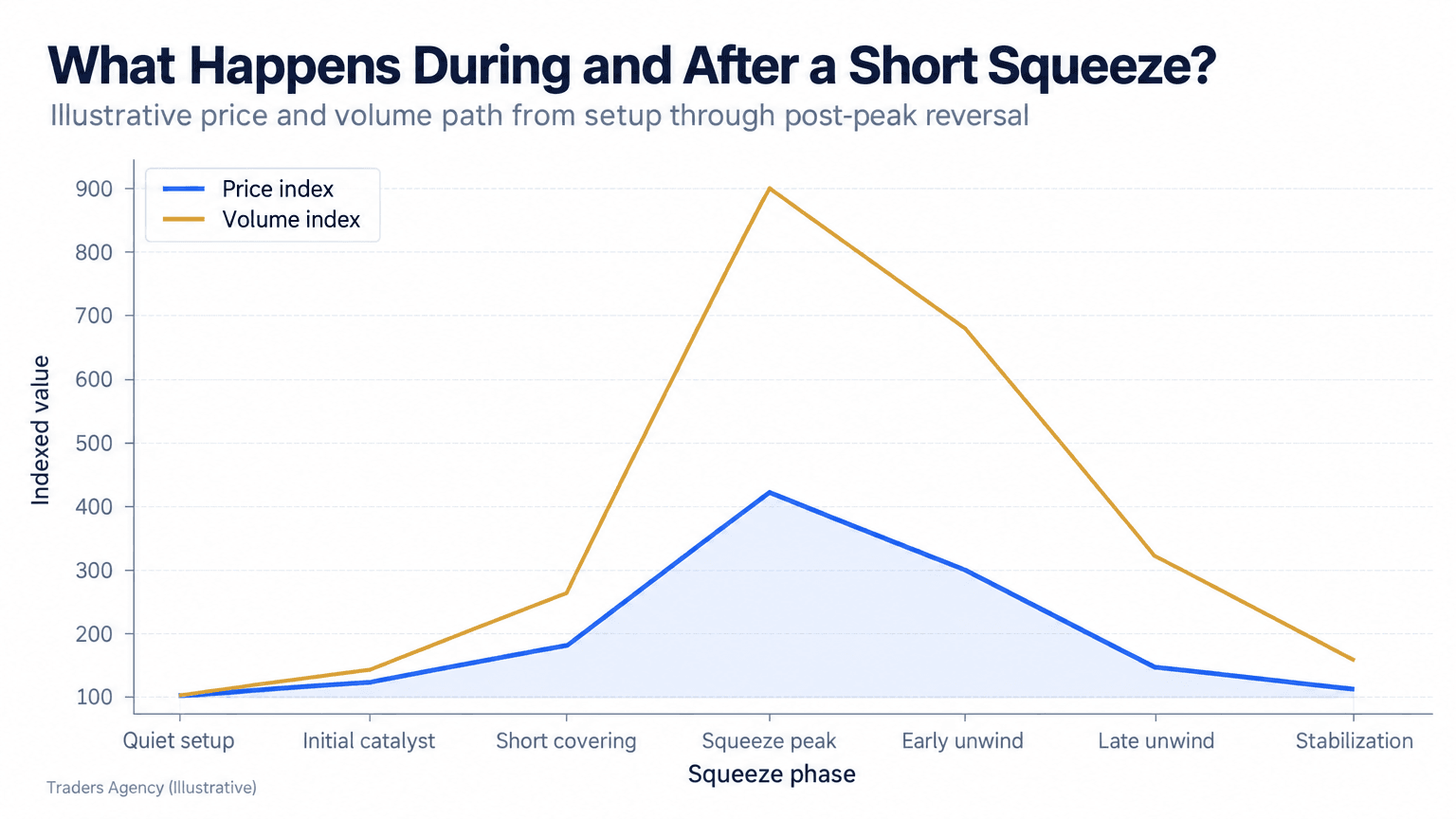
GameStop itself fell well off its 2021 peak in the months that followed, even as the company's actual business fundamentals changed far more slowly than its stock price did. This is a pattern worth remembering any time a new ticker gets labeled the next potential squeeze candidate.
Watch Out: The price action that defines a squeeze rarely reflects the company's real business value. Treat the spike as a trading event, not a signal that the underlying company has suddenly become more valuable.
Is a Short Squeeze Good for a Stock?
A short squeeze is neither simply good nor bad for a stock. It can reward traders holding shares into the spike, but the resulting volatility often hurts the company's longer-term price stability once the squeeze unwinds.
Whether a short squeeze works in your favor really depends on your time horizon and position. Traders who buy early and sell into the peak can see outsized gains in a short window. Shareholders who bought near the top, however, often end up holding a stock that gives back most of its gains once forced buying disappears.
For the company itself, a squeeze can bring short-term attention and sometimes enables capital raises at elevated prices, but it also attaches a reputation for extreme volatility that can scare off longer-term institutional investors.
When Should You Avoid a Short Squeeze Trade?
Our team generally avoids chasing a squeeze once it's already visible on social media and the price has moved triple-digit percentages in a matter of days. By that point, the easiest money has usually already been made, and the remaining move is harder to time.
A few situations call for staying on the sidelines entirely:
- The stock has already moved far beyond any reasonable valuation with no clear trigger to justify holding through a pullback.
- Options premiums are extremely inflated, which can make buying calls a poor risk-to-reward trade even if the stock keeps climbing.
- You can't clearly explain why short sellers would be forced to cover, beyond "a lot of people are talking about it."
- Your position size would be large enough to hurt your account if the stock reverses sharply, which it often does.
If you do decide to participate, keep position sizing small relative to your overall account, use defined stop levels rather than mental ones, and treat any gains as a bonus rather than an expectation. These setups move fast in both directions, and the same volatility that creates the upside can erase it just as quickly.
Key Concept: Our rule of thumb: if the only reason you can give for buying is "everyone's talking about it," you're chasing attention, not a setup. Real squeezes show up in the numbers first and the headlines second.
Want expert trading insights delivered daily?
Join thousands of traders who rely on Traders Agency for market analysis and trade ideas.
Join Traders AgencyDISCLAIMER: Traders Agency does not offer financial advice. The information provided is for educational purposes only and should not be considered financial advice. Traders Agency is not responsible for any financial losses or consequences resulting from the use of the information provided. Trading carries inherent risks and may not be suitable for all individuals. You are advised to conduct your own research and seek personalized advice before making any investment decisions, recognizing the potential risks and rewards involved.
See more from Traders Agency on Google
Make us a preferred source and our market analysis will appear more prominently in your Google Search, Top Stories, and AI results.
Add to Preferred Sources