
Hey, Ross here:
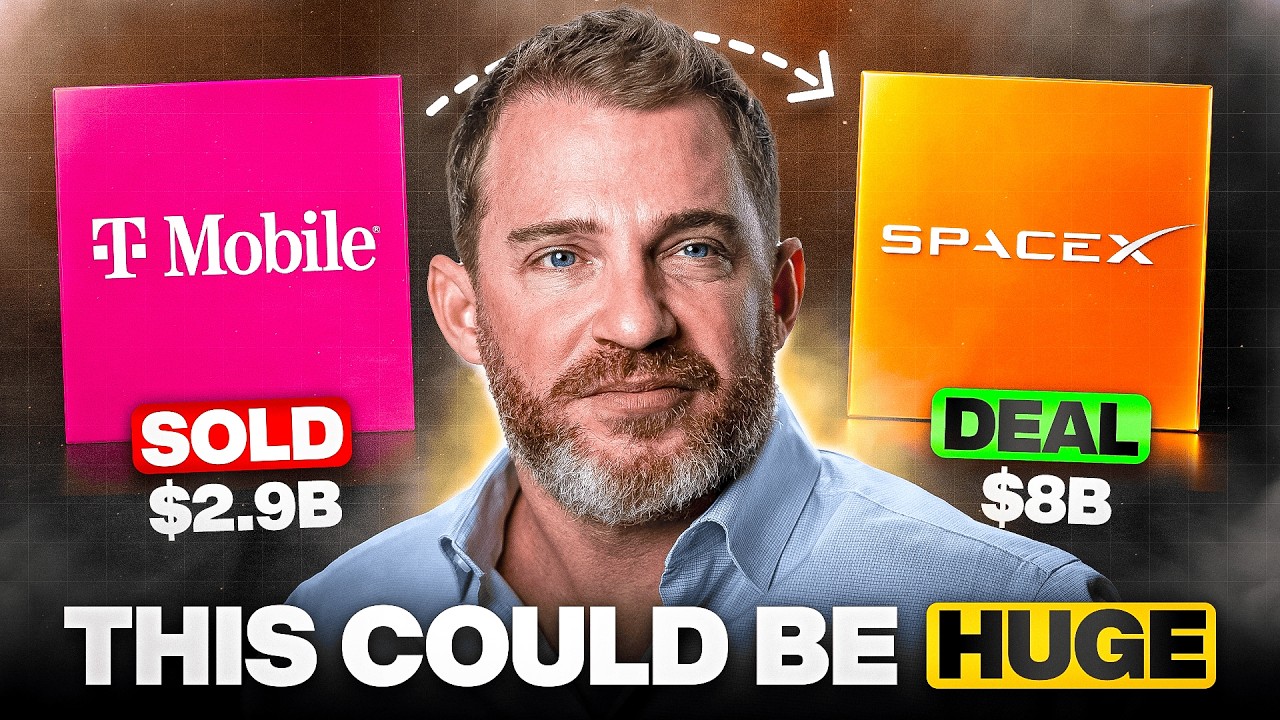
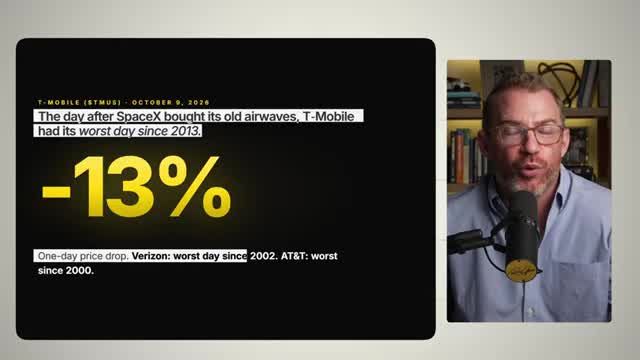
On October 8th, a private investment firm called Grain Management agreed to sell a nationwide block of wireless airwaves to SpaceX. The very next day, T-Mobile stock dropped 13% in its worst single-day move since 2013. Verizon had its worst day since 2002. AT&T had its worst day since 2000.
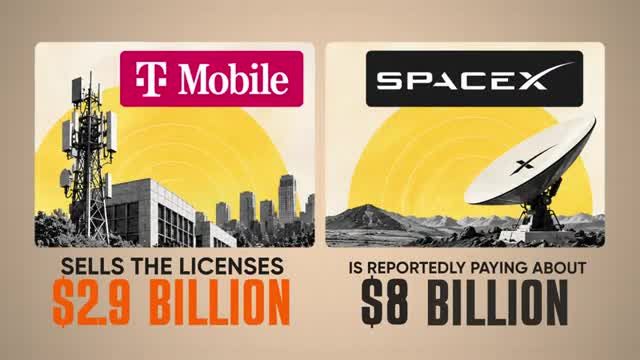
This wasn't random panic. The airwaves SpaceX just picked up used to belong to T-Mobile, which sold them to Grain Management for $2.9 billion only months earlier. Grain then turned around and flipped the same spectrum to Elon Musk for a reported $8 billion.
T-Mobile sold the weapon that is now pointed straight at its own customers.
A lot of people are writing off the October 9th sell-off as a one-day overreaction. I don't buy that. The pricing gap between what T-Mobile sold for and what SpaceX paid tells you everything about who understood the value of this spectrum and who didn't.
What Is the SpaceX Spectrum Deal?
Bottom Line: The EchoStar spectrum deal shows SpaceX buying wireless airwaves that T-Mobile itself sold off months earlier, now aimed at competing with T-Mobile, Verizon, and AT&T on their own turf. The size of the price gap between what T-Mobile got and what SpaceX paid suggests the telecoms may have underestimated this spectrum's value, with upcoming earnings calls and an FCC deadline likely to show whether the market's reaction was justified.
A middleman bought low, then sold very, very high.
Grain Management specializes in buying wireless spectrum licenses, sitting on them, and selling them to whoever needs them most. On October 8th, it sold a full portfolio of 800 MHz airwaves to SpaceX for a reported $8 billion. SpaceX plans to use that spectrum for a new service called Starlink Mobile.
Spectrum sounds complicated. It isn't. Every call, text, and video on your phone rides an invisible radio lane. The government owns the lanes and rents them out through licenses. No license, no lane, no phone business.
Here's how the chain actually worked. Over the summer, T-Mobile handed Grain a nationwide stack of 800 MHz licenses. Grain paid $2.9 billion in cash, plus tossed in a couple of 600 MHz licenses of its own. The FCC signed off on that swap in July.
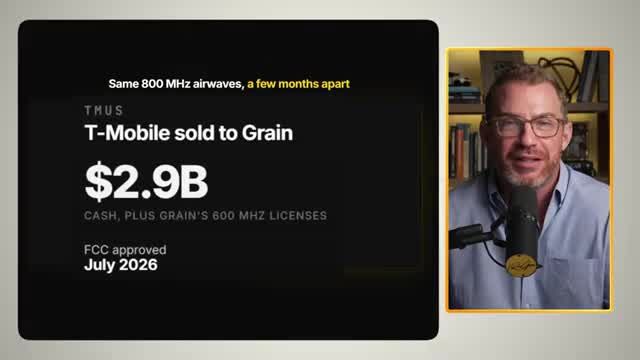
Then, a couple of months later, Grain announced it was selling 100% of that same 800 MHz portfolio to SpaceX. Neither company has disclosed the exact price, but the Wall Street Journal reports it's about $8 billion.
To be fair, T-Mobile picked up a couple of other licenses in that original swap, so it isn't a perfectly clean apples-to-apples comparison. But even accounting for that, somebody priced this deal badly. And it wasn't Grain.
Why Did SpaceX Want This Spectrum?
Think about how radio works in your car. An FM station fades the moment you drive out of town. An AM station, running on a lower frequency, carries five counties over. Low frequencies travel farther and go through walls.
The 800 MHz band T-Mobile sold off is what the industry calls low-band. It's the signal that reaches the back bedroom, the basement, the parking lot. It's also the signal that can reach a phone from very, very far away. Like, say, from space.
That matters because the biggest knock on satellite phone and internet service has always been that it's weak indoors. Anyone who owns a Starlink dish knows the routine: a 50-foot Ethernet cable, a walk out to the parking lot, and a patch of sky with no trees overhead. It's a pain. Low-band spectrum fixes a big piece of that.
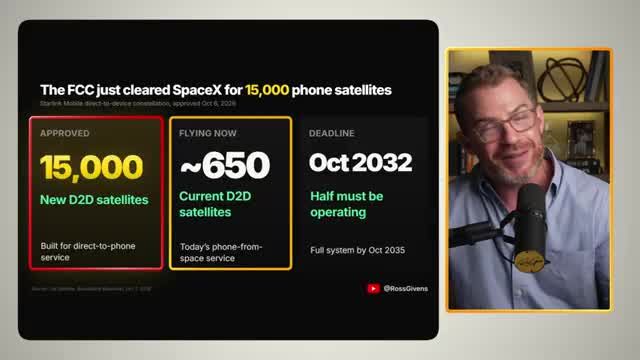
The satellites are coming too. Just days before the spectrum deal, the FCC cleared SpaceX to launch up to 15,000 new satellites built for direct-to-phone service. Satellites start flying next year, with service targeted by the end of 2027.
So how worried should the legacy carriers be? Very worried.
Get an entire year of live weekly mentoring sessions, my newsletter, indicators, bonus reports, tons more. Click the link and I'll see you in the next live session.
Join my Black Ops Trading ClubWhy Did T-Mobile Sell Its Spectrum?
T-Mobile wasn't really using that 800 MHz spectrum. The company already holds a mountain of licenses, and offloading the ones it didn't need brought in a quick $2.9 billion.
What T-Mobile didn't plan for was who would end up owning it next.
That's the part that stings. Management took the cash, called the licenses surplus, and moved on. Nobody on that side of the table seemed to anticipate that the buyer's buyer would be SpaceX, or that the spectrum would become the backbone of a direct-to-phone satellite network aimed squarely at T-Mobile's own customer base.
The Satellite-to-Cell Shift
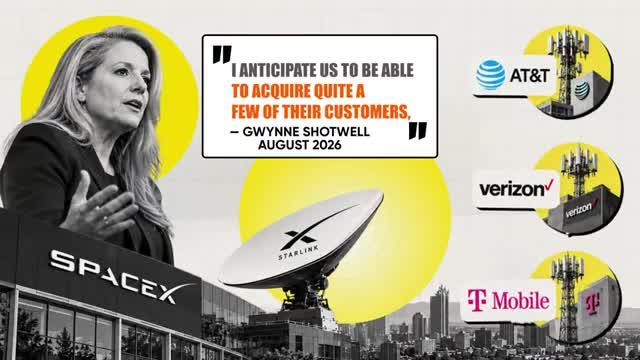
Shotwell already told investors what's coming. Back in August, on the company's first earnings call, she said she expects Starlink to "acquire quite a few of their customers," meaning AT&T, Verizon, and T-Mobile customers. She wasn't being subtle. Now she has the low-band airwaves to back it up.
Think about what the big three carriers actually sell you. Coverage. Fewer dropped calls, more bars, more places you can get a signal. "Can you hear me now?" is the entire pitch, repeated in commercial after commercial.
Now picture a carrier with no dead zones at all. Service on a fishing boat, on a ranch, in the middle of Wyoming, everywhere, because the signal comes from the sky instead of a tower. That's what SpaceX is building, and people want it.
A TD Cowen survey found that 34% of respondents would consider switching to a mobile service from SpaceX. That's one in three, and that number holds up even accounting for how many people out there can't stand Elon Musk.
Phone companies live and die on tiny shifts in subscriber counts. Wall Street grades AT&T, Verizon, and T-Mobile every single quarter on how many customers they added or lost. Even a sliver of that 34% actually switching would force the carriers to fight back with the only tool they have left: price. Lower bills for you, thinner profits for them.
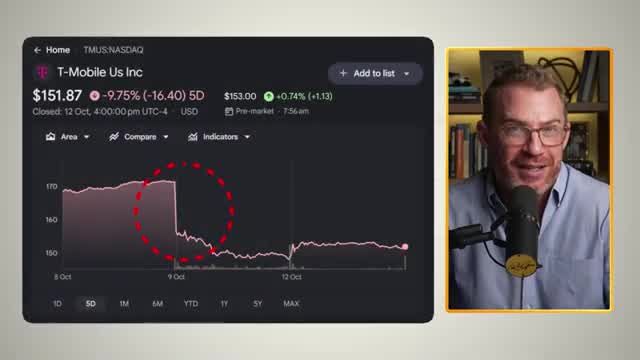
The market ran that math fast. On October 9th, all three carriers fell between 9% and 13% in a single session while SpaceX stock went up. The timing is clean: Grain's announcement hit after the closing bell on October 8th, and the sell-off landed the very next morning.
SpaceX Is Not Just a Rocket Company
Starlink had 12 million satellite internet subscribers as of June 30th, up from 6 million a year earlier. A doubling in 12 months, and still growing. Those subscribers pay an average of $66 a month, which works out to roughly $790 million a month, call it $9.5 to $10 billion a year, just from home internet.
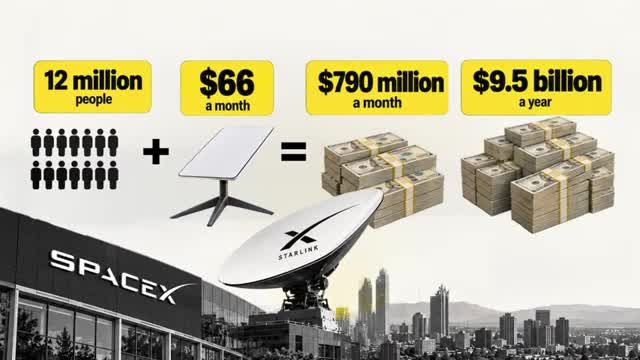
Now SpaceX wants the phone in your pocket too. Most of us pay two bills: one to the cable company or some other home internet provider, one to a wireless carrier. SpaceX wants to be both.
I think SpaceX has a real shot at building something close to a monopoly across satellite internet and phone service combined. Maybe not today. Regulators will probably force a split eventually. But right now, nobody else on Earth has all three pieces: the rockets to launch the satellites, the satellites to carry the signal, and the low-band airwaves to reach inside your house.
The carriers have towers. Nobody else has all three under one roof. That's the scary part if you're a legacy carrier, and the exciting part if you own SpaceX.
What the Stock Looks Like Here
SpaceX stock is sitting around $160 a share, putting the company's value at roughly $2.2 trillion. I was hoping for a chance to buy it much cheaper. We may not get it.
There are 38 analysts covering SpaceX, and their average 12-month price target sits around $222, about 35% above where it trades today.
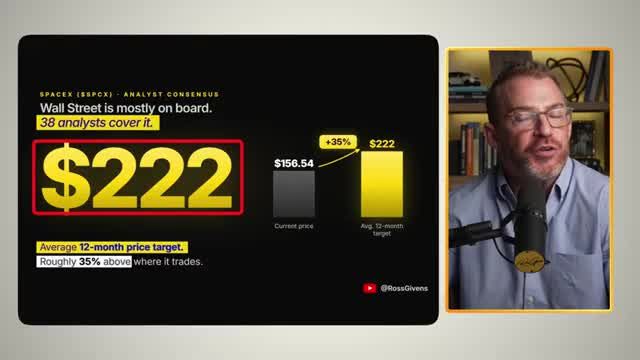
Is SpaceX stock overpriced? Of course it is. I'd put fair value at about half of where it trades today. But Elon's companies have always traded at premiums, and he remains the most hands-on CEO in the world. Electric cars, tunnels, rockets, robots, super intelligence. He keeps pulling it off.
The skeptics have a point in the short run. A J.P. Morgan analyst wrote that he sees limited near-term risk to the carriers, because building a real competing network takes time, infrastructure, and money. Over the near term, I agree. But the stock market doesn't wait for the network to get built. It prices the threat years before the customers show up. That's exactly what happened on October 9th.
And the referee isn't fighting SpaceX here. FCC Chairman Brendan Carr went on CNBC and called this kind of competition "really good news for the American consumers," adding that speeds go up and prices come down. When the referee is cheering for the new guy, it's curtains for the dinosaurs.
What Does the EchoStar SpaceX Deal Mean for T-Mobile?
T-Mobile is trading right around $150, roughly 45% off its all-time highs. That's a brutal fall for a company that spent the last decade as the disruptor in wireless. Now it's the one getting disrupted.
On paper, the stock looks cheap. It trades at 15 times last year's earnings and 13.6 times next year's expectations, against an S&P 500 average of 19 times next year's expectations. But buying T-Mobile here isn't a value play.
If SpaceX eats their lunch instead, offering a cheap, reliable cellular and internet bundle that works anywhere, T-Mobile is heading straight toward bankruptcy court, right alongside Verizon and AT&T. Which a lot of us are quietly cheering for.
Consider the convenience. You pay for internet at home, and it stays at home. Take your laptop to the park and you're piggybacking off a cellular hotspot that crawls. SpaceX could deliver one fast, reliable connection you carry with you anywhere. Everyone would sign up for that, even the people who can't stand Elon Musk.
Three Dates to Watch
- October 28th: T-Mobile reports third quarter earnings, the first time management has to answer for this on a live call.
- November 5th: Under the FCC's July order, the license holder has to run a competitive process to pick a satellite partner and report the result by this date.
- Ongoing approvals and launches: SpaceX still needs FCC clearance and thousands more satellites in orbit before Starlink Mobile is a functioning competitor.
T-Mobile made a colossal mistake. It sold these airwaves for $2.9 billion. SpaceX was apparently willing to pay $8 billion for the exact same spectrum. That gap tells you who sees the future more clearly.
A New Kind of Fight
For decades, your phone company owned the towers, and the towers owned you. Whoever had the most towers won your business.
SpaceX doesn't need to win the tower fight. It's moving the fight somewhere the carriers can't follow: straight up.
T-Mobile handed SpaceX a big piece of ammunition and collected $2.9 billion for doing it. AT&T and Verizon are watching the same threat develop, which is why all three stocks fell between 9% and 13% in a single session while SpaceX moved higher.
The next real test comes October 28th, when T-Mobile has to answer for this on its earnings call, followed by the November 5th FCC deadline on the satellite partner selection. Watch those dates. They'll tell you whether this is the start of something real or a one-day scare the market forgets.
Get an entire year of live weekly mentoring sessions, my newsletter, indicators, bonus reports, tons more. Click the link and I'll see you in the next live session.
DISCLAIMER: Traders Agency does not offer financial advice. The information provided is for educational purposes only and should not be considered financial advice. Traders Agency is not responsible for any financial losses or consequences resulting from the use of the information provided. Trading carries inherent risks and may not be suitable for all individuals. You are advised to conduct your own research and seek personalized advice before making any investment decisions, recognizing the potential risks and rewards involved.
See more from Traders Agency on Google
Make us a preferred source and our market analysis will appear more prominently in your Google Search, Top Stories, and AI results.
Add to Preferred Sources