
SpaceX has signed a definitive agreement to acquire 100% of Grain Management's nationwide 800 MHz spectrum portfolio, a license package described by SpaceX as covering up to 14 megahertz of paired spectrum, according to a Grain Management announcement and reporting from CNBC and Via Satellite. The deal is subject to FCC approval and other customary closing conditions, and it immediately rattled wireless carrier stocks.
What the Deal Covers
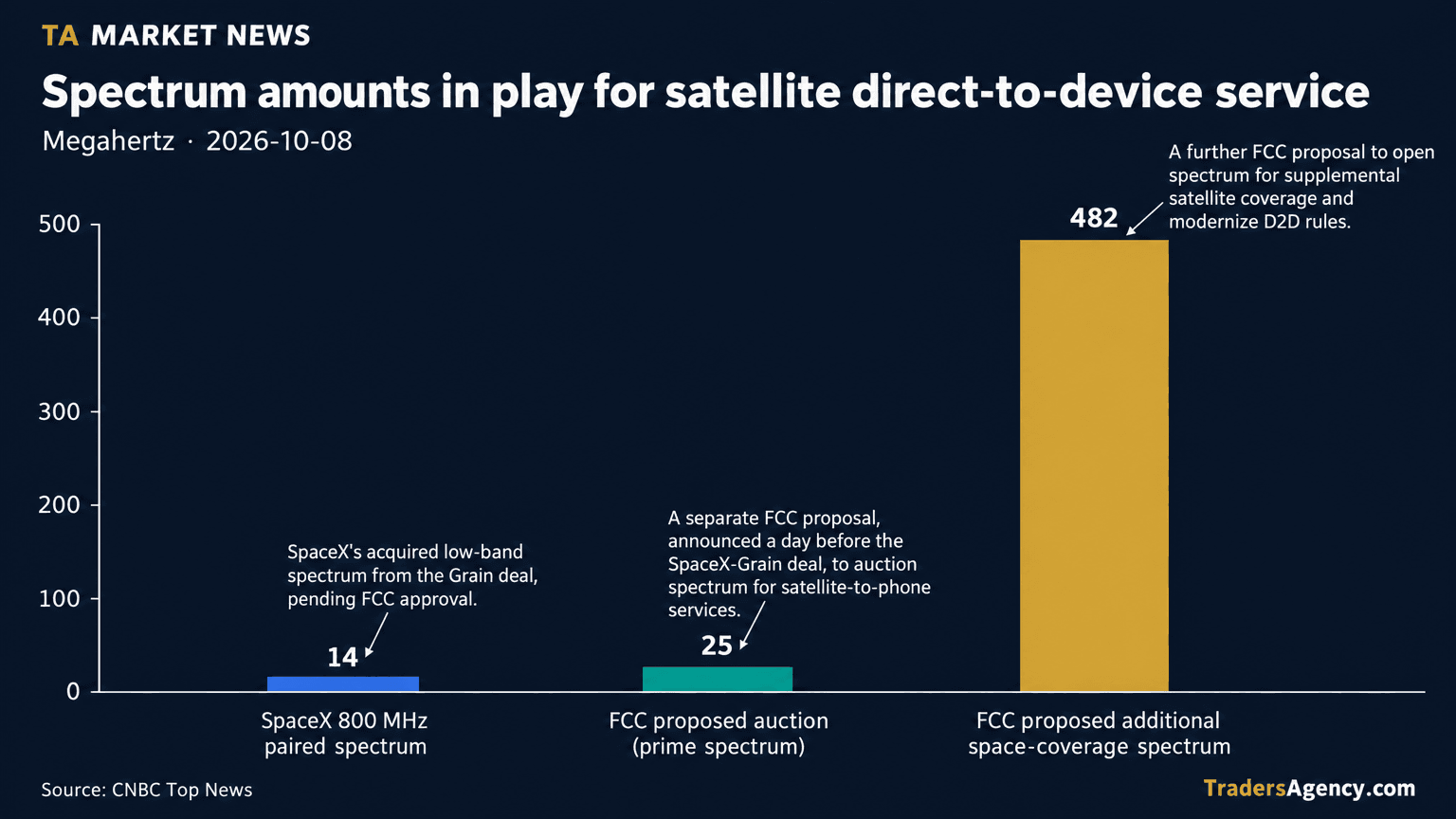
Grain Management said SpaceX will acquire the entirety of its nationwide 800 MHz holdings. SpaceX described the asset in a statement cited by CNBC as a "license portfolio of up to 14 megahertz of paired spectrum in the 800 MHz band." Via Satellite confirmed the same 14-megahertz figure. Financial terms of the transaction were not disclosed, Via Satellite reported.
Grain's spectrum position traces back to a separate transaction: the firm acquired the 800 MHz block from T-Mobile in a deal announced in early 2025 and completed in August 2026, Via Satellite reported, for $2.9 billion in cash plus additional spectrum licenses. Grain's own announcement described that exchange as cash plus Grain's 600 MHz spectrum holdings, after which the firm said it pursued "multiple use cases that would expand connectivity for American consumers and create value for the industry, Grain's investors, and the people whose futures they support."
Grain also said the new agreement with SpaceX "advances the objectives of the FCC's July 2026 order approving Grain's acquisition from T-Mobile, which established a competitive selection process and a conditional pathway for D2D deployment," according to the company's release. Grain CEO David Grain said in the statement that the firm's spectrum expertise "allows us to connect the strategic value of these assets with the technologies and operators that can realize their potential," adding that the SpaceX agreement brings that capability "to bear at extraordinary scale, with the potential to change where and how Americans connect."
BDT & MSD Partners served as financial advisor to Grain, with Milbank as legal counsel and Latham & Watkins as regulatory counsel, Grain's release stated.
How It Fits With Starlink Mobile
SpaceX positioned the low-band acquisition as a complement to spectrum it already controls for its direct-to-device service. Via Satellite reported that SpaceX described the 800 MHz holdings as a coverage layer sitting alongside Starlink Mobile's global 2 GHz mid-band spectrum: "While Starlink Mobile's global 2 GHz mid-band spectrum will provide high-bandwidth capacity in the United States, this new low-band spectrum will provide a coverage layer that ensures Starlink Mobile's signal penetrates through obstacles, such as walls, and can provide service to customers' devices even when they are in buildings," SpaceX said, according to Via Satellite.
CNBC reported that SpaceX called the 800 MHz band "prime low-band spectrum" that "addresses one of the key remaining technical gaps that will pave the way for Starlink Mobile to become a major mobile carrier in the US." Via Satellite also noted that the FCC recently approved SpaceX to deploy 15,000 satellites for the Starlink Mobile direct-to-device constellation, which is separate from SpaceX's existing Starlink broadband internet constellation.
SpaceX did not immediately respond to a request for further information, including when the new services might come online if regulators approve the transaction, CNBC reported.
Market and Regulatory Backdrop
CNBC reported that shares of AT&T, Verizon and T-Mobile tumbled in extended trading following the announcement, while SpaceX shares rose about 2% in extended trading after dropping 4% during the regular session. Those are the reported share-price moves on the day of the announcement only and are not an indication of where SpaceX or carrier shares will trade going forward.
The announcement arrived amid a broader regulatory push on satellite-to-phone spectrum. CNBC reported that a day earlier the FCC said it would vote on a proposal to auction 25 megahertz of "prime spectrum" to support direct-to-device services from satellites to smartphones, and that the agency would also vote on Oct. 29 on taking public comment on making an additional 482 megahertz of spectrum available for supplemental coverage from space and modernizing FCC rules for D2D services.
CNBC also noted that the deal lands amid a widening split between SpaceX and incumbent carriers. In the prior week, T-Mobile, AT&T and Verizon formed a joint venture focused on expanding coverage in underserved areas through satellite and D2D services, and Starlink was notably absent from that venture. T-Mobile had previously removed mention of Starlink from its T-Satellite promotions, per CNBC's reporting.
Analyst and Executive Reaction
Elon Musk called the transaction a "very big deal" in a post on X, CNBC reported. Industry analyst Tim Farrar of TMF Associates told CNBC the deal "adds fuel to the fire in the battle between SpaceX and the mobile operators," but cautioned that the spectrum holding remains limited in scope. "But it's still a very limited amount of spectrum and to get reliable building penetration in urban areas SpaceX would have to deploy towers on the ground," Farrar said, according to CNBC. In our reading of that caveat — an interpretation, not a source claim — the 800 MHz portfolio alone may not resolve the in-building and urban coverage challenges facing a satellite-based mobile offering.
CNBC also described the financial context for SpaceX, noting the company went public in June in a record IPO and is now valued at over $2 trillion, with Starlink serving as its cash cow and only profitable business segment to date, while its space and artificial intelligence units continue to lose money.
Bottom Line
The agreement, if approved by the FCC, would hand SpaceX a nationwide low-band spectrum layer that the company says is designed to strengthen indoor and obstacle-penetrating coverage for Starlink Mobile, building on its 2 GHz mid-band holdings and recently approved D2D satellite constellation. Financial terms remain undisclosed, and analysts such as Farrar note that the spectrum amount is limited and may still require ground infrastructure for reliable urban coverage. The transaction's ultimate impact on competition with AT&T, Verizon and T-Mobile will depend heavily on how the FCC handles the approval, including any conditions tied to the agency's prior July 2026 order governing Grain's T-Mobile acquisition.
DISCLAIMER: Traders Agency does not offer financial advice. The information provided is for educational purposes only and should not be considered financial advice. Traders Agency is not responsible for any financial losses or consequences resulting from the use of the information provided. Trading carries inherent risks and may not be suitable for all individuals. You are advised to conduct your own research and seek personalized advice before making any investment decisions, recognizing the potential risks and rewards involved.
- CNBC Top News: SpaceX deal to acquire spectrum license hammers shares of AT&T, Verizon and T-Mobile · accessed Oct 8, 2026
- Grain Management: Grain Management Announces Definitive Agreement to Sell Nationwide 800 MHz Spectrum Portfolio to SpaceX · accessed Oct 8, 2026
- Via Satellite: SpaceX Moves to Acquire Nationwide Low-Band Spectrum for Starlink Mobile · accessed Oct 8, 2026
See more from Traders Agency on Google
Make us a preferred source and our market analysis will appear more prominently in your Google Search, Top Stories, and AI results.
Add to Preferred Sources