Shares of the three largest U.S. wireless carriers suffered a sharp two-day selloff after SpaceX announced a definitive agreement to acquire Grain Management's nationwide 800 MHz spectrum portfolio, a deal the company framed as addressing "one of the key remaining technical gaps" standing between Starlink Mobile and status as a major U.S. mobile carrier, according to CNBC and Reuters reporting. Tower operators, meanwhile, rallied as analysts cited by CNBC argued the transaction keeps a terrestrial network build by SpaceX very much on the table.
The Selloff in Numbers
SpaceX said in a statement that it has agreed to acquire a "license portfolio of up to 14 megahertz of paired spectrum in the 800 MHz band," subject to Federal Communications Commission approval, according to CNBC. The companies did not disclose financial terms, but Reuters, citing the Wall Street Journal's sourcing, put the deal's value at roughly $8 billion, as reported by WTVB AM, carrying Reuters reporting.
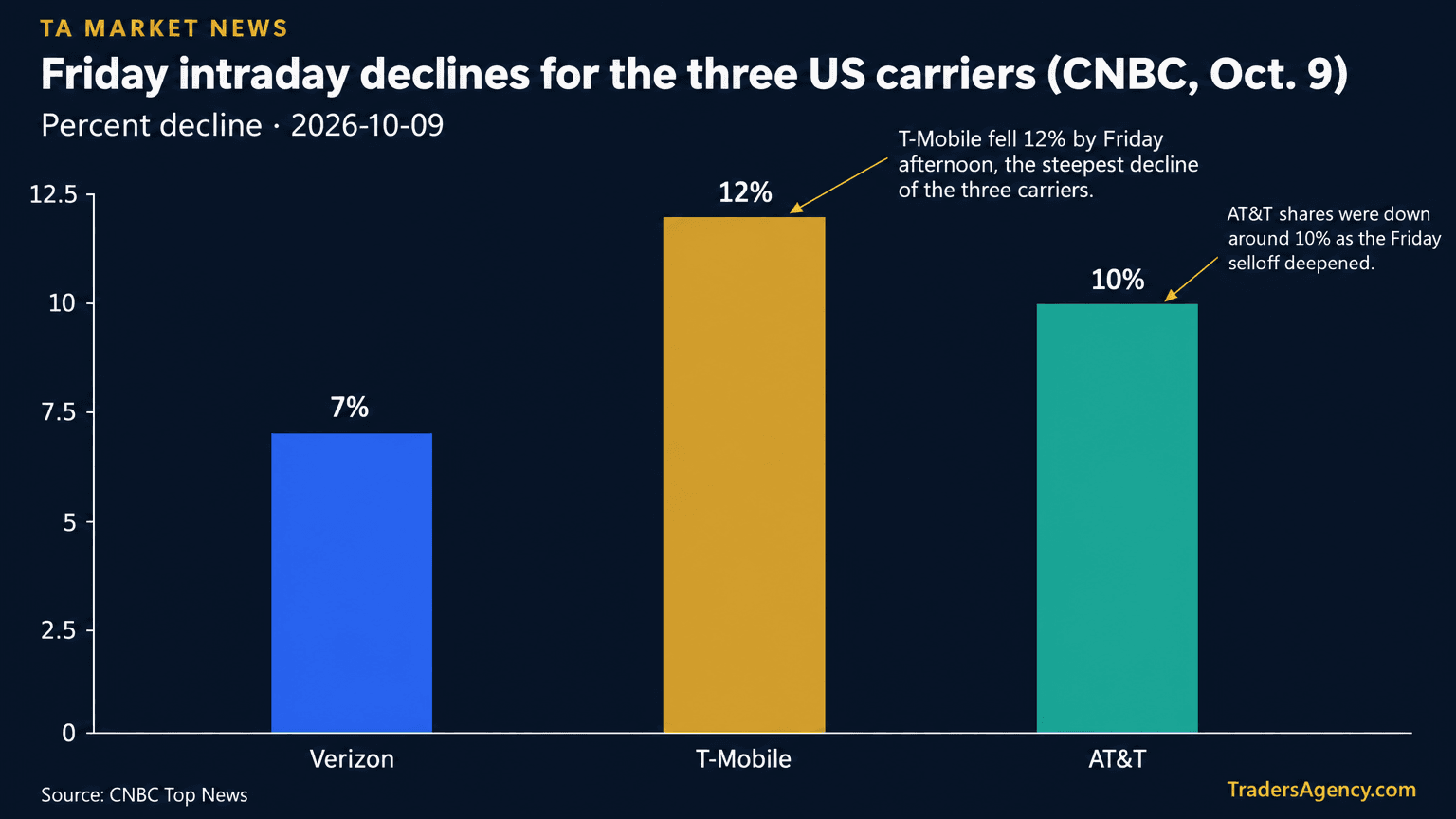
The market reaction came in waves. In Thursday extended trading immediately after the announcement, AT&T fell 6.75%, T-Mobile US dropped 5.4% and Verizon fell 5%, according to Yahoo Finance. By Friday premarket trading, Reuters reported (via WTVB AM) that all three had fallen between 5.5% and 7.4%. The declines deepened as Friday's session progressed: CNBC reported that by afternoon Verizon was down roughly 7%, pacing its worst day since 2002, while T-Mobile had fallen 12% and AT&T around 10%, per CNBC. Earlier in the Friday session, a separate CNBC report had T-Mobile as the session's worst performer among the three with a roughly 10% decline, illustrating how the losses widened through the day.
The repricing was not confined to the U.S. The STOXX Europe 600 Telecommunications index dropped more than 2% to its lowest level since Jan. 30, with Deutsche Telekom down 6.5%, Vodafone down 4.1%, Telefonica down 3.9% and Orange down 2.3%, according to Reuters as carried by WTVB AM. SpaceX's own shares moved only modestly by comparison: CNBC reported the stock rose about 2% in Thursday extended trading after dropping 4% during regular hours, then climbed around 1% on Friday, while Reuters (via WTVB AM) separately reported a 4% pop after the announcement.
Tower Stocks Rally on the Flip Side

While carrier shares fell, tower operators moved the opposite direction. CNBC reported that American Tower, Crown Castle and SBA Communications were all trading at least 6% higher Friday morning, with Crown Castle leading at around 12% in mid-morning trading, per CNBC. Reuters, as carried by WTVB AM, put the gains for the same three names between 6.7% and 8.3% earlier in the session. CNBC noted the rally came after a prolonged slump for the sector: American Tower is down more than 30% over the past five years, SBA Communications about 45%, and Crown Castle about 55%, with Crown Castle offering a 5.5% dividend yield at recent prices around $77, which CNBC attributed to higher interest rates and the growing prospect of satellite connectivity weighing on tower REITs before Friday's bounce.
What SpaceX Is Buying and Why
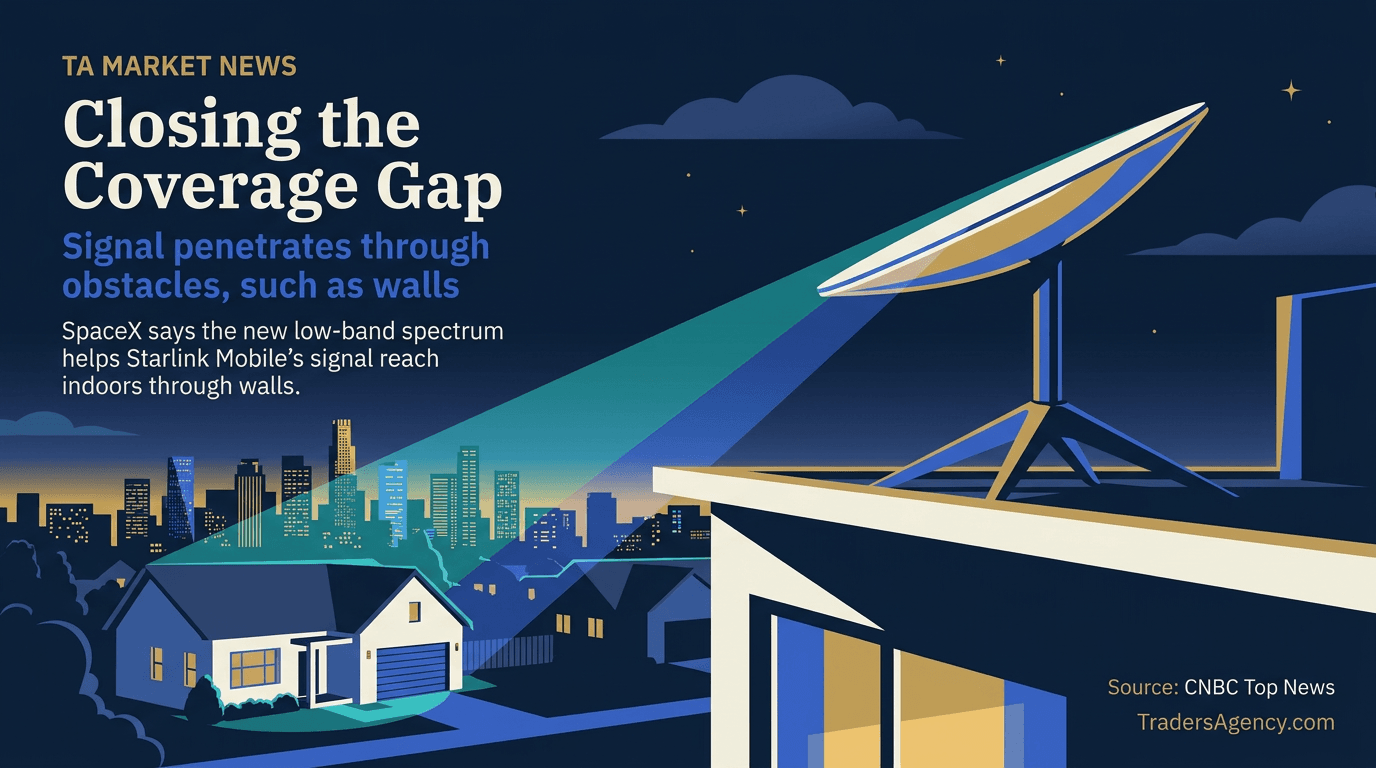
SpaceX described the purchase as addressing "one of the key remaining technical gaps that will pave the way for Starlink Mobile to become a major mobile carrier in the US," per the company's statement carried by CNBC. The low-band spectrum, SpaceX said, "will provide a coverage layer that ensures Starlink Mobile's signal penetrates through obstacles, such as walls, and can provide service to customers' devices even when they are in buildings," adding that most existing mobile devices already support the band. According to Anadolu Agency's report on the deal, the 800 MHz holdings are intended to complement Starlink Mobile's global 2 GHz mid-band spectrum, which the company plans to use for high-bandwidth capacity, with the combined network aimed at covering indoor, outdoor and dead-zone scenarios.
This is not SpaceX's first large spectrum purchase. According to industry analyst Sebastian Barros's Substack newsletter, the FCC previously approved SpaceX's acquisition of roughly 65 MHz across AWS-4, H Block and unpaired AWS-3 spectrum from EchoStar in a transaction valued at approximately $17 billion, explicitly tied to Starlink direct-to-cell and hybrid satellite-terrestrial service development. Separately, Anadolu Agency and Yahoo Finance both reported that the FCC this week approved Starlink Mobile's next-generation constellation application, authorizing 15,000 satellites optimized for 2 GHz operations, with SpaceX saying its V2 satellites will deliver more than 100 times the bandwidth of the current generation; the agency also authorized the Ka/V/E/W backhaul bands used by Starlink's V3 broadband satellites to interface with its existing gateway network.
Analysts Weigh Build-Out Versus Bluff
Wall Street's reaction centered on whether the spectrum purchase signals SpaceX is preparing to build physical towers. JPMorgan's Sebastiano Petti wrote in a Thursday note, per CNBC, that the transaction "is consistent with our view that … SpaceX would likely need to build a terrestrial network using macro towers to deliver a user experience on par with traditional wireless carriers." Petti also flagged that "we would not be surprised to see SpaceX pursue additional low-band assets over time, with Anterix's 900 MHz spectrum, which we value at $2.6 billion, uniquely positioned to fit this need."
Bernstein's Madison Rezaei argued the deal "chips away at the 'towers are obsolete in a [direct to device] world' narrative, with which we have long vehemently disagreed," and said it "lends credibility to a potential new buyer of tower capacity, whether the eventual build is large scale or more selective," adding her preliminary read was that "SPCX is keeping the terrestrial network build option very much alive," according to CNBC's reporting of her note.
Not every analyst took the announcement at face value. TD's Gregory Williams cautioned, per CNBC, that "SPCX may be bluffing to keep wireless down and get an [mobile virtual network operator agreement], but needs to be taken seriously," pointing to SpaceX's deliberate use of phrases such as "an advanced terrestrial deployment" and "to become a major mobile carrier" in its press release. Industry expert Tim Farrar of TMF Associates offered a more measured read, telling CNBC that "this adds fuel to the fire in the battle between SpaceX and the mobile operators," but cautioning that "it's still a very limited amount of spectrum and to get reliable building penetration in urban areas SpaceX would have to deploy towers on the ground."
Morgan Stanley, in a note carried by Reuters via WTVB AM, said "the Grain transaction is a clear sign that SpaceX is going to be a more aggressive acquirer of spectrum," while adding that any threat to established carriers is likely to materialize gradually, starting in rural markets. The firm separately called the transaction "incrementally constructive" for tower operators, noting that even a satellite-centric network could require deployments of towers, rooftops and small cells, while broader urban competition would require substantially more terrestrial infrastructure and spectrum. Read against the up-to-14 megahertz of paired spectrum in the Grain portfolio, that assessment implies SpaceX would need considerably more airwaves and ground infrastructure to compete in dense markets — an interpretation of the note rather than a figure stated by the firm.
Regulatory Backdrop and Industry Context
The deal requires FCC approval, and the agency's chair, Brendan Carr, declined to signal a position on the specific transaction but told CNBC's "Squawk on the Street" that competition in the spectrum market is "really good news for the American consumers," adding, "we're probably going to bring over $100 billion of spectrum into the market over the next two years, so we're seeing a lot of competition," and "it's not for us ultimately to pick winners and losers." The announcement landed a day after the FCC said it would vote on auctioning 25 megahertz of spectrum to support direct-to-device satellite services, and that it would vote Oct. 29 on taking public comment on making an additional 482 MHz available for supplemental coverage from space, per CNBC.
Notably, Yahoo Finance reported that Grain Management had acquired the same 800 MHz portfolio from T-Mobile only two months earlier, in August 2026, in an exchange involving cash and Grain's 600 MHz spectrum, meaning the assets changed hands twice in roughly two months. CNBC also noted that, one week before the SpaceX announcement, T-Mobile, AT&T and Verizon had formed a joint venture "focused on expanding coverage in underserved areas" via satellite and direct-to-device services, with Starlink notably absent from that effort; T-Mobile had also previously removed mention of Starlink from its T-Satellite promotions, according to CNBC.
CNBC's reporting also framed the deal against SpaceX's broader financial position: the company went public in June in a record IPO and is now valued at over $2 trillion, with Starlink serving as its only profitable business segment to date while its space and artificial intelligence units continue to lose money. SpaceX did not immediately respond to CNBC's request for further information, including when any new services might come online if regulators approve the transaction. SpaceX CEO Elon Musk called the transaction a "very big deal" in a post on X, per CNBC.
Bottom Line
The reported stock moves reflect how investors are pricing a plausible, if still unconfirmed, path for SpaceX to layer terrestrial infrastructure and low-band spectrum onto its satellite network and compete more directly with established carriers. Multiple analysts, including those at JPMorgan and Bernstein, read the Grain acquisition as evidence that a tower-based build is back on the table, while TD's Williams and TMF's Farrar urged caution about reading too much into a transaction that, on current terms, involves only 14 MHz of paired spectrum, a modest slice relative to the scale needed for broad urban competition. The deal's fate still rests with the FCC, whose chair has signaled openness to more spectrum competition without committing to this specific transaction's outcome.
DISCLAIMER: Traders Agency does not offer financial advice. The information provided is for educational purposes only and should not be considered financial advice. Traders Agency is not responsible for any financial losses or consequences resulting from the use of the information provided. Trading carries inherent risks and may not be suitable for all individuals. You are advised to conduct your own research and seek personalized advice before making any investment decisions, recognizing the potential risks and rewards involved.
- CNBC Top News: SpaceX deal to acquire spectrum license hammers shares of AT&T, Verizon and T-Mobile · accessed Oct 8, 2026
- CNBC Top News: Stocks making the biggest moves premarket: DAL, SPCX, TMUS · accessed Oct 9, 2026
- CNBC Top News: Verizon, AT&T and T-Mobile sell off on SpaceX U.S. network plans · accessed Oct 9, 2026
- CNBC Top News: SpaceX wireless plans lifts tower stocks · accessed Oct 9, 2026
- finance.yahoo.com: Telecom stocks tumble on SpaceX spectrum acquisition news · accessed Oct 9, 2026
- wtvbam.com: US, European telecom stocks slide as SpaceX spectrum deal rattles sector · accessed Oct 9, 2026
- www.exterrajsc.com: SpaceX’s $19.6 Billion Spectrum Gambit · accessed Oct 9, 2026
- sebastianbarros.substack.com: Starlink Wants More and More Spectrum. Telcos May Pay the Price. · accessed Oct 9, 2026
- www.youtube.com: SpaceX Purchasing $17 Billion In Wireless Spectrum Licenses From EchoStar · accessed Oct 9, 2026
- www.aa.com.tr: SpaceX strikes spectrum deal, paving way for Starlink to become major US mobile carrier · accessed Oct 9, 2026
See more from Traders Agency on Google
Make us a preferred source and our market analysis will appear more prominently in your Google Search, Top Stories, and AI results.
Add to Preferred Sources