
The European Central Bank just raised its key interest rate by a quarter point to 2.25%, marking its first hike since 2023. This is a significant shift in European monetary policy, and our team has been tracking the buildup for weeks. With the ongoing Iran war driving up global energy costs and pushing euro zone inflation further off target, this ecb rate decision june 2026 carries real consequences for traders holding European assets and energy-sensitive positions. Here is what the data means and how we're positioning around it.
What Did the ECB Decide in June 2026?
The ECB officially increased rates by 25 basis points, bringing the benchmark to 2.25%. Markets had priced in a near-100% probability of this move ahead of the June Governing Council meeting, so the hike itself was no surprise. The real story is in the revised projections and what they signal about the road ahead.
Key Projection: The ECB now expects headline euro zone inflation to average 3% in 2026, cooling to 2.3% in 2027 and hitting the 2% target in 2028. At the same time, growth forecasts were slashed: just 0.8% GDP growth projected for 2026, followed by 1.2% in 2027 and 1.5% in 2028.
That growth picture looks even worse when you consider the first quarter, where the euro zone economy expanded by a mere 0.1%. The ECB is hiking into weakness, and that tells you everything about how seriously they're taking the inflation threat.
What Happens When the ECB Raises Interest Rates?
When the ECB raises rates, borrowing costs increase across the euro zone to combat rising consumer prices. For traders, this typically strengthens the euro and pressures bond prices. But this cycle is different from a textbook tightening. The hike is designed to control inflation driven by energy supply shocks, not by strong economic demand.
The primary driver behind this tightening is the Iran war, which recently crossed the 100-day mark. The closure of the Strait of Hormuz and the destruction of Middle Eastern energy facilities have created severe supply constraints that are feeding directly into consumer prices.
ECB President Christine Lagarde reiterated that the war in the Middle East is generating inflation pressures. With euro zone inflation rising to 3.2% in May, the central bank felt compelled to act despite the weak growth outlook. That is a tough spot for any central bank, raising rates when the economy is barely growing.
How Is the Market Reacting?
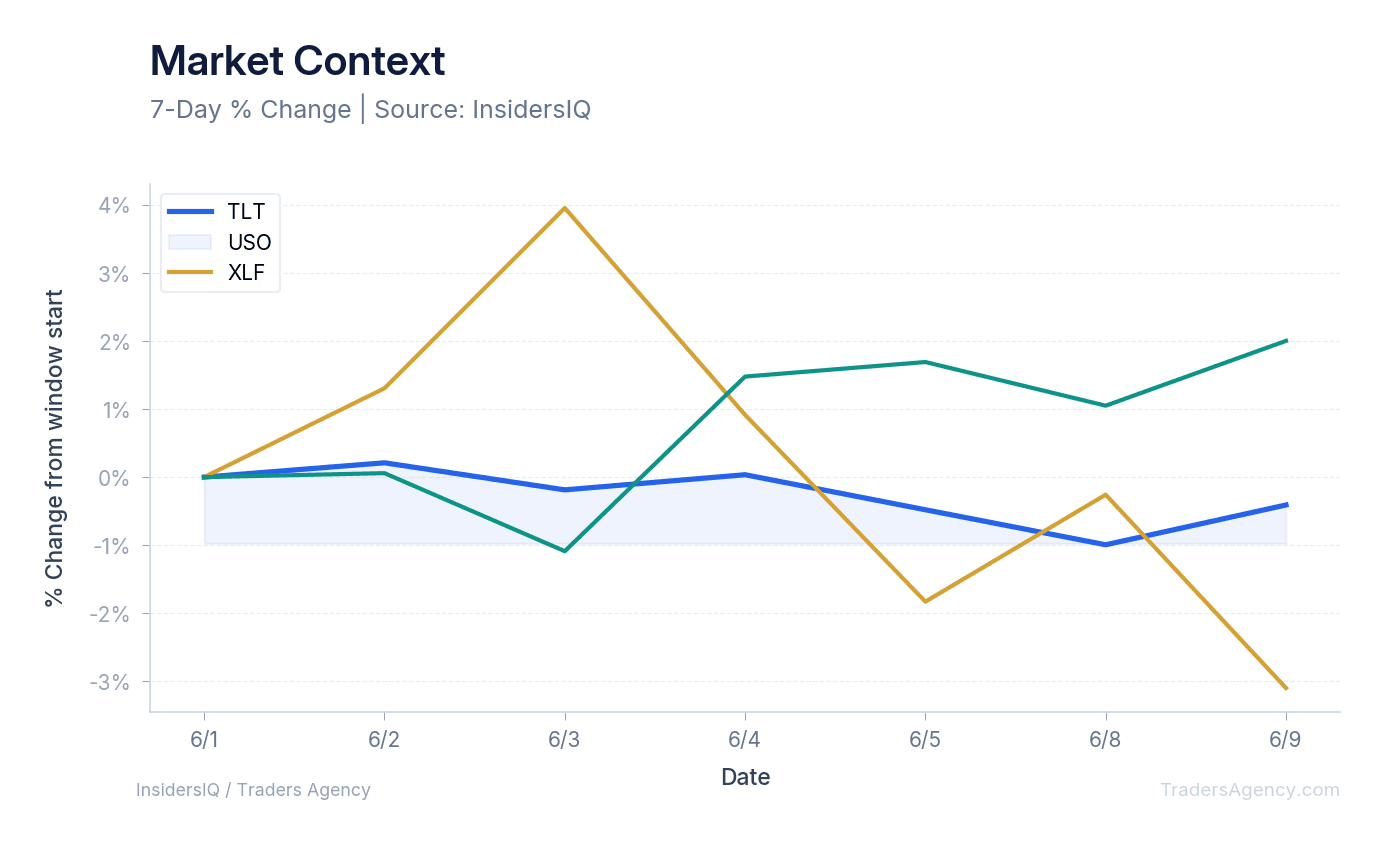
The market impact is already visible across major asset classes. Financial sectors are catching a bid, while bond markets and energy proxies show mixed reactions. We're tracking specific price action following the announcement.
10-Day Moves: The Financial Select Sector SPDR Fund (XLF) has posted a +2.00% gain, showing strength in banking and financial equities. The iShares 20+ Year Treasury Bond ETF (TLT) is down -0.41%, feeling the pressure of higher rates. The United States Oil Fund (USO) has dropped -3.10%, reflecting complex energy market dynamics despite Middle East supply constraints.
That USO decline might seem counterintuitive given the supply disruptions, but it reflects complex energy market dynamics where higher rates and weaker growth expectations may be weighing on demand outlooks. Traders need to account for both sides of that equation.
Want expert trading insights delivered daily?
Join thousands of traders who rely on Traders Agency for market analysis and trade ideas.
Join Traders AgencyWhat This Means for Traders Right Now
This policy shift means prioritizing sectors that benefit from higher yields while managing risk in growth-sensitive assets. The combination of rising inflation and lowered growth forecasts creates a challenging environment that demands strict position sizing and careful sector selection.
Our research team has identified three specific areas to monitor:
1. European Bond Yields
The yield on the 10-year German bund fell by 2 basis points immediately following the announcement. We expect continued volatility in European debt markets as traders digest the revised growth outlook. The initial move lower in yields suggests the market is more worried about growth than inflation at this point.
2. Currency Crosses
The euro remained flat against both the dollar and the British pound in the immediate aftermath. That muted reaction tells us the hike was fully priced in. Traders should watch for breakout setups in EUR/USD as the market digests the possibility of further hikes later this year.
3. Energy Sector Volatility
With a fragile ceasefire in place and tensions escalating between Washington and Tehran, energy markets remain highly sensitive. The scale of the energy price shock will dictate the medium-term inflation path, and by extension, the ECB's next move.
What Should Traders Watch After the ECB June 2026 Decision?
The ECB Governing Council stated they are not pre-committing to a particular rate path. That means every upcoming inflation print and energy market headline will trigger market reactions. Traders need to stay nimble.
Our analysis points to three specific variables in the coming weeks:
- Euro zone inflation flash data: We need to see whether the 3.2% May figure cools or accelerates. A hotter print would strengthen the case for a September hike.
- Energy supply updates from the Strait of Hormuz: Any escalation or de-escalation in the Iran conflict will move oil prices and reset inflation expectations overnight.
- Price action in TLT: This remains our preferred gauge for global bond market sentiment. Further weakness would confirm a broader repricing of rate expectations.
We're watching the September meeting closely. The central bank will need to balance upside risks to inflation against downside risks to economic growth. Analysts are divided on what comes next: Mark Wall, chief European economist at Deutsche Bank, expects "one more hike in September and that's it," while Neil Birrell, chief investment officer at Premier Miton, sees more rate hikes this year as likely, depending on the data.
Our Bottom Line
This ECB rate decision confirms that central banks are prioritizing inflation control over economic growth. Our team is actively trading the volatility in financial ETFs like XLF while maintaining tight stops on bond proxies like TLT. The energy supply situation tied to the Iran conflict is the single biggest wildcard for the second half of 2026.
We will continue monitoring energy supply lines and European inflation data for our next portfolio adjustments. This is a market that rewards preparation and punishes complacency.
Want expert trading insights delivered daily?
Join thousands of traders who rely on Traders Agency for market analysis and trade ideas.
Join Traders AgencyKey Takeaways
- The ECB raised its benchmark rate by 25 basis points to 2.25% in June 2026, its first hike since 2023, driven by persistent inflation tied to rising energy costs from the ongoing Iran conflict.
- The ECB now projects euro zone inflation at 3% for 2026, not reaching the 2% target until 2028, meaning rate pressure is unlikely to ease quickly.
- Growth forecasts were cut sharply: just 0.8% GDP growth expected in 2026, following a near-flat 0.1% expansion in Q1, confirming the ECB is hiking into economic weakness.
- Markets had priced in a near-100% probability of this hike before the meeting, so the move itself was not the story. The revised projections and forward guidance are what traders need to focus on.
- The team is actively trading volatility in financial ETFs like XLF and keeping tight stops on bond proxies like TLT, with energy supply lines flagged as the biggest wildcard for H2 2026.
DISCLAIMER: Traders Agency does not offer financial advice. The information provided is for educational purposes only and should not be considered financial advice. Traders Agency is not responsible for any financial losses or consequences resulting from the use of the information provided. Trading carries inherent risks and may not be suitable for all individuals. You are advised to conduct your own research and seek personalized advice before making any investment decisions, recognizing the potential risks and rewards involved.
See more from Traders Agency on Google
Make us a preferred source and our market analysis will appear more prominently in your Google Search, Top Stories, and AI results.
Add to Preferred Sources