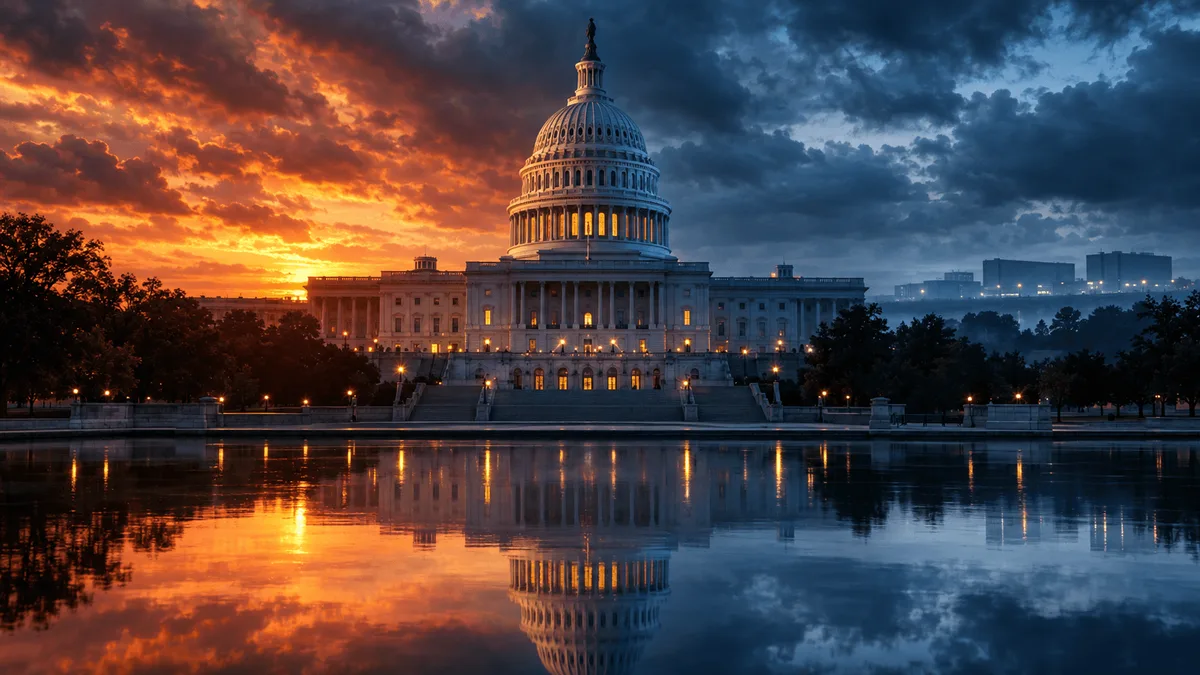
Democrats have won control of both chambers of Congress in the 2026 midterm elections, according to projections from NBC News and other major outlets, ending Republican unified control of Washington and setting up a sharply more adversarial relationship with the Trump administration heading into 2027.
The results, which became clear overnight Tuesday into Wednesday, included Senate flips in states Republicans had held for years and a House majority that an NBC News analysis estimated at a minimum of 258 seats. Markets reacted within hours, with equity futures sliding and Musk-linked stocks under particular pressure in premarket trading, according to CNBC.
Final Seat Counts and the Scale of the Majority
According to an NBC News analysis, Democrats will win at least 258 House seats, an estimate NBC News said could still move by a few seats but is "well beyond the 218 needed to secure a majority." That tally supersedes an earlier, more conservative election-night projection from CNBC's Election Desk, which had called the House for Democrats at a minimum of 225 seats versus at least 160 for Republicans before later counting pushed the Democratic total higher.
In the Senate, Democrats flipped at least seven seats, according to NBC News and DW, including Iowa, Kansas, Ohio, Maine, North Carolina, South Carolina and Texas, while holding onto contested seats in Georgia and Michigan, DW reported. The New York Times reported that Democrats will enter 2027 with at least 54 Senate seats, a majority that would give the party room to withstand some defections on procedural votes.
The wave extended to governors' races. NBC News reported Democrats flipped governorships in Texas, Georgia, Nevada, Ohio and Iowa. The Texas results were especially notable: CNBC reported that Democrat James Talarico defeated Republican Ken Paxton for the state's Senate seat, becoming the first Democrat elected to the U.S. Senate from Texas in nearly four decades, while Democrat Gina Hinojosa unseated three-term Gov. Greg Abbott. NPR put Talarico's margin at roughly 12 points, or about 1.1 million votes, and Hinojosa's at 7 points, or nearly 700,000 votes. CNBC noted that Hinojosa is the first Democratic governor of Texas since Ann Richards left office in 1995.
Reaction from within the Republican Party suggested some in the party see the setback as structural rather than a one-cycle blip. Florida Gov. Ron DeSantis wrote on X, as reported by CNN, that "it is very unlikely Republicans will recapture the Congress in 2028" given the Senate map and the size of the House margin, adding the party "might not have a shot at Senate control until 2032." That is DeSantis's own public assessment rather than a neutral forecast, but in our read it indicates how at least some Republicans are publicly gauging the durability of Tuesday's results.
Committee Turnover and What It Means for Tech, AI and Energy Oversight
Control of the House brings committee gavels that will shape oversight priorities for the next two years. Euronews and CNBC both reported that Rep. Robert Garcia of California is expected to become the next chair of the House Oversight Committee. Garcia signaled an assertive posture immediately, warning Republicans to "lawyer up," according to both outlets.
On the Senate side, CNBC reported that Sen. Susan Collins, who heads the Senate Appropriations Committee and was the only Republican senator from New England, lost her Maine reelection bid, a seat Democrats flipped as part of their broader Senate gains. The loss of Collins's gavel is significant because Appropriations controls the mechanics of government funding, an area likely to be central to the first clashes between the new Congress and the White House.
Tech and AI policy appear headed for closer scrutiny. CNBC reported that Rep. Greg Casar, who chairs the Congressional Progressive Caucus, said after Democrats were projected to win the House that "the House Democratic majority must make it a top priority to protect Americans' jobs, freedom, and lives from AI billionaires," adding that "AI company CEOs should be called to testify under oath." CNBC also reported more broadly that a more adversarial, Democratic-controlled Congress is likely to intensify scrutiny of tech companies and the ongoing AI data-center build-out.
That scrutiny has a geographic dimension. Gov.-elect Hinojosa campaigned in Texas on pausing new data-center projects, according to CNBC, a position with outsized stakes given that Texas is projected, by one estimate cited by CNBC, to overtake Virginia as the world's largest data-center market by 2030. In our read, the combination of a Democratic governor skeptical of unchecked data-center expansion and a House majority eager to question AI executives points toward a more contested regulatory environment for large-scale AI infrastructure projects, though the shape and timing of any legislation remains unknown at this stage.
Markets React: Futures Slide, Musk Stocks Hit Hardest
Equity futures moved lower as the scale of the Democratic gains became apparent Tuesday evening. CNBC reported that Dow Jones Industrial Average futures fell about 367 points, or 0.7%, while S&P 500 futures traded 1.1% lower and Nasdaq-100 futures shed 2%.
By Wednesday's premarket session, the selling had concentrated in Musk-linked and AI-adjacent names. CNBC reported that SpaceX was last trading down 3.8% and Tesla dropped 3.5% amid big losses for Republican candidates Musk had backed, and that artificial-intelligence stocks came under pressure overnight as Democrats — described by CNBC as seen by markets as proponents of data-center moratoriums — won big in midterm races held in key data-center hubs.
Musk's political spending made him one of the cycle's most exposed figures. CNBC's analysis of campaign finance records found Musk spent a record of at least $474 million on the midterms, funneling $224 million, nearly half the total, into Texas alone, where both Paxton and Abbott lost. Talarico had repeatedly attacked Musk on the campaign trail, CNBC reported, accusing him of trying to buy "his very own personal United States Senator." Tesla and SpaceX are both based in Texas, and CNBC's reporting frames the defeat of the candidates Musk backed most heavily there as a setback for him. In our read, that is a political setback tied to the election outcome, not evidence of any specific regulatory action against either company.
The Funding Fight Ahead and Trump's Veto Posture
Even before full results were in, CNBC reported that analysts expected gridlock if Democrats won one or both chambers, with government-funding measures potentially the only legislation likely to pass. That dynamic now falls to a Congress that includes a new Appropriations Committee chair in the Senate following Collins's defeat, adding fresh uncertainty to how funding negotiations will unfold.
President Trump signaled he intends to use his veto power aggressively against the incoming Democratic majorities. According to CNBC and the Guardian, Trump posted an image of a red baseball cap reading "VETO" on Truth Social overnight as results rolled in, a message the Guardian said was meant to "ram home" his intention to block Democratic-initiated legislation using what he called "tremendous powers."
Despite that combative signal, Trump struck a more measured tone in remarks reported by euronews, telling The New York Times he was "absolutely willing" to accept the results and telling Fox News, "I think the Democrats did a good job, I really do." In our read, the juxtaposition of the veto threat with that concession illustrates the uncertain tone of the transition to divided government, with the White House publicly accepting the outcome while signaling it will contest the new majority's legislative agenda.
Bottom Line
Democrats have secured at least 258 House seats, by NBC News's estimate, and at least 54 Senate seats, according to the New York Times — a margin wide enough that Florida Gov. Ron DeSantis wrote on X that Republicans are unlikely to recapture Congress in 2028 and might not have a shot at Senate control until 2032, per CNN. The practical consequences arrive quickly: new committee chairs including Robert Garcia at Oversight, a change at the top of Senate Appropriations after Susan Collins's defeat, and Progressive Caucus chair Greg Casar openly calling for AI executives to testify under oath. In our read, markets have begun to reflect some of that uncertainty, with Tesla and SpaceX falling in Wednesday's premarket session alongside broader AI-stock weakness, according to CNBC, even as the government-funding outlook and Trump's declared veto posture suggest the next fight in Washington is only beginning.
DISCLAIMER: Traders Agency does not offer financial advice. The information provided is for educational purposes only and should not be considered financial advice. Traders Agency is not responsible for any financial losses or consequences resulting from the use of the information provided. Trading carries inherent risks and may not be suitable for all individuals. You are advised to conduct your own research and seek personalized advice before making any investment decisions, recognizing the potential risks and rewards involved.
- CNBC Top News: House, Senate live updates · accessed Nov 4, 2026
- CNBC Top News: Tech billionaires hit as Democrats beat Republicans · accessed Nov 4, 2026
- www.nbcnews.com: Election results 2026 live updates: Democrats to take control of House and Senate, NBC News projects · accessed Nov 4, 2026
- www.cnn.com: 2026 Midterm Election Results Live: Democrats take control of Congress · accessed Nov 4, 2026
- www.nytimes.com: 2026 Midterm Election Live Updates: Democrats Win Control of Congress as Voters Rebuke Trump · accessed Nov 4, 2026
- www.npr.org: 6 takeaways from Democrats’ big midterm wave : NPR · accessed Nov 4, 2026
- www.theguardian.com: US voters rebuke Trump as Democrats win control of Congress in ‘blue wave’ · accessed Nov 4, 2026
- www.dw.com: US midterms: Sweeping Democrat wins deliver rebuke to Trump · accessed Nov 4, 2026
- www.euronews.com: Democrats win control of US Congress in midterm rejection of Trump presidency · accessed Nov 4, 2026
- www.cnbc.com: House, Senate results live updates · accessed Nov 4, 2026
See more from Traders Agency on Google
Make us a preferred source and our market analysis will appear more prominently in your Google Search, Top Stories, and AI results.
Add to Preferred Sources