Tuesday night delivered a far stronger showing for Democrats than most political handicappers had priced in, with the party notching Senate wins or projected wins in states that have leaned Republican for years. The result raises a genuine question for Washington watchers and investors alike: does a more unified opposition in Congress make gridlock worse, or does it actually open a path for deal-making? Markets, meanwhile, are weighing short-term uncertainty against a historical pattern of post-midterm strength.
A Sweep That Surprised Even Democrats
Of the Senate contests being watched most closely heading into election night, Democrats came out ahead in a striking number of them. Georgia and New Hampshire, both seen as competitive, went to Democrats. So did South Carolina, a state Donald Trump carried by roughly 18 points in 2024, and North Carolina, which he won by about eight points. Ohio flipped in what had been described as Democrats' best pickup opportunity in the state, and Michigan and Maine were trending Democratic as results continued to come in.
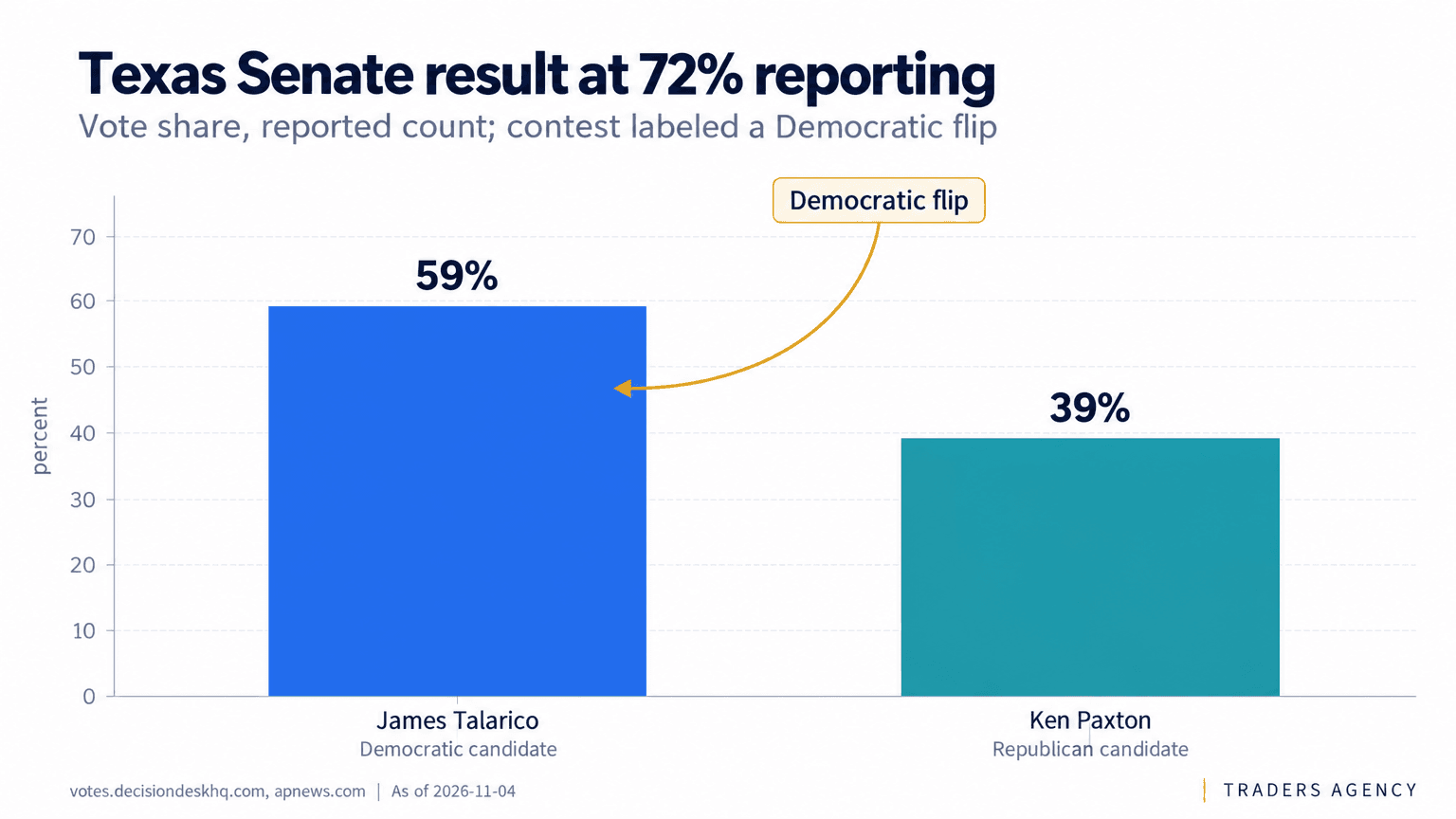
Two results stood out for their historical weight. Kansas appeared poised to send a Democrat to the U.S. Senate for the first time since George McGill's 1932 reelection, a gap of roughly 94 years. Texas, meanwhile, was on track for its first Democratic Senate victory since Lloyd Bentsen's 1988 reelection. Election-night figures cited in the broadcast showed Democrat James Talarico leading Republican Ken Paxton 59% to 39% with 72% of votes counted, a margin the source described as a decisive flip. That tally reflects reported, in-progress results rather than a certified outcome.
Signs of a Wider Regional Shift
Beyond the individual races, election-night coverage pointed to a broader directional shift toward Democrats across parts of the South, Midwest and Appalachia, though the transcript did not offer a consistent county-level measurement of how large that shift actually was. Republicans did hold some ground: citing Morgan Stanley's list of four House seats the bank had flagged as must-holds for the GOP, including seats in Florida, North Carolina and Virginia, the broadcast reported that all four reportedly stayed Republican even as the party lost ground elsewhere. Other House races remained too close to call as counting continued.
What the Prediction Markets Were Already Pricing In
Prediction markets had been leaning toward this outcome before polls closed. The broadcast cited Kalshi as pricing Democratic control of the Senate at somewhere between 60% and 73% in the run-up to the election, versus roughly 26% to 40% for Republicans. If accurate, that would mean the market-implied odds were directionally correct, though it is worth remembering that prediction-market pricing reflects the balance of money wagered rather than a guaranteed forecast.
Want expert trading insights delivered daily?
Join thousands of traders who rely on Traders Agency for market analysis and trade ideas.
Join Traders AgencyMarkets Flinch, But History Offers a Counterweight
Overnight futures reportedly showed the Nasdaq 100 down more than 2.3%, while solar name Enphase climbed roughly 4% on expectations that a more Democratic-controlled Congress could be friendlier to renewable energy policy. Those figures reflect the broadcast's own reporting at the time and were not independently confirmed.
The broadcast then leaned on research attributed to J.P. Morgan to argue that short-term volatility around midterms has historically given way to stronger returns. Since the 1990s, J.P. Morgan's data reportedly shows the Nasdaq 100 averaging a 37.6% gain in the twelve months following a midterm election, with the S&P 500 up an average of 14.7% over the same period. Going back to the 1950s, the broadcast cited a six-month post-midterm average S&P 500 gain of 13.8%, with the index higher in all 19 observed periods. These are historical averages cited in the broadcast rather than independently verified figures, and past patterns are not a guarantee of how markets will behave this time. Traders Agency analysts will be watching whether this post-midterm seasonality holds up against the specific policy uncertainty this election has introduced.
Data Centers and the AI Buildout Face a Political Test
One sector-specific worry raised in the broadcast involves Texas, where it was estimated that as much as 13.2 gigawatts of data-center capacity could face renewed uncertainty following this week's election results. That figure comes from the broadcast's own analysis and has not been independently verified, so it should be treated as a rough estimate rather than a confirmed capacity figure.
Talarico, as a Senate candidate, had proposed giving local communities more input into data-center siting decisions alongside tighter regulatory requirements, a campaign position rather than enacted Texas policy. The broadcast argued this points toward local governments playing a larger role in individual project approvals going forward, though the actual division of authority between state and local governments on this issue remains unsettled.
More broadly, the broadcast argued that political turbulence is unlikely to be a death blow for the AI infrastructure buildout. Projects that were already financially shaky might get shelved regardless of the election outcome, the reasoning goes, but the underlying demand for AI computing capacity is not something a single state election is likely to erase. That is a scenario and an opinion rather than a settled outcome, and it rests on the assumption that broader AI demand continues to outweigh any localized project delays.
A New Bargaining Dynamic in Washington
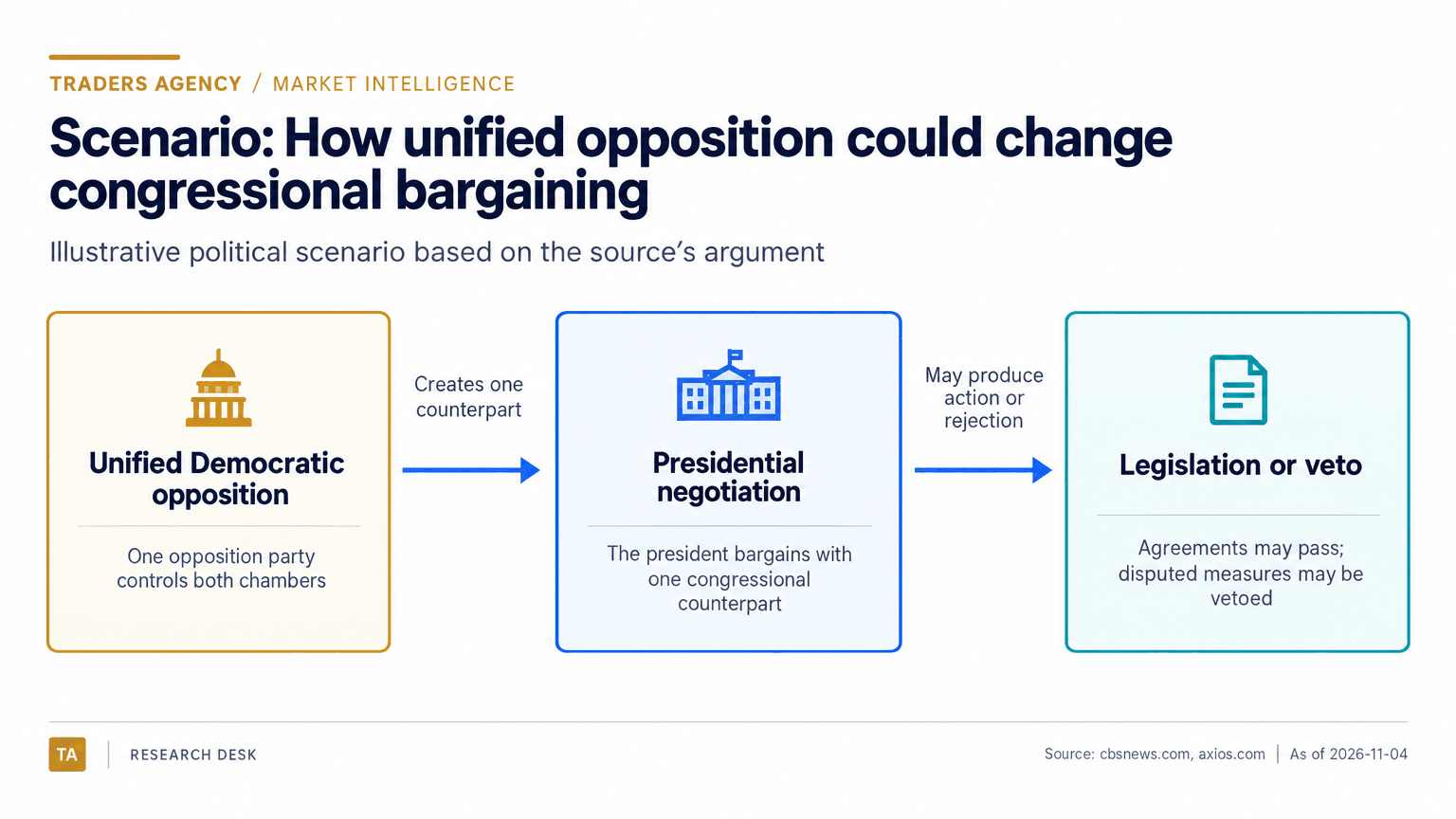
Perhaps the most counterintuitive argument in the broadcast concerned what a Democratic sweep might mean for legislative gridlock. The central argument here is that a divided Congress, split between Republicans and Democrats, tends to produce stalemate because the president has to satisfy two factions that frequently disagree with each other. A Congress unified under one opposition party, by contrast, gives the president a single negotiating counterpart. In that framing, deals become more achievable, not less, because there is only one party to strike a bargain with. This is a political scenario built on the assumption that the president is willing to negotiate and that a unified opposition would rather extract concessions than simply block everything, and it should be read as analysis rather than a forecast of what Congress will actually do.
The president's own public statements around the election appeared to shift depending on the moment. In an interview conducted before polls closed, Trump emphasized that he would use what he called "tremendous powers," including the veto, if Democrats took control of Congress. After the results came in, he said he was "absolutely willing to accept" the outcome and would "work with the Democrats." Those two statements are not necessarily contradictory. A willingness to negotiate and a readiness to use the veto on measures he opposes can coexist, and the full context of both remarks would need further verification.
Iran and Tariffs Add Another Layer of Uncertainty
Separately from the election, the broadcast flagged comments Trump made to the Financial Times indicating the United States has no immediate plans to strike Iran, while he remained prepared for further action if negotiations over enriched uranium stockpiles do not progress. That statement, as reported, suggests a continued but cautious diplomatic posture rather than an imminent escalation.
The broadcast also floated a longer-range, speculative scenario on trade policy: that existing tariffs could remain in place through the next presidential term and only be reduced starting around 2029 under a future administration, at which point the removal itself could act as a form of economic stimulus. That is explicitly a forward-looking guess built on several untested assumptions, including that current tariff policy holds steady and that whoever succeeds the current administration chooses to unwind it, and it should not be read as a near-term policy prediction.
The Bottom Line for Investors
The headline story here is straightforward: Democrats outperformed expectations in a wide swath of Senate races, including some in traditionally red territory, and that outcome is still being finalized in several contests. The market reaction so far has been mixed and short-term in nature, while the longer historical record on post-midterm performance, as cited from J.P. Morgan, has tended to favor patience over panic. Whether that pattern repeats this cycle will depend on how Washington handles the new balance of power, how the data-center and AI buildout absorbs any state-level policy shifts, and how geopolitical and trade questions evolve in the months ahead. None of that is settled yet, and investors should treat both the political reasoning and the historical market comparisons in this story as scenarios to monitor rather than guarantees of what comes next.
Want expert trading insights delivered daily?
Join thousands of traders who rely on Traders Agency for market analysis and trade ideas.
Join Traders AgencyDISCLAIMER: Traders Agency does not offer financial advice. The information provided is for educational purposes only and should not be considered financial advice. Traders Agency is not responsible for any financial losses or consequences resulting from the use of the information provided. Trading carries inherent risks and may not be suitable for all individuals. You are advised to conduct your own research and seek personalized advice before making any investment decisions, recognizing the potential risks and rewards involved.
- The Latest: Voters give Democrats control of Congress in rebuke to Trump
- Chris Pappas defeats John E. Sununu to keep New Hampshire US Senate seat in Democratic hands
- Election Night 2026: Abdul El-Sayed wins, adding to Democrat wipeout
- 2026 Senate Election Results
- 2026 Texas US Senate General Election Results | DDHQ
- Democrat James Talarico wins election to U.S. Senate from Texas
- Biographical Directory of the United States Congress 1774–2005
- James Talarico defeats Ken Paxton, giving Democrats their first U.S. Senate win in Texas since 1988
- 2026 Midterm Elections and Markets: What Investors Should Watch
- Rep. Anna Paulina Luna wins reelection in Florida’s 13th Congressional District, defeating Democrat Leela Gray
- Democrat Katy Padilla Stout wins election to U.S. House in Texas' 23rd Congressional District
- Kalshi projects James Talarico wins Texas Senate race
- US midterms: What’s next for markets?
- How U.S. midterm elections may affect markets
- Jumping Hurdles: The race to year-end
- Talarico calls for tighter regulation on data center development
- Trump says he is prepared to use "tremendous powers" if Democrats take control
- Trump says GOP lost because he wasn't on ballot, is "willing to accept" results
- US has no immediate plan to strike Iran, Trump tells FT
- Trump says US has no immediate plans to strike Iran, but remains ‘locked and loaded’
- Trump tells FT he has no 'immediate' plan for a new offensive against Iran
See more from Traders Agency on Google
Make us a preferred source and our market analysis will appear more prominently in your Google Search, Top Stories, and AI results.
Add to Preferred Sources