
SK Hynix's latest earnings commentary reads like one of the most bullish memory-sector updates in years, built around a simple pitch: long-term contracts, custom chip designs and broadening AI spending could finally break memory's historic boom-and-bust pattern. The company's own numbers support part of that case, but the same earnings call also confirms rising capital spending, and that combination leaves room for a more cautious read alongside the optimistic one.
Long-Term Agreements Aim to Break Memory's Boom-and-Bust Pattern
Memory chips have a well-worn history of shortage-driven price spikes followed by overbuilding and painful gluts, a pattern investors saw play out in 2023 and in earlier cycles stretching back to the dot-com era. SK Hynix is trying to convince the market this time is structurally different, pointing to a network of long-term supply agreements rather than pure spot-market sales.
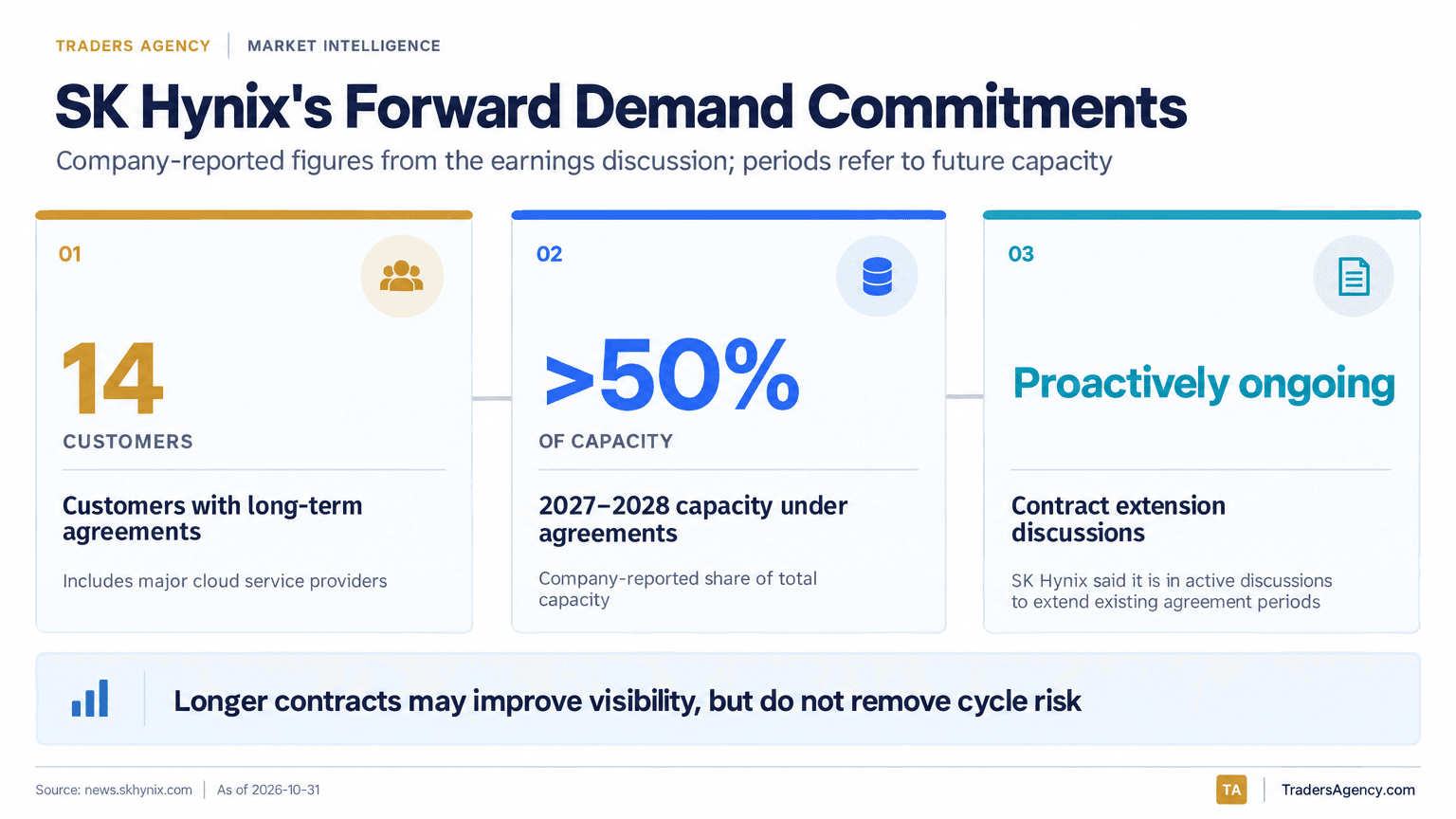
According to the company, it now has long-term agreements with 14 customers, including major cloud service providers, and those agreements cover more than 50% of its total production capacity for 2027 and 2028. That is a meaningful shift for an industry historically exposed to sudden demand swings, since it locks in a large share of future output ahead of time rather than leaving it to be sold as conditions change.
The obvious follow-up question is what happens once those agreements expire. Multi-year contracts can smooth near-term volatility, but they do not eliminate the underlying cyclicality of memory demand, they simply push the renewal risk further out on the calendar. If AI infrastructure spending cools by the time these deals come up for renewal, customers could still pull back or renegotiate terms, which is why this visibility should be read as a buffer against volatility rather than a guarantee against it.
Custom HBM and Capacity Expansion Complicate the Oversupply Debate
SK Hynix also described a shift toward custom high-bandwidth memory, chips optimized for an individual customer's system and workload rather than built as interchangeable, off-the-shelf parts. That mirrors a broader trend in AI hardware, where companies increasingly work with chip designers on application-specific products tailored to their own infrastructure, rather than relying solely on general-purpose components.
From an investment standpoint, custom and specification-driven memory is harder to resell into the open market if a single customer's plans change, which cuts both ways. It can deepen customer relationships and support longer contract terms, but it can also mean more concentrated exposure to the fortunes of whichever companies are doing the customizing.
Separately, the company confirmed that capital expenditures are expected to rise significantly in 2027 compared with 2026, tied to its Yongin Phase 1 facility entering full-scale operation and growing momentum in both domestic and overseas infrastructure investment. That is the detail that tempers the bullish framing: more capacity is coming online at the same time management is arguing that capacity additions will not simply translate into commodity oversupply. Investors weighing the long-term agreement story should keep both facts in view, since rising investment is the traditional precursor to the very gluts these contracts are meant to avoid.
AI Demand Diversification: More Than a Few Hyperscalers?
A second pillar of SK Hynix's bullish case is that AI infrastructure spending is no longer concentrated in a handful of hyperscale cloud providers. The company pointed to demand emerging from sovereign AI programs, non-technology companies building their own AI infrastructure, and a shift toward more multi-site, small and mid-sized data center deployments designed to bring power and capacity online faster than a handful of mega-facilities could.
That diversification argument matters for risk assessment. If AI-related memory demand depended on just one or two buyers slowing their spending, a single customer's budget cut could ripple through the entire sector. A broader base of demand, spanning multiple hyperscalers, sovereign initiatives and enterprise buyers, would in theory make memory demand less fragile to any one company's decisions. It is worth noting this diversification narrative comes from the company's own characterization of its customer base and should be treated as management's interpretation of the market rather than an independently audited breakdown of buyer concentration.
Want expert trading insights delivered daily?
Join thousands of traders who rely on Traders Agency for market analysis and trade ideas.
Join Traders AgencyNAND and the Quiet Expansion of Storage Demand
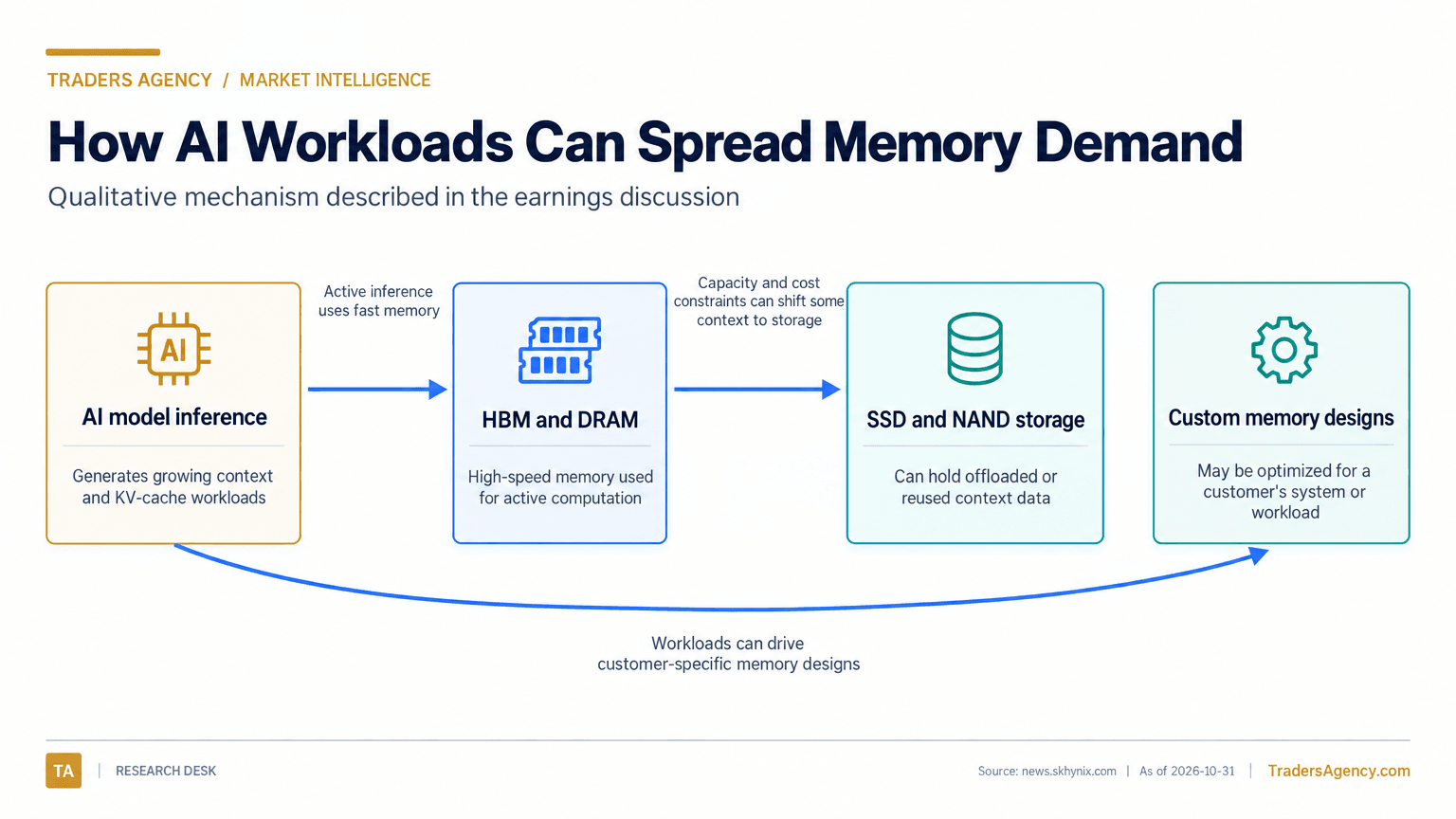
Beyond DRAM and high-bandwidth memory, SK Hynix also pointed to NAND-based storage as a growing piece of the AI demand story. The underlying mechanism described in the earnings discussion is straightforward: as AI inference workloads generate larger context windows and reuse data across sessions, some of that information may be too costly or too capacity-constrained to keep entirely in fast memory like HBM or DRAM. Shifting part of that workload to SSD-based storage offers a cheaper, if slower, alternative.
If that pattern holds at scale, it would give memory makers a second demand pathway tied to AI growth, one less dependent on the same high-bandwidth memory products driving most of the current enthusiasm. The specific scale of that shift, and how it plays out across different AI system designs, remains dependent on software architecture and deployment choices that are still evolving, so this should be treated as a plausible trend rather than a quantified forecast.
Capital Spending, Cash Flow and the Valuation Question
SK Hynix has also signaled a capital-return framework tied to free cash flow, saying it plans to return up to 50% of free cash flow to shareholders while continuing to fund expansion, rather than committing to an unconditional fixed payout of that amount every year. That framing matters because it gives the company flexibility to prioritize reinvestment if AI-driven demand continues, while still offering a path to returning cash if growth moderates.
Materials accompanying the earnings discussion also walked through a longer-term free cash flow outlook extending toward 2028, suggesting cash generation could continue to outpace rising capital spending, though these are forward projections rather than reported historical results and should be read as illustrative rather than confirmed outcomes. The discussion additionally included an illustrative valuation exercise, converting Korean-won earnings estimates into an ADR framework and applying several years of forward growth assumptions, concluding that shares appeared inexpensive relative to projected growth. That calculation depends on currency conversion assumptions, analyst forecasts and the accuracy of a multi-year earnings path, including an assumed down year within the forecast window, so it functions as a scenario for investors to weigh rather than a verified valuation finding.
What Traders Agency Analysts Are Watching
The combination here is genuinely unusual for the memory sector: expanding long-term contracts, product customization and a broader AI customer base on one side, against rising capital expenditure and the sector's long history of overbuilding on the other. SK Hynix's own disclosures support the demand-visibility argument, but management is also the party with the clearest incentive to downplay oversupply risk tied to its own expansion plans.
Traders Agency analysts will be watching how much of that long-term agreement coverage survives contract renewals as 2027 and 2028 approach, whether capital spending growth stays proportional to confirmed demand rather than speculative capacity, and whether NAND's role in AI inference storage develops into a measurable revenue driver or remains a secondary narrative. The bullish case is well supported by the company's own numbers, but the memory cycle has disappointed optimists before, and that history is reason enough to treat this as a promising setup rather than a settled outcome.
Want expert trading insights delivered daily?
Join thousands of traders who rely on Traders Agency for market analysis and trade ideas.
Join Traders AgencyDISCLAIMER: Traders Agency does not offer financial advice. The information provided is for educational purposes only and should not be considered financial advice. Traders Agency is not responsible for any financial losses or consequences resulting from the use of the information provided. Trading carries inherent risks and may not be suitable for all individuals. You are advised to conduct your own research and seek personalized advice before making any investment decisions, recognizing the potential risks and rewards involved.
See more from Traders Agency on Google
Make us a preferred source and our market analysis will appear more prominently in your Google Search, Top Stories, and AI results.
Add to Preferred Sources