
The Bank of England's Monetary Policy Committee voted 6-3 on September 16 to leave Bank Rate unchanged at 3.75%, resisting pressure to follow other major central banks higher even as UK inflation climbed to 3.1% in August, its first reading above 3% since March. Three MPC members pushed for an immediate quarter-point increase to 4%, and Governor Andrew Bailey warned that a hike is becoming more likely the longer an energy-driven price shock persists, according to CNBC.
The Vote and the Dissents
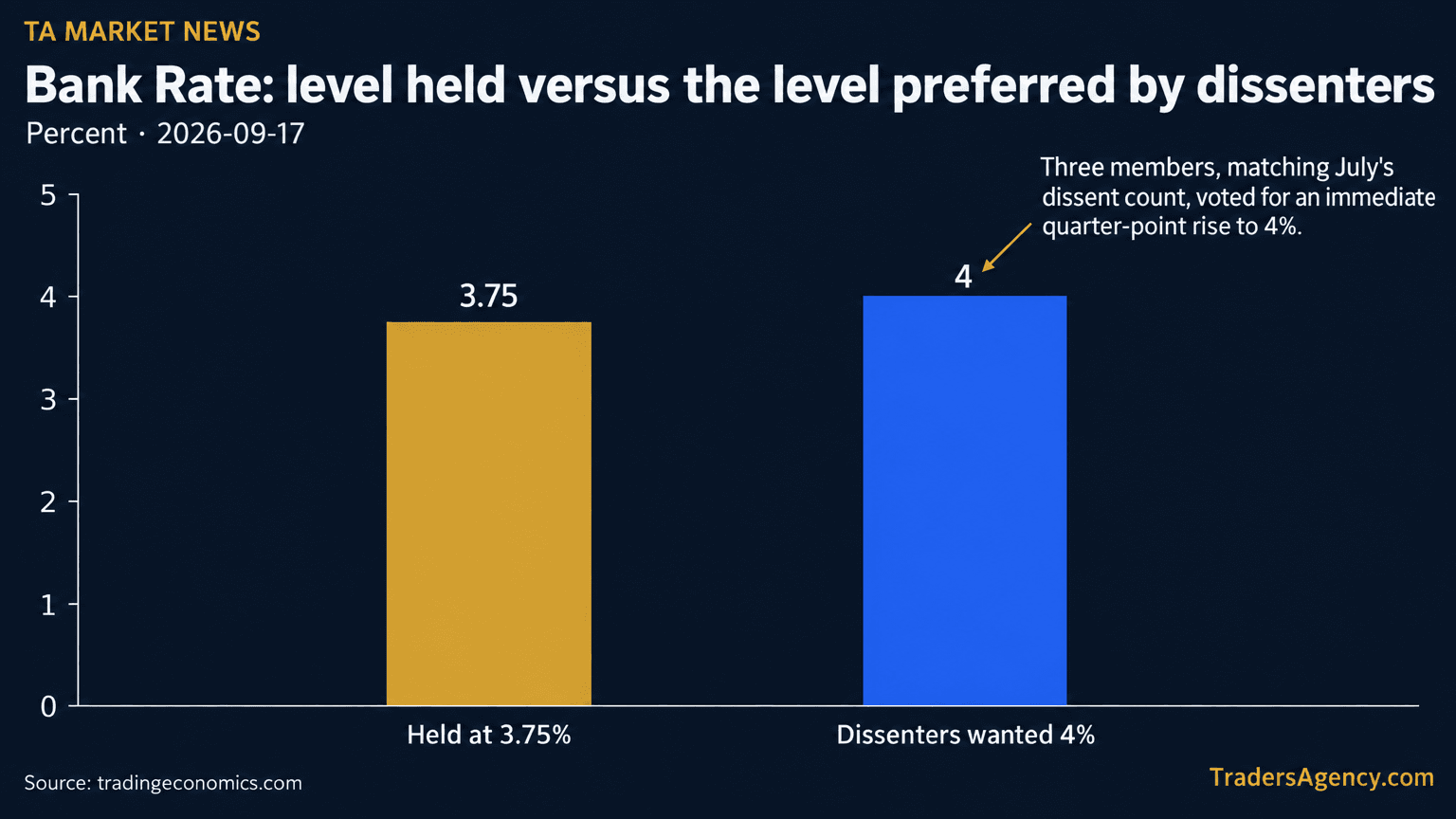
The 6-3 split matched the dissent count from the Bank's July meeting, according to Trading Economics' summary of the decision. The three members who voted for tightening set out distinct reasoning. Catherine L. Mann argued that upside inflation risks had increased since July, pointing to the Bank's own short-term forecast showing CPI rising above 4% in early 2027, and said that "raising Bank Rate is a better risk-management strategy when faced with uncertainty about inflation dynamics and second-round effects," per CNBC's reporting. Megan Greene cited uncertainty over second-round effects from the Iran war, AI-related supply constraints and the El Niño climate event as inflationary risks. Huw Pill argued an immediate move would have sent a "clear signal of the MPC's commitment to achieving its price stability mandate amidst the fog of geopolitical conflict and data noise," adding that acting decisively would head off inflationary pressures "rather having to reverse them once they become ingrained."
The gap between the rate the majority held (3.75%) and the level the dissenters preferred (4%) is 0.25 percentage points, leaving the held rate roughly 6.25% below the preferred level in relative terms (our calculation: 3.75 minus 4, divided by 4). Interpretation: that is a modest numerical distance, but it reflects a real split on the Committee over how long the current inflation overshoot will run.
Inflation Pressures and the Energy Shock
The MPC, in a decision summary reported by Trading Economics, attributed the rise in CPI inflation to 3.1% in August largely to prolonged conflict in the Middle East, which has pushed crude and refined energy prices higher and increased volatility. The Office for National Statistics said the spike was largely driven by motor fuel costs, which surged 23% year-on-year, per CNBC. The Committee said further increases in inflation are expected in coming quarters, though it noted only limited evidence so far of significant second-round effects on wages and prices, a risk that "could increase if energy costs remain elevated," per the same summary.
Bailey framed the policy calculus directly: "So far, higher global energy costs have had a limited effect on price and wage setting in the U.K. But the longer this volatility persists, the bigger the impact it will have on inflation, and the more likely it is we will need to raise Bank Rate to ensure that inflation falls back to our 2% target," he said in a statement reported by CNBC.
At 3.1%, inflation sits 1.1 percentage points above the Bank's 2% target, a gap of 55% in relative terms (our calculation: 3.1 minus 2, divided by 2), based on the figure reported by ABC News. ABC News also reported that many economists expect inflation to rise further from that level in coming months as households face another increase in domestic energy bills beginning in October, and that the market consensus is for a rate rise at either the November or December meeting.
Market Reaction
Gilt yields fell immediately after the decision, according to CNBC, with the benchmark 10-year yield down 4 basis points to 5.2473% and the 30-year yield down about 7 basis points to 5.7932%. That left the 10-year yield 0.5459 percentage points, or about 9.4%, below the 30-year (our calculation: 5.2473 minus 5.7932, divided by 5.7932). CNBC also reported that Britain has the highest borrowing costs in the G7, with 20- and 30-year gilt yields approaching the 6% mark amid broader global inflation concerns and fiscal worries. Ahead of the meeting, markets had priced a 76% chance of a hold, according to LSEG data cited by CNBC, with a hike of at least 25 basis points widely anticipated at the Bank's November meeting.
Analysts characterized the hold as the Bank buying time rather than signaling comfort. Scott Gardner of J.P. Morgan Personal Investing noted, per CNBC, that despite headline inflation creeping up over the summer, the labour market continues to soften while core and services inflation have been relatively resilient since the Middle East conflict began, and that the UK economy has largely been insulated from the conflict aside from higher energy bills. Neil Birrell, chief investment officer at Premier Miton, said in a note cited by CNBC that "the Bank seems to be more relaxed on inflation risks than their international counterparts, although the markets are setting borrowing costs at present anyway."
Diverging From Global Peers
The hold puts the Bank of England out of step with other major central banks this week. CNBC reported that the Federal Reserve announced a quarter-point hike on Wednesday, its first since 2023, while the European Central Bank delivered its second increase of the year last week after raising rates in June for the first time in three years.
On the balance sheet, Trading Economics reported that the MPC unanimously agreed to reduce its stock of government bond purchases to zero through a multi-year programme, unwinding holdings at an average annual pace of £46 billion through 2034. The Bank has not changed Bank Rate since December, when it cut by 25 basis points, according to CNBC; UK rates had been trending down from a 15-year high of 5.25% until the US and Israel attacked Iran in late February, after which the Strait of Hormuz has been largely closed to traffic, per ABC News.
Bottom Line
The Bank of England chose to wait rather than follow the Federal Reserve and the European Central Bank, holding Bank Rate at 3.75% while three of the nine MPC members pushed for an immediate hike. With inflation at 3.1% and further increases expected as domestic energy bills rise from October, per ABC News, the Committee has effectively put markets on notice that a rate rise — most likely in November or December, according to CNBC and ABC News — hinges on how long the energy-driven price shock persists and whether it feeds into wages and underlying prices.
DISCLAIMER: Traders Agency does not offer financial advice. The information provided is for educational purposes only and should not be considered financial advice. Traders Agency is not responsible for any financial losses or consequences resulting from the use of the information provided. Trading carries inherent risks and may not be suitable for all individuals. You are advised to conduct your own research and seek personalized advice before making any investment decisions, recognizing the potential risks and rewards involved.
- CNBC Top News: Bank of England defies Fed’s rate-hike lead, leaving rates unchanged · accessed Sep 17, 2026
- www.bankofengland.co.uk: Interest rates and Bank Rate: our latest decision · accessed Sep 17, 2026
- www.bbc.com: Interest rates held at 3.75% as Bank of England warns Iran war 'shock' will push up inflation · accessed Sep 17, 2026
- abcnews.com: Bank of England expected to keep interest rates unchanged despite rising inflation · accessed Sep 17, 2026
- tradingeconomics.com: United Kingdom Interest Rate · accessed Sep 17, 2026
- www.bankofengland.co.uk: Inflation and the 2% target · accessed Sep 17, 2026
- www.lbc.co.uk: Bank of England holds interest rates at 3.75% despite inflation fears · accessed Sep 17, 2026
- www.bankofengland.co.uk: Bank Rate maintained at 3.75% - June 2026 Monetary Policy Summary and Minutes · accessed Sep 17, 2026
See more from Traders Agency on Google
Make us a preferred source and our market analysis will appear more prominently in your Google Search, Top Stories, and AI results.
Add to Preferred Sources