
Lucid Group and European shared-mobility platform Bolt announced a strategic partnership on Sept. 17, 2026, to develop and deploy autonomous mobility services across Europe. Under the agreement, Bolt aims to deploy at least 25,000 fully autonomous Lucid vehicles across multiple European cities and countries, built on Lucid's upcoming Midsize platform and Nvidia's Hyperion autonomous-vehicle reference architecture, according to Lucid's announcement.
What the companies announced

The partnership calls for Lucid and Bolt to work together from the product-development stage on an autonomous driving system (ADS)-ready vehicle platform designed for SAE Level 4 autonomous mobility, per the release. The vehicles are expected to use Nvidia Hyperion, described in the announcement as a production-ready autonomous-vehicle reference architecture combining high-performance compute with a standardized sensor suite. The release does not name a specific autonomous-driving software supplier, stating only that Lucid and Bolt will work with unnamed autonomous-driving technology partners as well as European regulators and policymakers to support what it calls the safe, secure and scalable introduction of autonomous mobility services across the region.
Bolt intends to own and operate the fleet through a dedicated unit, Bolt Autonomous Driving Solutions, which will build the fleet infrastructure, operating systems and city partnerships needed to deploy the vehicles at scale. On Lucid's side, the program will be led by the newly established Lucid Technologies unit, which brings together the company's artificial intelligence, ADAS, autonomy and broader digital functions under one structure, according to the release.
Lucid CEO Silvio Napoli said shared autonomous mobility offers an opportunity to extend the company's technology beyond consumer vehicles, calling Bolt's reach and operating expertise an ideal fit to scale autonomous mobility across Europe. Bolt founder and CEO Markus Villig said autonomous driving in Europe requires data, software, vehicles and operations to work as one system built for European roads and regulation, and pointed to Bolt's data and more than a decade of operating experience across over 850 cities as the basis for co-designing the vehicle and software with Lucid, per the same release.
Scale of the target, and what remains unconfirmed
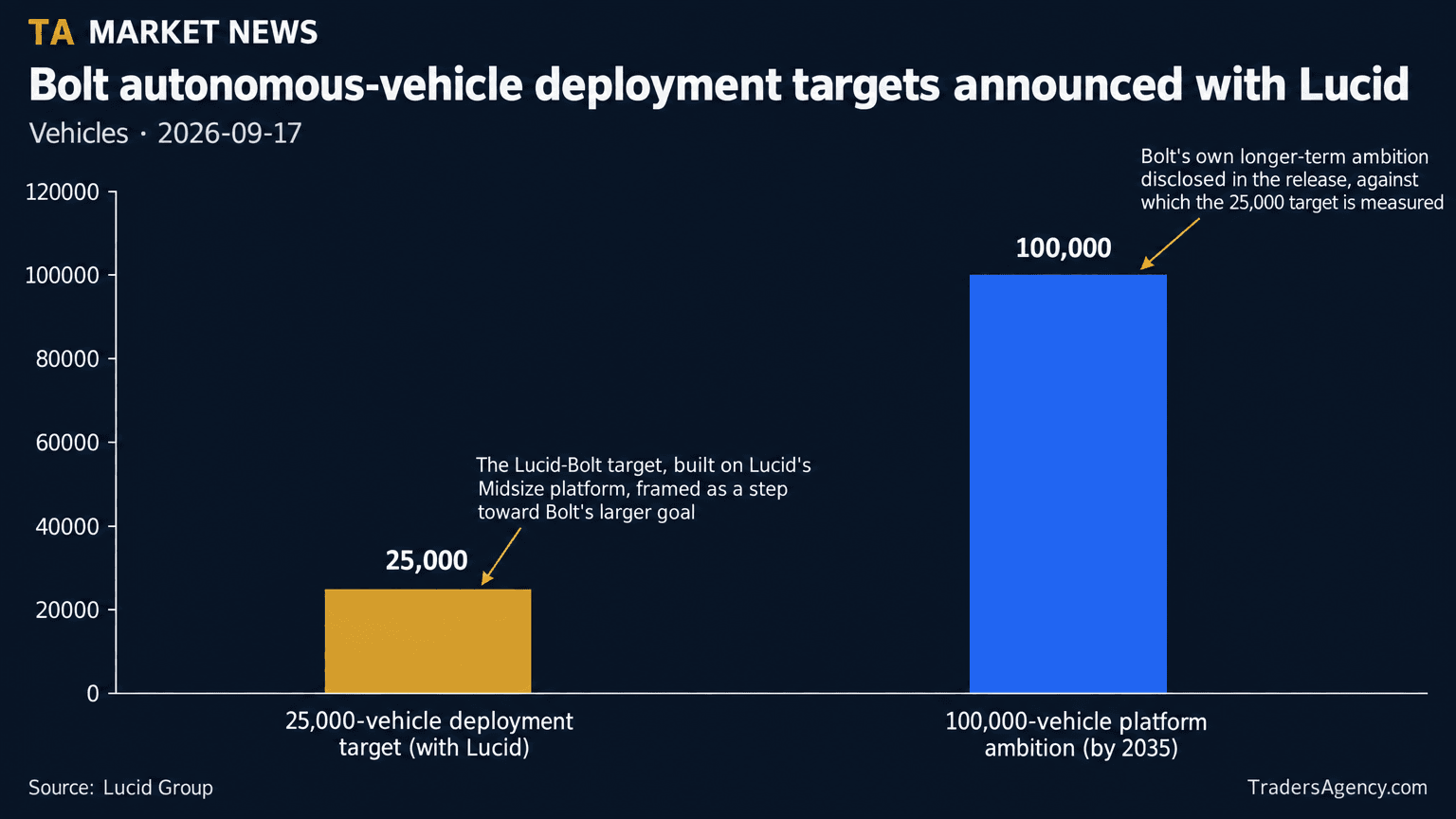
Bolt's own scale is substantial: the company operates in over 50 countries and 850 cities, serves more than 200 million customers, and has more than 4.5 million drivers and couriers using its platform, according to the announcement. The 25,000-vehicle target is framed in the release as a step toward Bolt's broader ambition of putting 100,000 autonomous vehicles on its platform by 2035. Using those two disclosed figures, the initial deployment target equals 25% of the 2035 ambition (25,000 ÷ 100,000 × 100), an arithmetic comparison of the companies' own numbers rather than an independent projection.
The announcement does not disclose a purchase order, minimum volume commitment, prepayment or other financial terms attached to the 25,000-vehicle target. Lucid's forward-looking-statements disclosure in the release explicitly lists “Bolt's targeted deployment of autonomous vehicles on its platform” as a forward-looking statement, cautioning that such statements are not intended to serve as, and must not be relied on as, a guarantee, assurance or definitive statement of fact or probability. In other words, by Lucid's own characterization, the 25,000 figure is a target rather than a contracted or funded order.
Timeline details are similarly limited in the release: it does not specify a first-market launch date, a production start for Lucid's Midsize platform, or which European regulatory approvals the partners still need to secure for Level 4 operation beyond the general statement that they intend to work with regulators and policymakers.
Lucid's existing autonomy footprint

The Bolt partnership adds a second geography to Lucid's autonomy push. In the U.S., Lucid already has a robotaxi program with Uber and Nuro that was in active testing and validation as of its second-quarter 2026 results, supported by a fleet of nearly 100 vehicles across the San Francisco Bay Area and Houston, with production-validation Lucid Gravity units already delivered to Nuro, according to Lucid's second-quarter 2026 results release. That same release showed Lucid producing 4,774 vehicles and delivering 3,953 in the quarter, up 24% and 19% year over year respectively, though the company said production was intentionally reduced to lower inventory and free up cash. Subtracting those two disclosed figures (4,774 − 3,953) leaves an 821-vehicle gap between production and deliveries for the quarter. Neither release ties these production figures to the new Bolt program or specifies capital spending or revenue-recognition plans for the European deployment.
The wider European robotaxi landscape
Bolt's move with Lucid follows an earlier autonomy partnership the company signed with Chinese robotaxi operator Pony.ai, set to begin on Bolt's ride-hailing platform in 2026 and expand across both EU and non-EU markets, according to reporting from Eleport. That indicates Bolt is pursuing autonomy through more than one technology supplier rather than relying solely on Lucid and Nvidia Hyperion.
Coverage of the broader sector from Driving Vision News notes that Europe's robotaxi market remains behind the U.S. and China in commercial driverless fleet size, with much of 2026's activity still consisting of supervised trials rather than fully driverless service. In Zagreb, for example, riders can currently request an autonomous vehicle through Uber using Pony.ai technology and a fleet operated by Verne, but a licensed operator still monitors the vehicle from behind the wheel, so the service is not yet driverless, per that outlet's reporting. Separate commentary published by Yahoo Finance cautions that the revenue model, regulatory environment and consumer appetite for robotaxi services remain uncertain across the sector, while Driving Vision News adds that regulation, local fleet partners and city-level operations will ultimately decide which announcements become actual public services.
Bottom Line
Lucid and Bolt have set a public target of at least 25,000 autonomous vehicles across Europe, built around Lucid's Midsize platform and Nvidia Hyperion, but the companies' own release frames that number as a forward-looking target rather than a signed order, with no disclosed purchase commitment, financial terms, launch date or confirmed regulatory pathway. Readers weighing the announcement's significance should note that it sits alongside Lucid's existing, further-along U.S. robotaxi testing with Uber and Nuro, and within a European market where Driving Vision News reports that most current robotaxi rides still require a licensed human operator on board.
DISCLAIMER: Traders Agency does not offer financial advice. The information provided is for educational purposes only and should not be considered financial advice. Traders Agency is not responsible for any financial losses or consequences resulting from the use of the information provided. Trading carries inherent risks and may not be suitable for all individuals. You are advised to conduct your own research and seek personalized advice before making any investment decisions, recognizing the potential risks and rewards involved.
- Lucid Group: Lucid and Bolt Partner to Develop and Deploy Autonomous Mobility at Scale Across Europe · accessed Sep 17, 2026
- eleport.com: The Electric Robotaxi Revolution Is Arriving In Europe In 2026, Here's When And Where · accessed Sep 17, 2026
- www.youtube.com: - YouTube · accessed Sep 17, 2026
- www.investors.com: Tesla Won't Add Cars To Robotaxi Fleet Until Cybercab Ready, JPMorgan · accessed Sep 17, 2026
- www.youtube.com: - YouTube · accessed Sep 17, 2026
- finance.yahoo.com: 2026 will be the year of the robotaxi · accessed Sep 17, 2026
- www.drivingvisionnews.com: Europe's robotaxi year is taking shape · accessed Sep 17, 2026
- www.prnewswire.com: Lucid Announces Operational Reset and Second Quarter 2026 Results · accessed Sep 17, 2026
See more from Traders Agency on Google
Make us a preferred source and our market analysis will appear more prominently in your Google Search, Top Stories, and AI results.
Add to Preferred Sources