Huawei told attendees at its Huawei Connect conference in Shanghai on Sept 17, 2026 that it is accelerating the rollout of its flagship Ascend 960DT AI chip and that Chinese demand for its AI computing hardware already exceeds what it can produce, a constraint the company says is limiting how aggressively it can sell overseas, according to The Edge Malaysia's carriage of the Reuters dispatch and Business Times.
Roadmap Pulled Forward
Rotating chairman Wang Tao said the Ascend 960DT chip, originally slated for late 2027, will now be ready in the first quarter of 2027, three quarters earlier than previously planned, according to The Edge Malaysia's report of the Reuters dispatch and Business Times. A companion variant, the 960PR, is now due in the third quarter of 2027, one quarter ahead of its earlier schedule. Huawei also outlined an annual cadence beyond that, with the Ascend 970 due in 2028 and the Ascend 980 in 2029, and said each new generation is expected to roughly double the compute of its predecessor, per Business Times and WTOP's account of the event.
Alongside the chips, Huawei unveiled a computing architecture it calls Peerium, designed eventually to let as many as 1 million processors operate together as a single system, with its UnifiedBus protocol connecting processors, memory, storage and networking. Huawei said the new Ascend 960 supernode would connect as many as 4,096 AI processors, per The Edge Malaysia's carriage of the Reuters dispatch. Bloomberg reported, as relayed by Business Times, that Huawei's SuperPod connectivity technology will soon allow clusters of as many as 100,000 Ascend chips, enabling faster data transmission via UnifiedBus. Huawei justified that scaling push by saying clusters of about 100,000 chips have become standard for training some of the largest AI models, and that communication between machines can consume more than 40% of training time in conventional server systems, according to the same report.
Demand Outstrips Supply, Limiting Overseas Sales
The most consequential line from the event concerned capacity rather than performance. Rotating chairman Eric Xu told reporters at the conference that Huawei cannot produce enough artificial-intelligence computing equipment to meet demand in China and is therefore limiting overseas sales, according to The Edge Malaysia's carriage of the Reuters dispatch. "Since we don't have enough capacity to even satisfy the demand in China, we don't have a plan to expand into the international market in a fully-fledged way," Xu said, adding that Huawei supplies some countries where demand is particularly strong but that volumes remain limited. Bloomberg has reported that the company is exploring foreign markets including Malaysia and Egypt, per Business Times.
That tightness is already showing up in pricing. Business Times reported that Huawei recently raised pricing for the Ascend 950DT chip by 60%, citing tight component supply in communications with customers. The same report said DeepSeek plans to deploy at least 160,000 Ascend 950DT chips at a data centre it is building in Inner Mongolia.
Xu also said reliable data on Nvidia's share of China's AI chip market was difficult to obtain, but added: "I think Ascend market share should be bigger than Nvidia's." Huawei did not provide data to support that estimate, The Edge Malaysia reported, which also noted that Nvidia retains a major advantage in software through its widely used CUDA platform and that the US chipmaker did not immediately respond to a request for comment.
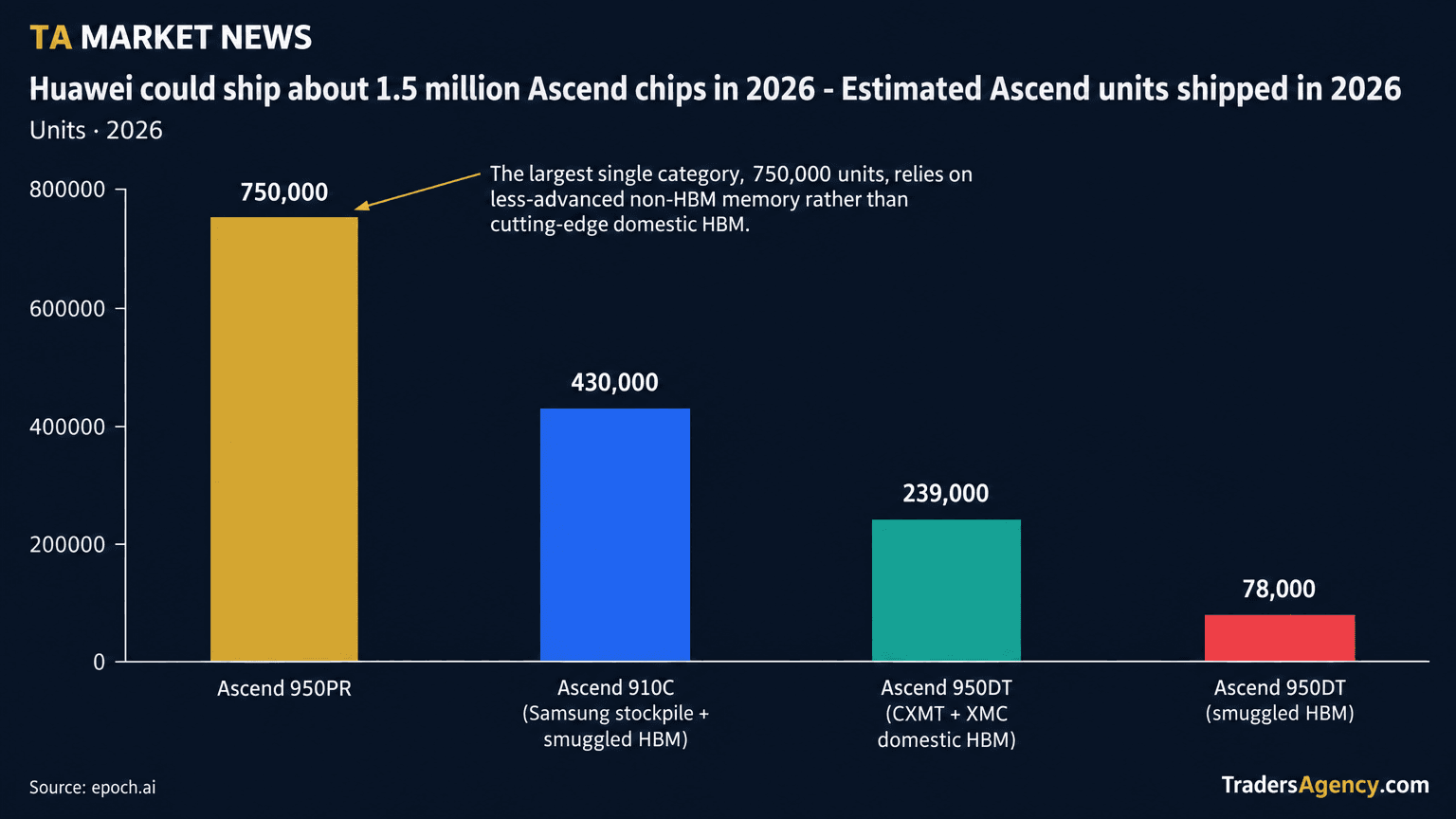
Several questions went unanswered. Per Business Times, Wang did not address how Huawei will navigate manufacturing bottlenecks and ramp up production to meet demand, and spent little time discussing the capabilities of the new chips marketed for training. Independent research firm Epoch AI, in a Sept 4, 2026 analysis, estimated Huawei would produce 1.5 million AI chip units in 2026 against 5.9 million for Nvidia — a gap of 4.4 million units, or roughly 74.6% below Nvidia (1.5 - 5.9 = -4.4; (1.5 - 5.9) / 5.9 x 100 = -74.6%) — and put Huawei's 2026 AI compute output at less than 4% of Nvidia's. Epoch AI identified high-bandwidth memory as the binding constraint, estimating that only about 240,000 of those 1.5 million units use domestic HBM while about 750,000 use less advanced non-HBM memory, with CXMT and the smaller XMC only beginning to ramp HBM production. On the foundry side, Epoch AI noted the 950 and 960 compute dies are fabricated on SMIC's N+3 process, and that export controls on advanced lithography leave SMIC unable to print transistors denser than a 5 nm-equivalent process until at least the end of the decade.
Interpretation, tied to the evidence above: a three-quarter pull-forward on the 960DT changes the roadmap date, not the supply picture Huawei itself describes. With Xu saying domestic demand cannot be met, Huawei repricing the 950DT 60% higher on component tightness, and Epoch AI pointing to HBM and SMIC lithography limits, an earlier launch date is best read as a competitive signal rather than evidence of near-term volume relief. Morgan Stanley analyst Charlie Chan wrote in a recent research note that "System-level competitiveness matters more than ever" and that "The effective gap is narrowing through multi-die design, advanced packaging, rack-scale system architecture, optical networking, and software-hardware co-optimisation" — a framing that fits Huawei's emphasis on Peerium and large clusters over single-chip performance. George Chen of The Asia Group told WTOP the timing, "less than two weeks before President Xi Jinping's visit to Washington - underscores Beijing's confidence and ambition in technology and innovation"; WTOP reported a Trump-Xi meeting was expected in Washington on Sept 24.
Bottom Line
Huawei moved its flagship Ascend 960DT into the first quarter of 2027, three quarters earlier than planned, and extended an annual cadence through the Ascend 970 in 2028 and Ascend 980 in 2029, per The Edge Malaysia's carriage of the Reuters dispatch, Business Times and WTOP. But the company's own executives framed capacity, not silicon design, as the limiting factor: Xu said Huawei cannot meet Chinese demand and is holding back international expansion, and Business Times reported management left manufacturing bottlenecks and production ramp plans unaddressed. Nothing in the sourced material quantifies how much 960-series output Huawei can actually deliver in 2027.
DISCLAIMER: Traders Agency does not offer financial advice. The information provided is for educational purposes only and should not be considered financial advice. Traders Agency is not responsible for any financial losses or consequences resulting from the use of the information provided. Trading carries inherent risks and may not be suitable for all individuals. You are advised to conduct your own research and seek personalized advice before making any investment decisions, recognizing the potential risks and rewards involved.
- IEX, carrying Reuters reporting: China's Huawei says AI chip demand outstrips supply as it steps up Nvidia challenge · accessed Sep 17, 2026
- epoch.ai: Will Huawei catch up to Nvidia by 2030? · accessed Sep 17, 2026
- theedgemalaysia.com: China's Huawei says AI chip demand outstrips supply as it steps up Nvidia challenge · accessed Sep 17, 2026
- www.linkedin.com: The most important China tech news today is Huawei’s unveiling of its Ascend AI chip roadmap at the Full Connect Conference 2025. · accessed Sep 17, 2026
- www.businesstimes.com.sg: Huawei accelerates launch of new AI chip to take on Nvidia · accessed Sep 17, 2026
- asia.nikkei.com: Huawei debuts 11 AI-related chips in challenge to Nvidia, Intel, AMD · accessed Sep 17, 2026
- www.huawei.com: Newsroom - Huawei · accessed Sep 17, 2026
- wtop.com: Huawei unveils new chip technologies as Chinese firm steps up the AI race with Nvidia · accessed Sep 17, 2026
See more from Traders Agency on Google
Make us a preferred source and our market analysis will appear more prominently in your Google Search, Top Stories, and AI results.
Add to Preferred Sources