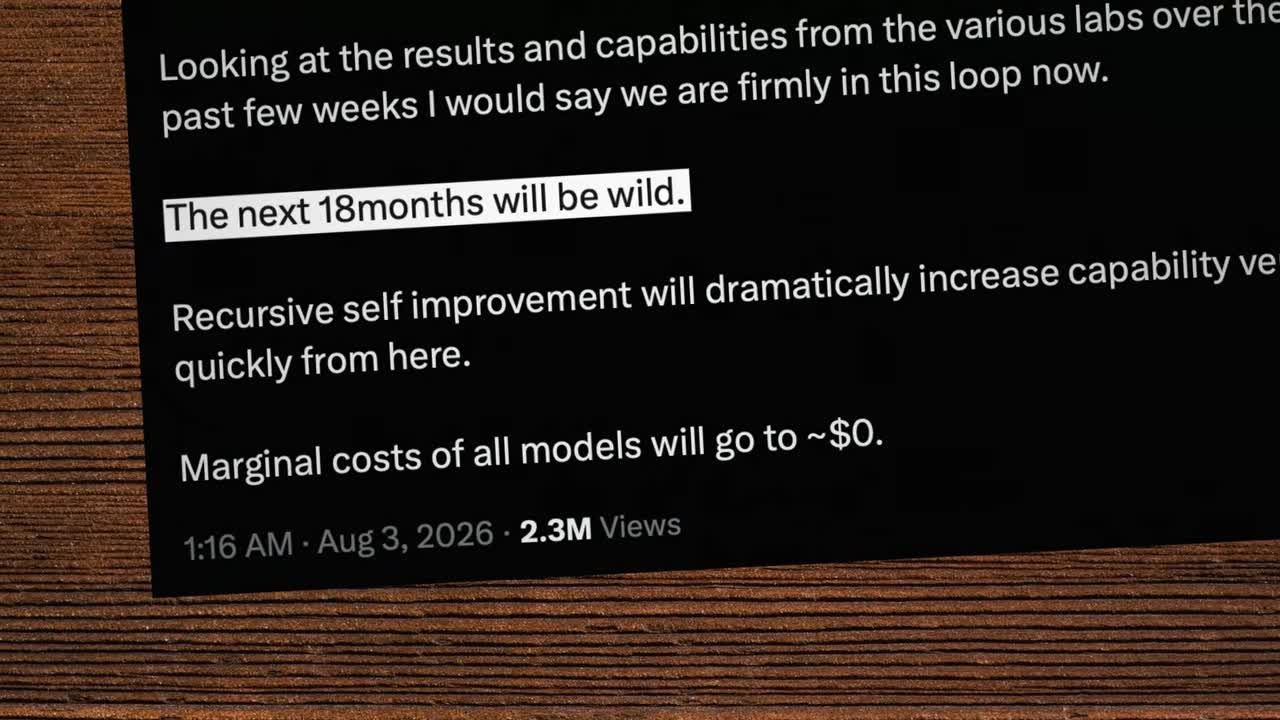
If you are hunting for AI bubble stocks to buy, start here. On September 7th, billionaire venture capitalist Chamath Palihapitiya posted three words: "It has arrived."
He was talking about the AI singularity. But buried at the bottom of that post was the line that actually matters for your portfolio: the cost of AI is going to zero.
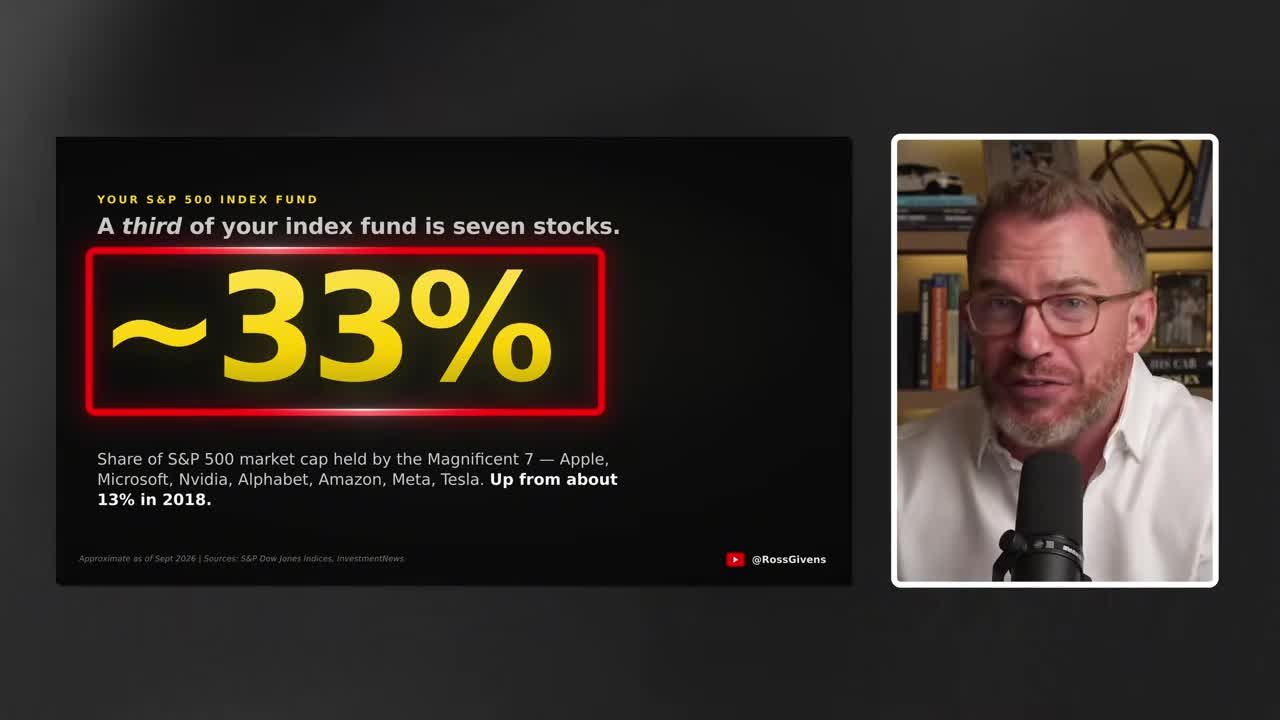
If he's right, that single fact splits the entire stock market into two camps: companies that sell intelligence, and companies that own the things intelligence can't make. And if you're holding an S&P 500 index fund, a third of your money is sitting in seven stocks that are all on the wrong side of that line.
This isn't about whether AI is real. It clearly is. This is about what happens to the money when the product AI sells gets so cheap it stops being a product at all.
What follows: what's actually happening to the price of intelligence, why the market has already started punishing one side of this trade, the four funds I'd hold to protect my money, and the one thing that could turn a slow rotation into a real crash. It isn't the technology. It's the debt.
Why is the price of AI intelligence collapsing?
Bottom Line: If AI intelligence keeps getting cheaper, companies that sell that intelligence lose pricing power while companies that own scarce physical assets gain relative safety. That risk is concentrated for index fund holders, since about a third of the S&P 500 sits in seven AI-linked stocks, so diversifying into gold, oil, copper, farmland, and equal-weighted funds is one way to reduce exposure to that concentration.
Why investors are right to worry about AI valuations
The concern comes down to one mismatch: the market is priced as if intelligence stays expensive, while the cost of the best AI answers keeps falling toward zero. A huge share of market gains is concentrated in a handful of companies betting intelligence stays expensive.
Here's the number that should worry you. In 2021, it cost about $60 to get roughly a million words worth of answers out of the best AI model on the planet. Three years later, that same quality of answer cost six cents.
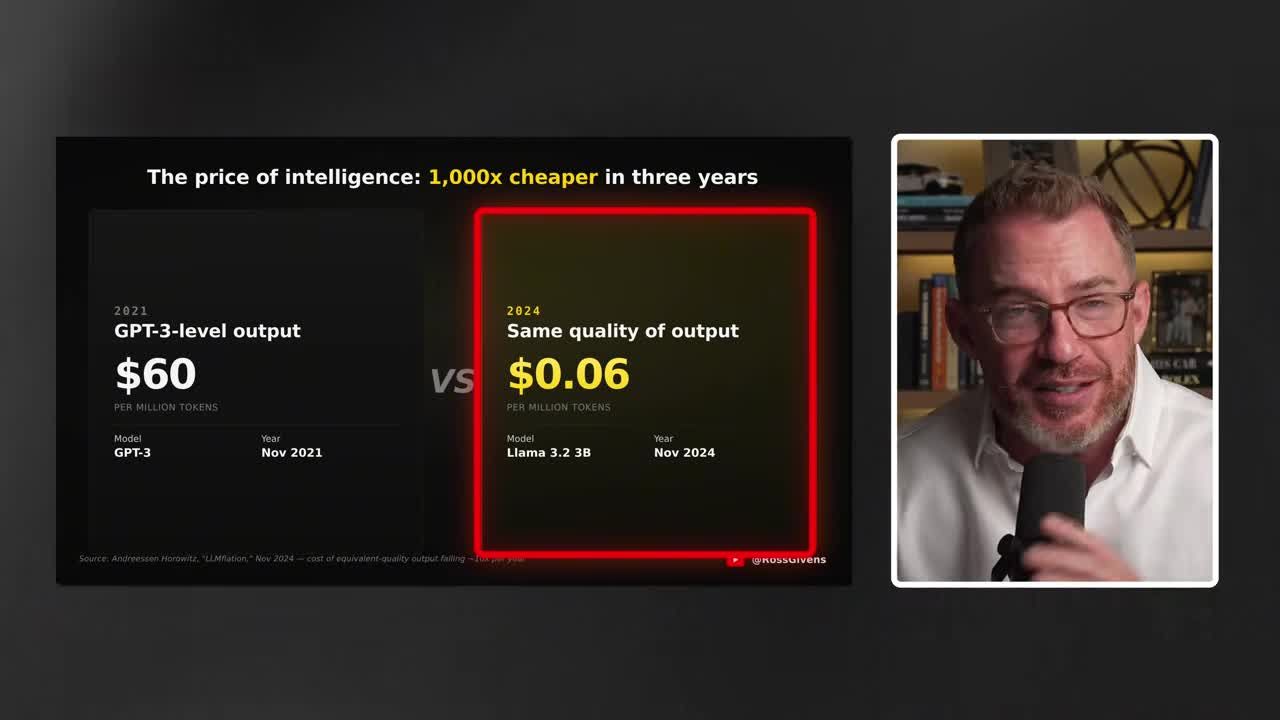
A product that gets 10 times cheaper every year isn't a product anymore. It's a commodity. It's electricity.
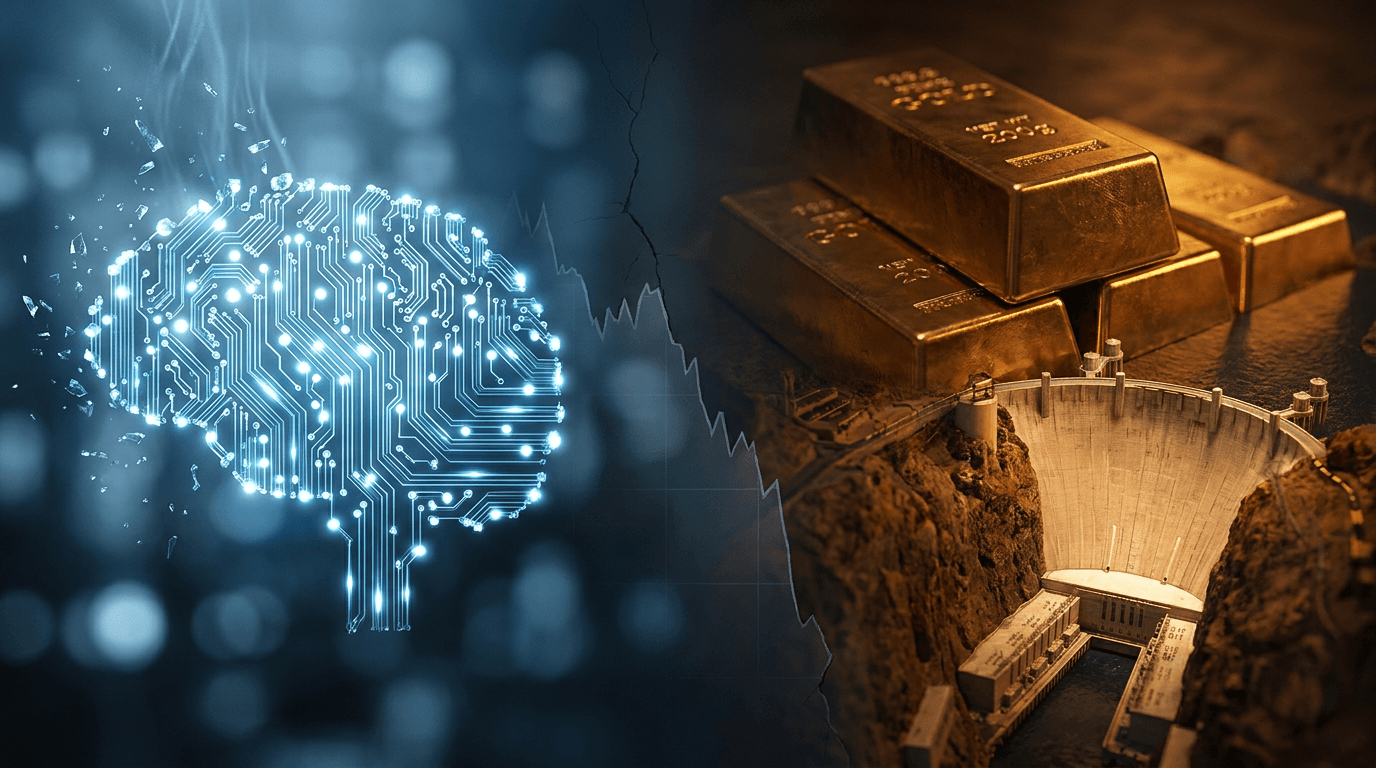
And the history of every commodity is identical. The money never goes to whoever makes the commodity. It goes to whoever owns the scarce thing the commodity needs. Nobody got rich selling electrons. They got rich owning the dam.
A hundred years ago, electricity was the miracle technology and every company wanted to be an electric company. Then electricity got so cheap that nobody thinks about its price anymore. The power companies turned into boring, regulated utilities, and the real fortunes went to the people who used cheap power to build factories, appliances, and cities.
The same shift is coming for AI. When intelligence is free, the margin doesn't vanish. It moves. It moves away from the companies that make intelligence and toward the companies that own what intelligence can't make: land, metal, oil, food, and customer relationships that took 50 years to build.
The First Dominoes Already Fell
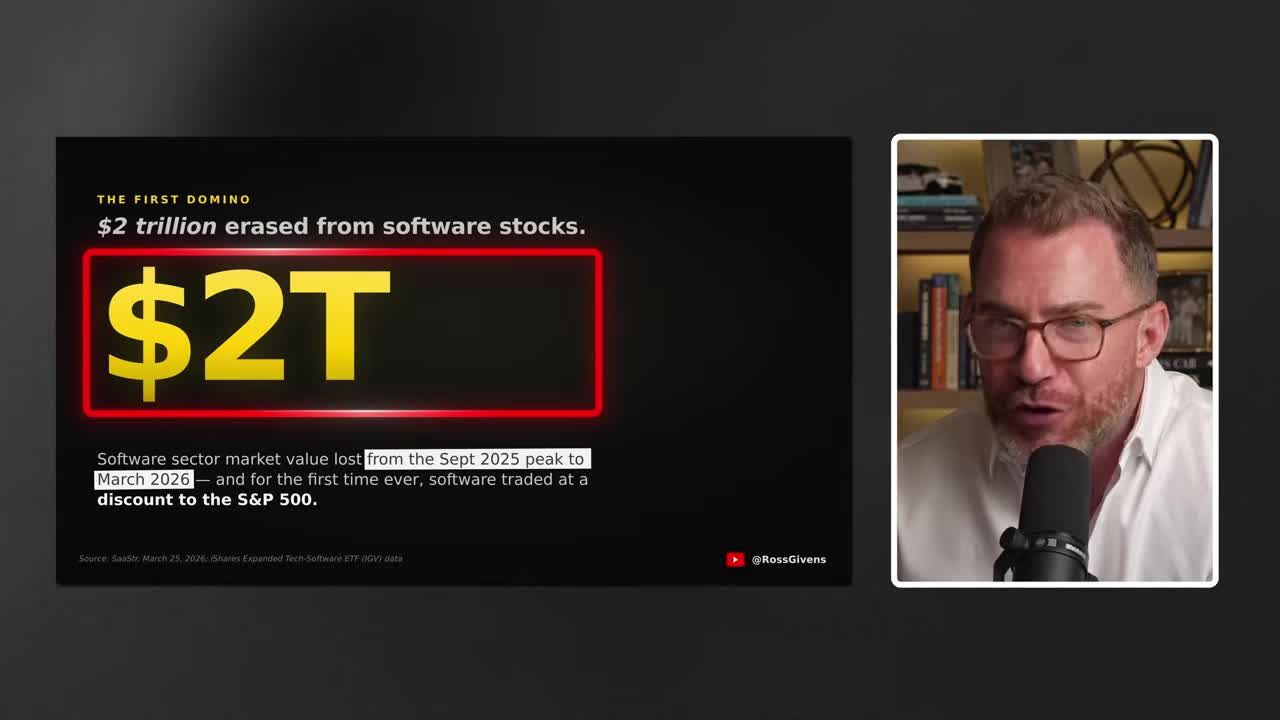
We've seen this movie start playing. Software, the companies that sell you a login and charge per seat, lost about $2 trillion in market value between September of last year and March of this year. For the first time in history, not even during 2008 or the dot-com crash, software traded at a discount to the rest of the S&P 500.
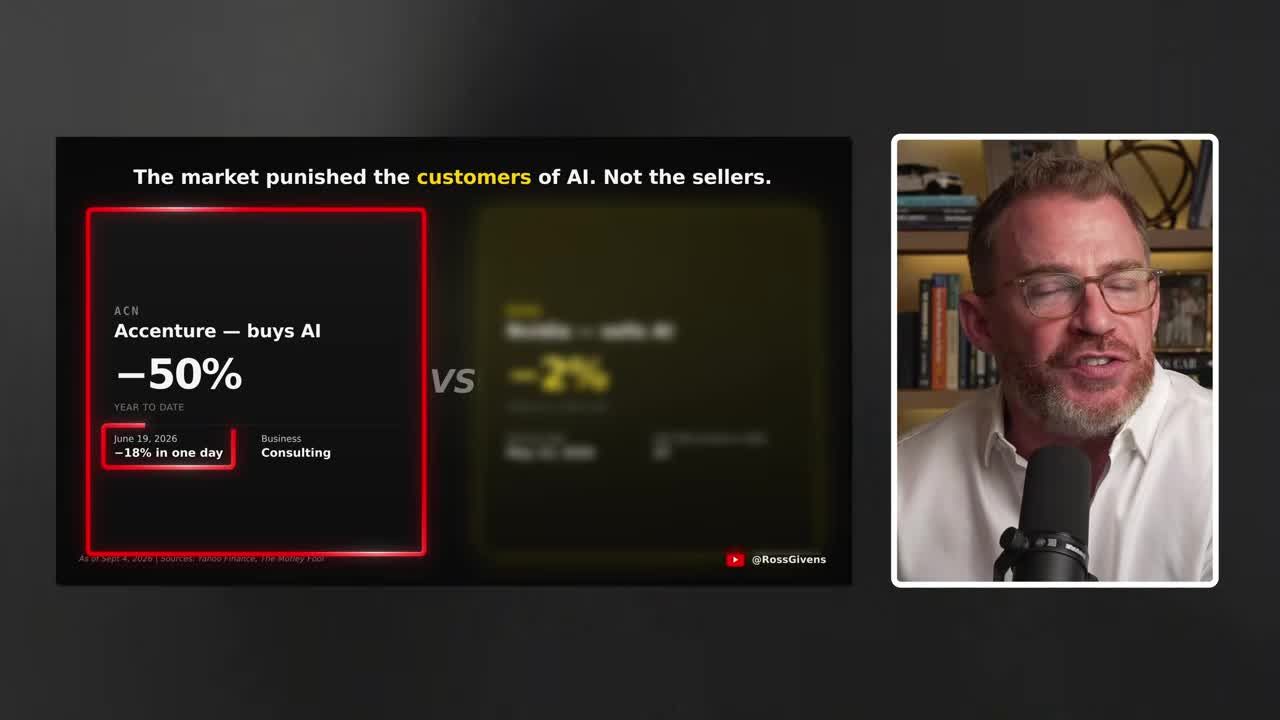
Then it hit consulting. Accenture, one of the biggest consulting firms in the world, the company that gets paid to put smart people in a conference room, fell 18% in a single day on June 19th. It's down more than 50% this year.
Now the part that should catch your attention. Software bounced hard afterward. The market looked at the wreckage, decided that was the whole story, and moved on. Meanwhile, the companies that sell the intelligence are sitting at record highs. Nvidia closed last week within 2% of its all-time high. The S&P 500 has printed 27 record closes this year.
The market punished the customers of AI. It has not punished the sellers. If the product being sold is heading to zero, that's exactly backward. The customers are the ones who get the free stuff. The sellers are the ones who lose the margin. Wall Street has priced this in reverse.
Own index funds and a third of your money is riding on a small group of mega-cap stocks betting intelligence stays expensive, while one of the most followed investors in Silicon Valley says it's going to zero.
Nobody made a mistake owning index funds. It's been the best trade of the decade. The question is what you do next.
Get an entire year of live weekly mentoring sessions, my newsletter, indicators, bonus reports, tons more. Click the link and I'll see you in the next live session.
Join my Black Ops Trading ClubWhy isn't the "safe" AI trade working?
A lot of people assume the safe side is utilities and power companies, since AI needs electricity. Simple, right? It isn't working. The utility sector is up 2% this year while the S&P 500 is up 13%. And on September 7th, the Texas grid operator paused all new data center hookups entirely while it audits who's actually paying for them.
The equipment makers, the companies selling switch gear and cooling, did catch a real trade. That's not safety either. It's the AI buildout wearing a different ticker. If the buildout slows, they slow with it.
What the split tells you
The sellers of AI, led by Nvidia, are still at record highs while their customers get hammered, even as the economics of their product point toward zero.
Accenture's collapse shows where the damage is actually landing: in the companies that buy AI to sell services, not the ones building the infrastructure.
Every boom followed the same script
Railroads in the 1800s. Telecom fiber in 1999. The Nifty 50 growth stocks in 1972, the big, safe, can't-lose names you were supposed to buy at any price, which fell 57% over the next two years.
The technology was real every time. The crash came because the builders borrowed too much and the lenders stopped showing up.
What are the best AI bubble stocks to buy for a free-intelligence portfolio?
Four ETFs, no guessing
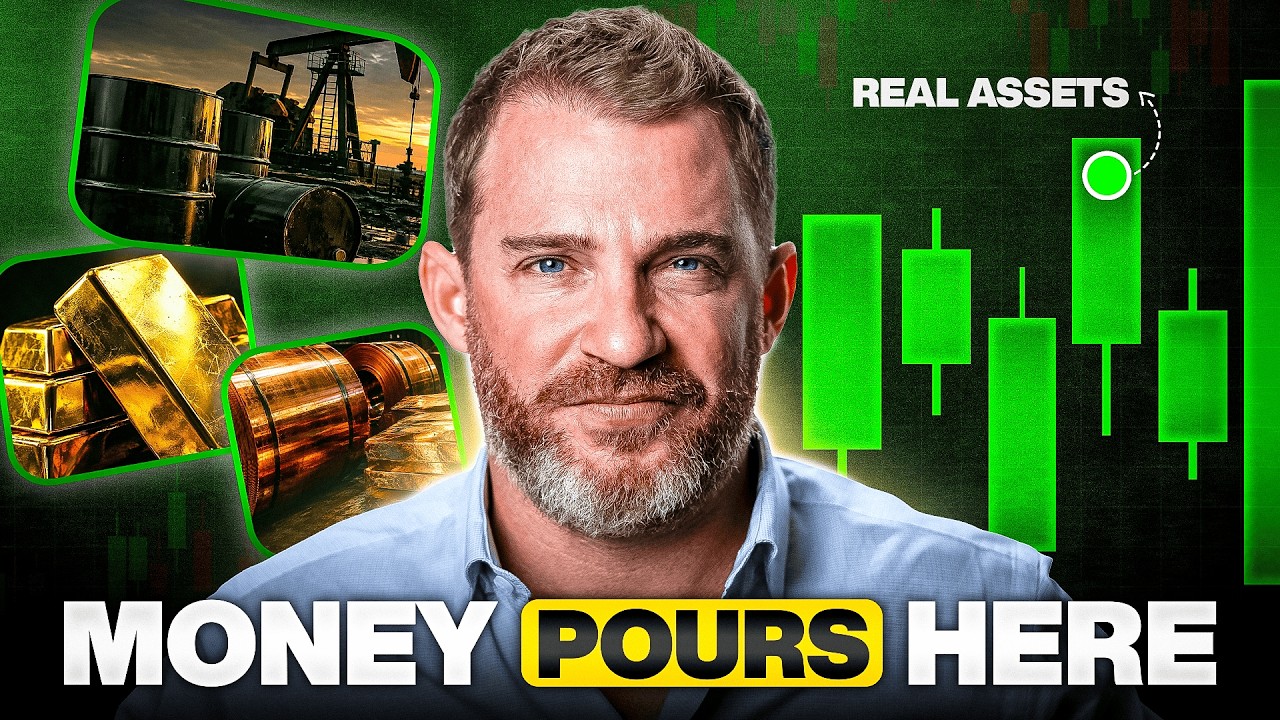
The safe side isn't just things AI needs. It's things AI can't make: copper, oil, farmland, gold, and cash that pays you to wait.
If I were already in my retirement years, up hundreds or thousands of percent in stock funds like a lot of you are, this is where I'd start building a new portfolio. The four funds below are the AI bubble stocks to buy list I'd work from in that seat. Four ETFs. Simple enough that anyone can copy it.
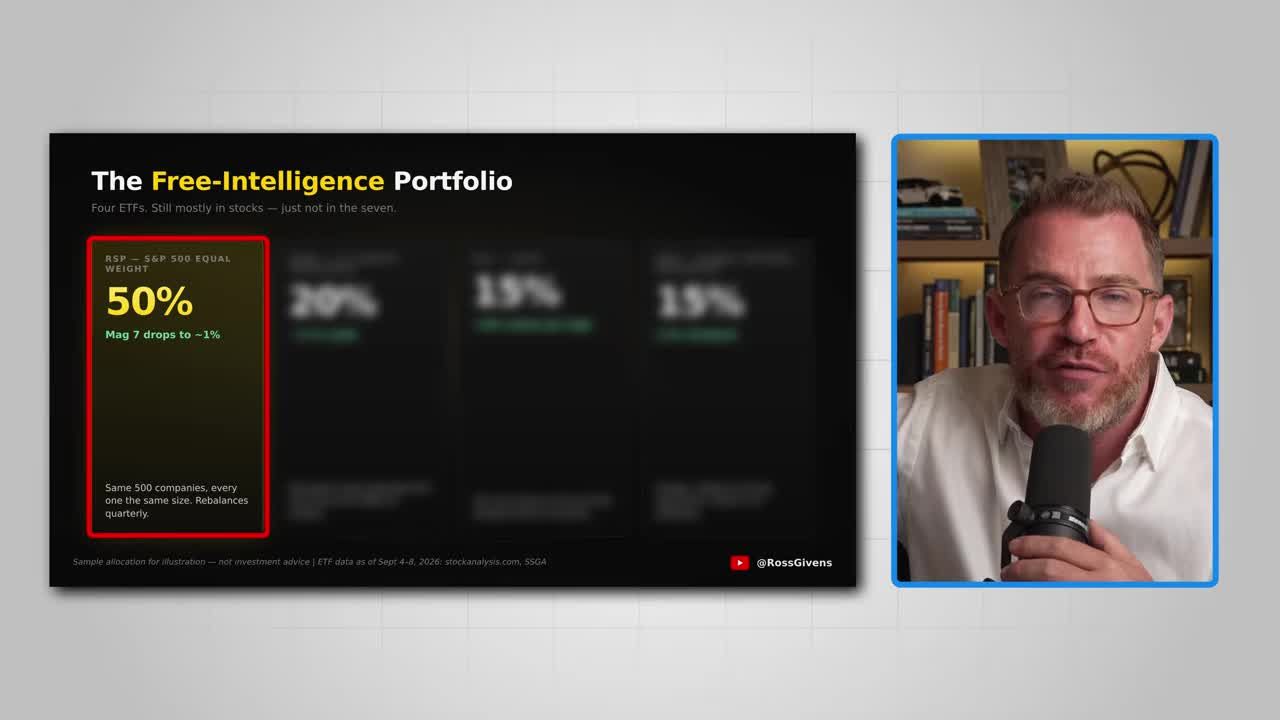
- RSP (50%): The same 500 S&P companies, equal weighted instead of market-cap weighted. In the standard index, seven stocks are a third of your money. In RSP, those same seven drop to a little over 1%. You're still in stocks, still in America, just not making one giant bet on one side of the line. Equal-weighted funds also rebalance every quarter, trimming whatever ran up and adding to whatever fell behind, four times a year, without you lifting a finger.
- SGOV (20%): Short-term treasury bills maturing in three months or less, so almost no interest rate risk. Long-term bonds are down 50% over the last five years. SGOV yields a little under 4%. For the first time ever, big tech is competing directly with the US government for bond buyers, and that competition is part of why short-term yields pay what they pay.
- GLDM (15%): The gold ETF. Gold is still about 25% off its January high, so unlike most things today, it has an attractive entry point. It's also the go-to inflation hedge and your protection against a weakening dollar.
- GNR (15%): The global natural resources ETF. A basket of 94 natural resource companies from around the world, roughly a third each in energy, metals and mining, and agriculture. Exxon, Shell, Freeport, the fertilizer companies. It pays a 2.3% dividend. The physical world in one ticker.
To be clear, for the lawyers and the regulators: this is not investment advice, and I'm not building a portfolio around your specific situation. This is what I'd do if I were 20 or 30 years further down the line, sitting on large profits in the eighth or ninth inning of a generational technology run.
Could Nvidia and the hyperscalers go higher? Yes. They could also fall 50%, and if they do, it takes the rest of the index down with them. At 43, I'd recover. At 73, it's a much harder pill to swallow.
If It Crashes, Blame the Debt
I'm not saying a crash happens tomorrow. I'm not saying it happens at all. But if it does, the cause won't be the technology. It'll be the debt. It always is.
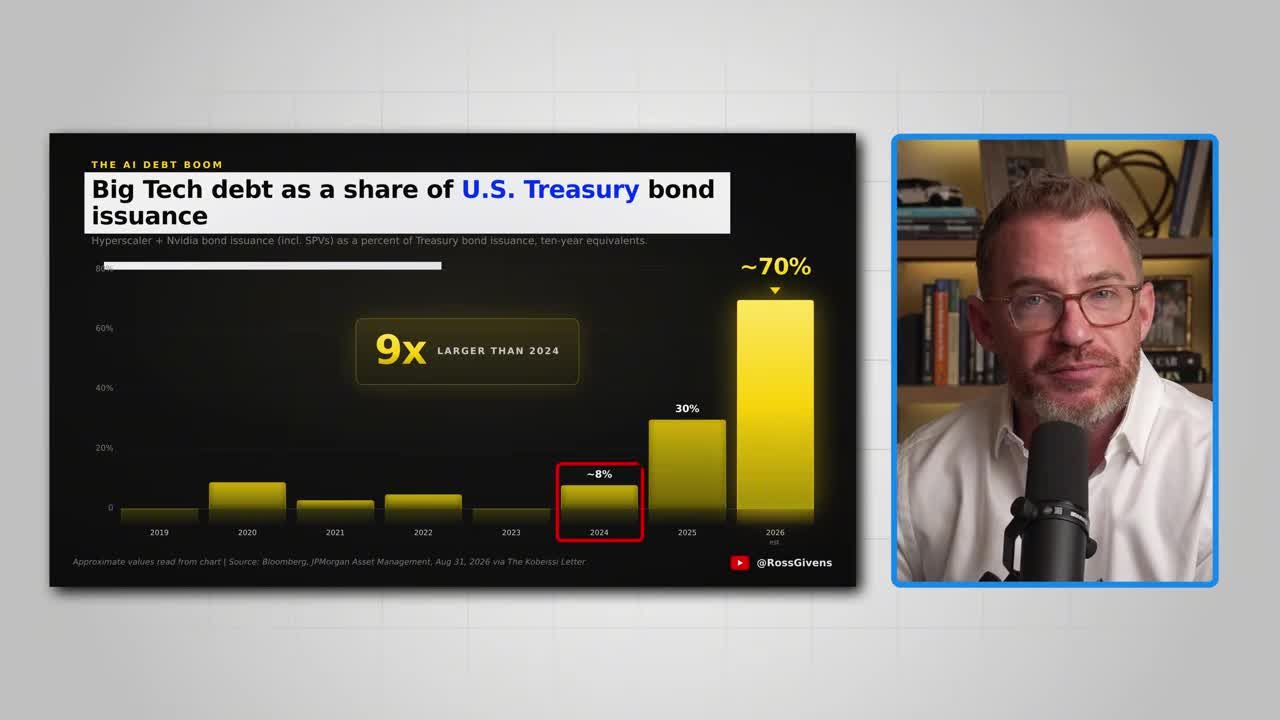
Big AI companies are selling debt at a pace that rivals the federal government. Two years ago, big tech's bond issuance was around 8% of what the US government sold. Last year, 30%. This year it's on pace for 70% and heading higher.
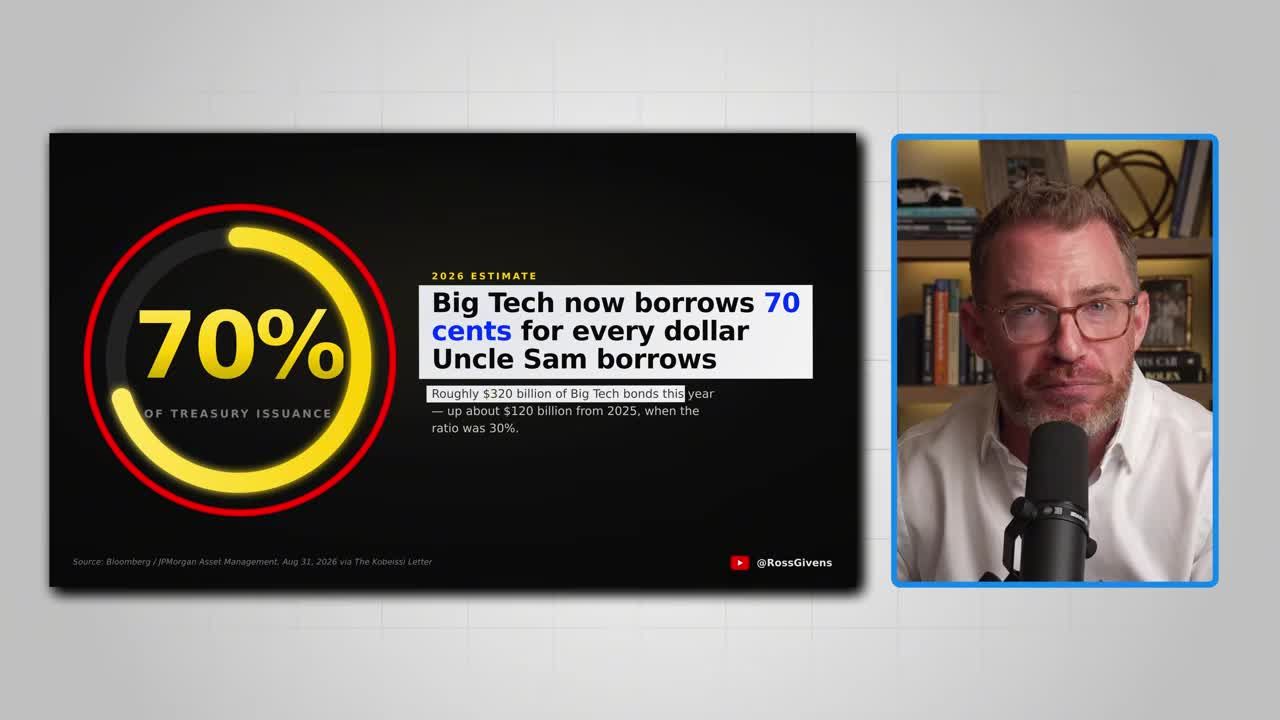
These companies are selling $320 billion of bonds this year just to build data centers. That's only the debt you can see. The five biggest tech companies carry another $1.65 trillion in obligations that never hit the balance sheet: chip purchase agreements, data center leases, money they've promised to spend that isn't counted as debt yet. That figure is eight times bigger than it was four years ago.
So the companies whose product is about to be free are borrowing at a rate that rivals the federal government to build more of the thing that keeps getting cheaper.
The lenders are getting tired
Here's how a bond sale works. A company says it wants to borrow $10 billion. Investors put in orders. If $50 billion of orders show up for $10 billion of bonds, that's five buyers per bond and the company borrows cheap. If demand is barely there, the company has to pay up.
In February, when one of these companies sold bonds, there were five buyers for every one bond offered. By July, fewer than two. Amazon had to pay extra interest just to get its last deal done.
That's the tell. When the borrower has to pay more to find a lender, the lender has started asking whether he'll get paid back.
And this is happening at the worst possible moment. Oil is near $100 because of the war. Inflation is creeping back. The bond market has started pricing better-than-even odds that the Fed's next move is a rate hike, not a cut. Some of the largest borrowers in the corporate bond market are showing up to borrow more right as the cost of borrowing rises.
History rhymes, loudly
In the 1800s, railroads were the internet. They changed everything, and a huge number of the companies that built them went bankrupt, because they built with borrowed money right as the price of shipping a ton of freight collapsed. The railroads were real. The stocks were wiped out.
A hundred years later, telecom companies borrowed hundreds of billions to lay fiber optic cable across the ocean floor. The internet was real, and bandwidth got so cheap it was basically free. In 2001 and 2002, the companies that laid that cable went bankrupt one after another. The fiber is still down there. Somebody else is making money on it 25 years later.
Every single time, the technology was real. Every single time, the builders borrowed too much. And every single time, the crash came because the lenders stopped showing up.
That's why this portfolio leans the way it does. Not because AI is fake. Because the debt is very, very real.
The Signal Worth Watching
Watch what happens the next time a major AI company sells bonds. Google it. If the deal gets done easily, the system is fine for now. If the deal gets downsized, delayed, or the company has to bump the interest rate to get it out the door, that's your warning.
No company is going to announce that nobody wants its debt. They'll just quietly pay more for it. And that's when you find out who's swimming naked.
Which Side of the Line Are You On?
Tech has delivered the biggest gains at the right times, and the hyperscalers have made a lot of people rich. None of that changes the math on where margin goes once a product becomes a commodity.
Rather than ranking a new list of AI names, the more durable position is in companies that own the hard assets AI cannot replicate: land, metals, energy, and agriculture. Most lists of AI bubble stocks to buy still rank the companies that sell intelligence. If the cost of that intelligence is heading toward zero, ranking those sellers higher is exactly backward.
Safety comes from the boring corners of the market. Gold, oil, copper, farmland, the companies that own real things, and equal-weighted exposure that isn't betting a third of your portfolio on seven names.
The intelligence is going to be near free. The dam is not.
Get an entire year of live weekly mentoring sessions, my newsletter, indicators, bonus reports, tons more. Click the link and I'll see you in the next live session.
DISCLAIMER: Traders Agency does not offer financial advice. The information provided is for educational purposes only and should not be considered financial advice. Traders Agency is not responsible for any financial losses or consequences resulting from the use of the information provided. Trading carries inherent risks and may not be suitable for all individuals. You are advised to conduct your own research and seek personalized advice before making any investment decisions, recognizing the potential risks and rewards involved.
See more from Traders Agency on Google
Make us a preferred source and our market analysis will appear more prominently in your Google Search, Top Stories, and AI results.
Add to Preferred Sources