Shares of chipmakers and AI infrastructure companies fell sharply in Monday premarket trading after Anthropic CEO Dario Amodei published a weekend essay urging the industry to slow the pace of frontier AI capability gains, a call that OpenAI CEO Sam Altman and SpaceX CEO Elon Musk publicly backed. The selloff hit semiconductor names, data-center suppliers and cloud infrastructure stocks in the United States, Asia and Europe, though hyperscalers were comparatively resilient, and analysts were divided on whether the proposal implies any actual pullback in AI spending.
The essay that moved markets

Amodei's roughly 3,800-word essay, published Saturday, argued that safety and oversight need time to keep pace with AI capability gains, writing: "We must slow the pace at which we improve the capabilities of AI models," while adding that "progress will still seem fast," according to CNBC and Yahoo Finance. Amodei framed the urgency around a shift he dated to roughly this summer, when, he said, "AI has been advancing drastically faster, driven primarily by AI's growing ability to build the next generation of AI," per CNBC.
He proposed a three-part plan he said could avoid "sacrificing commercial advantage or the United States' lead in AI": giving external evaluators "employee-like access" inside frontier labs (a step he said Anthropic was adopting immediately), establishing common safety standards across frontier AI companies, and attempting to coordinate limits on unchecked AI progress globally, according to CNBC's reporting on the essay.
What Altman and Musk endorsed, and where they drew lines

Altman said in a Saturday X post that he agreed AI companies should "pace the frontier" and committed OpenAI to matching Anthropic's move on independent evaluators, calling it "a great idea," per CNBC. He was explicit, however, that the commitment was not open-ended: in a Monday post he wrote that "pacing" does "not mean 'stopping,'" adding that "progress has been rapid and will continue to be. But it should be slower than it otherwise could be; interventions like safety cases and monitoring have significant costs."
Altman also said, in a post just after midnight Monday, that OpenAI would "welcome a federal framework that sets consistent safety requirements for frontier AI" and that "no amount of American competitive pressure should justify recklessness," while noting that international coordination would require government involvement, per CNBC. He described two failure modes he wants avoided: losing "control of the future to AI," and excessive concentration of power in a single person, company or country.
Musk's endorsement was brief. He posted on X: "Dario is right," according to CNBC, aligning himself with Amodei's call without elaborating on specific mechanisms.
The Monday selloff, by the numbers
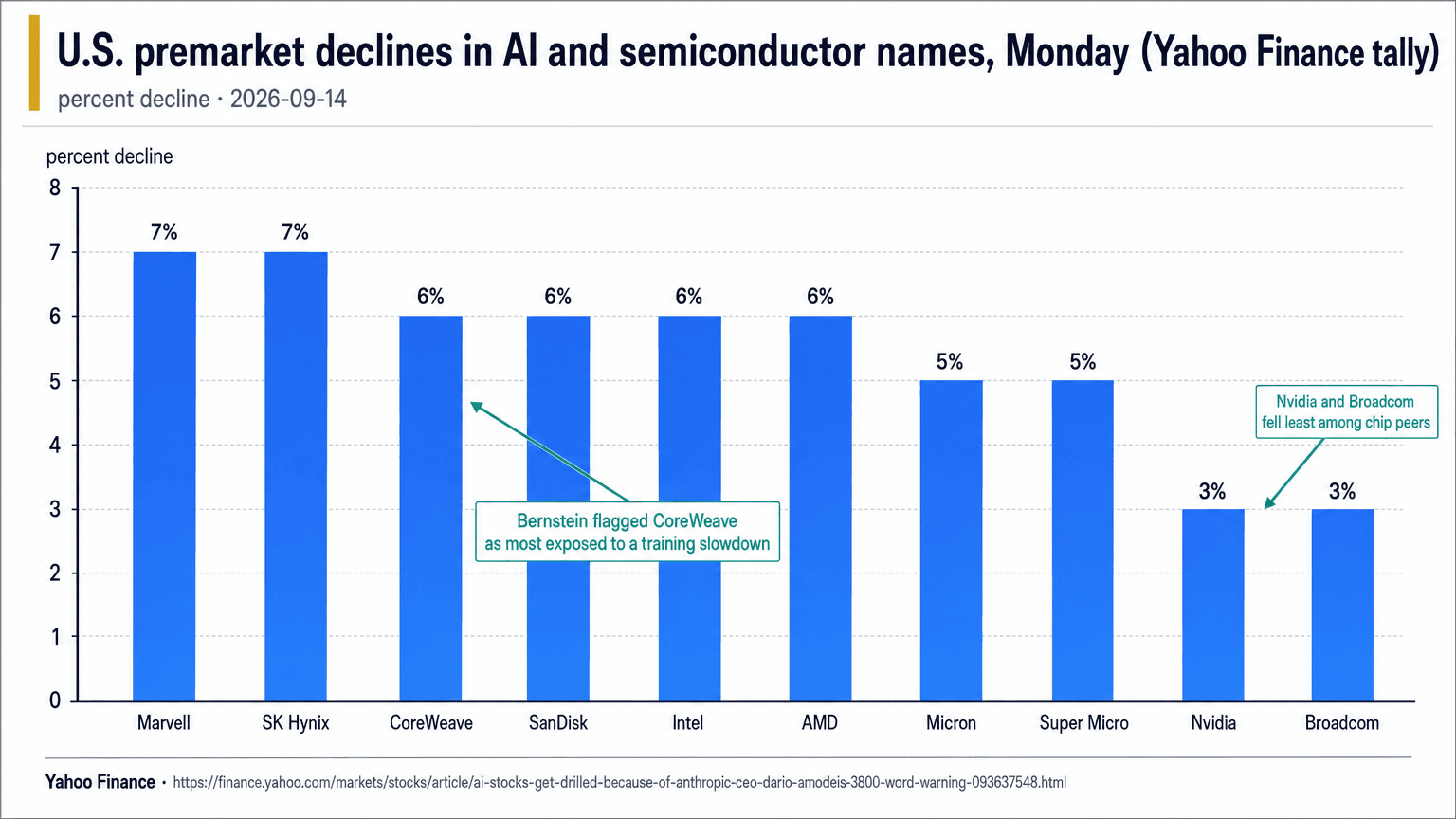
U.S. premarket moves were steep and, in some cases, reported differently depending on when the snapshot was taken. One Yahoo Finance tally showed Marvell and SK Hynix each down 7%, CoreWeave, SanDisk, Intel and AMD off 6%, Micron and Super Micro down 5%, and Nvidia and Broadcom down 3%. A separate Yahoo Finance report put Nvidia down 2%, Broadcom down 3%, Intel down 5% and Marvell down 7%. CNBC separately reported Micron down around 5%, Intel down nearly 6% and Nvidia nearly 3% lower. Hyperscalers Microsoft, Amazon and Alphabet were all only slightly lower, per CNBC.
Index futures pointed to a tech-led decline: Nasdaq-100 futures were down 1.5%, S&P 500 futures off 0.6% and Dow futures down 114 points, or 0.2%, according to Yahoo Finance.
Overseas, the damage was concentrated in chip and data-center names. In Asia, SK Hynix closed down more than 6% and Samsung Electronics more than 4%, while SoftBank, one of the largest investors in OpenAI, fell 10% in Japan, per CNBC. In Europe, ASML fell more than 5%, Nokia around 8% and Infineon more than 7%, with data-center suppliers Siemens Energy and Schneider Electric also lower, CNBC reported.
How analysts are framing the capex and earnings risk
Sell-side reaction so far treats the essay as a governance and safety framework rather than a spending pullback. Bernstein analyst Madison Rezaei wrote, per Yahoo Finance, that the proposal centers on "independent reviewers, coordination on safety standards, and international cooperation," adding: "At this point, it's not a call for a lowering of capex or stopping model training. However, many investors have started to question what happens if training slows." Rezaei flagged CoreWeave as the name most exposed in her coverage, estimating that 25% of its existing active U.S. power and roughly 74% of its contracted power sit in Tier 3 and Tier 4 markets; she said take-or-pay backlog contracts limit near-term risk, but a pullback in demand for contracted, not-yet-sold rural power is possible if training development slows.
Ben Barringer, global head of technology research at Quilter Cheviot, argued to CNBC that company revenues are unlikely to be hit because inference, not training, remains the industry's supply bottleneck: "Even if training and rollout is slowed, inference is still the area that the industry is short in supply. Demand still far outstrips supply, so even if things are to slow a little, company revenues are unlikely to be impacted." By contrast, Zoe Gillespie, senior director at RBC Brewin Dolphin, told CNBC's "Squawk Box Europe" that the equity rally has rested on AI growth and productivity gains, warning: "so if we do see that start to derail, then it could have an impact on equity performance going forward." CNBC also reported that investors are broadly concerned any slowdown in the pace of AI development could ripple from chip purchases to computing-power purchases, where hundreds of billions of dollars of capital expenditure is headed.
Context: safety alarm, political pushback and IPO timing

The essay landed amid an escalating internal debate over AI risk. Last week, Anthropic researcher Jacob Coxon, who had previously worked at OpenAI, resigned, saying Anthropic and OpenAI are "gambling with our lives," per CNBC. Anthropic safety researcher Evan Hubinger responded that he believes there is a greater than 10% chance AI will "kill all humans" within the next decade, according to CNBC.
Amodei, speaking on CBS News' "Sunday Morning," called the biggest unresolved problem the risk that adversarial nations would not follow any agreed limits, saying a global "speed limit" on AI progress "is going to be very difficult" and "I don't know if it's possible, but we should try," per CNBC. President Donald Trump dismissed the call on Sunday, saying a slowdown was unnecessary and would risk America's AI lead over China, CNBC reported. China's response was pointed: the state-run Global Times wrote Monday that "Amodei's proposals seek to portray China's legitimate development in AI as a threat," while China's Foreign Ministry called the CEOs' comments "fear mongering," per CNBC.
The safety pivot also comes as Anthropic and OpenAI prepare for what CNBC described as expected historic IPOs. Altman ruled out an OpenAI listing in 2026 in a Fortune interview published Saturday, saying it would be "ill-advised," a detail also noted by Yahoo Finance.
Monday's tape was not driven by AI headlines alone. Yahoo Finance reported that WTI crude futures rose 3% to trade above $103 a barrel, with Brent above $108, after Saudi Arabia shut a pipeline that had been a critical conduit for crude exports through the Strait of Hormuz region, while the Federal Reserve opens its September policy meeting this week with fed funds futures assigning about an 86% probability to a rate increase.
Bottom line
Monday's selloff reflects a market reassessing risk around the AI buildout, triggered by a safety proposal that Altman says is about pacing rather than stopping development and that Bernstein's Rezaei says is "not a call for a lowering of capex or stopping model training." Rezaei and Quilter Cheviot's Barringer both suggest the near-term earnings and capex impact looks limited, given inference demand and take-or-pay backlog structures, while RBC Brewin Dolphin's Gillespie points to the deeper risk: an equity rally built on AI growth and productivity expectations could see equity performance affected if that narrative derails. With Amodei himself saying a global "speed limit" on AI progress "is going to be very difficult," and Washington and Beijing both pushing back on the substance, whether "pacing the frontier" changes actual lab behavior remains the open question for investors.
DISCLAIMER: Traders Agency does not offer financial advice. The information provided is for educational purposes only and should not be considered financial advice. Traders Agency is not responsible for any financial losses or consequences resulting from the use of the information provided. Trading carries inherent risks and may not be suitable for all individuals. You are advised to conduct your own research and seek personalized advice before making any investment decisions, recognizing the potential risks and rewards involved.
- Yahoo Finance: Nvidia, chip stocks fall as AI CEOs call for slowdown · accessed Sep 14, 2026
- Yahoo Finance: Dow Jones Futures: Techs Tumble As Anthropic Leads AI Slowdown Call; Fed Meeting Ahead · accessed Sep 14, 2026
- CNBC Top News: Sam Altman spells out how and why the AI industry wants to slow down · accessed Sep 14, 2026
- Yahoo Finance: AI stocks get drilled because of Anthropic CEO Dario Amodei's 3,800 word warning · accessed Sep 14, 2026
- CNBC Top News: AI stocks slide after Anthropic, OpenAI CEOs urge slowdown · accessed Sep 14, 2026
See more from Traders Agency on Google
Make us a preferred source and our market analysis will appear more prominently in your Google Search, Top Stories, and AI results.
Add to Preferred Sources