
airBaltic has begun a US Chapter 11 restructuring process backed by a binding commitment for €350 million in new debtor-in-possession (DIP) financing, with the Latvian carrier targeting completion of the case by roughly June 2027, according to Dienas Bizness. The airline says the filing is designed to reduce its long-term debt burden while flights, ticket sales and partner operations continue without interruption.
The Chapter 11 filing and DIP financing
Dienas Bizness reports that Strategic Value Partners acted as arranger of the €350 million DIP facility, with Barclays, Hayfin Capital Management, Morgan Stanley and Oaktree Capital Management providing the financing as additional lenders. The company said it would turn to a US court in the coming days to obtain the approval customary in such cases to use the financing. The Dienas Bizness report does not disclose DIP pricing, milestones, any roll-up structure or a first-day hearing date.
The company said it plans to complete the Chapter 11 process by approximately June 2027, subject to required US court approvals and other conditions, per Dienas Bizness.
Management, oversight and creditor framework
airBaltic's existing management board continues to run the company day to day, with the supervisory council maintaining oversight during the case, Dienas Bizness reported. Supervisory council chairman Andrejs Martinovs said the court-supervised process, which shields the airline from creditor claims while it proceeds, "provides a clear framework and deadlines to reach agreement with creditors, including aircraft lessors and other involved parties," according to the outlet. Martinovs added that the process will demand "strict financial discipline" and that airBaltic must satisfy "several material conditions," with the stated goal of ending the case as "a financially stronger airBaltic" carrying "a substantially reduced debt burden that the company can service long term."
President and CEO Erno Hildén said the process is not noticeable to passengers, telling Dienas Bizness that the airline continues flying, selling tickets and planning its future schedule "with the same attention to safety and operational reliability," while implementing changes set out in its revised business plan. airBaltic also pointed to precedent, noting that SAS, United Airlines, Delta Air Lines, GOL and American Airlines used the same US Chapter 11 mechanism while continuing to fly, and argued that because its own financing, creditors and aircraft lease agreements are international, a single US-supervised framework is appropriate, per the Dienas Bizness report.
What preceded the filing

The Chapter 11 filing follows weeks of restructuring activity. In early September, airBaltic had agreed terms for up to €257 million in interim financing from a mix of existing bondholders and third-party finance providers through newly issued bonds maturing on 26 February 2027, according to Aviator.aero. Under that proposed structure, €180 million would have become available shortly after bondholder approval, with a further €77 million accessible once additional conditions were met; Aviator.aero reported a bondholder meeting on the transaction was scheduled for September 11. That interim financing did not require a new financial contribution from the Latvian government, though Latvia could participate proportionally to its existing position as an airBaltic bondholder under recently adopted legislation, the outlet said.
Earlier still, Ishka Airfinance reported that airBaltic met lessors, creditors and other stakeholders in Dublin to help repair its financial position, citing people familiar with the matter, as fleet expansion, limited financial flexibility and rising leasing and debt-service costs weighed on liquidity and leverage even while the carrier maintained what Ishka described as a respectable EBITDAR margin at the operational level. Ishka Airfinance's Airline Intelligence data, cited in that report, put leverage at almost eight times, with fixed charge cover remaining below 1x and liquidity falling from 6.6% of revenues to 2%. The same report noted that any restructuring agreement carries implications for a broad group of aircraft lessors, since Ishka's Fleet Intelligence data showed airBaltic operating 57 Airbus A220-300s, the backbone of its leased fleet.
Operations, fleet plan and wet-lease flying
airBaltic has said flight operations, ticket sales and partner cooperation are unaffected by the Chapter 11 process, and that it will keep meeting obligations to suppliers and service providers in the ordinary course of business, per Dienas Bizness. Separately, under a revised business plan reported by Cranky Flier, the airline has abandoned earlier ambitions of a 100-aircraft fleet and is instead shrinking from 54 aircraft to 36 by the end of the year, only gradually climbing back to 40 by 2031.
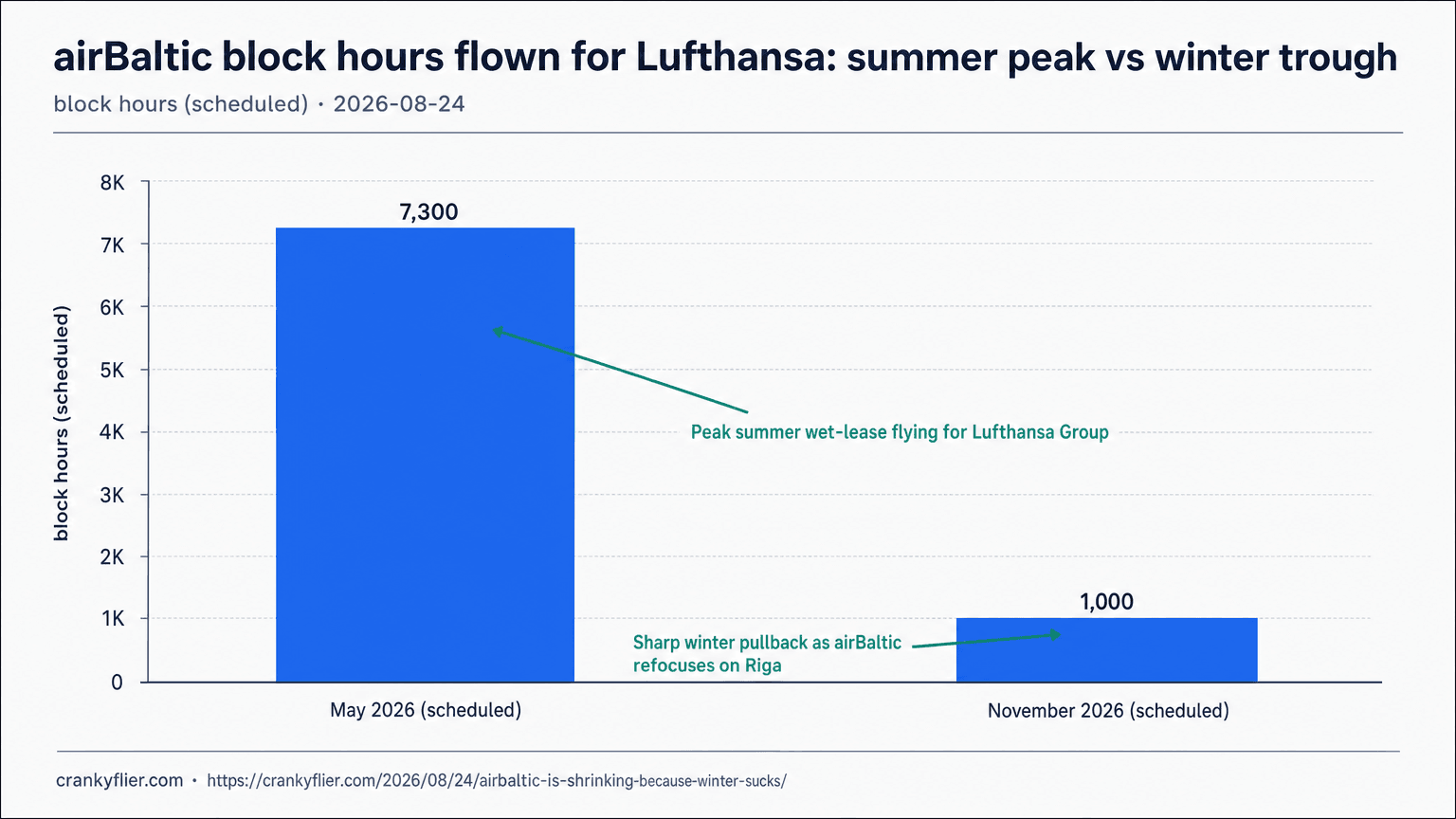
Cranky Flier also reported that wet-lease flying for other carriers had grown into a large share of airBaltic's summer operation, with the airline's own flying accounting for only about 55% of total block hours this past summer and most of the remainder flown for Lufthansa Group. According to data cited in that report, airBaltic was scheduled to fly more than 7,300 block hours for Lufthansa this past May, falling to just over 1,000 block hours this coming November — a decline of 6,300 block hours (7,300 − 1,000); put the other way, the May total was roughly 630% higher than the November total ((7,300 − 1,000) ÷ 1,000 × 100), by our calculation from those two reported figures. The airline's stated plan is to scale back contract flying for other carriers toward a more balanced summer-winter mix while retaining "selected point-to-point services" and refocusing on its Riga base, Cranky Flier reported. airBaltic has attributed its broader strategic reset to moderating demand and revenue growth, geopolitical developments in Ukraine and the Middle East that have raised uncertainty and operating costs, and prolonged Pratt & Whitney engine availability constraints limiting fleet deployment, according to the same report.
Bottom Line
airBaltic has moved from months of lessor and bondholder negotiations, including a proposed €257 million interim financing package, into a formal Chapter 11 case anchored by a €350 million DIP commitment, with management framing the goal as emerging by roughly mid-2027 with a lighter debt load, according to Dienas Bizness. The company says day-to-day flying, ticket sales and supplier relationships continue unaffected, but the process still requires US court approval to draw on the DIP financing and will hinge on negotiations with a wide creditor group that includes lessors exposed to the 57 A220-300s that Ishka Airfinance's fleet data show airBaltic operates.
DISCLAIMER: Traders Agency does not offer financial advice. The information provided is for educational purposes only and should not be considered financial advice. Traders Agency is not responsible for any financial losses or consequences resulting from the use of the information provided. Trading carries inherent risks and may not be suitable for all individuals. You are advised to conduct your own research and seek personalized advice before making any investment decisions, recognizing the potential risks and rewards involved.
- Dienas Bizness: airBaltic uzsāk finanšu saistību restrukturizāciju Chapter 11 procesa ietvaros · accessed Sep 14, 2026
- www.fitchratings.com: Fitch Downgrades airBaltic to 'RD' on DDE · accessed Sep 14, 2026
- company.airbaltic.com: Newsroom - Company | airBaltic · accessed Sep 14, 2026
- www.9fin.com: Air Baltic’s restructuring buys runway but execution remains key - Analysis · accessed Sep 14, 2026
- aviator.aero: airBaltic Secures Commitments for Up to €257 Million of Interim Financing · accessed Sep 14, 2026
- www.linkedin.com: Exclusive: airBaltic engages in restructuring talks · accessed Sep 14, 2026
- crankyflier.com: airBaltic is Shrinking Because Winter Sucks · accessed Sep 14, 2026
See more from Traders Agency on Google
Make us a preferred source and our market analysis will appear more prominently in your Google Search, Top Stories, and AI results.
Add to Preferred Sources