


On August 26th, Nvidia told Wall Street that $1.3 trillion is about to get spent building AI, and that it still cannot build fast enough to keep up. For anyone tracking ai semiconductor stocks, that is the most important data point in the market right now.
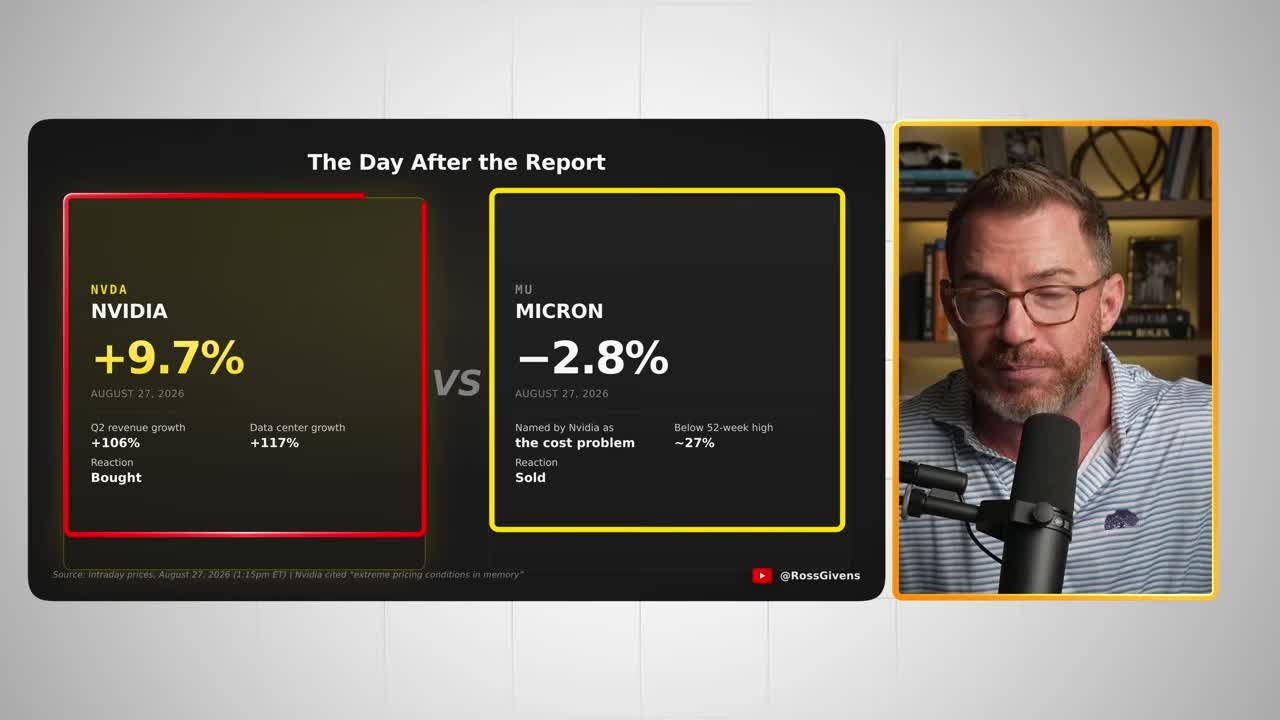
The next morning, the reaction told you exactly where that money is going. Micron, the American company sitting closest to the shortage Nvidia just described, fell more than 3%. Nvidia was up 10%. Same day. Same news. Opposite directions.
If you own anything in AI, that split matters more than any single number in the earnings report. Wall Street sold the obvious winner, and they did it for a specific reason.
Here is the one bottleneck Nvidia cannot engineer its way around, and the exact company standing directly in front of it.
Is Capacity Now the Only Limit on Nvidia's Growth?
Bottom Line: The AI semiconductor trade has shifted from a demand story to a supply and infrastructure story. The real constraint is no longer chip design but the power and cooling required to run those chips at scale, and Vertiv is the name most directly exposed to that spending.
Demand stopped being the variable
First, understand the scale. Nvidia reported revenue of $96.2 billion, up 106% in a single year. Data center revenue hit $89 billion, up 117%. We have never seen this level of growth at this scale in the history of the stock market.
Then they guided to $108 billion for next quarter. That is more in three months than Nvidia did in all of 2024.
Here is the part most people get backwards. Nvidia guided to roughly 70% revenue growth next year. That is a supply forecast, not a demand forecast. CEO Jensen Huang said flat out that real demand is higher than that.
Nvidia is telling the market what they can physically build, not what people want to buy. Demand is no longer the variable. Capacity is.
The AI trade just got a two-year extension, confirmed by the one company that knows the industry best.
Why Micron Got Dumped Among AI Semiconductor Stocks
The best news memory ever received, and the stock fell
Why did the memory stocks sell off after the best news they have ever gotten? It comes down to basic math. Memory companies do not get paid on price alone. They get paid on price times bits. And Nvidia is quietly cutting the bits.
In August, Bank of America reported that Nvidia is testing its next flagship chip, Rubin Ultra, at as little as 192 to 288 GB of high bandwidth memory. The original spec was a full terabyte, or 1,000 gigabits. That is an 80% cut.
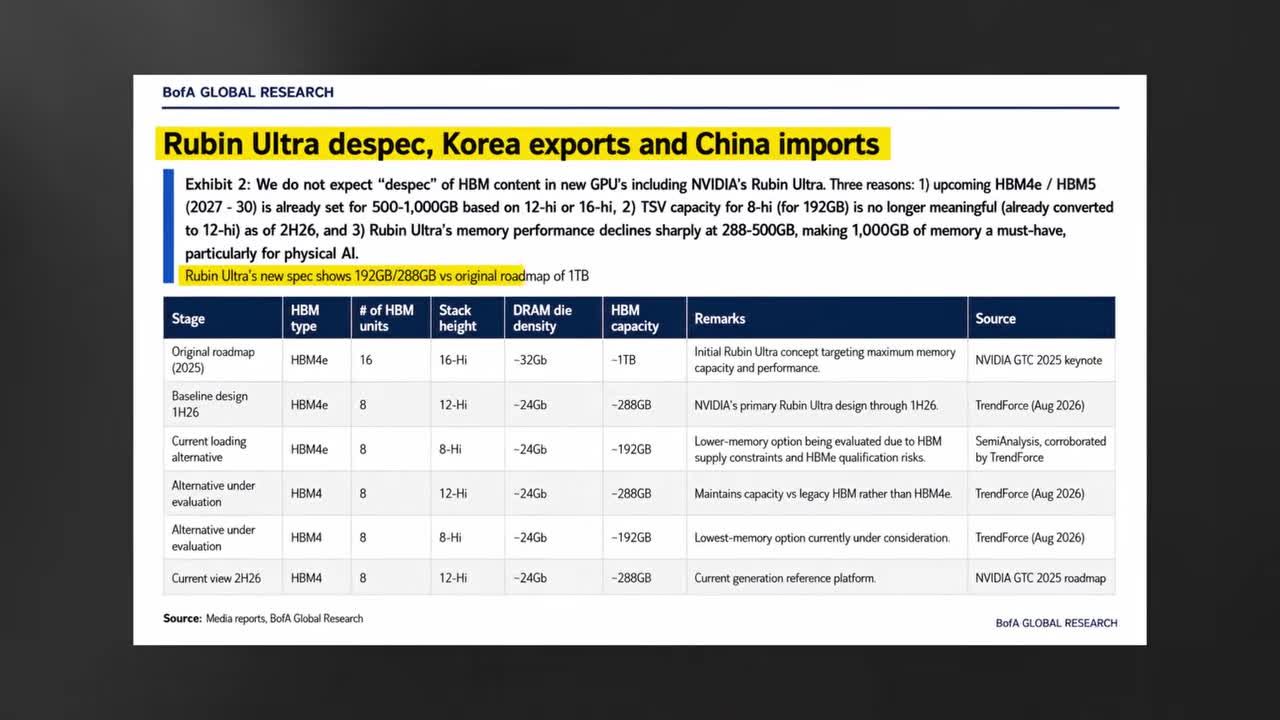
That cut may not stick permanently. But it tells you exactly what Nvidia's engineers are working on. When Nvidia says memory is expensive, they are not complaining. They are telling you what their engineers are already working on.
And they have options. Nvidia has SK Hynix carrying about 70% of its next-generation memory, with Samsung qualifying right behind them. That is how a company manufactures competition among its own suppliers. Back in June, Google published a memory compression technique, and the memory stocks fell on that news too.
This is the whole lesson of the earnings report, and almost nobody is saying it out loud. Do not buy the bottleneck your customer can engineer around. It is a warning that applies to more than just ai semiconductor stocks.
Nvidia is spending real money and real engineering hours to need less memory. The market looked at the best news memory has ever gotten and realized the product is being made smaller.
What Is the Bottleneck Nvidia Can't Engineer Its Way Around?
You can compress a model. You can't compress a gigawatt.
Buried in that earnings call, Nvidia's chief financial officer admitted something I have not heard a company this size say out loud in 20 years of doing this. Gross margin is falling from 75% down to 71% by the fourth quarter, and the money is going straight to a supplier Nvidia cannot say no to.
When investors hunt for ai semiconductor stocks to buy, they focus entirely on the chip designers. The real money is flowing toward the physical limits of the data center.
You can compress a model to use less memory. Google already did it. Nobody has figured out how to compress a gigawatt.
Nvidia is not trying to use less power. It is not trying to use less cooling. It is deliberately making that problem bigger every single generation. Look at their own roadmap.
Their next rack, Rubin Ultra, runs at 600 kilowatts. It has zero fans. It requires complete liquid cooling, because at that density, air simply does not work anymore. This is not an analyst forecast. It is a published product design for the back half of next year.
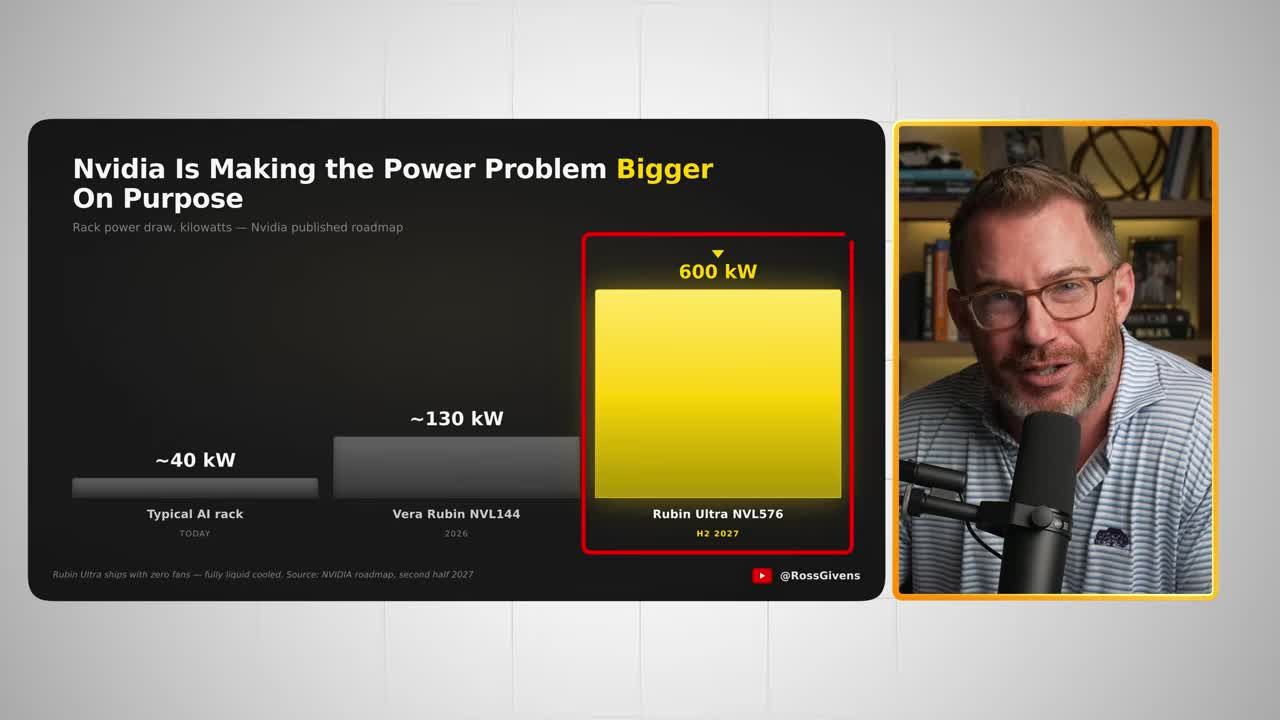
Nvidia can engineer around the memory problem. It cannot engineer around power and cooling.
Get an entire year of live weekly mentoring sessions, my newsletter, indicators, bonus reports, tons more. Click the link and I'll see you in the next live session.
Join my Black Ops Trading ClubWhich Company Is Most Exposed to the $1.3 Trillion AI Buildout?
Vertiv, ticker VRT
The company that builds the power is Vertiv, ticker VRT. Vertiv makes the power and cooling systems that sit inside data centers. Not the chips. The stuff that keeps the chips alive: power distribution, liquid cooling, thermal management.
Roughly $11.5 billion in annual revenue, and essentially all of it is data center infrastructure. This is not a conglomerate with a data center division. This is a whole company built around it.
That last metric is the one that matters. Deferred revenue means customers are paying upfront. Nobody prepays a vendor they could easily replace.
The morning after Nvidia's earnings, Vertiv gapped straight up almost 4%. Somebody connected the dots immediately. Then by noon, the stock had given it all back and then some.
The market made the connection for about an hour, then went right back to arguing about memory chips. That is not a stock that has priced in $1.3 trillion. That is a stock nobody has finished doing the math on yet, and it is still roughly 30% below its 52-week high.
How to Read the Chart
Acceptance, price discovery, and the 200-day line
Vertiv has been a monster for the last few years. We are not paying the crazy premium where it traded back in May. It has pulled back roughly 30% to 40% from its peak.
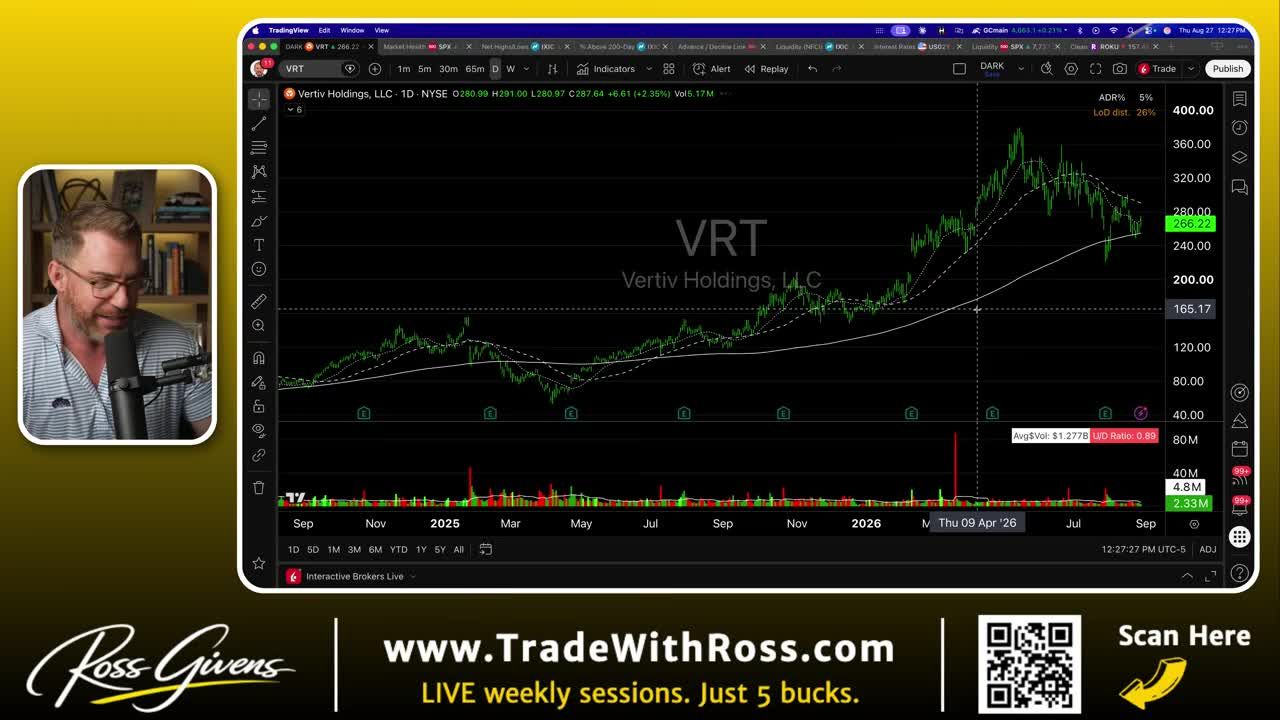
Stocks tend to move from acceptance to price discovery. Acceptance is an area where buyers and sellers agree on a fair price, choppy and going nowhere. Price discovery is when new news comes out and the stock runs higher or lower until it finds a new fair price.
When a stock pulls back, it tends to return to its last area of acceptance. For Vertiv, that is the $240 to $270 range. It stopped in this exact range in July, then pushed up right where it is sitting now.
It is currently resting on its 200-day simple moving average, the defining line between long-term uptrends and downtrends. It sits at a previous acceptance area, and it just got extremely good news for the future demand of its products, whether the market realizes it yet or not.
My $50,000 Trade on VRT
Tight risk, good odds
I put roughly $50,000 into Vertiv. The stock was trading around $266 a share, so I picked up 188 shares.
I am not taking a big, uncalculated risk here. We are not yoloing. I am keeping it tight, because if the thesis is correct, Wall Street should realize it fast and drive the price higher. If the stock sells off to $240, $230, or $220, then I am either wrong or early.
My stop loss sits at $248, just below Monday's low near $249. That means I am risking about 6.5% to 7% on the trade.
We are testing a thesis early at a great turning point. If we are wrong, we lose 6.5% and live to fight another day. If this cannot hold above the last couple of weeks' low with $1.3 trillion of capex confirmed, then I am early or I am wrong, and I do not want to be in while I find out.
Wall Street's average price target on Vertiv sits around $388. I think the analysts are behind. I believe this stock could take out its old high near $380 toward the end of this year or in 2027. If Nvidia builds even most of what it just guided to, Vertiv could be worth a lot more than that over the next two to three years.
Two Things I Don't Love
The risks worth hearing
To be clear, there are two things I do not love about Vertiv, and you should hear them.
First, they stopped disclosing their backlog number in the second quarter. Companies tend to headline their backlog when it is growing. Hiding it is a red flag.
Second, competition is real. Every big industrial is trying to buy its way into this business.
- Eaton paid $9.5 billion for Void Thermal
- Ecolab paid $4.75 billion for CoolIT
- Trane bought LiquidStack
But the demand is not a story. It is a published spec sheet. Nvidia has already told the world exactly what its racks will require in 2027, and somebody has to build the power and cooling to match it. You can review Vertiv's filings directly through the SEC's EDGAR database.
The Real Bottleneck
The $1.3 trillion buildout is confirmed. Nvidia's gross margins are compressing because they are paying a premium to a supplier they cannot say no to.
Nvidia is engineering its way out of the memory shortage. It is deliberately making the power requirements larger. Vertiv is standing directly in the path of that $1.3 trillion spend, and the market has not fully priced it in yet.
Get an entire year of live weekly mentoring sessions, my newsletter, indicators, bonus reports, tons more. Click the link and I'll see you in the next live session.
Key Takeaways
- Nvidia reported $96.2 billion in revenue, up 106% year-over-year, with data center revenue alone hitting $89 billion, up 117%.
- Nvidia's guidance of roughly 70% revenue growth next year reflects a supply constraint, not a demand ceiling. Jensen Huang stated that real demand exceeds what Nvidia can currently ship.
- Gross margin compression at Nvidia points to a supplier Nvidia cannot replace or pressure on price, identifying a structural bottleneck beyond the chips themselves.
- Vertiv, which provides power and cooling infrastructure for AI data centers, is identified as the company most directly positioned in front of the $1.3 trillion AI buildout spending.
- On the day after Nvidia's earnings report, Nvidia rose roughly 10% while Micron fell more than 3%, a divergence that signals where Wall Street sees the next constraint in the AI supply chain.
DISCLAIMER: Traders Agency does not offer financial advice. The information provided is for educational purposes only and should not be considered financial advice. Traders Agency is not responsible for any financial losses or consequences resulting from the use of the information provided. Trading carries inherent risks and may not be suitable for all individuals. You are advised to conduct your own research and seek personalized advice before making any investment decisions, recognizing the potential risks and rewards involved.
See more from Traders Agency on Google
Make us a preferred source and our market analysis will appear more prominently in your Google Search, Top Stories, and AI results.
Add to Preferred Sources