
If you have ever expected a stock to make a big move but had no idea which direction it would go, you have probably run into the straddle vs strangle decision. A straddle buys a call and a put at the same strike price, while a strangle buys a call and a put at different, further-out strikes. Both are volatility strategies, but they differ sharply in cost, breakeven distance, and how much movement you actually need to turn a profit. By the end of this guide, we'll show you how to build each position, compare their breakeven math side by side, and decide which one fits your market view and your account size.
What Is a Straddle vs Strangle?
Bottom Line: A straddle costs more but needs a smaller move to pay off, while a strangle costs less but needs a bigger move. Pick a straddle when you expect volatility soon and want tighter breakevens, and pick a strangle when you want a cheaper bet but can tolerate needing a larger price swing.
A straddle is an options position where you buy one call and one put at the same strike price and the same expiration date. A strangle uses the same basic idea but with two different strikes, typically a call above the current price and a put below it.
Both strategies profit from a large move in either direction and lose money if the stock sits still. The straddle is built at-the-money (ATM), so both legs have intrinsic value potential almost immediately once the stock moves even slightly. The strangle is built with out-of-the-money (OTM) legs, which means the stock has to travel further before either option gains real value.
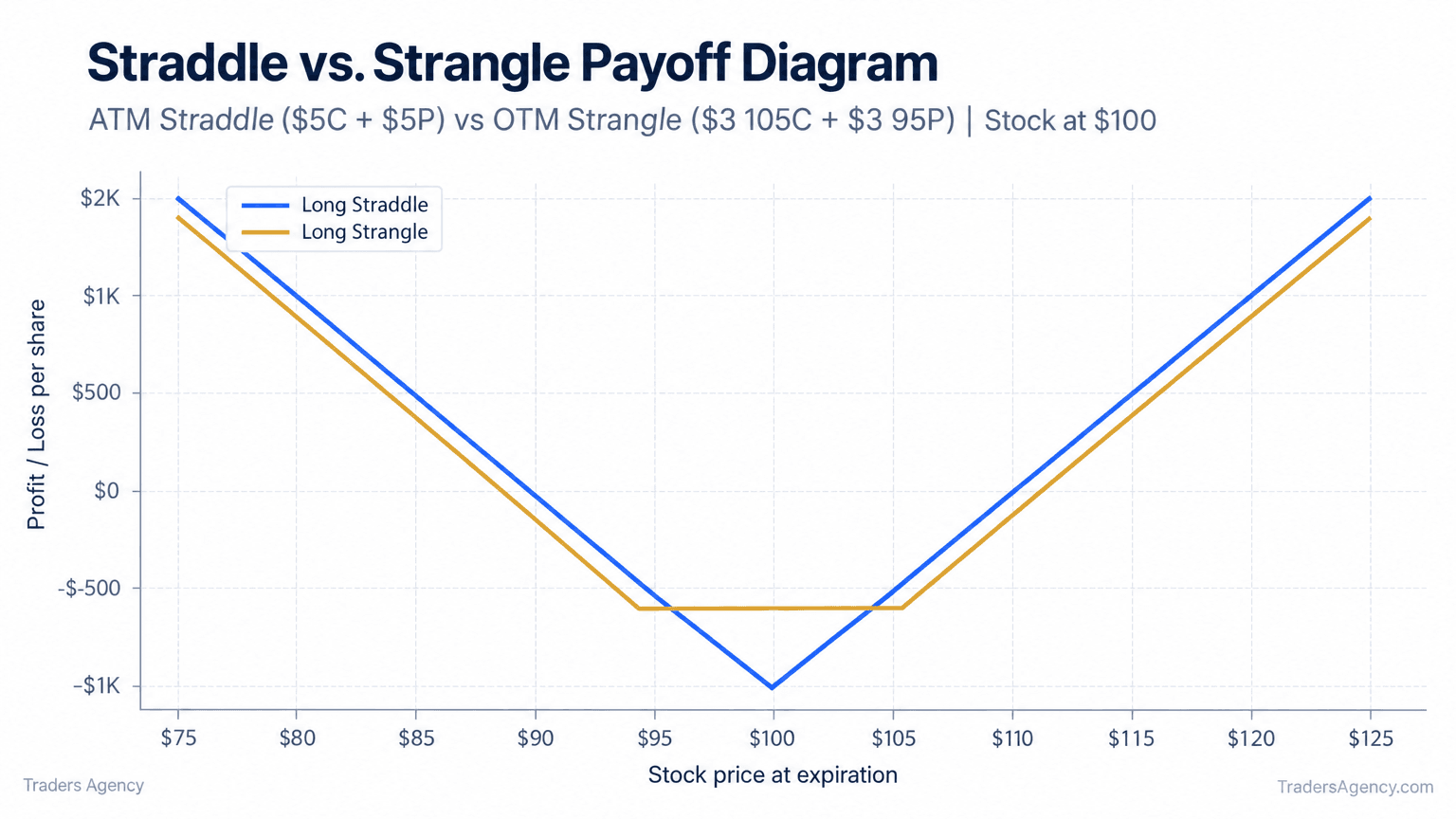
Here is the mechanical difference in plain terms: if a stock trades at $100, a straddle might use the $100 call and $100 put. A strangle on the same stock might use the $105 call and $95 put. Same underlying, same expiration, different strike spacing on the options exchange listing those contracts.
This strike spacing is the entire reason these two strategies behave so differently in cost, breakeven, and risk. Everything else in this guide builds from that one distinction.
Key Concept: A straddle trades a higher upfront cost for a tighter breakeven range. A strangle trades a lower upfront cost for a wider breakeven range. Neither one gives you something for nothing.
How Do the Breakeven Points Compare?
Breakeven on a straddle is tighter because both legs start closer to the money, while a strangle's breakeven points sit wider apart because the stock must clear two OTM strikes before either leg turns profitable.
Here's an example we use with our students. Say a stock trades at $100 with 30 days to expiration.
| Parameter | Straddle | Strangle |
|---|---|---|
| Call Strike / Cost | $100 call for $5.00 | $105 call for $3.00 |
| Put Strike / Cost | $100 put for $5.00 | $95 put for $3.00 |
| Total Debit | $10.00 | $6.00 |
| Upper Breakeven | $110 | $111 |
| Lower Breakeven | $90 | $89 |
Notice something here: the strangle actually needs a slightly bigger move to break even in this example ($111 or $89 versus $110 or $90), even though it costs less upfront. That is the trade-off we want you to remember. You pay less for a strangle, but you are not automatically getting an easier path to profit. You are getting a cheaper entry ticket with a different risk profile.
Outcome Scenarios
Using the numbers above, here is what happens at expiration under three conditions:
| Scenario | Stock Price at Expiration | Straddle P/L | Strangle P/L |
|---|---|---|---|
| Best Case (big move) | $130 | +$20 | +$19 |
| Most Likely (small move) | $103 | -$7 | -$6 |
| Worst Case (no move) | $100 | -$10 | -$6 |
In the best case, the straddle edges ahead in raw dollars because it required less upside to start generating value. In the small-move case, the $100 call still recovers $3.00 of the straddle's debit, leaving a $7.00 loss against the strangle's $6.00 loss, so the two outcomes are closer than the price tags suggest. In the worst case, both positions expire worthless, but the strangle loses less capital overall.
How Do Cost and Strike Prices Differ Between a Straddle and a Strangle?
The straddle vs strangle cost gap exists because ATM options carry more premium (more intrinsic-value potential) than OTM options, which have none yet and need the stock to travel before they matter.
Why is a strangle cheaper than a straddle? Because OTM options have no intrinsic value and lower delta, so they are priced cheaper than ATM options that sit right at the current stock price.
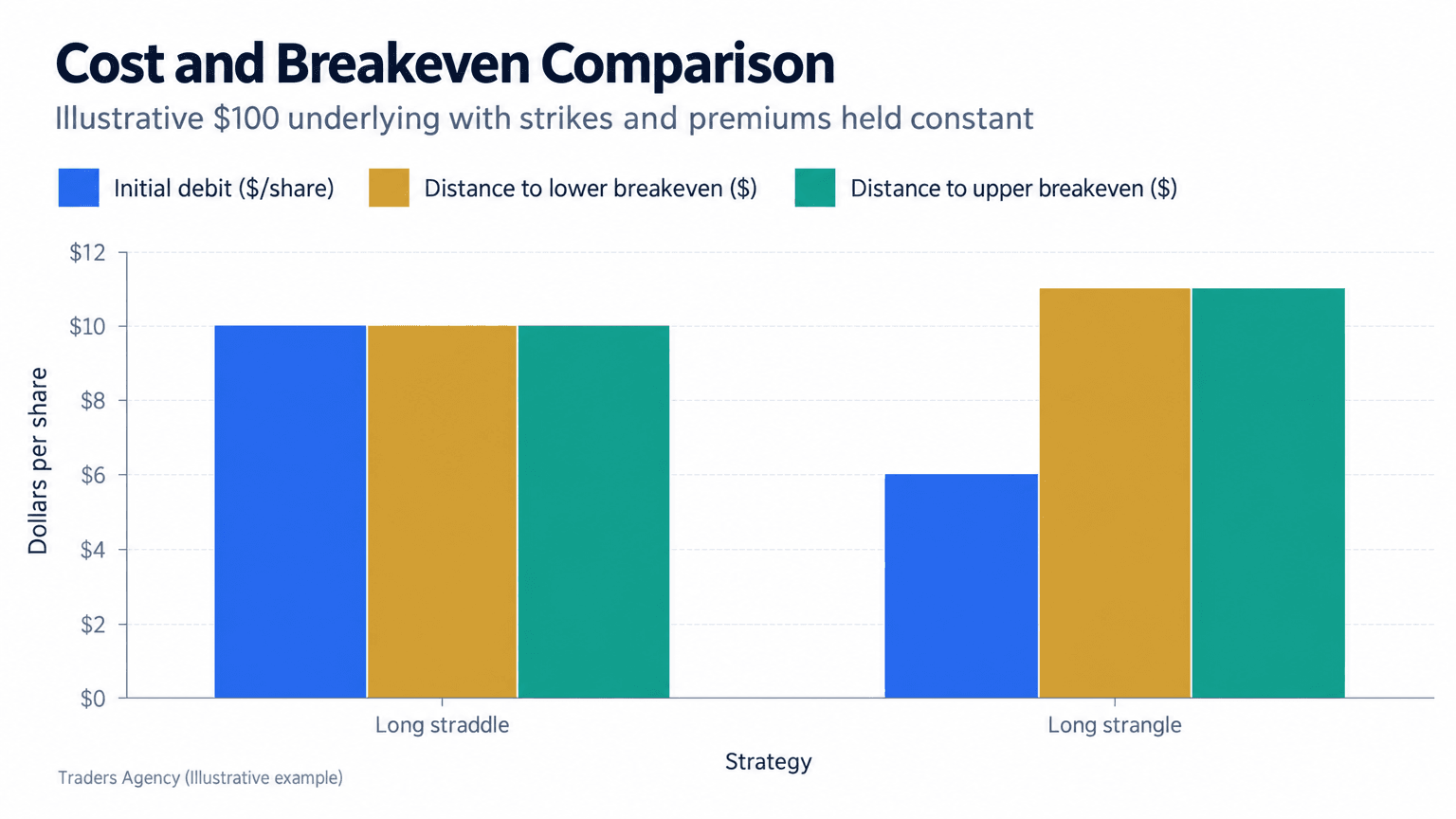
This cost gap matters for position sizing. Because each contract covers 100 shares, a $10.00 straddle debit costs $1,000 per contract while a $6.00 strangle debit costs $600 per contract. A trader with $3,000 to allocate could buy three straddles or five strangles. More contracts means more exposure to a big move, but also more total dollars at risk if the stock just sits there.
Want expert trading insights delivered daily?
Join thousands of traders who rely on Traders Agency for market analysis and trade ideas.
Join Traders AgencyWhich Is Best, Straddle or Strangle?
Neither strategy is universally "best." The straddle wins when you expect a large move but aren't sure it will be large enough to clear a wide strangle breakeven. The strangle wins when you want cheaper exposure and are comfortable needing a bigger relative move.
We tend to think about it this way: the straddle is the higher-conviction, higher-cost bet, and the strangle is the lower-cost, lower-conviction bet that still needs a real move to pay off.
Straddle vs Strangle Pros and Cons
- Straddle pros: tighter breakevens, simpler strike selection (one strike instead of two), often better for high-conviction volatility plays
- Straddle cons: higher upfront cost, bigger dollar loss if the stock doesn't move
- Strangle pros: lower cost, smaller maximum loss in dollar terms, flexible strike width to match your volatility expectation
- Strangle cons: wider breakeven distance in some cases, two strikes to track instead of one
Some traders also compare these to defined-risk alternatives. A straddle vs strangle vs iron condor comparison is really a comparison between buying volatility and selling it: the iron condor profits when the stock stays in a range, the opposite goal of a long straddle or strangle. A straddle vs strangle vs butterfly comparison highlights that butterflies profit from low movement near a target price, while straddles and strangles need movement away from the current price. And a straddle vs strangle vs spread comparison usually comes down to directional bias: spreads assume you know which way the stock is going, while straddles and strangles don't require a directional opinion at all.
Greeks Impact: Delta, Theta, and Vega
Delta: Both positions start close to delta-neutral when the strikes sit symmetrically around the stock price. The difference is that a strangle's OTM legs each carry smaller individual deltas, meaning the stock has to move further before either leg's delta grows meaningfully.
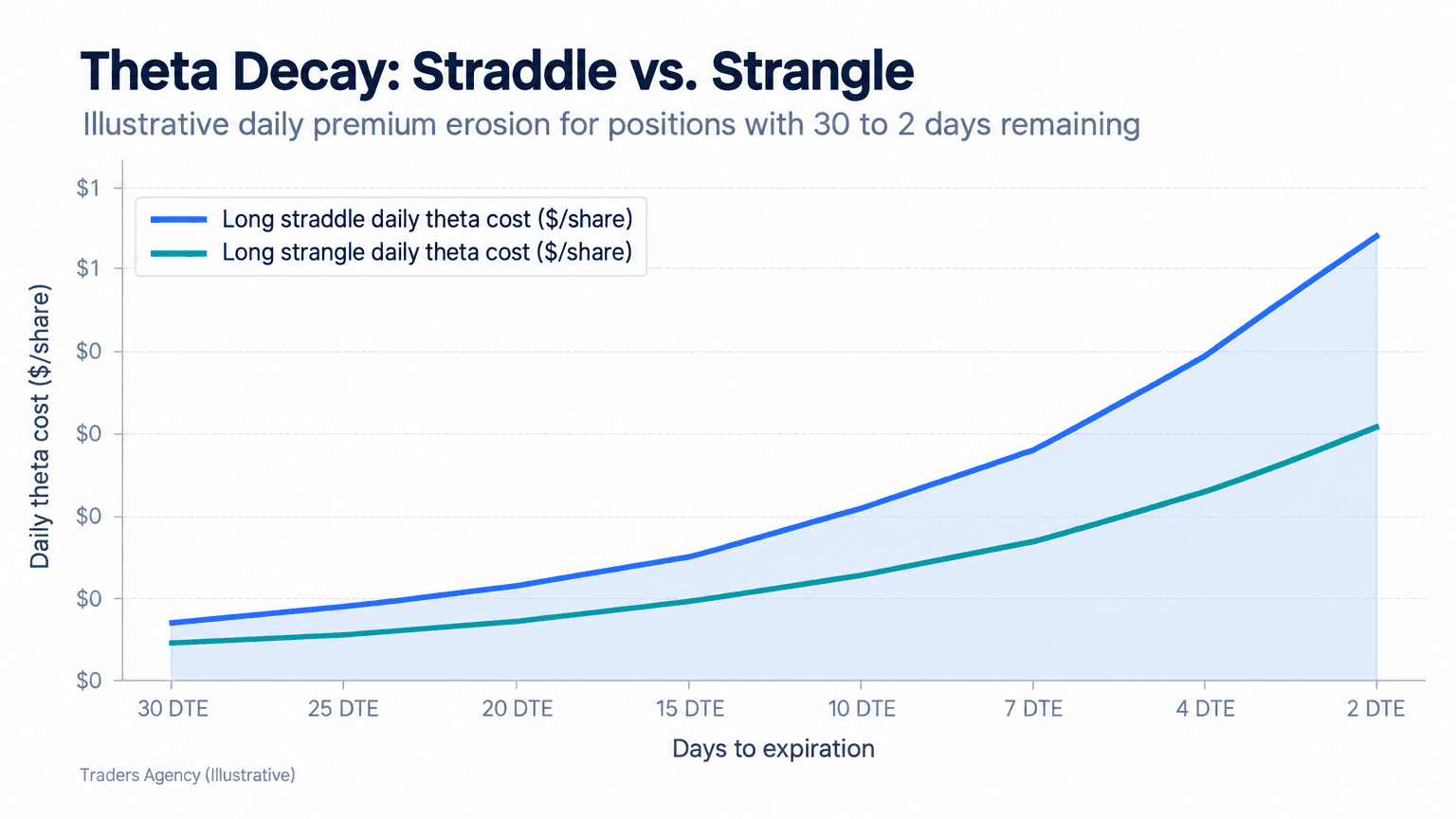
Theta (time decay): Both strategies lose value every day the stock doesn't move, but the straddle typically loses more dollars per day early on because it has more premium at risk.
Vega (volatility sensitivity): Both positions gain value when implied volatility rises and lose value when it falls, since you are long options on both legs.
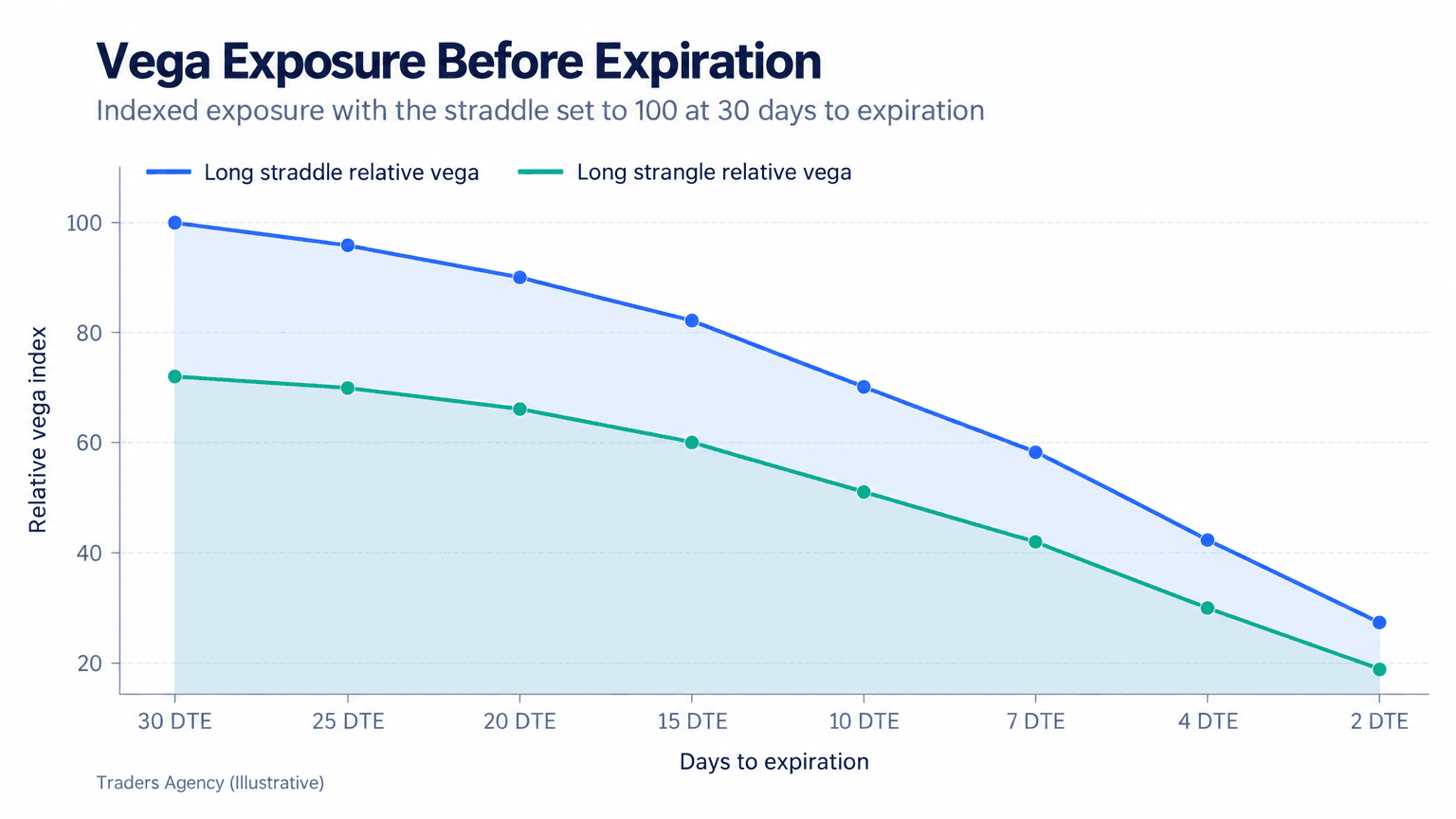
This is why a volatility crush right after earnings can hurt both positions badly, even if the stock makes a decent move. If implied volatility drops sharply, the extra premium you paid for vega exposure can evaporate faster than the stock price gain can offset it.
When Should You Use a Straddle vs a Strangle?
Use a straddle when:
- You expect a major event (earnings, FDA decision, court ruling) with high conviction
- You can afford the higher upfront debit
- You want the simplicity of one strike price to manage
Use a strangle when:
- You want cheaper exposure to a volatility event
- You're comfortable needing a larger relative move
- You want to size up contract count without increasing total dollar risk
Avoid Both When: Implied volatility is already elevated going into the trade, the stock has historically made small, gradual moves rather than sharp ones, or you don't have a plan for exiting before theta decay erodes most of your premium.
A short straddle vs strangle comparison flips this entire conversation. Selling a straddle or strangle profits from a quiet market and collects premium instead of paying it, but carries undefined risk if the stock makes a large unexpected move. That is a strategy for experienced traders only, and it deserves its own detailed discussion. Some traders also look at a straddle vs strangle vs collar when they already own the underlying stock and want to manage existing risk rather than open a fresh volatility bet. A collar caps both upside and downside on a position you already hold, which is a very different goal than the pure volatility plays we've covered here.
What Mistakes Should You Avoid With Straddles and Strangles?
- Buying straddles or strangles right before a known event without checking implied volatility levels first. If volatility is already priced in, the move you're expecting may not be enough to overcome inflated premiums.
- Holding through expiration out of stubbornness. If the stock hasn't moved by the midpoint of your holding period, consider closing early to preserve remaining premium rather than letting theta erode it to zero.
- Ignoring position sizing. Never allocate so much capital to a single volatility bet that a max loss meaningfully damages your account.
- Confusing a strangle's lower cost with lower risk. The dollar amount at risk is lower, but the probability of hitting breakeven can be similar or even less favorable depending on strike selection.
- Not having an adjustment plan. If the trade is going against you, decide in advance whether you'll roll the position to a further expiration, close for a loss, or hold to expiration. Making that decision in the moment, under stress, rarely produces good outcomes.
Is a straddle strategy profitable? It can be, but profitability depends entirely on whether the actual stock move exceeds the premium paid plus any volatility contraction. Many straddles expire worthless because the expected move didn't materialize or implied volatility collapsed faster than the stock could compensate.
Frequently Asked Questions
Which is best, straddle or strangle?
Neither is universally better. Straddles suit high-conviction, well-funded trades with tighter breakevens, while strangles suit traders who want lower cost and are comfortable needing a larger relative move.
Why is a strangle cheaper than a straddle?
A strangle uses out-of-the-money strikes with no intrinsic value and lower delta, so each leg costs less than the at-the-money options used in a straddle.
What is the least risky option strategy?
Credit spreads and other spread strategies have a hard-capped max loss (spread width minus net credit). Covered calls and cash-secured puts have defined but potentially large downside, since the stock can fall substantially, so their dollar risk is often far greater than a long straddle's debit. A long straddle or strangle risks only the premium paid, though that premium is frequently lost in full.
Is a straddle strategy profitable?
It can be profitable if the stock move exceeds the total premium paid before expiration, but it frequently loses money when the stock stays within its breakeven range or implied volatility drops sharply.
What's the difference between a straddle vs strangle vs iron condor?
Straddles and strangles are long volatility plays that profit from movement, while an iron condor is a short volatility play that profits when the stock stays within a defined range.
How does a straddle vs strangle vs butterfly comparison work?
Straddles and strangles need the stock to move away from the current price to profit, while a butterfly profits from the stock staying near a specific target price at expiration.
What's the difference between a short straddle vs strangle?
A short straddle or strangle sells the options instead of buying them, collecting premium upfront but facing undefined risk if the stock makes a large unexpected move.
Can a straddle vs strangle vs collar serve the same purpose?
Not really. Straddles and strangles are standalone volatility bets, while a collar is used to protect an existing stock position by capping both potential gains and losses.
Want expert trading insights delivered daily?
Join thousands of traders who rely on Traders Agency for market analysis and trade ideas.
Join Traders AgencyDISCLAIMER: Traders Agency does not offer financial advice. The information provided is for educational purposes only and should not be considered financial advice. Traders Agency is not responsible for any financial losses or consequences resulting from the use of the information provided. Trading carries inherent risks and may not be suitable for all individuals. You are advised to conduct your own research and seek personalized advice before making any investment decisions, recognizing the potential risks and rewards involved.
See more from Traders Agency on Google
Make us a preferred source and our market analysis will appear more prominently in your Google Search, Top Stories, and AI results.
Add to Preferred Sources