
You've probably watched a stock jump 15% in a single session while the company released no actual news. Chances are, the move started on a Reddit thread or a trending StockTwits ticker, not an earnings report. That's the world of sentiment based trading, and it's become too big for intermediate traders to ignore.
In this guide, we'll show you how social sentiment actually moves prices, where it works, where it fails, and how to use it without getting burned by a pump group dressed up as a "grassroots" rally. By the end, you'll know how to read sentiment data as confirmation rather than a standalone entry signal, and you'll understand the specific mistakes that cost retail traders money every earnings season.
We built this guide because our members keep asking the same question: is social sentiment actually useful, or is it noise? The honest answer is both, depending on how you use it.
What Is Sentiment Analysis Trading?
Bottom Line: Sentiment based trading works best as a confirmation layer, not a standalone entry signal, since crowd mood shifts fast and can reverse once interest fades. Traders who treat it as one input alongside moving averages, volume, and fundamentals, while using hard stops and scaling out in parts, avoid the common mistake of chasing a pump that has no underlying support.
Sentiment based trading is a strategy that uses the collective tone of public commentary, posts, and discussion volume about a stock to inform entry and exit decisions. The social sentiment meaning here is straightforward: it's a numerical score representing whether the crowd is talking positively, negatively, or neutrally about a ticker.
We pull this kind of data from platforms like X (formerly Twitter), StockTwits, and Reddit, then run it through natural language processing tools that score the tone of each post. A sentiment score might run from -1 (extremely bearish chatter) to +1 (extremely bullish chatter), with volume of mentions acting as a secondary signal.
The logic behind it is simple: retail trading now moves real volume. When thousands of people start posting bullish takes on a small-cap stock within a few hours, that chatter can translate into actual buy orders. Twitter stock sentiment tracking became popular precisely because platforms like X give traders a real-time pulse on what retail investors are discussing before the move fully plays out in price.
This isn't theoretical. In our own tracking, spikes in social mention volume often line up with short-term price volatility, though the relationship is inconsistent enough that we never treat it as a rule.
How Does Social Media Sentiment Move Stock Prices?
Social sentiment moves stock prices when a large enough group of traders acts on the same information at the same time, creating real buying or selling pressure. The effect is strongest in low-float, high-retail-interest stocks, where a relatively small amount of capital can shift the price significantly.
Here's the mechanical chain we walk our members through:
- A post goes viral on Reddit or X around a specific ticker.
- Mention volume spikes sharply within a short window.
- Retail order flow surges on that ticker as brokerages see a wave of new buy orders.
- Market makers adjust pricing to account for the new demand.
- Options activity follows, especially cheap out-of-the-money calls, which can trigger a gamma squeeze if market makers need to hedge aggressively.
This is the same basic mechanism behind the 2021 meme stock episodes. Stocks with heavy short interest and high retail attention saw sentiment and price reinforce each other in a feedback loop: rising prices generated more bullish posts, which drew in more buyers, which pushed prices higher still.
The catch is that this loop runs in both directions. When sentiment turns, the unwind can be just as fast, and often faster, because the buyers who chased the hype have no fundamental thesis holding them in the position.
Is Sentiment a Leading or Lagging Indicator?
Sentiment can act as both a leading and lagging indicator depending on the stock and the situation, which is why we never use it in isolation. In smaller, thinly-traded names, sentiment often leads price by hours or even a day. In large-cap, heavily-analyzed stocks, sentiment usually just confirms a move that's already underway.
This distinction matters enormously for how you build a strategy around it. If you're trading a micro-cap that just appeared on a trending list, a sentiment spike may genuinely be the earliest signal available, arriving before volume data or price action fully reflects the shift. If you're trading AAPL or MSFT, social chatter is almost always reacting to news that institutional algorithms already priced in milliseconds earlier.
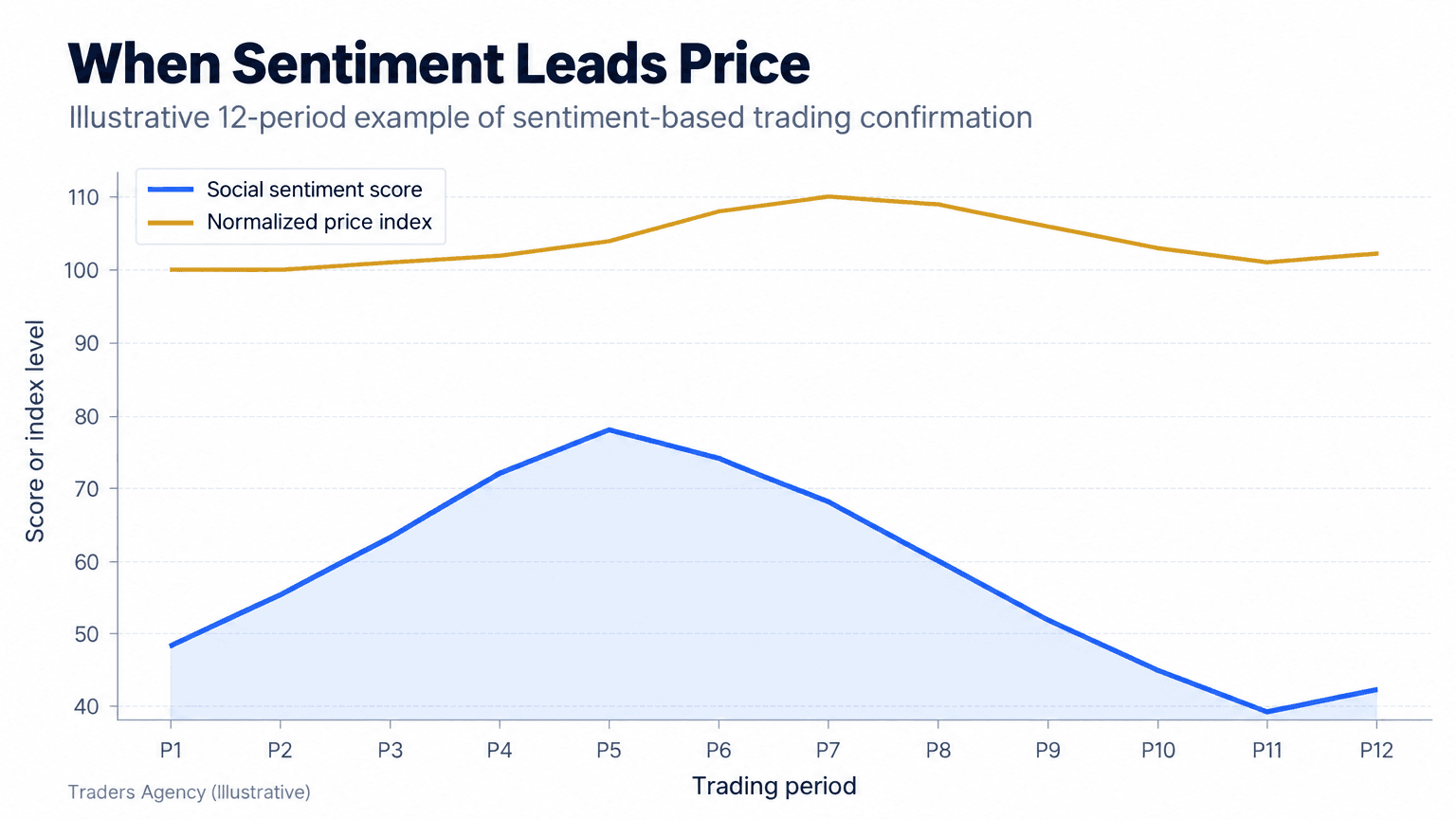
Key Concept: Always check sentiment against price action before acting on it. If sentiment is rising but price hasn't moved yet, that's a potential early signal worth watching closely. If sentiment is rising after a big green candle, you're likely looking at confirmation of a move that's already well underway, and chasing it is a much weaker trade.
Want expert trading insights delivered daily?
Join thousands of traders who rely on Traders Agency for market analysis and trade ideas.
Join Traders AgencyHow Do You Use Sentiment Analysis as a Confirmation Signal?
The safest and most reliable way to use sentiment based trading is as a confirmation layer on top of a technical or fundamental setup you've already identified, rather than as the trigger itself. Sentiment agreeing with your existing thesis increases conviction; sentiment alone, with nothing else backing it, is a weak foundation for a position.
Picture a setup where a stock you're watching breaks above a 50-day moving average on above-average volume. That's your primary signal. If you then check a stock sentiment tracker and see mention volume up 300% with a strongly positive tone over the past six hours, that's confirmation the move has real crowd participation behind it, not just a single large order.
| Confirmation Factor | What You're Checking |
|---|---|
| Primary Signal | Price breaks above the 50-day moving average on above-average volume |
| Sentiment Reading | Mention volume up 300% over 6 hours, strongly positive tone |
| Interpretation | Crowd participation confirms the move, lower risk of a single-order fake-out |
| Action | Treat as a higher-conviction entry, size accordingly |
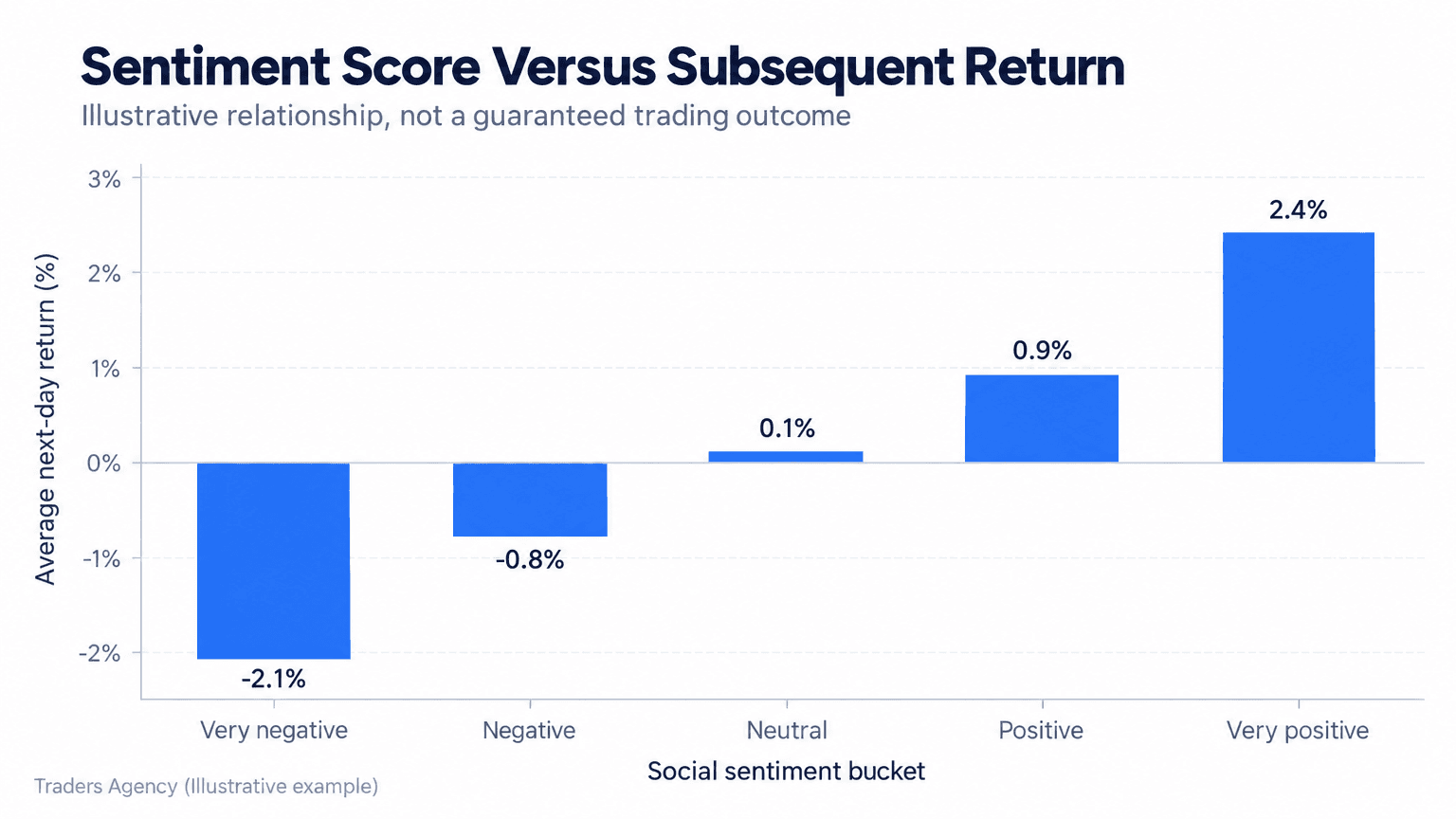
As the illustrative pattern above shows, extreme sentiment readings on either end tend to correspond with larger next-day moves on average, but the relationship is noisy and far from guaranteed. We treat it as one data point among several, never as the whole decision.
A Practical Confirmation Checklist
Before sizing into a sentiment-backed trade, we walk through this:
- Price action first: Is there already a technical setup (breakout, support bounce, trend continuation)?
- Volume check: Is trading volume elevated alongside the sentiment spike, or is chatter outpacing actual order flow?
- Source diversity: Is the bullish tone coming from multiple independent accounts, or a handful of repeat posters?
- Stock news sentiment: Is there an actual news trigger, or is this purely social chatter with no fundamental driver?
- Float and liquidity: Can you actually enter and exit this position without major slippage?
If a setup fails more than one of these checks, we treat it as low-conviction regardless of how loud the sentiment reading looks.
What Are the Best Tools for Sentiment Analysis Trading?
Several platforms now offer built-in algorithmic trading sentiment analysis, scoring stocks automatically so you don't have to read thousands of posts manually. StockTwits has its own native bullish/bearish sentiment tagging system built directly into posts. Fintech platforms built specifically around social sentiment stocks screening aggregate mention volume across X, Reddit, and StockTwits into a single composite score.
Brokerages including Fidelity and Interactive Brokers have incorporated third-party sentiment and news-analytics feeds into their research tools, giving retail traders access to data that used to be institutional-only. These tend to combine sentiment with traditional stock news sentiment scoring pulled from wire services and press releases, which adds a layer of reliability compared to pure social chatter.
When we evaluate any tool, we look for three things: how transparent the scoring methodology is, how frequently the data refreshes, and whether it separates organic retail chatter from bot-driven or coordinated posting.
What Are Common Mistakes When Trading on Social Sentiment?
Most losses in sentiment based trading come from a short list of repeatable errors, not from the strategy itself being broken.
- Treating sentiment as a standalone signal: Entering a trade purely because a ticker is trending, with no price or volume confirmation.
- Ignoring source quality: Weighting a post from a brand-new account the same as one from an established trader with a track record.
- Chasing after the spike: Buying once a stock is already up 20% on the day because sentiment "just turned positive," when the real move already happened.
- Oversizing positions: Allocating a large percentage of capital to a single sentiment-driven idea instead of treating it as a smaller, speculative position.
- Confusing volume with conviction: Assuming high post count means high-quality analysis, when it often just means high attention.
Pump Groups and Coordinated Manipulation
One of the biggest risks in this space is organized manipulation. Pump groups on Discord, Telegram, and even smaller Reddit communities coordinate posting campaigns around low-float stocks, flooding platforms with bullish content to attract unsuspecting buyers before dumping their own shares.
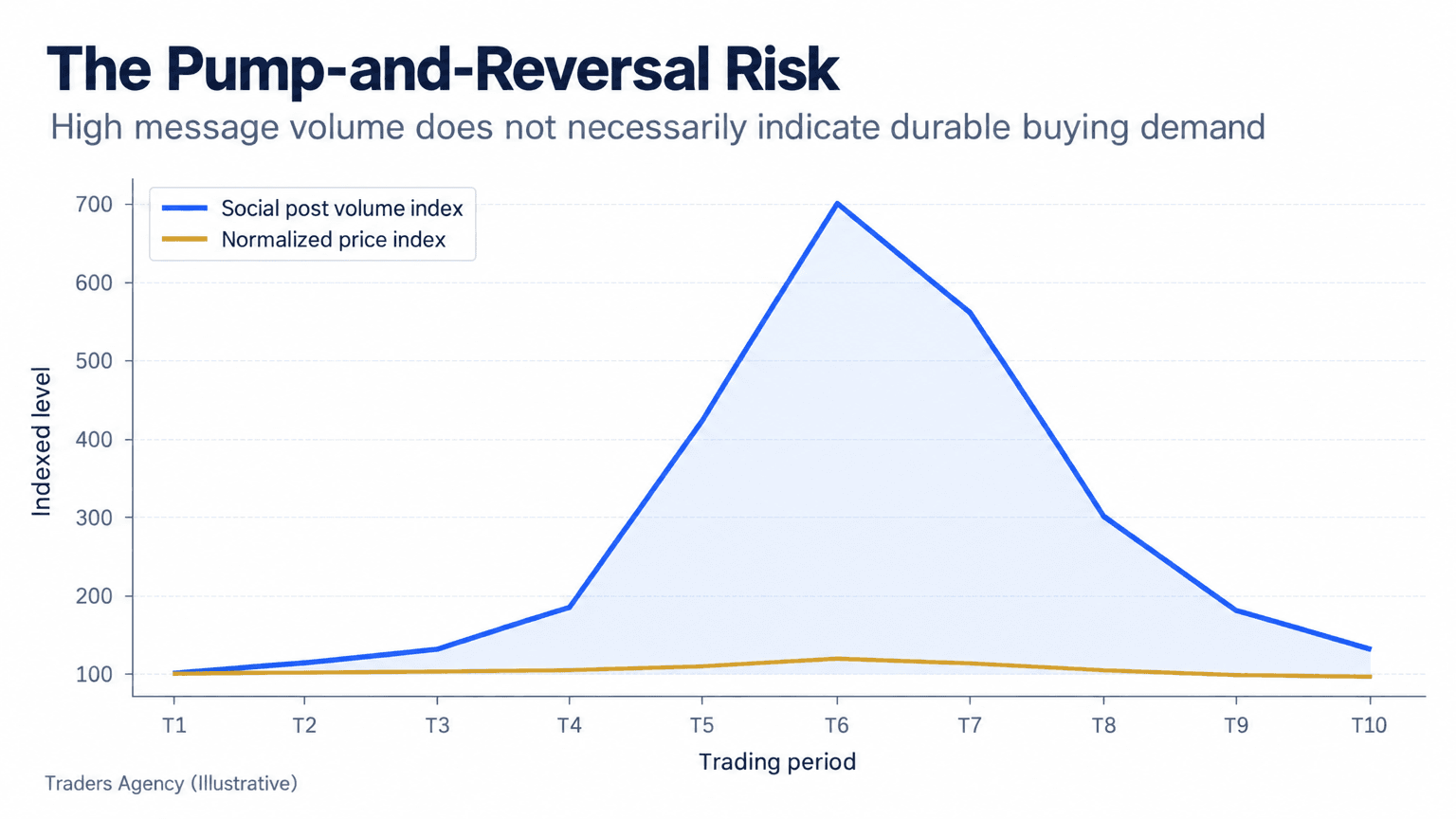
The pattern is recognizable once you know what to look for: a sharp, synchronized spike in post volume with nearly identical language across multiple accounts, a brief price pop, and then a reversal below the starting price once the coordinated group exits. The SEC has issued public investor alerts specifically warning about pump-and-dump schemes conducted through social media and online forums, which tells you regulators take this risk seriously.
Watch Out: If you notice posts using nearly identical phrasing, suspiciously new accounts driving the volume, or a stock with almost no trading history suddenly trending, treat that as a warning sign rather than an opportunity.
When Should You Avoid Sentiment-Based Trades?
We avoid sentiment-based trades when the sentiment spike has no accompanying volume increase, when the stock is extremely low-float and thinly traded, or when we cannot independently verify the news or trigger behind the chatter. These conditions are the clearest signs of manipulation risk rather than genuine market interest.
Earnings season is another time to be cautious. Sentiment often spikes immediately after a print, but the initial reaction can reverse hard once institutional analysts digest the full report, so entering purely on the first wave of social reaction is risky. We also avoid acting on sentiment around stocks with recent halts or unusual options activity until the picture clears up, since these are often exactly the setups pump groups target.
Risk Management for Sentiment Based Trading
Because sentiment driven moves can be sharp and fast-reversing, position sizing matters more here than in most other strategies. We generally recommend treating sentiment-confirmed trades as a smaller slice of your overall portfolio, something in the range most traders reserve for speculative or momentum positions, rather than a core holding.
A hard stop loss is non-negotiable given how quickly these setups can reverse once the crowd loses interest. We also suggest scaling out of winning sentiment trades in parts rather than holding for a single exit target, since these moves rarely give you a clean, orderly top.
Key Concept: Combine sentiment data with the tools you already use: moving averages, volume profile, and fundamental context. Sentiment works best as one more data point layered onto a process you trust, not as a replacement for that process.
Want expert trading insights delivered daily?
Join thousands of traders who rely on Traders Agency for market analysis and trade ideas.
Join Traders AgencyDISCLAIMER: Traders Agency does not offer financial advice. The information provided is for educational purposes only and should not be considered financial advice. Traders Agency is not responsible for any financial losses or consequences resulting from the use of the information provided. Trading carries inherent risks and may not be suitable for all individuals. You are advised to conduct your own research and seek personalized advice before making any investment decisions, recognizing the potential risks and rewards involved.
See more from Traders Agency on Google
Make us a preferred source and our market analysis will appear more prominently in your Google Search, Top Stories, and AI results.
Add to Preferred Sources