
DeFi yield farming lets traders put crypto assets to work inside decentralized protocols, earning token rewards and a share of transaction fees instead of letting capital sit idle in a wallet. We'll show you how the mechanics actually work, where the real risk hides beneath the advertised returns, and how to size a farming position so one bad week doesn't erase six months of gains.
By the end of this guide, you'll know how to read an APY quote with a skeptical eye, how to screen a protocol's smart contract exposure before depositing a dollar, and how yield farming stacks up against staking and more traditional exposure like equities or metals.
What Is DeFi Yield Farming?
Bottom Line: DeFi yield farming's advertised APY often overstates the real return once impermanent loss, smart contract exposure, and token incentive decay are accounted for. Treat it as a risk-sized satellite position rather than a core holding, and recalculate net APY regularly since incentive rates shift fast.
Yield farming, in practical terms, means moving capital between decentralized finance protocols to chase the best combination of trading fees, interest, and token incentives. Farmers deposit assets into liquidity pools on automated market makers (AMMs) or lend them through money markets, earning a return generated by other users' activity.
The mechanism depends on the protocol type:
- AMM liquidity provision: You deposit a pair of tokens (say ETH and USDC) into a pool on Uniswap or Curve, and you earn a cut of every trade routed through that pool.
- Lending markets: You supply an asset to a protocol like Aave, and borrowers pay interest that flows back to you as the lender.
- Incentive layering: Many protocols add a native governance token on top of base fees to attract deposits, inflating the headline APY well beyond the organic yield.
Crypto yield farming differs from simple holding because your capital is actively deployed to generate fees or interest. That active deployment is exactly where the risk enters, since your funds are now exposed to the protocol's code, its liquidity depth, and the price behavior of whatever you deposited.
Key Concept: Yield farming is not a yield. It's a risk-reward stack combining market-making exposure, smart contract code, and token incentives, any one of which can fail on its own.
Is Yield Farming Risky?
Yes. Returns are generated by combining market-making exposure, smart contract code, and token incentive structures, and any one of those layers can fail independently of the others. The headline APY almost never reflects the realistic net return once DeFi yield farming risks are priced in.
The risk isn't a single variable, it's a stack of them. A farmer can get the token price direction right and still lose money to impermanent loss. A farmer can pick a protocol with sound tokenomics and still lose principal to a contract exploit. A farmer can do everything right on-chain and still get liquidated because a price oracle lagged a flash crash by thirty seconds.
We teach our members to treat yield farming as a reasonable addition to an active trading book, but only when each risk layer is measured and sized separately, not lumped into one "DeFi is risky" shrug.
What Do Traders Miss About Impermanent Loss and APY vs APR?
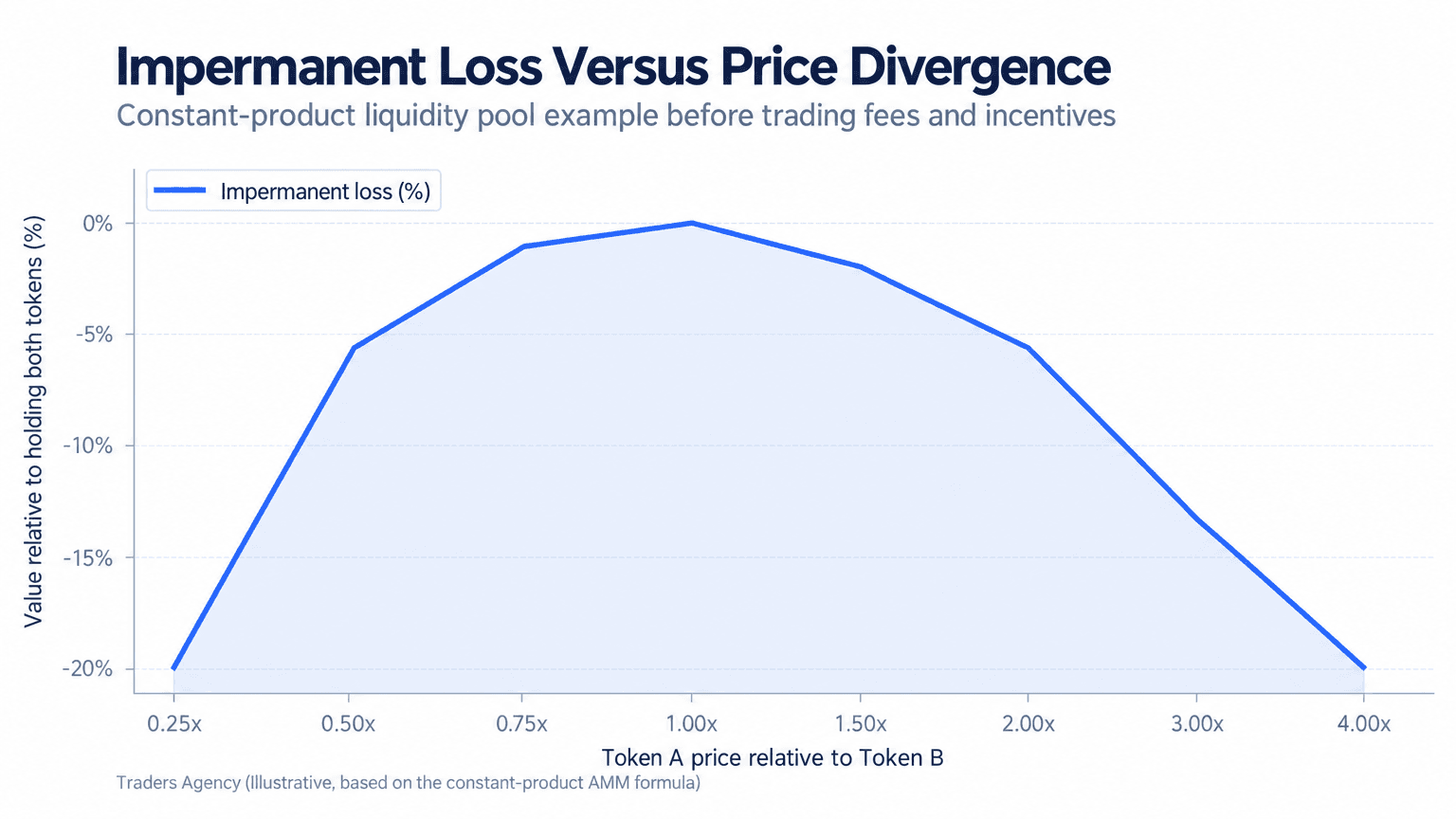
Impermanent loss happens when the price ratio of the two tokens in a liquidity pool diverges from the ratio at the time of deposit, causing the pool's automatic rebalancing to leave you with less value than if you had simply held the tokens.
Here's a concrete example. Suppose you deposit $10,000 into an ETH/USDC pool on Uniswap when ETH trades at $2,000, split evenly: 2.5 ETH and $5,000 USDC. If ETH rallies to $4,000 (a 2x move), the constant-product formula forces the pool to sell ETH into strength and buy USDC.
| Scenario | Value of Position |
|---|---|
| Held 2.5 ETH + $5,000 USDC outside the pool | $15,000 |
| Same capital left inside the liquidity pool | $14,142 |
| Impermanent loss | ~5.7% (about $858) |
That gap is impermanent loss, and it grows nonlinearly as the price ratio widens further.
APY vs APR: Why the Difference Matters More in DeFi
APR (annual percentage rate) reflects simple, non-compounded returns, while APY (annual percentage yield) assumes reinvestment of rewards at the same rate, which is rarely realistic in volatile token markets. Protocols often advertise APY because the number looks bigger, but a farmer who doesn't compound daily, or who compounds into a token that's declining in price, will never see that printed figure.
We teach our members to convert every advertised APY back to a base APR and then subtract:
- Impermanent loss drag, estimated from expected volatility between the pair
- Gas and transaction costs from compounding or rebalancing
- Borrowing costs if the position uses leverage or a recursive lending loop
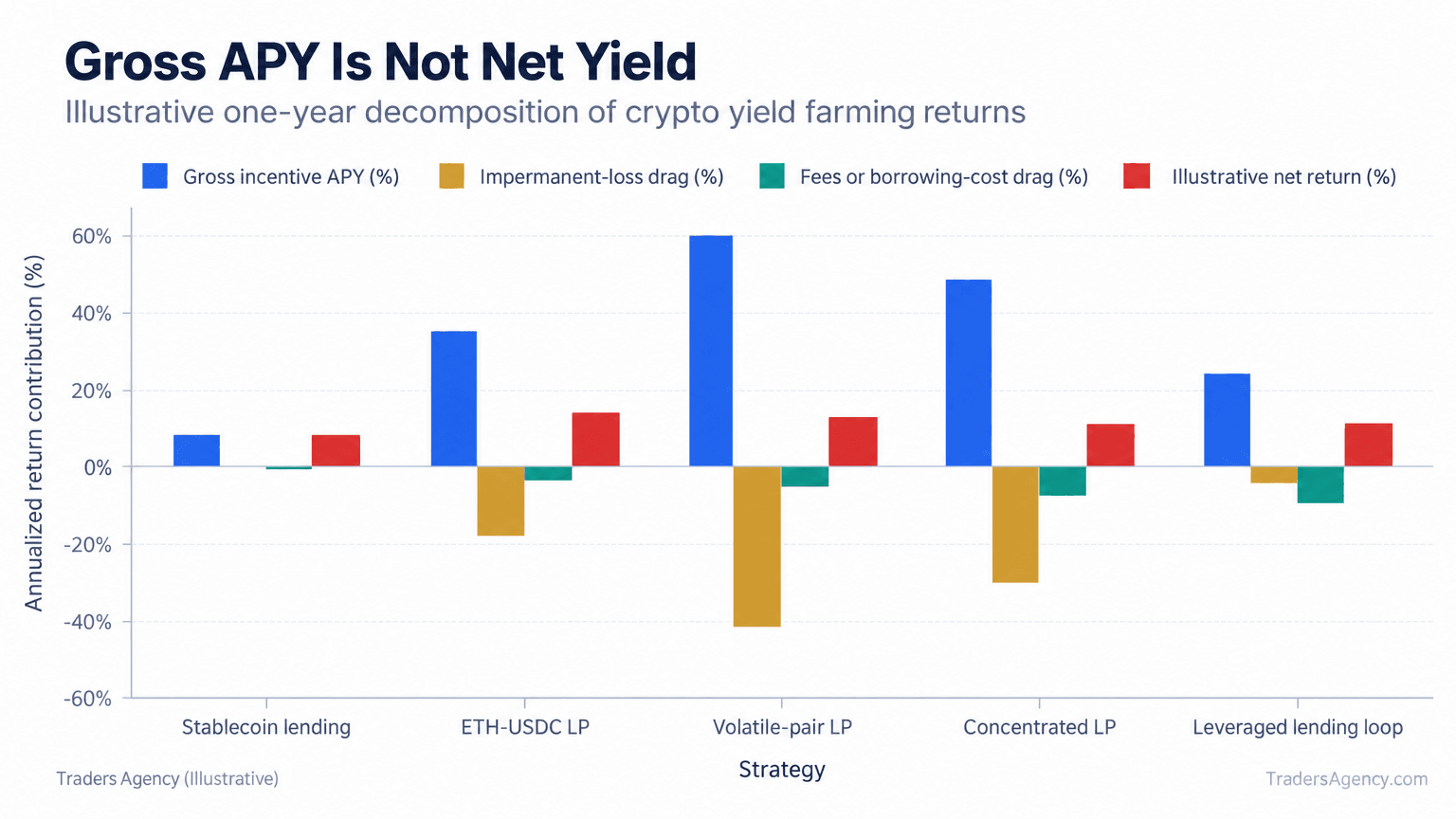
Key Concept: In our experience, a pool advertising 40% APY frequently nets closer to 8 to 15% once impermanent loss and token depreciation are backed out, still attractive, but a very different number to size a position around.
Want expert trading insights delivered daily?
Join thousands of traders who rely on Traders Agency for market analysis and trade ideas.
Join Traders AgencyHow Can You Identify Smart Contract Risk and Rug Pulls?
Smart contract risk is the possibility that a protocol's code contains a bug, backdoor, or exploitable logic flaw that lets an attacker drain deposited funds, and it exists independently of how sound the underlying market strategy is.
Rug pulls specifically refer to cases where developers, or malicious actors embedded in the code, intentionally design an exit that drains liquidity once deposits reach a threshold. We teach our members to push due diligence beyond "has it been audited" and work through a structured checklist:
- Audit provenance: Check whether the audit came from a recognized firm such as Quantstamp or a comparable security auditor, and read the actual findings, not just the badge.
- Admin key concentration: Confirm whether a single wallet or multisig can unilaterally change contract parameters or pause withdrawals.
- Liquidity lock verification: For newer protocols, check whether liquidity provider tokens are time-locked in a verifiable contract rather than held freely by the team.
- Token distribution skew: A highly concentrated token supply held by insiders is a leading indicator of coordinated dumps following a farming incentive campaign.
- Contract age and TVL stability: Sudden TVL spikes on unaudited contracts are a classic precursor to exploit attempts, since attackers often wait for deposits to peak.
How Do Aave, Uniswap, and Curve Compare?
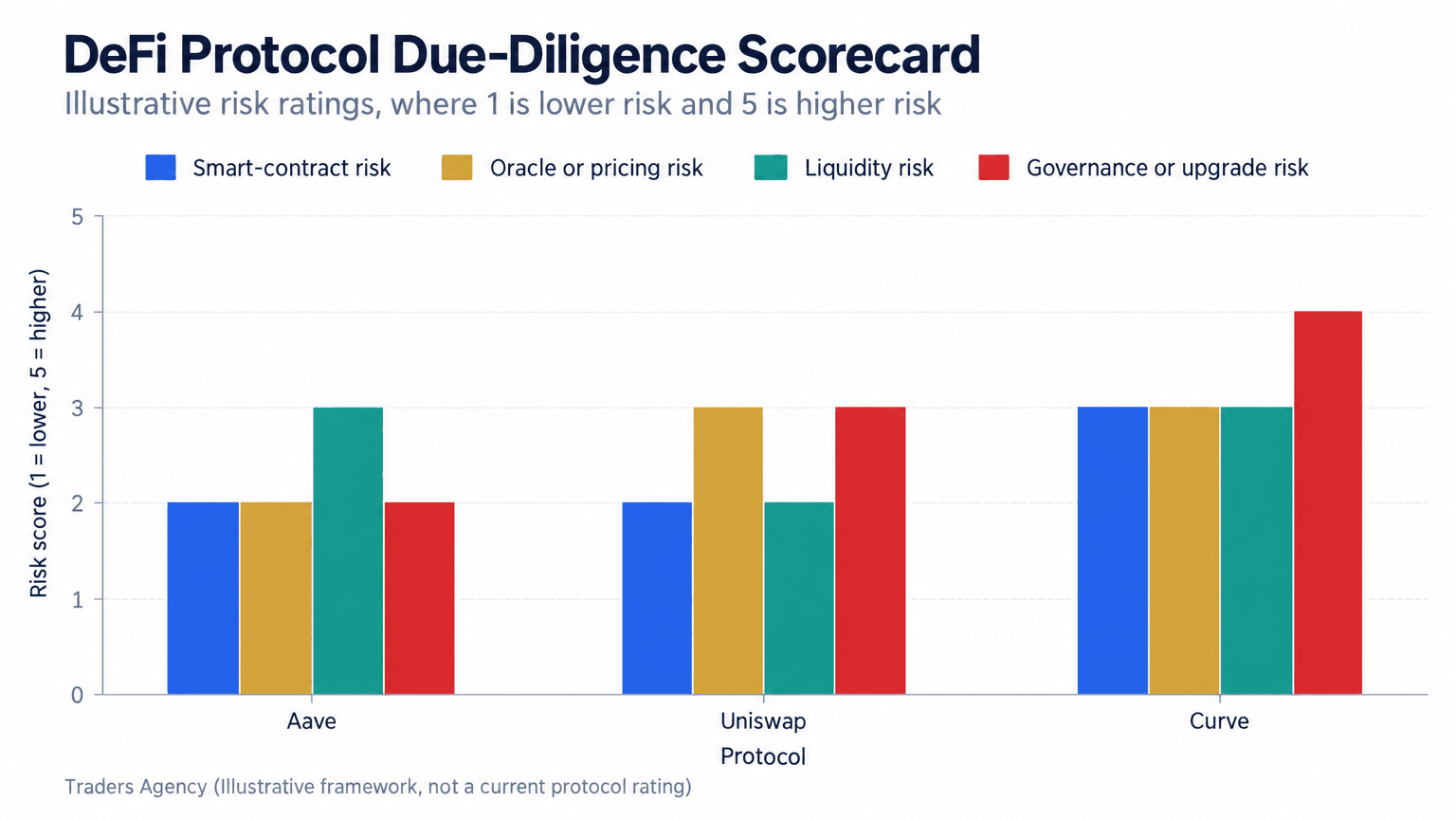
These three protocols represent different risk profiles within yield farming, and understanding the distinction matters more than chasing whichever has the highest posted rate this week.
| Protocol | Model | Primary Risk |
|---|---|---|
| Aave | Lending market | Borrower default and liquidation mechanics |
| Uniswap | General-purpose AMM | Impermanent loss, highest on volatile pairs |
| Curve | Stablecoin and pegged-asset AMM | Peg stability and governance token incentives |
When our members build a watchlist of candidates to screen, we suggest ranking them by total value locked stability over a 90-day window, audit recency, and the proportion of yield coming from organic fees versus inflationary token emissions. The best opportunities are rarely the newest or highest-APY pools. They're the pools where a meaningful share of yield is fee-based and sustainable.
Operational Security for Advanced Yield Farmers
Operational security failures, not protocol exploits, cause a large share of farmer losses, and they're entirely within your control. A hardware wallet, a dedicated browser profile for DeFi interactions, and transaction simulation tools before signing are non-negotiable at any meaningful position size.
We recommend separating "hot" capital used for active farming from "cold" long-term holdings, and never approving unlimited token spending allowances to a contract when a capped allowance accomplishes the same goal. Revoking unused approvals periodically closes a quiet attack surface that many farmers forget exists months after they've stopped using a protocol.
Watch Out: Unlimited token approvals left open on a wallet are one of the most common, and most avoidable, ways farmers get drained long after they've moved on from a protocol. Set capped allowances and revoke them when you're done.
Yield Farming vs Staking: Which Fits Your Portfolio?
Yield farming versus staking comes down to a tradeoff between return potential and complexity. Staking typically means locking a single asset to secure a network or protocol for a simpler, more predictable reward, while yield farming involves multi-asset exposure, impermanent loss risk, and more active management.
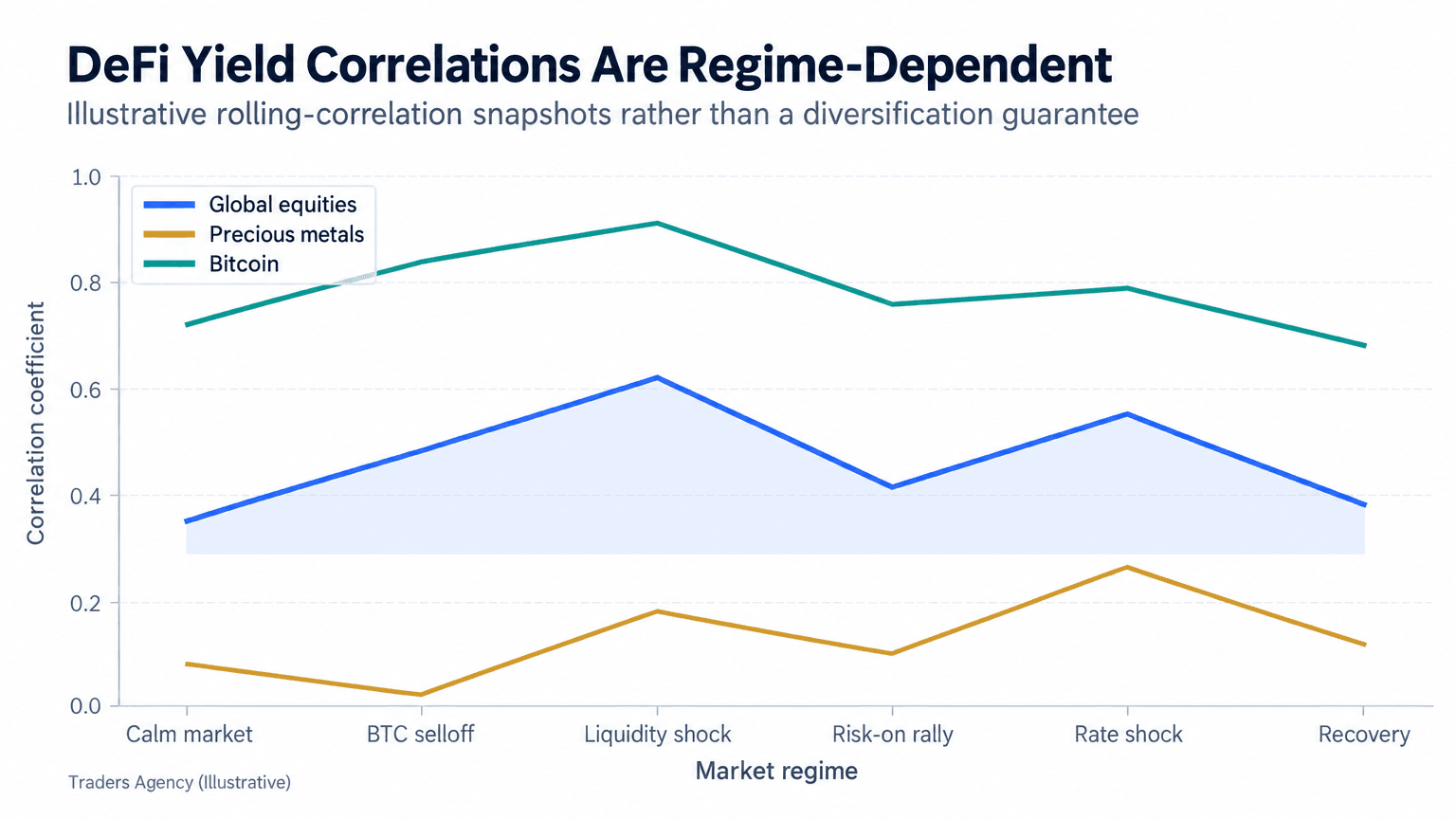
We generally treat yield farming as a satellite allocation inside a diversified crypto sleeve, not a core holding. Correlation matters here: DeFi yield strategies tend to move with broader crypto beta during risk-off periods, meaning they don't offer the same diversification benefit that direct precious metals exposure or uncorrelated equity factors can provide during a drawdown.
Position Sizing and Risk Management
Our general framework for allocating to yield farming within a trading book:
- Cap total DeFi yield farming exposure at a small, defined percentage of the active trading portion of the portfolio, not the entire account
- Diversify across protocol types (lending, AMM, stablecoin-focused) rather than concentrating in one pool
- Set a personal maximum for unaudited or newly launched protocols, treated as venture-style risk capital
- Re-underwrite the net APY monthly using the APY-to-APR adjustment process above, since token incentive rates change frequently
How risky is DeFi overall compared to other crypto exposure? It depends heavily on the specific protocol and strategy chosen, but layered smart contract, liquidity, and impermanent loss risks generally make active yield farming higher-risk than simply holding or staking a major asset directly.
Key Concept: Treat yield farming as a satellite, risk-sized position inside an active portfolio, not a substitute for holding or staking your core crypto exposure.
Want expert trading insights delivered daily?
Join thousands of traders who rely on Traders Agency for market analysis and trade ideas.
Join Traders AgencyDISCLAIMER: Traders Agency does not offer financial advice. The information provided is for educational purposes only and should not be considered financial advice. Traders Agency is not responsible for any financial losses or consequences resulting from the use of the information provided. Trading carries inherent risks and may not be suitable for all individuals. You are advised to conduct your own research and seek personalized advice before making any investment decisions, recognizing the potential risks and rewards involved.
See more from Traders Agency on Google
Make us a preferred source and our market analysis will appear more prominently in your Google Search, Top Stories, and AI results.
Add to Preferred Sources